Tree profile
Red spruce (Picea rubens): how to identify it
The spruce of the Maritimes, northern New England and the high Appalachians. A shiny, curved needle, an orange hairy twig and a chocolate-brown cone set it apart from black and white spruce.
In short
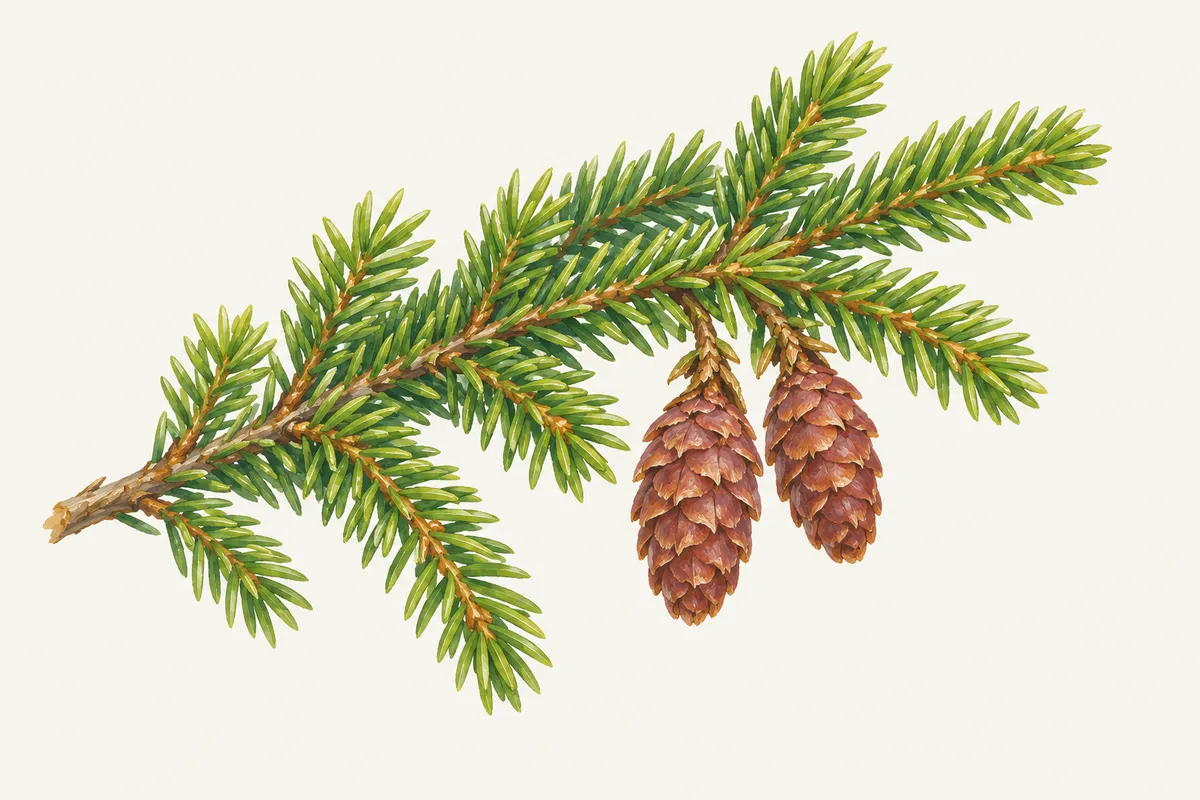
Red spruce identification comes down to three checks. Its needles are four-sided, 10 to 16 mm (about 1/2 inch) long, curved, shiny yellowish-green and pointing forward along the twig. The youngest twigs are shiny yellow to orange and finely hairy. The hanging cones are 3 to 5 cm (1 1/4 to 2 inches), egg-shaped, rich chocolate-brown, and usually fall within a year.
- Shiny yellow-green needles that curve forward along an orange, hairy twig point to red spruce; black spruce needles are dull grayish-green.
- Red spruce cones fall from the tree within about a year; black spruce cones can hang on for decades.
- In the southern Appalachians red spruce grows only on the high peaks, from about 4,500 feet, often beside Fraser fir.
Field marks at a glance
- Scientific name
- Picea rubens
- Family
- Pinaceae (pine family)
- Type
- Conifer, evergreen
- Needles
- Single, four-sided, 10 to 16 mm (about 1/2 inch) long, curved, blunt-tipped, shiny yellowish-green, pointing forward and often pressed close to the twig (NRCan).
- Twigs
- This year's twig shiny yellow to yellowish-orange and finely hairy, turning reddish-brown in the second year; rough with woody pegs where needles fell.
- Buds
- Small, conical, chestnut-brown; the outer scales are hairy, with long slender points reaching past the bud tip (NRCan).
- Cones
- Hang down, broadly egg-shaped, 3 to 5 cm (1 1/4 to 2 in), rich chocolate-brown; they open in autumn and are usually shed the following year (NRCan). The USDA Forest Service gives 3 to 4 cm, light reddish brown.
- Bark
- Reddish-brown to reddish-black, shredded on young trees, breaking into scales or plates and becoming dark and furrowed with age.
- Form
- Broadly conical, rather open crown, the branch tips abruptly upturned; 60 to 75 ft in the Northeast, up to 115 ft in the Appalachians (USDA Forest Service).
- Range
- Maritime provinces, southern Quebec and Ontario, Maine to New York, then south along the Appalachians to western North Carolina and eastern Tennessee.
- Habitat
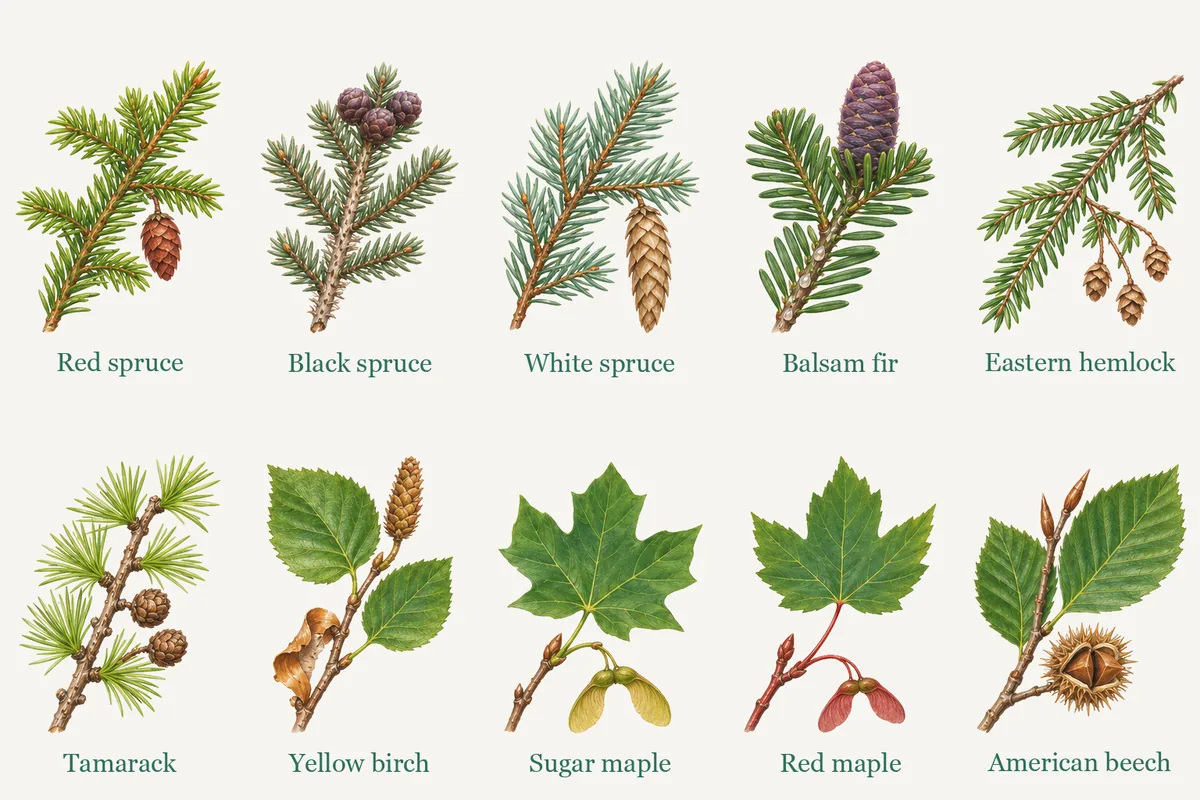
- Cool, moist uplands and mountain slopes on acid soils, with balsam fir, eastern hemlock, yellow birch and sugar maple; Fraser fir on the southern peaks.
Red spruce (Picea rubens) is the spruce of the Acadian forest of the Maritimes and northern New England, and of the cold high peaks of the Appalachians from West Virginia to the Great Smokies. It shares most of its range with black spruce and white spruce, and the three are easy to confuse until you look closely at the needle, the twig and the cone. The spruce genus page sets all seven common spruces side by side; this page goes one level deeper on red spruce. It is a common tree: the USDA Forest Service inventory of live trees on US forest land ranks it 21st of 431 species.
How to identify red spruce in four checks
Do these on a low branch you can reach, in this order.
1. Confirm it is a spruce. Roll a needle between your fingers: a spruce needle is four-sided and rolls. Pull one off and it leaves a small woody peg on the twig. Flat, soft needles that leave a round scar belong to a fir; the spruce vs fir guide runs that test step by step.
2. Look at the needles. Natural Resources Canada's red spruce factsheet describes needles 10 to 16 mm long, curved, with blunt tips, shiny yellowish-green with faint lines of white dots on all sides, pointing forward and often pressed close to the twig. NC State's Plant Toolbox gives about 0.5 to 0.6 inch, dark yellow-green and shiny, tending to point upward. The shine and the forward curve are the first things that separate it from black spruce.
3. Check the twig with a hand lens. The current year's twig is shiny yellow to yellowish-orange and carries fine hairs, with a brown stain at the base of each needle peg; in the second year it turns reddish-brown (NRCan). NC State calls the stems orangish-brown with fine hairs. White spruce twigs are hairless, so this one test rules it out.
4. Find a cone. Red spruce cones hang down and are broadly egg-shaped, 3 to 5 cm long, rich chocolate-brown, with wide-spreading scales; they open in autumn and are usually shed the following year (NRCan). The USDA Forest Service's Silvics of North America gives 3 to 4 cm (1.3 to 1.5 inches), light reddish brown, maturing from about mid-September to early October. Look under the tree: fallen cones are usually there.
If the crown is out of reach, Tree Identifier can name a spruce from one photo of a branch, a cone or the whole tree. The app shows one name with no confidence score and no look-alike list, and red spruce is not among the 138 species in its Collection, so confirm the result with the twig and cone checks above.
Red spruce vs black spruce and white spruce
All three grow together in the Maritimes, Quebec and northern New England. The USDA Forest Service notes that their wood cannot be told apart and is sold together as "eastern spruce", so the living tree is where you separate them.
| Trait | Red spruce | Black spruce | White spruce |
|---|---|---|---|
| Needle length | 10–16 mm, curved | 8–15 mm, straight | 15–22 mm, straight |
| Needle color | Shiny yellowish-green | Dull grayish-green | Green to bluish-green |
| Crushed needle | No strong smell noted | No strong smell noted | Unpleasantly pungent |
| Young twig | Shiny yellow-orange, hairy | Dull orange-brown, hairy, some hairs gland-tipped | Shiny, hairless |
| Cone | 3–5 cm, egg-shaped, chocolate-brown | Small, nearly round when open | 3–6 cm, slender cylinder |
| Cone stays on tree | Usually shed the next year | Up to 30 years | Opens late summer, sheds seed to spring |
| Typical site | Moist uplands, mountain slopes | Bogs and wet, poorly drained ground | Many soils, old fields, tree line |
Sources: NRCan factsheets for black spruce and white spruce, and for red spruce as above.
The habitat helps as much as any trait. Black spruce fills bogs and wet lowlands; red spruce prefers moist but drained upland soils, north-facing slopes and lake shores. Red and black spruce do hybridize: the USDA Forest Service says hybrids occur to some extent in nature, while each parent stays true to type in its own habitat. Detailed pages for black spruce and white spruce cover each one in turn.
Where red spruce grows, by elevation
The USDA Forest Service gives a range from the Maritime provinces west to Maine, southern Quebec and southeastern Ontario, south into central New York, eastern Pennsylvania, northern New Jersey and Massachusetts, then along the Appalachians through western Maryland, eastern West Virginia, Virginia, western North Carolina and eastern Tennessee. NRCan adds that it is present but uncommon in south-central Ontario and in Quebec north of the St. Lawrence.
Elevation changes from north to south:
- North: from near sea level to about 4,500 feet (1,370 m). In the White Mountains of New Hampshire it is well represented between about 2,600 and 3,300 feet.
- West Virginia: spruce-fir stands from as low as 3,200 feet (980 m).
- Southern Appalachians: from about 4,500 to 5,000 feet mixed with hardwoods and eastern hemlock, then in spruce-fir forest above; over 6,200 feet it becomes less frequent than Fraser fir.
On those southern peaks the look-alike is Fraser fir, not another spruce. The Appalachian tree guide separates the two by cone and needle, and NC State notes red spruce along the Blue Ridge Parkway on the highest peaks of North Carolina and Virginia. In the Northeast, its usual neighbors are balsam fir, eastern hemlock, eastern white pine, yellow birch and sugar maple (NRCan).
Bark, crown and size
From a distance, look for a broadly conical, rather open crown whose branch tips turn abruptly upward (NRCan). Bark is reddish-brown, shredded on young trees, breaking into scales or plates with age and becoming dark and furrowed, reddish-black on old trees; freshly exposed bark under a scale is dull yellow or reddish-brown.
Size depends on region. The USDA Forest Service gives 60 to 75 feet tall and 12 to 24 inches in diameter in the Northeast, and up to 115 feet in the Appalachians; the largest red spruce it lists, in Great Smoky Mountains National Park, was 110 feet tall and 52.5 inches across. NRCan gives up to 25 m (82 ft) and 60 cm in Canada. For age, NRCan gives a maximum of about 300 years and the USDA Forest Service about 400. Red spruce is very shade-tolerant and can wait for many years as a small understory tree (NRCan), so a short, narrow red spruce under hardwoods may be far older than it looks.
Decline on the high peaks
The USDA Forest Service reports that growth of red spruce at high elevations along the eastern Appalachians has declined since the 1960s, with increased mortality and crown damage. No single natural cause has been confirmed; the silvics hypothesize interactions among insects, diseases and air pollutants such as sulfur dioxide, nitrogen oxides, ozone and nitric and sulfuric acids. Low-elevation stands in northern New England appeared to be within normal ranges. A thin, browning crown on a mountaintop spruce is therefore not by itself a clue to species.
With location turned on, Tree Identifier's Tree Map pins each find, a simple way to return to the same tree in September, when the new chocolate-brown cones make the identification certain. For the other evergreens around it, the conifer identification key sorts spruces, firs, hemlocks, pines and larches with three needle questions.
Look-alikes and how to tell them apart
Black spruce (Picea mariana)
Black spruce needles are shorter, 8 to 15 mm, dull grayish-green rather than shiny, and its cones are small, nearly round when open, and can stay on the tree for up to 30 years, clustered near the top. Red spruce cones are chocolate-brown, longer, and drop within a year.
White spruce (Picea glauca)
White spruce twigs are hairless and its needles straight, 15 to 22 mm, with an unpleasant smell when crushed. Its cones are slender cylinders with smooth, rounded scale edges. Red spruce twigs are hairy and its needles curved and short.
Norway spruce (Picea abies)
A planted European spruce with hairless twigs, longer dark green needles and drooping branchlets. Its cones are 4 to 6 inches long, at least twice the length of a red spruce cone.
Balsam fir and Fraser fir (Abies)
Fir needles are flat and soft, will not roll between the fingers and leave a smooth round scar instead of a woody peg. Fir cones stand upright on the top branches and fall apart there; red spruce cones hang down and drop whole.
What a photo can't settle
- Red and black spruce hybridize, and the USDA Forest Service reports hybrid swarms in central New Brunswick; a tree with mixed traits cannot be named to species from a photo.
- Cones are often high in the crown. Without a fallen cone, red, black and white spruce are hard to separate on a foliage photo alone; check twig hairs and needle shine up close.
- Needle and cone measurements differ between sources (cones 3 to 4 cm for the USDA Forest Service, 3 to 5 cm for NRCan), so treat each number as a range, not a cut-off.
Questions people ask
How do you tell red spruce from black spruce?
Look at needle shine and the cones. Red spruce needles are shiny yellowish-green and curved; black spruce needles are dull grayish-green. Red spruce cones are chocolate-brown, 3 to 5 cm, and fall within a year, while black spruce cones are smaller and can stay on the tree for decades. Where both grow, hybrids occur.
Why is it called red spruce?
Natural Resources Canada describes reddish-brown bark that darkens to reddish-black, and twigs that turn reddish-brown in their second year. Its cones are chocolate-brown to light reddish brown. Other names include eastern spruce, yellow spruce and he-balsam.
Where does red spruce grow?
From the Maritime provinces, southern Quebec and Maine through New York and New England, then south along the Appalachians to western North Carolina and eastern Tennessee, according to the USDA Forest Service. In the North it grows from near sea level; in the southern Appalachians only from about 4,500 feet up.
How big does red spruce get?
The USDA Forest Service gives 60 to 75 feet and 12 to 24 inches in diameter in the Northeast and up to 115 feet in the Appalachians. Its largest listed tree, in Great Smoky Mountains National Park, was 110 feet tall and 52.5 inches across. Maximum age is about 400 years.
Sources
- Red Spruce (Picea rubens), Silvics of North America — USDA Forest Service
- Red spruce (Picea rubens), Trees, insects and diseases of Canada's forests — Natural Resources Canada, Canadian Forest Service
- Picea rubens (Red Spruce) — North Carolina Extension Gardener Plant Toolbox, NC State University
- Black spruce (Picea mariana), Trees, insects and diseases of Canada's forests — Natural Resources Canada, Canadian Forest Service
- White spruce (Picea glauca), Trees, insects and diseases of Canada's forests — Natural Resources Canada, Canadian Forest Service
Keep reading
- Tree profileSpruce trees (Picea): how to identify the species
- Tree comparisonSpruce vs fir: how to tell them apart
- Regional guideAppalachian tree identification, from the peaks down to the coves
- Maritimes field guideTrees of Nova Scotia and the Maritimes
- Regional guideNew England tree identification, north to south