Maritimes field guide
Trees of Nova Scotia and the Maritimes
Nova Scotia, New Brunswick and Prince Edward Island share one forest, the Acadian mixedwood. Learn its three spruces first, then the birches and maples that grow with them.
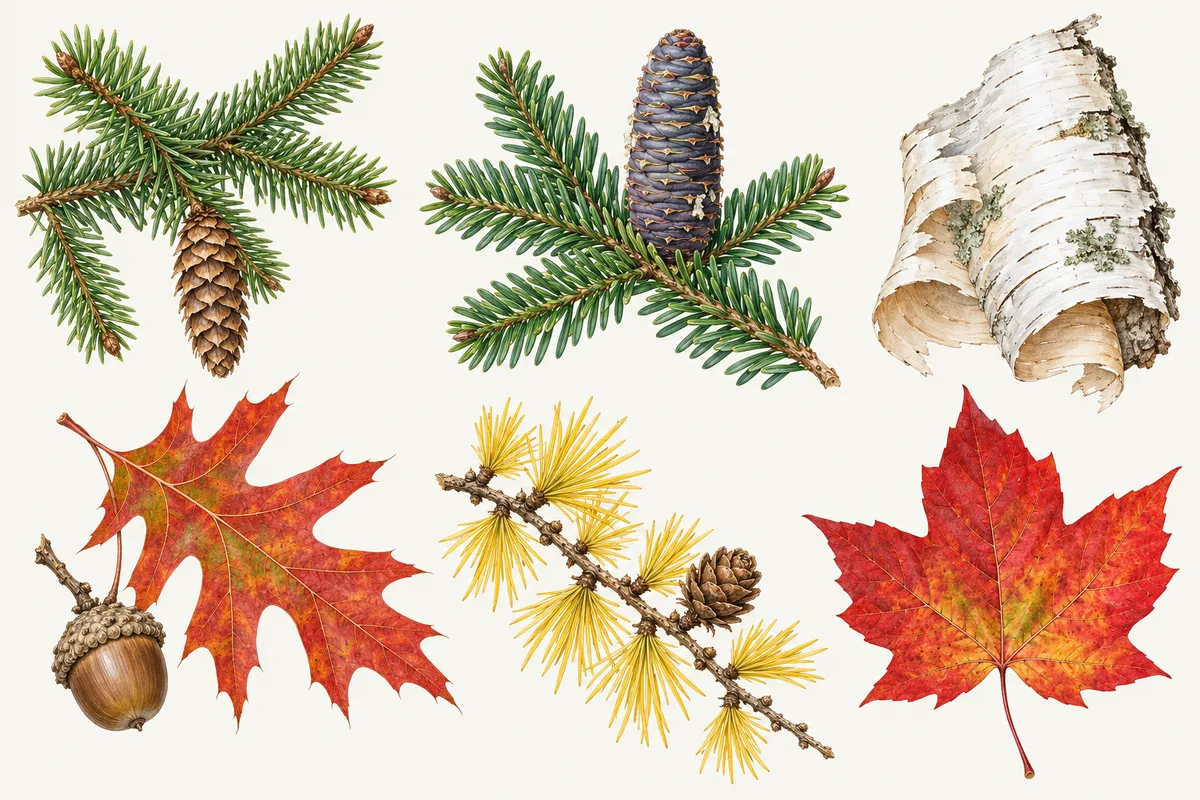
In short
The trees of Nova Scotia and the other Maritime provinces belong to the Acadian forest. Start with the conifers: red spruce (Nova Scotia's tree, shiny yellow-green needles), black and white spruce, balsam fir (New Brunswick's tree, flat fragrant needles) and eastern hemlock. Then learn yellow birch, sugar, red and striped maple, American beech and red oak, Prince Edward Island's tree.
- Red spruce and yellow birch together form the climax Acadian mixedwood of mainland Nova Scotia, most common in the centre and east of the province and along the Bay of Fundy.
- Each Maritime province has a different tree: red spruce for Nova Scotia (1988), balsam fir for New Brunswick (1987) and red oak for Prince Edward Island.
- To separate the three spruces, look at needle colour and the twig: yellow-green on a hairy orange twig (red), blue-green on a brownish hairy twig (black), blue-green on a pale hairless twig (white).
Nova Scotia, New Brunswick and Prince Edward Island share one forest. Foresters call it the Acadian forest: a mix of long-lived conifers and hardwoods where red spruce grows with yellow birch, balsam fir, hemlock and the maples. This guide gives the trees most worth learning first and one clue that settles each, with measurements from Natural Resources Canada's (NRCan) tree factsheets unless another source is named. Never eat a berry, nut, seed or pod on the strength of a web page or an app; check with a local expert.
The Maritime trees at a glance
Two questions sort most trees in a Maritime wood. Does it have needles or leaves? If leaves, do they sit opposite each other on the twig (maples and ashes) or alternate (everything else)? Then use this table.
| Tree | Where you meet it | The feature that settles it |
|---|---|---|
| Red spruce | Upland mixedwoods, Nova Scotia's tree | Shiny yellow-green needles 10–16 mm, hairy orange twig |
| Black spruce | Bogs and poor, wet ground | Dull grey-green needles 8–15 mm, small round cones high in the crown |
| White spruce | Old fields, coasts | Blue-green needles 15–22 mm with a skunky smell, hairless twig |
| Balsam fir | Everywhere, New Brunswick's tree | Flat needles 15–25 mm, resin blisters on young bark |
| Eastern hemlock | Cool, moist slopes | Flat needles 10–20 mm with two white lines beneath, cones 12–20 mm |
| Tamarack | Bogs | Soft needles in tufts of 15–60 that drop in autumn |
| Yellow birch | Rich, moist mixedwoods | Bronze bark in curly shreds; twigs taste of wintergreen |
| Sugar maple | Hardwood hills | Opposite leaves, 5 lobes with rounded notches |
| Red maple | Swamps to dry hills | Opposite leaves, 3–5 lobes with V-shaped notches, red twigs |
| American beech | Hardwood hills | Smooth grey bark; dead leaves stay on in winter |
| Red oak | Warmer hardwood sites, PEI's tree | Lobes with bristle tips; acorn in a saucer-shaped cup |
Spruces, fir and hemlock: the Acadian conifers
Red spruce (Picea rubens) is the signature tree. NRCan describes curved, blunt needles 10 to 16 mm long, shiny yellowish-green, pointing forward along the twig; chestnut-brown buds; and cones 3 to 5 cm long, a rich chocolate-brown, that open in autumn. It grows to about 25 m and can live 300 years. NRCan gives its range as the Maritime provinces south into the Appalachians, uncommon in Ontario and Quebec. The Nova Scotia government's tree identification guide calls it "Maritime spruce" among its other names and the most valuable lumber and pulpwood species in the province.
The province's guide separates the three spruces with two clues, needle colour and twig:
- Red spruce: distinct yellow-green needles on a light orange, slightly hairy twig.
- Black spruce (Picea mariana): distinct blue-green needles on a brownish, slightly hairy twig. NRCan adds that its needles are short (8 to 15 mm) and dull, and that its small, almost round cones, massed near the top of the tree, can stay on for up to 30 years. Look for it in bogs and on wet, poor ground.
- White spruce (Picea glauca): blue-green, sharp needles with a smell on a pale, hairless twig. NRCan gives 15 to 22 mm needles that are "unpleasantly pungent when crushed", which explains its old names cat spruce and skunk spruce, and slender cones 3 to 6 cm long. NRCan notes that in eastern Canada it invades abandoned farmland, and the Nova Scotia guide calls it the fastest-growing spruce in the province.
Balsam fir (Abies balsamea), New Brunswick's tree, is the Maritime Christmas tree. Its flat needles, 15 to 25 mm, are shiny dark green above with white lines beneath and smell strongly when crushed. Young trunks are smooth with raised resin blisters, and the cones stand upright on the branch and fall apart in autumn. The Nova Scotia guide's softwood key splits fir from spruce in one step: flattened needles (fir and hemlock) or four-sided needles (the spruces). The spruce vs fir guide covers the other clues.
Eastern hemlock (Tsuga canadensis) has the shortest flat needles of the group, 10 to 20 mm, with two well-defined white lines beneath, on twigs that form flat sprays; its cones are only 12 to 20 mm. NRCan says it needs a cool, moist site and can live 600 years.
Tamarack (Larix laricina), also called eastern larch or hackmatack, is the conifer that drops its needles in autumn. They grow in tufts of 15 to 60 on short spur shoots, and NRCan places the tree on cold, wet sites such as sphagnum bogs. Eastern white cedar (Thuja occidentalis) has tiny, flat, scale-like leaves in fan-shaped sprays; the Nova Scotia guide describes them as soft and yellow-green. Pines are fewer here: eastern white pine has soft needles in fives, jack pine short twisted needles in pairs.
The Acadian hardwoods: birch, maple, beech and oak
The Nova Scotia government's forest vegetation type MW1 describes red spruce and yellow birch sharing the canopy as "a climax Acadian mixedwood" found throughout mainland Nova Scotia, most common in the centre and east and along the Bay of Fundy shore, with sugar maple, hemlock, beech, balsam fir, red maple, white pine and white ash in smaller numbers. The same type grows in New Brunswick but not on Prince Edward Island.
- Yellow birch (Betula alleghaniensis): NRCan describes thin bark in papery shreds ending in tight curls, shiny reddish-brown when young, then dull yellow and finally bronze. Scratch a twig: it has a wintergreen flavour. Leaves are oval, 8 to 11 cm, with straight parallel veins.
- White birch (Betula papyrifera): bright creamy-white bark that sheds in large sheets, and leaves 5 to 10 cm. Its smaller cousin grey birch (B. populifolia), which the Nova Scotia guide describes as a short, stunted tree with slender, wiry twigs, has dull, chalky-white bark that is tight and hard to peel, with black triangles where the limbs join the trunk.
- Sugar maple (Acer saccharum): five lobes separated by wide, rounded notches, leaves 8 to 20 cm, autumn colour from yellow to bright red. NRCan gives its range as the Maritime provinces, southern Ontario and Quebec.
- Red maple (Acer rubrum): three to five lobes with shallow, angular notches, sharp irregular teeth and a whitened underside; shiny red to greyish-brown twigs; flowers in late winter, before the leaves, earlier than most maples. It thrives on swamps and moist soils but grows almost anywhere. The red maple vs sugar maple guide compares the two side by side.
- Striped maple (Acer pensylvanicum), or moosewood: a small tree to about 10 m with long, vertical whitish stripes on green bark and broad, three-lobed leaves 10 to 16 cm. NRCan places it from Ontario east into the Maritime provinces.
- American beech (Fagus grandifolia): thin, smooth, light bluish-grey bark; leaves 6 to 14 cm with 9 to 14 straight veins, each ending in a tooth; long, slender, pointed buds; and dead leaves that often stay on the tree into winter. The Nova Scotia guide notes heavy damage from beech bark disease in the province, which leaves bark cankered and stems crooked. More clues on the beech page.
- Red oak (Quercus rubra): leaves 10 to 20 cm with 7 to 9 lobes, the larger ones with bristle-tipped teeth, and acorns 12 to 25 mm in a saucer-shaped cup that covers about a quarter of the nut.
Along with these, the Nova Scotia guide's hardwood key covers white ash and black ash (opposite, compound leaves), trembling and largetooth aspen, balsam poplar, ironwood, white elm, mountain maple, choke cherry and American mountain-ash.
Provincial trees of the Maritimes
Each province picked a different tree, and all three are easy to learn:
- Nova Scotia: red spruce. Canadian Heritage's Nova Scotia page says it was adopted by an Act of the House of Assembly in 1988 to represent the strength and resilience of Nova Scotians.
- New Brunswick: balsam fir, adopted in 1987. Canadian Heritage's New Brunswick page calls it best recognized as a Christmas tree, up to 20 m tall, and says its long wood fibres suit high-quality paper.
- Prince Edward Island: red oak. Canadian Heritage's Prince Edward Island page says early settlers cut it so heavily for its fine-grained wood that it nearly disappeared from the Island, and that the province now protects a stand in the Royalty Oaks Natural Area in Charlottetown.
For the provincial trees of the rest of the country and a sorting method that works from coast to coast, see the Canada tree identification guide.
Field guides and a photo app for Maritime trees
The Nova Scotia Department of Natural Resources' Tree Identification Guide for Common Native Trees of Nova Scotia is a free PDF, read on 21 October 2026. It opens with a softwood key and a hardwood key that step through one choice at a time (needles in bundles or single, leaves opposite or alternate), then gives each species photos of needles or leaves and bark, a mature height, life expectancy and wildlife value. It states that it covers most of the province's commercial species and points readers to Gary Saunders' Trees of Nova Scotia and R.C. Rosie's Native Trees of Canada for the rest. NRCan's factsheets add measurements and range maps for every tree on this page.
When the leaves are out of reach or the cones are high in a spruce, Tree Identifier names a tree from one photo of a needle spray, a leaf, the bark or a cone. Its follow-up chat can take a question such as "is this red spruce or black spruce?", but it shows no confidence score and no look-alike list, so check the result against the twig and needle colour clues above. The app's Collection includes sugar maple, red maple, American beech, red oak, eastern hemlock and eastern white cedar, and its Tree Map keeps each find you locate, which helps when you come back in autumn to see whether a conifer is a tamarack.
What a photo can't settle
- Black spruce can hybridize with red spruce, which the Nova Scotia guide calls difficult to tell apart; a single sprig may show mixed features that neither a key nor a photo settles.
- Town streets and old farms in the Maritimes hold many planted trees from Europe and elsewhere that a native-tree list does not cover.
- Beech bark disease changes the look of American beech bark, so a bark photo alone may not match the smooth grey bark in a guide.
Questions people ask
What is Nova Scotia's provincial tree?
The red spruce (Picea rubens), adopted by an Act of the House of Assembly in 1988, according to Canadian Heritage. Look for shiny yellowish-green needles 10 to 16 mm long that point forward along a hairy, yellowish-orange twig, and chocolate-brown cones 3 to 5 cm long.
Does Nova Scotia have maple trees?
Yes, several. The Nova Scotia Department of Natural Resources' tree guide covers sugar maple, red maple and striped maple, and Natural Resources Canada lists mountain maple as a characteristic understory tree of eastern Canada's forests. Red maple is the one you meet almost everywhere, from swamps to dry hills.
Does Nova Scotia have oak trees?
Yes. Red oak is the native oak in the Nova Scotia government's tree guide, recognized by leaves with 7 to 11 bristle-tipped lobes and acorns in a shallow cup. Natural Resources Canada's range for bur oak runs from southern Saskatchewan east only to New Brunswick.
Does Nova Scotia have aspen trees?
Yes. The provincial tree guide includes trembling aspen and largetooth aspen, plus balsam poplar. Trembling aspen has finely toothed leaves 3 to 7 cm long on flattened stalks that make them flutter; largetooth aspen's leaves have obvious, round indentations along the edges.
Is there a free guide to the trees of Nova Scotia?
Yes. The Nova Scotia Department of Natural Resources publishes a free Tree Identification Guide for Common Native Trees of Nova Scotia as a PDF, with keys for softwoods and hardwoods. It covers most of the province's commercial species and points to Gary Saunders' book Trees of Nova Scotia for the rest.
Sources
- Tree Identification Guide for Common Native Trees of Nova Scotia — Nova Scotia Department of Natural Resources
- Forest Vegetation Types: MW1, Red spruce – Yellow birch / Evergreen wood fern — Government of Nova Scotia (novascotia.ca)
- Trees, insects and diseases of Canada's forests: tree factsheets — Natural Resources Canada, Canadian Forest Service
- Nova Scotia: provincial symbols — Canadian Heritage, Government of Canada
- New Brunswick: provincial symbols — Canadian Heritage, Government of Canada
- Prince Edward Island: provincial symbols — Canadian Heritage, Government of Canada
Keep reading
- Canada field guideTree identification in Canada, region by region
- Canada by the numbersThe most common trees in Canada, ranked by forest area
- Tree comparisonSpruce vs fir: how to tell them apart
- Tree comparisonRed maple vs sugar maple: how to tell them apart
- Tree profileTamarack (Larix laricina): how to identify it