Tree profile
Post oak (Quercus stellata): how to identify it
A white oak of dry, rocky ridges with thick leaves shaped like a cross, star-shaped hairs on the upper surface and gnarled branches.
In short
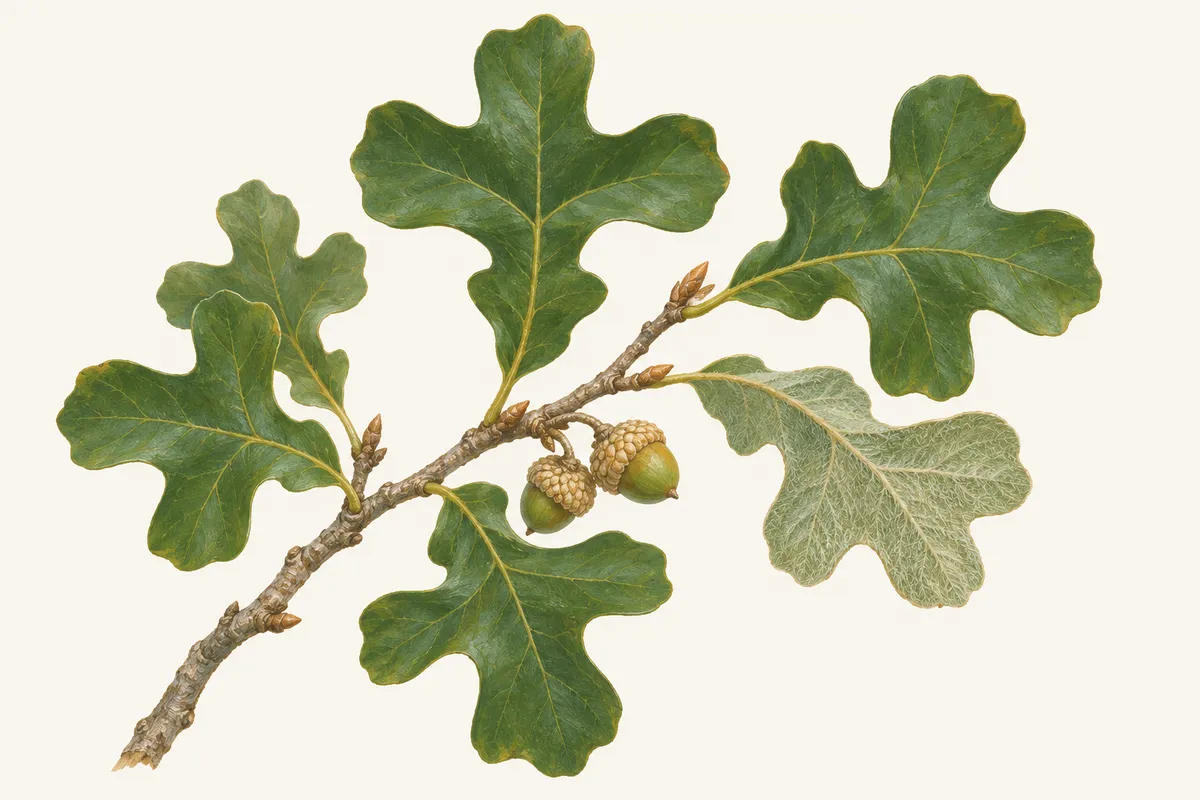
Post oak tree identification starts with the leaf: thick and leathery, usually with 5 rounded lobes, the middle two squared off so the leaf looks like a cross. Its upper surface carries scattered star-shaped hairs, and the underside is paler and hairy. Acorns are 1/2 to 2/3 inch long in a warty bowl cap and ripen in one season.
- The cross shape comes from two large, square-ended middle lobes; few other oaks have it.
- Check the top of a leaf with a hand lens: post oak carries star-shaped hairs, white oak does not.
- Post oak is in the white oak group: rounded lobes without bristles and acorns that ripen in a single season.
Field marks at a glance
- Scientific name
- Quercus stellata
- Family
- Fagaceae (beech family)
- Type
- Broadleaf, deciduous
- Leaves
- Alternate, simple, thick and leathery, usually 5 rounded lobes, the two middle lobes squared off so the leaf forms a cross. Virginia Tech gives 6 to 10 inches; NC State gives 3 to 8 inches.
- Leaf surfaces
- Upper side green with scattered star-shaped (stellate) hairs, best seen with a hand lens; underside paler and hairy.
- Fall color
- Brown to yellow, not showy; leaves may hang on into winter (NC State).
- Acorns
- 1/2 to 2/3 inch long, ovoid and often striped, in a warty bowl-shaped cap covering 1/3 to 1/2 of the nut; stalkless or short-stalked; ripen in one season, dropping September to November.
- Twigs and buds
- Twigs gray or tawny and fuzzy, with many lenticels; several short, blunt, orange-brown, somewhat hairy end buds; thread-like stipules sometimes present.
- Bark
- Ashy gray and scaly when young, later blocky and ridged, with horizontal cross-breaks on old trees; very similar to white oak.
- Size and form
- Small to medium tree, usually 50 to 60 ft in the Southeast, up to 65 ft (Virginia Tech); a dense, rounded crown of gnarled, twisted branches.
- Range and site
- Southeastern Massachusetts and Rhode Island west to Missouri, eastern Kansas, western Oklahoma and Texas, south to central Florida; dry, rocky or sandy ridges and upper slopes.
Post oak is the white oak of poor, dry ground: rocky ridges, sandy uplands and the Cross Timbers of Oklahoma and Texas. It is rarely a giant, and its crown is a tangle of twisted branches, but its leaf is one of the easiest oak leaves to recognize once you have seen it. Two square middle lobes stick out sideways, and the whole leaf reads as a cross.
How to identify a post oak
1. The cross-shaped leaf. The Virginia Tech post oak fact sheet describes an oblong leaf with 5 lobes, the two middle lobes distinctly square, giving a "cruciform" look, with a thick texture. NC State Extension describes up to four rounded lobes on each side and an upper pair often much larger than the rest, giving a Maltese cross shape. Leaf length differs between sources: 6 to 10 inches at Virginia Tech, 3 to 8 inches at NC State.
2. Look closely at the top of the leaf. The upper surface carries scattered star-shaped hairs, which is where the name stellata comes from; the underside is paler and hairy (Virginia Tech). Under a hand lens, each of these hairs branches into a small star; white oak leaves have none.
3. No bristles, round lobes. Post oak is in the white oak group: lobes rounded, no bristle tip at the end of any lobe. The group key is on the red oak vs white oak page.
4. Fuzzy twigs and blunt buds. Twigs are gray or tawny and fuzzy, with many lenticels, and the cluster of end buds is short, blunt, orange-brown and somewhat hairy. Small thread-like stipules may cling near the buds.
5. Gnarled crown. Virginia Tech describes a small to medium tree, up to 65 feet, with a crown of gnarled and twisted branches; NC State notes the twisted upper branches too.
If you can only reach a fallen leaf or an acorn, Tree Identifier can name a post oak from one photo of either. It shows one name, without a confidence score or a list of look-alikes, so confirm with the leaf-surface test above.
Post oak vs white oak vs bur oak
Virginia Tech lists sand post oak, overcup oak, bur oak and white oak as post oak's look-alikes. White and bur oak are the two most people meet. Figures below come from the Virginia Tech fact sheets for white oak, bur oak and post oak.
| Mark | Post oak | White oak | Bur oak |
|---|---|---|---|
| Leaf | 5 lobes, middle two square (a cross), thick | 4–7 in, 7–10 even finger-like lobes | 6–12 in, middle sinuses nearly to the midrib |
| Upper surface | Star-shaped hairs | No star-shaped hairs | Not stated |
| Underside | Paler, hairy | Whitish | Not stated |
| Acorn | 1/2–2/3 in, warty bowl over 1/3–1/2 | Warty bowl over about 1/4, detaches at maturity | About 1 1/2 in, cap with a long fringe |
| Twig | Fuzzy, gray or tawny | Hairless, often shiny | Stout, often with corky ridges |
Bark does not help much here: Virginia Tech calls post oak bark "very similar" to white oak's, ashy gray and scaly, later blocky. Use the leaf outline and the twig. The full profiles are on the white oak page and the bur oak page.
Acorns: one season, small and striped
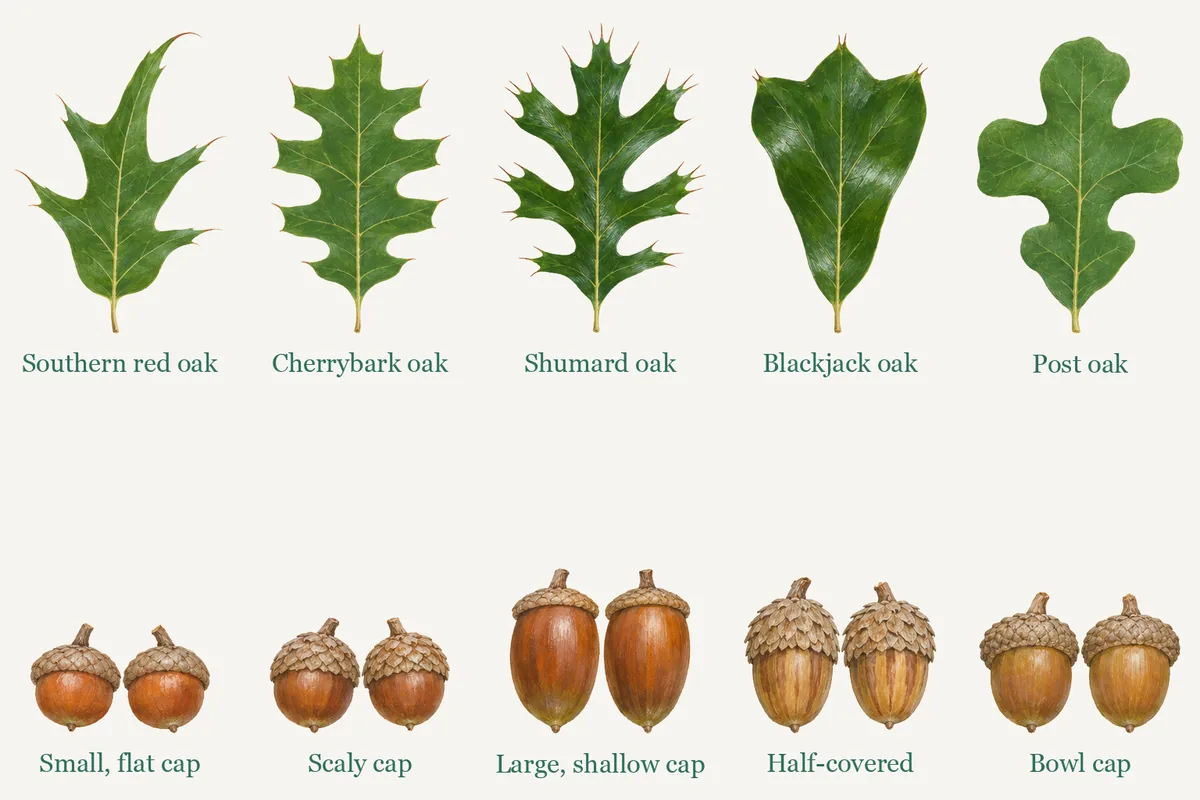
The USDA Forest Service Silvics of North America describes oval to ovoid-oblong acorns 1/2 to 3/4 inch long, often striped, in a bowl-shaped cup covering a third to half of the nut. The cup is pale, often hairy inside, with reddish-brown scales, and the acorns sit singly, in pairs or in clusters, stalkless or on short stalks. They mature in one growing season and drop from September through November; good crops come every 2 to 3 years, and trees begin bearing around age 25.
Virginia Tech adds that the scales on the cap are more visible than on a white oak acorn. For a loose acorn without a tree, the acorn identification guide keys caps by shape, size and stalk.
Where post oak grows
The Forest Service gives a range from southeastern Massachusetts and Rhode Island west to Missouri, eastern Kansas, western Oklahoma and Texas, and south to central Florida. It is abundant in the southern Coastal Plain, the Piedmont and on the lower Appalachian slopes, and it forms pure stands in the Cross Timbers of Oklahoma and Texas. NC State places it in the mountains up to 2,500 feet.
It grows on dry sites: rocky or sandy ridges, upper slopes and dry woodlands, on well-drained soils low in nutrients. The Forest Service calls it drought resistant, and it often grows with blackjack oak, black oak and hickories. Blackjack oak is the one with thick, bell-shaped leaves and nearly black bark; see the blackjack oak page. Finding an oak with cross-shaped leaves on a dry, rocky ridge is close to a field identification on its own.
Size, varieties and hybrids
In the Southeast mature post oaks are about 50 to 60 feet tall and 12 to 24 inches in diameter; the Forest Service says heights over 100 feet and trunks over 48 inches are uncommon. NC State gives 35 to 50 feet tall and as wide, with slow growth.
The Forest Service names two varieties, sand post oak (var. margaretta) and Delta post oak (var. paludosa), and a long list of hybrids, including crosses with white oak (Q. × fernowii), bur oak (Q. × guadalupensis), overcup oak and southern live oak. A tree that looks like post oak but with fewer star hairs, or leaves that are not quite cross-shaped, may be one of them.
To keep track of a tree you want to check again in fall for acorns, Tree Identifier's Tree Map pins a find made with location turned on; the oak identification page covers the other common US oaks.
Look-alikes and how to tell them apart
White oak (Quercus alba)
White oak leaves have 7 to 10 even, finger-like lobes, a whitish underside and no star-shaped hairs. Its end buds are small, rounded and hairless; post oak's twigs and buds are fuzzy. Both have ashy gray scaly bark, so use the leaf and the twig.
Bur oak (Quercus macrocarpa)
Bur oak leaves are larger, 6 to 12 inches, with two middle sinuses that cut nearly to the midrib, splitting the leaf in two. Its acorn is about 1 1/2 inches long in a cap with a long fringe; post oak's acorn is under 1 inch in a plain warty bowl.
What a photo can't settle
- Post oak hybridizes with white, bur, swamp white, overcup, chestnut and live oak, among others (USDA Forest Service), and a hybrid may lose the clean cross shape.
- Shade leaves and leaves from sprouts are often less cross-shaped than sun leaves at the top of the crown; collect several leaves from the sunny side.
- The star-shaped hairs need a hand lens to see clearly. A photo app, Tree Identifier included, works from what one photo shows, so check the leaf surface with a hand lens to confirm.
Questions people ask
Why is it called post oak?
The USDA Forest Service notes that post oak wood is very durable in contact with soil, which led to its use for fence posts. The same source lists iron oak as another common name, and says the wood is sold commercially as white oak.
Is post oak a white oak?
It belongs to the white oak group. Its lobes are rounded with no bristle tips, and its acorns ripen in one season, the two group marks. Its lumber is also sold as white oak, according to the Forest Service, although the species white oak is Quercus alba.
What does a post oak leaf look like?
Thick and leathery, usually with five rounded lobes. The two middle lobes are large and squared off, so the leaf looks like a cross; NC State compares it to a Maltese cross. The top carries star-shaped hairs and the underside is pale and hairy.
Where do post oaks grow?
On dry sites across the East and South Central US: rocky or sandy ridges, upper slopes and dry woodlands, from southeastern Massachusetts to central Florida and west to Texas, western Oklahoma and eastern Kansas. The Forest Service says it forms pure stands in the Cross Timbers of Oklahoma and Texas.
Sources
- Post oak (Quercus stellata) fact sheet — Virginia Tech Dendrology
- Post Oak, Silvics of North America — USDA Forest Service
- Quercus stellata (post oak) — North Carolina Extension Gardener Plant Toolbox, NC State University
- White oak (Quercus alba) fact sheet — Virginia Tech Dendrology
- Bur oak (Quercus macrocarpa) fact sheet — Virginia Tech Dendrology
Keep reading
- Tree profileOak trees (Quercus): how to identify them
- Tree profileWhite oak (Quercus alba): how to identify it
- Tree profileBur oak (Quercus macrocarpa): how to identify it
- Tree comparisonRed oak vs white oak trees: how to tell the living trees apart
- Clue guideAcorn identification: which oak dropped this acorn?