Tree comparison
Hickory vs walnut: how to tell the two nut trees apart
Both have long compound leaves and nuts in green husks, and they often share a woodlot. Split a twig: a ladder of tiny chambers inside means walnut, solid pith means hickory.
In short
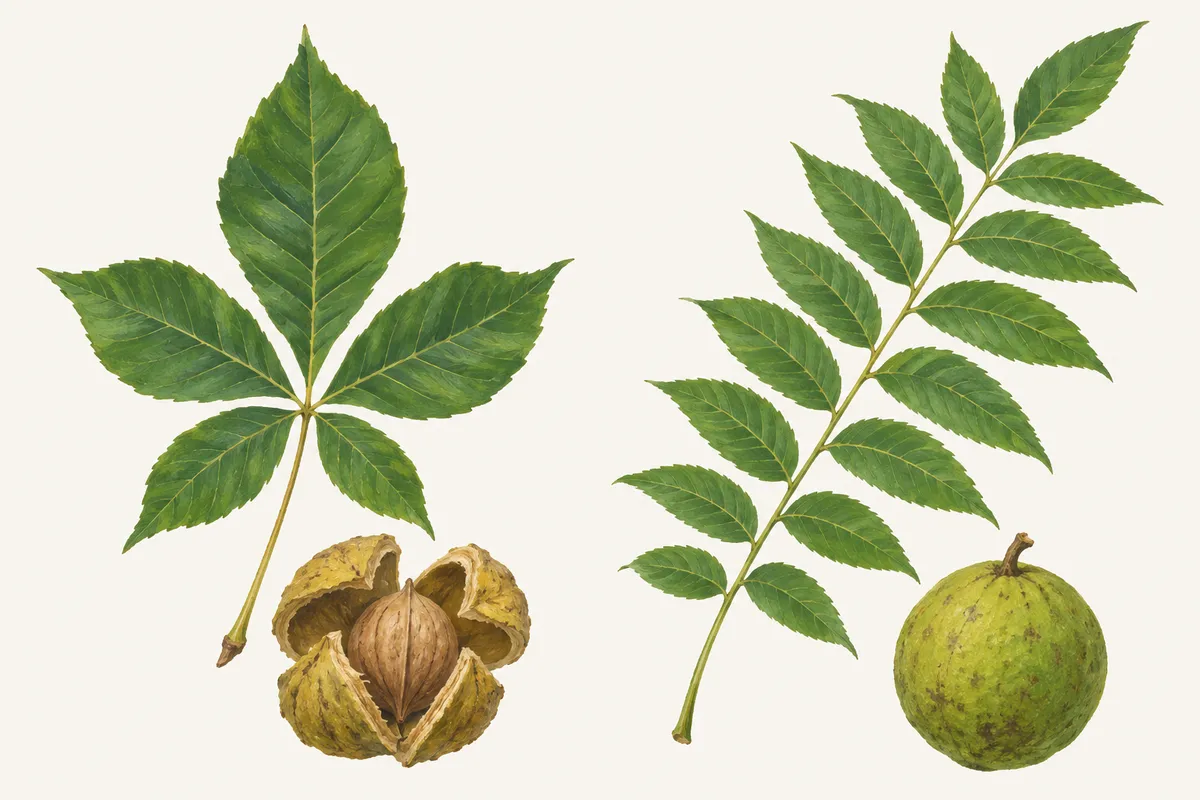
Hickory vs walnut is settled fastest by a split twig: walnut pith is divided into small chambers by crosswalls, hickory pith is solid. Then count leaflets: black walnut has 10 to 24 narrow ones, often with no end leaflet, while shagbark hickory has 5, sometimes 7, with a large end leaflet. In fall, a hickory husk splits into four sections; a walnut husk does not split open.
- Chambered pith means walnut; solid pith means hickory, pecan included.
- Five to seven broad leaflets with a big one at the tip: hickory. Ten to 24 narrow leaflets, end one small or missing: black walnut.
- A husk that peels back in four neat sections is hickory; a round husk that rots on the ground without opening is walnut.
Field marks at a glance
- Scientific name
- Carya ovata and Juglans nigra
- Family
- Juglandaceae (walnut family)
- Type
- Broadleaf, deciduous
- Twig pith
- Walnut: chambered, crossed by thin walls like a ladder (buff in black walnut). Hickory: solid, no crosswalls.
- Leaflets
- Black walnut: 10 to 24, narrow, finely toothed, 3 to 3 1/2 in; end leaflet often poorly formed or missing. Shagbark hickory: 5, sometimes 7; end leaflet much larger than the side ones.
- Leaf length
- Black walnut: 12 to 24 inches. Shagbark hickory: 8 to 14 inches. Pecan, a hickory: 12 to 18 inches with 9 to 15 curved leaflets.
- Husk
- Walnut: thick, green, round, does not split open. Hickory: dries and splits into four sections, on shagbark freely to the base.
- Nut
- Black walnut: round husk 2 to 2 1/2 in; nut hard and irregularly furrowed. Hickory: shell more or less smooth; shagbark nut distinctly 4-ribbed.
- Bark
- Black walnut: brown, darker brown when cut, ridged and furrowed in a rough diamond pattern. Shagbark hickory: gray, in long plates attached at the middle that curl away from the trunk.
- Buds
- Black walnut: tan, large, few hairy scales; leaf scar 3-lobed like a monkey face. Shagbark: large, brown, hairy, with 3 to 4 brown scales; leaf scar also 3-lobed.
- Size
- Black walnut: 100 to 120 ft on good sites. Shagbark hickory: typically 70 to 80 ft, up to 130 ft.
Hickories and walnuts are cousins in the walnut family, and in an eastern woodlot they often stand side by side. Both have long, alternate, pinnately compound leaves and both drop nuts in green husks. The two genera are still easy to separate with three checks: the pith inside a twig, the number and shape of the leaflets, and what the husk does when it ripens. This page compares black walnut, the common wild walnut, with the hickories, using shagbark as the reference. Never eat a berry, nut or seed on the strength of a web page or an app; check with a local expert.
Hickory vs walnut, side by side
The botanists' rule is in the opening couplet of the Key to the Juglandaceae of Iowa: walnuts have pith "chambered, interrupted by crosswalls", a distinctly furrowed nut and a husk not splitting into sections; hickories have solid pith, a more or less smooth shell, and a husk "splitting into four sections at maturity". The rest of the table comes from Virginia Tech Dendrology's fact sheets for black walnut and shagbark hickory.
| Feature | Black walnut (Juglans nigra) | Shagbark hickory (Carya ovata) |
|---|---|---|
| Twig pith | Buff, chambered | Solid |
| Leaf length | 12–24 in | 8–14 in |
| Leaflets | 10–24, narrow, finely toothed | 5, sometimes 7, broad |
| End leaflet | Often poorly formed or missing | Much larger than the side leaflets |
| Husk | Thick, green, round, does not split | Very thick, splits into four sections |
| Nut | Hard, irregularly furrowed | Distinctly 4-ribbed, smoother |
| Bark | Brown, rough diamond ridges | Gray, long plates curling away |
| Buds | Tan, large, few hairy scales | Brown, hairy, 3–4 scales, elongated |
| Twigs | Stout, light brown | Stout, usually hairy, many pale lenticels |
Two marks are shared and will not help: both have a three-lobed leaf scar that Virginia Tech compares to a monkey face, and both are monoecious, with male catkins and short female spikes in spring.
The pith test: split a twig
Cut a living twig lengthwise with a pocketknife, through the center. Inside a walnut, the soft core is divided by thin crosswalls into a row of small chambers, like the rungs of a ladder; in black walnut the pith is buff. Inside a hickory, the pith is a solid, continuous column. This works in every season, on any twig thick enough to cut cleanly, and it is the one test that never depends on the crop or the season.
Pecan is where it matters most. Pecan is a hickory, but its leaves look like a walnut's: 12 to 18 inches long with 9 to 15 finely toothed, often curved leaflets, according to Virginia Tech's pecan fact sheet. Its pith is solid, so the twig test puts it with the hickories at once. The pecan page covers it in full.
The pith also catches the other two look-alikes. Butternut, the other native walnut, has chambered pith too, but very dark brown. Tree of heaven, the invasive tree with leaves 1 to 3 feet long, has large, reddish-brown pith with no chambers at all, and its broken twigs give off a strong odor.
Leaves: count the leaflets and look at the tip
Hold up a whole leaf, from the twig to the tip.
- Black walnut leaves are long, 12 to 24 inches, with 10 to 24 narrow, finely toothed leaflets, each 3 to 3 1/2 inches. Virginia Tech notes that the end leaflet is often poorly formed or missing, so many leaves end in a pair rather than a single leaflet.
- Shagbark hickory leaves are shorter, 8 to 14 inches, with only 5 leaflets, sometimes 7. The end leaflet is "much larger than the laterals", and the edges are toothed and fringed with fine hairs.
Most other hickories also carry 5 to 9 leaflets with a big end leaflet; the hickory page compares six species. Pecan, with up to 15, is the exception. Black walnut leaves come out late and, according to the USDA Forest Service's black walnut Silvics chapter, fall somewhat earlier than those of other trees, so a bare walnut among hickories still in leaf in early fall is a strong hint. The guide to trees with compound leaves sorts the other trees with leaves like these.
Nuts and husks in fall
Walk under the tree in September or October.
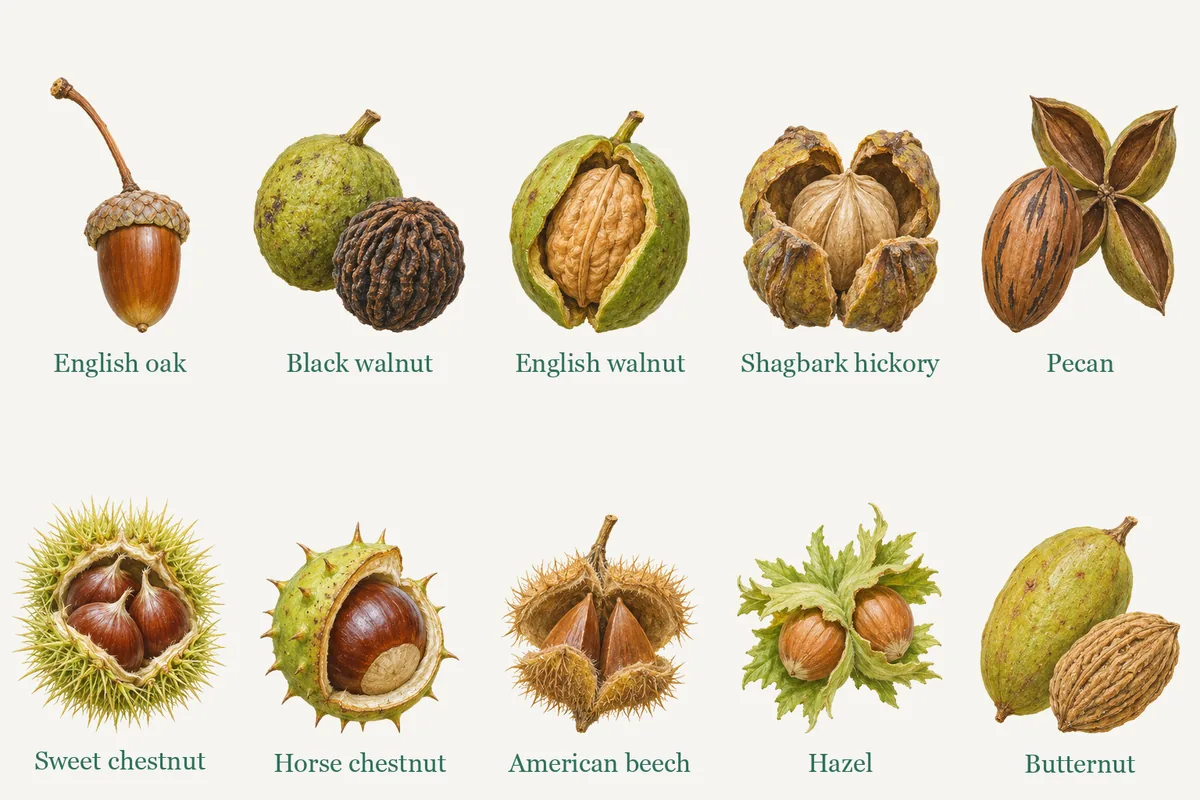
Black walnut fruit is round, 2 to 2 1/2 inches across, in a thick green husk that does not split open (Virginia Tech). The Forest Service says it ripens in September or October and drops shortly after the leaves fall. Inside is a hard, deeply and irregularly furrowed nut.
Hickory husks open on their own. The Forest Service's shagbark Silvics chapter describes husks that turn brown to brownish black as they ripen, then dry and split freely to the base into four valves along grooved sutures. The nut inside is light brownish white and, on shagbark, distinctly 4-ribbed. Shagbark nuts ripen in September and October and fall from September through December. The Iowa key gives a husk splitting into four sections as the mark of the whole hickory genus.
Crops vary: the Forest Service gives black walnut good crops perhaps twice in five years and shagbark every 1 to 3 years, so some autumns you will find nothing under either tree.
Bark and winter buds
On mature trees the bark can decide it from across a field.
- Shagbark hickory: smooth and gray when young, later breaking into long, wide plates attached at the middle and curving away from the trunk at both ends, a "coarsely shaggy appearance" in Virginia Tech's words. The Forest Service calls it probably the most distinctive of all the hickories.
- Black walnut: brown, ridged and furrowed in a rough diamond pattern; a shallow cut shows darker brown underneath.
Not every hickory is shaggy, and Virginia Tech notes that even shagbark is smooth and gray when young, so on a young or tight-barked tree use the pith or the husks under it. In winter the buds help too: black walnut buds are tan and large with a few hairy scales, while shagbark's terminal bud is large, brown and hairy with 3 to 4 dark outer scales.
Tree Identifier can name the tree from a single photo of a leaf, a husk or the bark. Black walnut is in the app's 138-species Collection; no hickory is listed there, though the app can still name one. It returns one name without a confidence score, so when the answer is "walnut" or "hickory" and you have a twig, the pith test takes ten seconds to confirm it.
Where each grows, and a note on juglone
The Forest Service maps black walnut from western Vermont and Massachusetts west to Nebraska and Minnesota, south to central Texas and east to Georgia and northwestern Florida, excluding the Mississippi Delta. Shagbark hickory grows through most of the eastern United States, from southeastern Nebraska and Minnesota to southern Ontario and Quebec, south to eastern Texas, but is largely absent from the southeastern and Gulf coastal plains. The ranges overlap widely, and the Forest Service lists hickories among the chief associates of black walnut.
Black walnut has one more trait hickories lack: juglone. The Forest Service describes it as a toxic substance found in the leaves, bark, nut husks and roots of walnut trees, and reports tomatoes as especially susceptible and apple, paper birch and several pines as sensitive. A vegetable garden that struggles under one of two big compound-leaved trees is a reason to check whether the tree is a walnut. For the trees themselves, the walnut page covers black walnut, butternut and English walnut.
Look-alikes and how to tell them apart
Pecan (Carya illinoinensis)
A hickory with walnut-like leaves, 12 to 18 inches with 9 to 15 often curved leaflets. Its pith is solid and its oblong nuts, 1 1/2 to 2 inches, sit in thin husks in clusters. Black walnut's pith is chambered and its nut round.
Butternut (Juglans cinerea)
A walnut, so the pith is chambered, but very dark brown, not buff. Its 11 to 17 leaflets end in a well-developed end leaflet, its nut is oblong and lemon-shaped in a sticky husk, and a tuft of hairs sits above each leaf scar like an eyebrow.
Tree of heaven (Ailanthus altissima)
Leaves 1 to 3 feet with many leaflets, but each leaflet has large glandular teeth near the base, and a broken twig gives off a strong odor. The pith is large and reddish brown without chambers, and the fruit is twisted winged seeds, never nuts.
What a photo can't settle
- Leaflet counts vary from leaf to leaf, and black walnut sometimes keeps its end leaflet; count several leaves.
- Young hickories and walnuts both have smooth bark, so a bark photo of a young tree may not separate them; the pith test does.
- The pith test needs a twig in hand. A photo app, Tree Identifier included, works from what the photo shows and returns one name with no confidence score.
Questions people ask
Is a walnut a type of hickory?
No, but they are close relatives. Both belong to the walnut family, Juglandaceae: walnuts and butternut are the genus Juglans, hickories and pecan the genus Carya. The Iowa key separates the two genera by pith, nut shell and husk.
How can you tell hickory from walnut in winter?
Cut a twig lengthwise: chambered pith is walnut, solid pith is hickory. Both have three-lobed leaf scars, so the scar alone will not decide it. Look under the tree for husks: split into four sections means hickory, whole and blackening means walnut.
How do you tell hickory bark from walnut bark?
Shagbark hickory bark peels in long gray plates attached at the middle and curling away at both ends. Black walnut bark is brown, ridged and furrowed in a rough diamond pattern, and shows darker brown when cut. Smooth-barked hickories such as bitternut need the leaves or the pith.
Do hickory and walnut grow together?
Often. The USDA Forest Service lists hickories among the chief associates of black walnut in eastern hardwood forests, along with yellow-poplar, white ash, black cherry, basswood, beech, sugar maple and oaks.
Which is bigger, a hickory or a walnut?
They overlap. The Forest Service gives black walnut 100 to 120 feet on good sites, and 150 feet on the best Indiana sites, and shagbark hickory typically 70 to 80 feet, occasionally up to 130 feet. Virginia Tech gives shagbark over 120 feet.
Sources
- Key to the Juglandaceae of Iowa — Plants of Iowa
- Black walnut fact sheet — Virginia Tech Dendrology
- Shagbark hickory fact sheet — Virginia Tech Dendrology
- Pecan fact sheet — Virginia Tech Dendrology
- Black Walnut (Juglans nigra), Silvics of North America — USDA Forest Service
- Shagbark Hickory (Carya ovata), Silvics of North America — USDA Forest Service
- Butternut fact sheet — Virginia Tech Dendrology
- Tree-of-heaven fact sheet — Virginia Tech Dendrology
Keep reading
- Tree profileHickory trees (Carya): how to identify them
- Tree profileWalnut trees (Juglans): how to identify them
- Tree profilePecan (Carya illinoinensis): how to identify it
- Clue guideWhich tree has compound leaves? Count the leaflets, then check the twig
- Field guideTree seed identification: from acorn, pod or samara to the tree