Also in Español
Tree profile
Mesquite trees (Prosopis): how to identify them
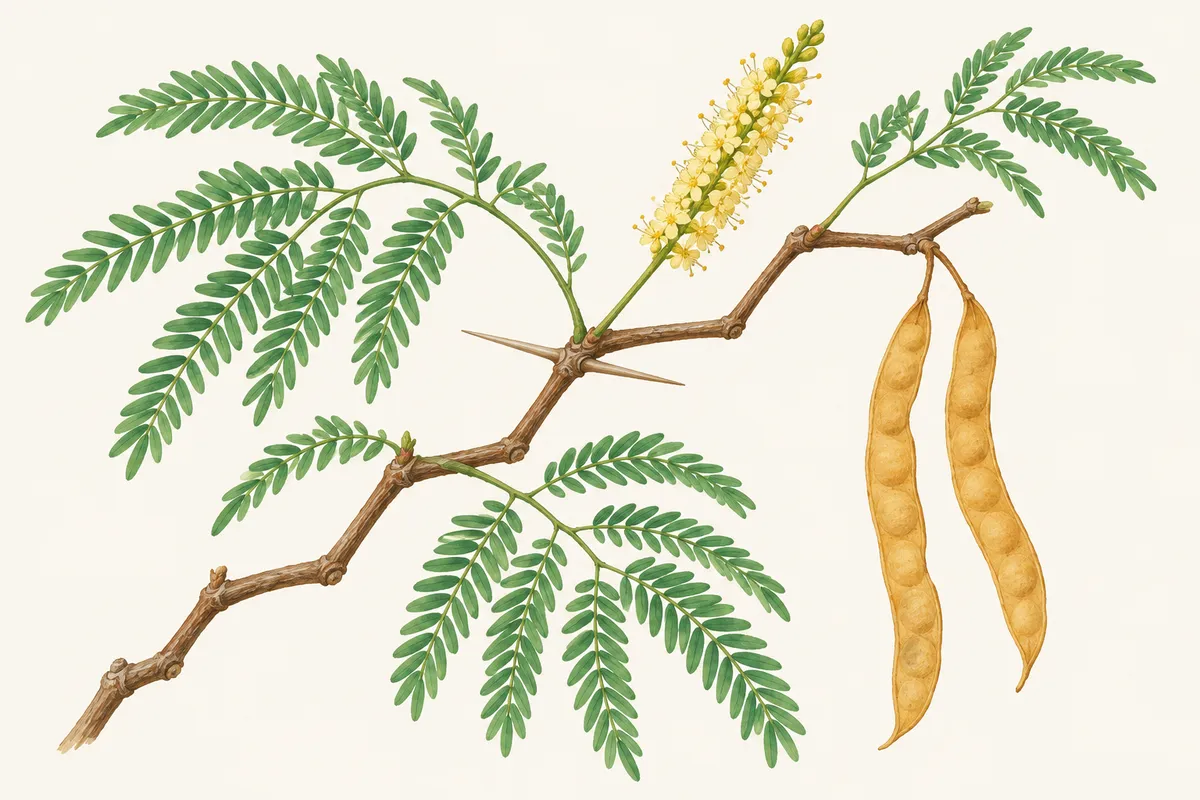
A leaf that forks into two feathery halves, thorns at the nodes, catkin-like yellow flower spikes and bean pods: that is a mesquite. The pods and the hairs tell you which one.
In short
Mesquite tree identification starts with the leaf: bipinnately compound, usually forked into just two feathery halves lined with narrow leaflets. Add thorns at the nodes, slender spikes of pale yellow flowers 2 to 3 inches long, and bean pods. Straight pods and hairless leaves mean honey mesquite, straight pods and velvety hairs mean velvet mesquite, and tightly coiled pods 1 to 2 inches long mean screwbean mesquite.
- Count the halves: most mesquite leaves fork into one pair of feathery branches, rarely two or three.
- Hairless leaflets 3/8 inch or longer point to honey mesquite; short, finely hairy leaflets and velvety twigs to velvet mesquite.
- A pod twisted into a tight spring, like a screw, is screwbean mesquite and nothing else.
Field marks at a glance
- Scientific name
- Prosopis (P. glandulosa, P. velutina, P. pubescens)
- Family
- Fabaceae (legume family)
- Type
- Broadleaf, deciduous
- Leaves
- Alternate, bipinnately compound, 1 to 6 inches long, usually with only two main branches (pinnae), each lined with many narrow leaflets; deciduous.
- Thorns
- At the nodes: paired, slender spines up to 1 inch (Virginia Tech); honey mesquite often single thorns 1 to 2 inches on young branches (University of Arizona). Some velvet mesquite twigs have few or none.
- Flowers
- Small, pale yellow to greenish-yellow, fragrant, in slender spikes 2 to 3 inches long like catkins; spring into summer.
- Pods
- Honey: straight, reddish-brown to yellowish-brown, constricted between the seeds. Velvet: straight, tan, sometimes streaked red, 3 to 6 inches. Screwbean: tightly coiled, 1 to 2 inches.
- Bark
- Rough, shreddy to scaly; older bark gray-brown, newer bark reddish brown; velvet mesquite trunks described as shaggy.
- Form
- Large shrub or small tree, usually 20 to 25 ft, with several crooked, arching stems and a broad, round crown; thicket-forming.
- Habitat
- Desert washes, bottomlands, sandy flats, plains and dry rangeland of the US Southwest and northern Mexico; screwbean mainly along streams.
Mesquites are the thorny, feathery-leaved trees of desert washes, Texas pastures and Southwest yards. They are legumes, like locusts and acacias, and every one carries the same kit: a leaf that forks into two feathery halves, thorns at the nodes, slender yellow flower spikes and bean pods. Three species cover most of what you will meet in the United States: honey mesquite, velvet mesquite and screwbean mesquite. Never eat a berry, nut, seed or pod on the strength of a web page or an app; check with a local expert.
How to identify a mesquite in four checks
1. The leaf forks in two. A mesquite leaf is bipinnately compound: a short stalk that splits into main branches, each lined with pairs of narrow leaflets. On all three species Virginia Tech's fact sheets describe "usually" only two main branches, occasionally two or three pairs. That gives most mesquite leaves the look of a pair of small green feathers joined at the base. They are alternate along the twig and drop in winter.
2. Thorns at the nodes. Virginia Tech describes paired, slender spines up to 1 inch long at the base of each leaf on honey, velvet and screwbean mesquite. University of Arizona Cooperative Extension describes honey mesquite thorns as 1 to 2 inches long and usually single on young branches, and the NRCS honey mesquite plant guide gives "one or two stout spines" at the nodes. Expect straight thorns, singly or in pairs; some velvet mesquite twigs have few or none.
3. Flower spikes. Mesquite flowers are tiny, pale yellow to greenish-yellow and fragrant, packed into slender spikes 2 to 3 inches long that look like catkins. Virginia Tech places them in late spring and early summer; Arizona Extension gives March through August for honey mesquite.
4. Bean pods. Mesquite fruit is a pod that hangs in bunches through summer. Its shape names the species, as the next section shows. For other trees that carry pods, see our guide to trees with long seed pods.
The bark of all three is rough, shreddy to scaly, gray-brown on old wood and reddish brown on new wood, and the trees usually grow as several crooked, arching stems with a broad, round crown. Our guide to desert tree identification places mesquite beside palo verde, desert ironwood and Joshua tree.
Honey, velvet and screwbean mesquite compared
| Feature | Honey mesquite (P. glandulosa) | Velvet mesquite (P. velutina) | Screwbean mesquite (P. pubescens) |
|---|---|---|---|
| Leaf length | 3–6 in | 3–6 in | 1–2 in |
| Leaflets per branch | 10–16 pairs, 3/8–1 in | 15–20 pairs, 1/4–1/2 in | 6–9 pairs, small |
| Hairs | Leaves hairless | Short, dense hairs on every part; twigs velvety | Leaves fuzzy |
| Pod | Straight, reddish-brown, constricted between seeds | Straight, tan, sometimes streaked red | Tightly coiled spring, 1–2 in |
| Height | Up to 25 ft | Up to 25 ft | Up to 20 ft |
| Where | Plains, washes, sandy flats | Desert washes and plains, Arizona to western Texas | Along streams, rocky and sandy soils |
Leaf and leaflet figures come from Virginia Tech's fact sheets for honey, velvet and screwbean mesquite. The sources disagree in the details: the NRCS honey mesquite plant guide gives 6 to 15 leaflets per branch, each 15 to 62 mm long, and Arizona Extension 8 to 20. Count several leaves and use the hairs and the pods as well.
Honey mesquite
Honey mesquite is the mesquite of the southern plains and of many Arizona washes. The NRCS plant guide describes a shrub or tree 4 to 6 meters tall, with smooth leaflets, yellow flowers in spikes 7 to 9 cm long, and straight pods 7 to 20 cm long, reddish-brown, nearly as thick as they are broad and constricted between the seeds. Its other names include glandular mesquite and algaroba. Arizona Extension gives about 20 feet tall and as wide, often with several trunks, sprouting from the roots into dense thickets, from sea level to about 5,000 feet in bottomlands, washes and sandy flats.
Honey mesquite survives fire: the NRCS notes that after the top is killed, sprouts arise from buds on an underground stem. That is why a burned or cleared pasture often comes back as a ring of thorny stems.
Velvet mesquite
Velvet mesquite is the big mesquite of southern Arizona. The NRCS velvet mesquite plant guide describes a deciduous shrub or tree under 15 meters with a spreading, rounded crown, in which every part carries short, dense hairs. The branches are crooked with spines 1 to 2 cm long, the trunk has shaggy bark, and the pods are linear and flat, 8 to 15 cm long, tan or sometimes streaked with red. It grows below 1,700 meters in desert washes and plains from Yavapai County, Arizona, east and south to western Texas and northern Mexico, and is uncommon in California.
Virginia Tech notes that an undisturbed velvet mesquite usually keeps one dominant trunk; grazed or cut plants become multi-stemmed. Run a finger along a twig: velvet mesquite feels velvety, honey mesquite smooth.
Screwbean mesquite
Screwbean mesquite is the easiest to name, as soon as it has fruit. Virginia Tech calls the pod "a very unique, tightly coiled legume", 1 to 2 inches long, light brown and ripening in mid to late summer. Arizona Extension's screwbean page describes the coils as yellowish-green turning light brown, and also lists the names tornillo and screwpod mesquite.
Without pods, look for small, fuzzy leaves only 1 to 2 inches long with 5 to 9 pairs of leaflets, paired, slender, nearly white spines up to 1 inch, and light brown bark peeling in long, narrow strips. It is a thicket-forming tree of 10 to 25 feet that grows mainly along streams, on rocky or sandy soils, where water is easier to reach than on the open desert.
Mesquite vs catclaw acacia, palo verde and locust
Catclaw acacia grows in the same washes and is the look-alike Virginia Tech lists for all three mesquites. Its fact sheet describes numerous stout, backward-curving spines about 1/4 inch long, which hook clothing like a cat's claw, and leaves only 1 to 2 inches long with 1 to 3 pairs of branches. Its pods are flat and very twisted, 3 to 6 inches long and about 1/2 inch wide. Short hooked thorns mean catclaw; longer straight thorns mean mesquite. The guide to trees with thorns covers other thorny trees.
Palo verde has green bark on its trunk and branches, as the desert tree guide explains from the National Park Service; a mesquite trunk is dark and rough. Honey locust, a legume tree with branched thorns and long twisted pods, is a separate genus; the locust page covers it.
Tree Identifier can name a mesquite from one photo of a leaf, a pod or the bark, though mesquite is not one of the 138 species in its Collection; finds outside the Collection go under Wild Discoveries. The app needs a data connection, so on a remote trail take the photos and identify them later. Its follow-up chat can answer "honey or velvet mesquite?" under a result, and, with location turned on, the Tree Map pins where each tree stood.
Look-alikes and how to tell them apart
Catclaw acacia (Senegalia greggii)
Thorns short, about 1/4 inch, stout and curved backward like a cat's claw, not straight. Leaves only 1 to 2 inches with 1 to 3 pairs of branches and 4 to 6 pairs of tiny leaflets; pods flat and very twisted, 3 to 6 inches, but not coiled into a spring.
Palo verde (Parkinsonia)
Green bark on the trunk and branches. Mesquite trunks and large limbs are dark gray-brown and rough, never green.
What a photo can't settle
- Honey and velvet mesquite overlap and the sources give different leaflet counts and thorn descriptions for them; check hairiness, leaflets and pods together.
- Mesquite, palo verde and Joshua tree are not among the 138 species in Tree Identifier's Collection; the app can still name a mesquite, and finds outside the Collection go to Wild Discoveries.
- Mesquite leaves are tiny and can be missing in drought or early spring; photograph the bark, a thorn and a pod as well.
Questions people ask
How do you tell honey mesquite from velvet mesquite?
Feel the leaves and twigs. Velvet mesquite is covered in short, dense hairs, and Virginia Tech gives it 15 to 20 pairs of small leaflets, 1/4 to 1/2 inch. Honey mesquite leaves are hairless, with fewer, longer leaflets, 3/8 to 1 inch in Virginia Tech's figures. Location helps: velvet mesquite is the Arizona species.
What does a screwbean mesquite look like?
A thicket-forming small tree, up to about 20 to 25 feet, with paired, slender, nearly white spines, fuzzy leaves of 5 to 9 pairs of leaflets, and its unmistakable fruit: a light brown pod 1 to 2 inches long coiled tightly like a screw. Pods ripen in mid to late summer.
Are mesquite trees evergreen?
No. University of Arizona Cooperative Extension and Virginia Tech describe the leaves as deciduous. Mesquites leaf out late in spring, so a bare thorny tree in a wash in early spring can still be a mesquite.
How tall do mesquite trees get?
Most are large shrubs or small trees. Virginia Tech gives honey and velvet mesquite up to 25 feet and screwbean up to 20 feet; the NRCS gives honey mesquite 4 to 6 meters and velvet mesquite under 15 meters. Sprouts after fire or cutting form multi-stemmed thickets.
Sources
- Honey mesquite (Prosopis glandulosa) Plant Guide — USDA Natural Resources Conservation Service
- Velvet mesquite (Prosopis velutina) Plant Guide — USDA Natural Resources Conservation Service
- Honey mesquite fact sheet — Virginia Tech Dendrology
- Velvet mesquite fact sheet — Virginia Tech Dendrology
- Screwbean mesquite fact sheet — Virginia Tech Dendrology
- Prosopis glandulosa (honey mesquite) — University of Arizona Cooperative Extension, Yavapai County Native and Naturalized Plants
- Prosopis pubescens (screwbean mesquite) — University of Arizona Cooperative Extension, Yavapai County Native and Naturalized Plants
- Catclaw acacia fact sheet — Virginia Tech Dendrology