Tree profile
River birch (Betula nigra): how to identify it
Bark that curls back in salmon, cream and cinnamon layers, a small diamond-shaped leaf with double teeth, and a trunk that splits low into several stems: the native birch of southern riverbanks and northern yards.
In short
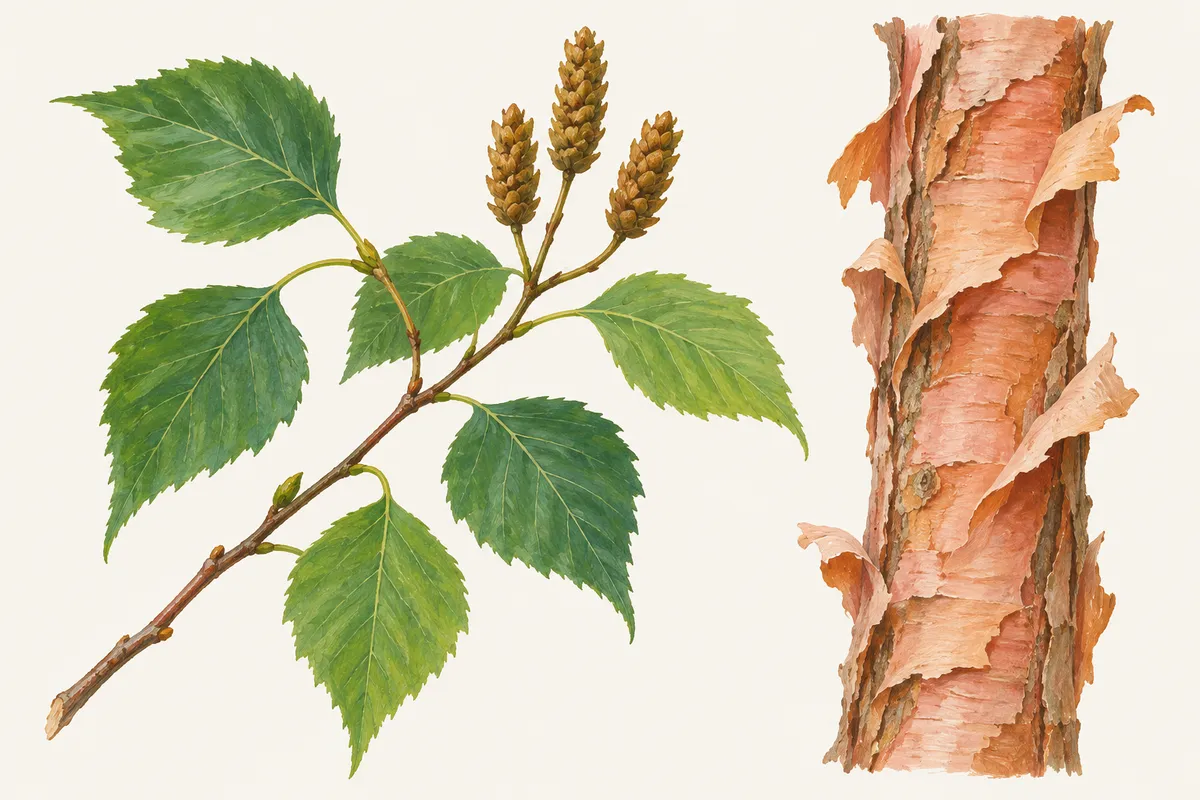
River birch identification starts with the bark: salmon-pink to cinnamon on young trunks, peeling in papery layers that show cream to orange-brown beneath, and breaking into dark, scaly ridges on old trees. The leaves are diamond-shaped to triangular, 1 1/2 to 3 1/2 inches long, doubly toothed, with a wedge-shaped base, and the trunk usually divides low into several stems.
- Peeling salmon, cream and cinnamon bark: river birch. Chalky white bark peeling in sheets: paper birch.
- River birch is the only birch in the United States that sheds its seed in late spring, not in fall and winter.
- A twig with no wintergreen smell separates it from black and yellow birch.
Field marks at a glance
- Scientific name
- Betula nigra
- Family
- Betulaceae (birch family)
- Type
- Broadleaf, deciduous
- Bark
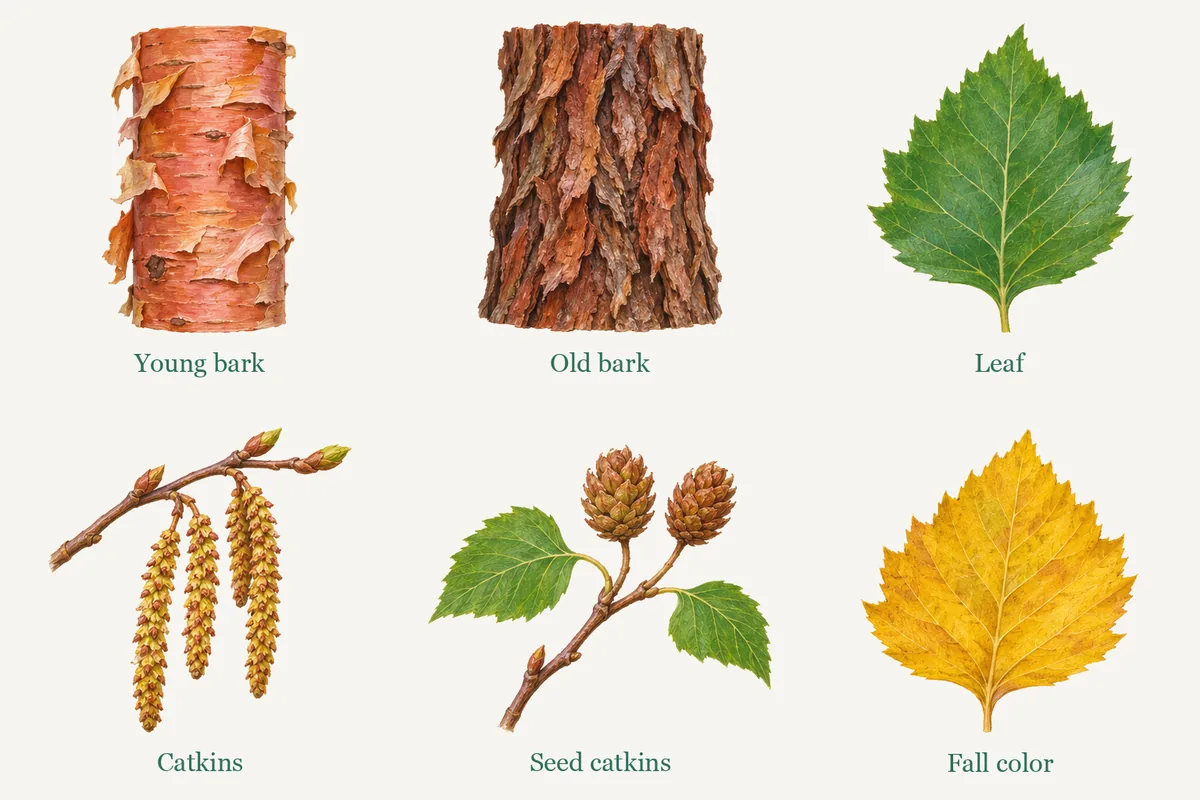
- Young trunks smooth, salmon to rust or cinnamon, peeling in papery layers that show cream to orange-brown; old trunks dark reddish brown to nearly black, in thick, irregular scales.
- Leaves
- Alternate, simple, rhombic (diamond-shaped) to triangular, 1 1/2 to 3 1/2 inches long, conspicuously doubly toothed, with a wedge-shaped base; paler and fuzzy beneath.
- Form
- Trunk usually divides low into several upright stems; open, pyramidal to rounded crown.
- Twigs and buds
- Slender, orange-brown; no true end bud; no wintergreen smell when scratched (Virginia Tech).
- Catkins
- Male catkins 2 to 3 inches, formed in fall and hanging near the twig tips through winter; female catkins upright, 1/4 to 1/2 inch, in spring.
- Fruit
- Cone-like, 1 to 1 1/2 inches, reddish brown; it ripens in late spring or early summer and breaks into small winged seeds.
- Fall color
- Yellow, often modest; leaves may drop early, and interior leaves fall in summer droughts.
- Size
- Usually 30 to 70 ft (NC State), 30 to 40 ft planted (Morton Arboretum); isolated trees to 100 ft in the lower Mississippi Valley (USDA Forest Service).
- Range and habitat
- Riverbanks, streambanks and floodplains of the southeastern quarter of the US, scattered north to southern Minnesota, central Wisconsin and New England.
River birch is the birch that likes heat and wet feet. It lines the rivers of the Southeast, where no other birch grows wild, and it is one of the most planted yard trees farther north, because its peeling bark looks good all year and it is highly resistant to the bronze birch borer. The bark usually gives it away. The leaf and the habit of splitting into several trunks confirm it.
How to identify a river birch
Check these in order.
1. The bark: salmon, cream and cinnamon. The Virginia Tech fact sheet describes bark that is smooth and salmon to rust-colored on young trees, then develops papery scales that peel horizontally to show several colors, creamy to orange-brown. NC State Extension adds that it peels year-round in paper-like layers that stay attached to the trunk, so the tree always looks ragged. Look at a trunk a few inches thick, where the effect is strongest.
2. The leaf: a small, double-toothed diamond. Virginia Tech gives leaves 1 1/2 to 3 inches long, rhombic to ovate, conspicuously doubly toothed, with a wedge-shaped base, green above and paler and fuzzy below. NC State gives 2 to 3 1/2 inches and describes the shape as triangular, ovate or rhomboidal with a sharp tip. The wedge-shaped base, tapering into the stalk like the bottom of a diamond, is the detail to look for.
3. The form: several trunks. The trunk generally divides low into several upright stems (Virginia Tech). The USDA Forest Service's Silvics of North America notes that multiple stems are common in the wild, probably from stump sprouts, often with a curve at the base. Nurseries also sell river birch as multi-stem clumps.
4. The twig. Scratch a slender, orange-brown twig: there is no wintergreen smell (Virginia Tech). That separates river birch from black and yellow birch, which smell strongly of it.
5. The place. Wild river birches grow on riverbanks, streambanks and floodplains (NC State). A birch on a southern river with salmon bark is almost certainly this species.
When the trunk is behind a fence or the leaves are out of reach, a photo of the bark or a fallen leaf is enough for Tree Identifier to suggest a name. River birch is not one of the 138 species in the app's Collection, though a photo still returns a name. The app gives no confidence score or list of look-alikes, so check the bark color and the leaf base yourself.
River birch bark through the years
River birch bark changes more with age than most birches, and that confuses people who expect it to stay salmon.
| Age | Bark | Source |
|---|---|---|
| Young stems | Silvery gray to light reddish brown or cinnamon, with darker narrow horizontal lenticels | USDA Forest Service |
| Young trunks | Salmon to rust, peeling in papery layers showing cream to orange-brown | Virginia Tech, NC State |
| Branches of old trees | Smooth and gray | USDA Forest Service |
| Old trunks | Dark reddish brown to gray or nearly black, broken into thick, irregular scales or flat, scaly ridges | USDA Forest Service, NC State |
So a big old river birch on a riverbank may show dark, scaly bark at the base and the familiar peeling layers only higher up and on the limbs. Our guide to trees with peeling bark compares it with paperbark maple, sycamore, crape myrtle and other peelers.
Catkins, seed and the spring fruit
River birch is monoecious: male and female catkins grow on the same tree. The Forest Service says the male catkins form in fall and stay on the twig tips through winter, maturing in April or May; Virginia Tech gives them as 2 to 3 inches long and reddish green. The female catkins are small, upright and light green, 1/4 to 1/2 inch, and appear with the leaves.
The fruit is the unusual part. According to the Forest Service, river birch is the only birch that does not produce its seed in fall: the cone-like fruit, 1 to 1 1/2 inches long (Virginia Tech), ripens in late spring or early summer and breaks apart into small winged seeds, the largest of any native US birch. NC State also gives spring seed shed. The seeds travel by wind and by water, and the Forest Service notes that seedlings often form thickets on sandbars.
Fall color is yellow; the Morton Arboretum calls it buttery yellow, while NC State calls it modest and notes the leaves drop early and quickly.
River birch vs paper birch, gray birch and sycamore
Paper birch is the white birch of the North. The Virginia Tech paper birch fact sheet describes chalky to creamy white bark peeling in horizontal strips, orange inner bark, and ovate leaves 3 to 5 inches long with a rounded base. Where both are planted, the color of the peel decides it. The paper birch page covers it in detail.
Gray birch has gray to chalky white bark that generally does not peel, and a triangular leaf with a very long, drawn-out tip, 2 to 3 inches long (Virginia Tech).
American sycamore shares the riverbanks and the flaking bark. Virginia Tech's sycamore fact sheet describes thin, mottled brown, green, tan and white camouflage bark that readily exfoliates, but the leaves are 4 to 8 inches wide with 3 to 5 lobes, and the round seed balls hang on 3- to 6-inch stalks into winter. One look at the leaf separates them.
For the black and yellow birches, which smell of wintergreen, see the birch identification page.
Range, size and planted cultivars
The Forest Service gives the main range as the southeastern quarter of the United States, from eastern Texas and southeastern Iowa to Virginia and northern Florida, with scattered populations north to southern Minnesota, central Wisconsin and the middle New England states; the Appalachian mountains are largely excluded. NC State lists it from Vermont to Florida and west to Texas, Oklahoma, Nebraska and Minnesota, and gives hardiness zones 4a to 9b.
Size varies with site. The Morton Arboretum gives 30 to 40 feet tall and 20 to 30 feet wide for planted trees, and NC State 30 to 70 feet tall. In the wild, the Forest Service reports average trees of 50 to 80 feet, with isolated trees in the lower Mississippi Valley reaching 100 feet and 60 inches in diameter.
The Forest Service notes that river birch is highly resistant to the bronze birch borer and especially recommended for planting in the Northeast and Midwest, which is why it shows up in yards well outside its wild range. Common cultivars include Heritage ('Cully'), with salmon bark that peels to a whiter inner bark, and Dura-Heat, with creamy white bark (NC State). Fox Valley ('Little King') is a dense dwarf of 10 to 12 feet (Morton Arboretum). A cultivar changes the shade of the bark and the size of the tree, but not the diamond-shaped, double-toothed leaf.
If you want to follow one tree through its spring seed drop, Tree Identifier's Tree Map pins where it stands if location is on.
Look-alikes and how to tell them apart
Paper birch (Betula papyrifera)
Paper birch bark is chalky to creamy white, peeling in horizontal sheets with orange inner bark, and its leaves are ovate with a rounded base, 3 to 5 inches. River birch bark is salmon to cinnamon and its leaf base is wedge-shaped.
Gray birch (Betula populifolia)
Gray birch bark is gray to chalky white and generally does not peel, and its leaf is a triangle with a very long, drawn-out tip. River birch peels in salmon layers and its leaf base is a short wedge.
American sycamore (Platanus occidentalis)
Sycamore bark also flakes off, in a mottled brown, green, tan and white camouflage pattern, but its leaves are maple-like, 4 to 8 inches wide with 3 to 5 lobes, and its seed balls hang on long stalks all winter.
Heritage river birch (Betula nigra 'Cully')
It is a river birch, a planted cultivar. NC State describes salmon bark that peels to a whiter inner bark, and the Morton Arboretum notes larger, glossy dark green leaves. Treat a very pale-peeling yard river birch as a likely cultivar.
What a photo can't settle
- Bark color changes with age: old river birch trunks lose the salmon peel and turn dark and scaly at the base, so photograph the upper trunk or a younger stem too.
- Planted cultivars such as Heritage and Dura-Heat have paler, whiter peeling bark than wild trees, and a photo names the species, not the cultivar.
- Planted river birches grow far north and west of the wild range, so where a tree stands says little about whether it is a river birch.
Questions people ask
How do I know if my tree is a river birch?
Look at the bark on a trunk a few inches thick: salmon to cinnamon, curling back in papery layers that show cream and orange-brown. Then check a leaf: diamond-shaped, doubly toothed, with a wedge-shaped base. Most river birches also split into several trunks near the ground.
Why is my river birch dropping leaves in summer?
Usually dry weather. NC State Extension says river birch sheds interior leaves during summer droughts and is stressed by heat and humidity, and the Morton Arboretum says leaves can yellow and drop in severe drought, even on mature trees. The Morton Arboretum also notes iron chlorosis, yellowing, in high-pH soils.
Is the peeling bark on a river birch normal?
Yes. Peeling bark is the species' defining feature. NC State describes bark that peels year-round in paper-like layers that stay attached, and the Virginia Tech fact sheet describes it exfoliating horizontally in several colors from creamy to orange-brown.
How big does a river birch get?
The Morton Arboretum gives 30 to 40 feet tall and 20 to 30 feet wide for planted trees; NC State gives 30 to 70 feet. The USDA Forest Service reports isolated trees in the lower Mississippi Valley up to 100 feet tall and 60 inches in diameter.
What is the difference between river birch and paper birch?
Bark color, leaf and range. River birch bark is salmon to cinnamon with cream layers, its leaf diamond-shaped with a wedge base, and it is a southern and Midwestern lowland tree. Paper birch is chalky white, its leaf ovate with a rounded base, and it is a northern tree.
Sources
- River Birch (Betula nigra), Silvics of North America — USDA Forest Service
- River birch fact sheet — Virginia Tech Dendrology
- Betula nigra (River Birch) — North Carolina Extension Gardener Plant Toolbox, NC State University
- River birch — The Morton Arboretum
- Paper birch fact sheet — Virginia Tech Dendrology
- Gray birch fact sheet — Virginia Tech Dendrology
- American sycamore fact sheet — Virginia Tech Dendrology