Also in Français
Tree profile
Paper birch (Betula papyrifera): how to identify the white birch
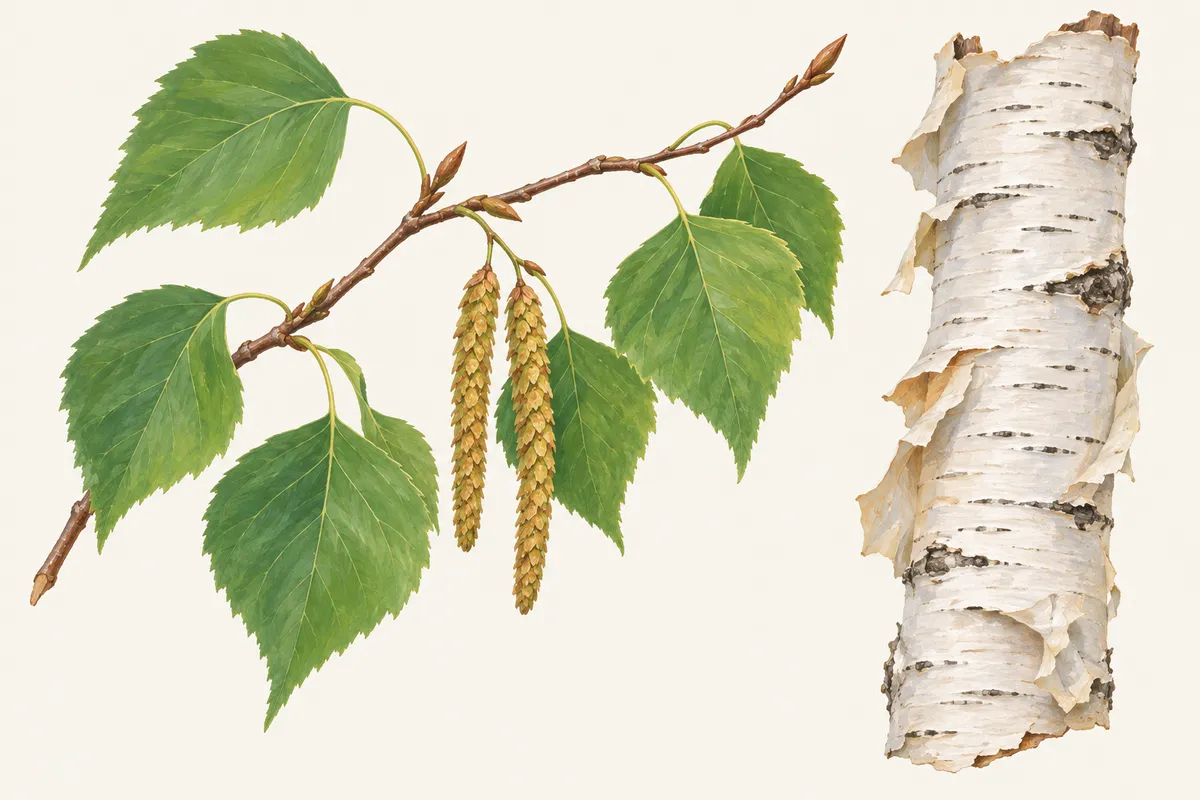
White bark that peels in sheets over orange, a pointed oval leaf with double teeth, and hanging seed catkins in late summer. Three other white-barked trees share its woods, and two checks separate them.
In short
Paper birch identification starts with the bark: chalky to creamy white, peeling in thin horizontal sheets that show orange inner bark, with dark horizontal lenticels. The leaf is ovate with a pointed tip, about 2 to 4 inches long, doubly toothed, with 9 or fewer vein pairs, and in late summer the tree carries hanging, cone-like seed catkins 1 to 2 inches long.
- White bark that peels in sheets with orange beneath: paper birch. White bark that stays smooth on a small leaning tree: gray birch.
- Saplings are not white: paper birch bark stays reddish brown or golden until about age 10 to 12.
- No wintergreen smell from a scratched twig, unlike black and yellow birch.
Field marks at a glance
- Scientific name
- Betula papyrifera
- Family
- Betulaceae (birch family)
- Type
- Broadleaf, deciduous
- Bark
- Thin, chalky to creamy white, peeling in horizontal papery sheets; orange inner bark that darkens with exposure; brown to black and furrowed at the base of old trees.
- Young bark
- Dark red to reddish brown with pale lenticels; the white color comes at about age 10 to 12 (USDA Forest Service).
- Leaves
- Alternate, simple, ovate with a pointed tip and a rounded, wedge-shaped or heart-shaped base, 2 to 4 inches (5 to 10 cm), up to 5 inches on vigorous shoots; dull green above.
- Leaf edge and veins
- Doubly toothed: each vein ends in a large tooth with 3 to 5 smaller teeth between; 9 or fewer vein pairs (Natural Resources Canada).
- Twigs and buds
- Twigs slender, dull reddish brown, with pale lenticels and a few warty resin glands; no wintergreen smell; buds slender, gummy, 5 to 7 mm, green at the base and brown at the tip.
- Catkins and fruit
- Male catkins in groups of 2 to 5 near the twig tips through winter; seed catkins hanging, 1 to 2 inches (3 to 5 cm), ripening August to September and shedding seed through winter.
- Form
- To about 70 ft, often with several trunks; narrow, open crown with ascending branches.
- Range and habitat
- Across Canada to Alaska, south to New England, the Great Lakes and down the Appalachians to western North Carolina; forest edges, lakeshores, burns and clearings.
Paper birch is the white birch of the North: the tree of lakeshores, burns and forest edges from Newfoundland to Alaska, whose bark was used for canoes. White bark alone is not enough to name it, though. Gray birch, European white birch, aspen and a mountain relative are all pale-barked too. Check how the bark peels, then the leaf, then the catkins.
How to identify a paper birch
1. The bark: white sheets over orange. The Virginia Tech fact sheet describes bark that turns chalky to creamy white and peels in horizontal papery strips, with orange inner bark, and becomes brown to black and sometimes furrowed at the base. Natural Resources Canada's white birch factsheet adds that it often sheds in large sheets and that the reddish-orange inner bark turns black. Look for loose curls of white bark and patches of orange where they have come away.
2. The leaf: a pointed oval with double teeth. Virginia Tech gives ovate leaves 3 to 5 inches long with an acute tip, a rounded (occasionally heart-shaped) base and irregular double teeth. NRCan gives 5 to 10 cm (2 to 4 inches), widest below the middle, and two details worth checking: 9 or fewer vein pairs, and each vein ending in a large tooth with 3 to 5 smaller teeth between. The upper surface is dull green.
3. The catkins. In late summer the seed catkins hang down from short side shoots. NRCan gives 3 to 5 cm; Virginia Tech gives 1 to 1 1/2 inches, cylindrical, falling apart at maturity to release small two-winged nutlets. Male catkins, 3/4 to 1 1/4 inches, sit near the twig tips in groups of 2 to 5 all winter.
4. The twig. Scratch a slender, dull red-brown twig: there is no wintergreen smell (Virginia Tech), unlike black and yellow birch. NRCan notes a few warty resin glands on the twig and slender, gummy buds 5 to 7 mm long, green at the base and brown at the tip.
5. The form. A medium-size tree to about 70 feet, often with several trunks, with a pyramidal or irregular crown (Virginia Tech). In forests NRCan describes a slender, often curved trunk and a narrow, open crown.
If the bark is out of reach or you want a second opinion on a white trunk, a photo of the bark or a leaf is enough for Tree Identifier to suggest a name. Paper birch is one of the 138 species in the app's Collection, alongside the European white birch. The app gives one name, with no confidence score or list of look-alikes, so check the peel and the leaf base afterward.
Bark from sapling to old tree
The white bark that makes paper birch famous takes years to appear. The USDA Forest Service's Silvics of North America says young trees stay golden or brown until about age 10 to 12. NRCan describes young stems as dark red to almost black, becoming reddish brown, then bright creamy white.
| Stage | Bark |
|---|---|
| Young stems | Dark red to reddish brown, with pale lenticels; not white |
| From about age 10 to 12 | Turning chalky to creamy white, peeling in horizontal sheets |
| Where sheets peel off | Reddish-orange inner bark, darkening to black with time |
| Base of old trunks | Brown to black, sometimes furrowed |
This is why a thicket of young birches after a fire or clear-cut can look brown, then turn white over a decade. The Forest Service describes paper birch as a pioneer that often forms nearly pure stands after fire or logging, and notes that its thin, highly flammable bark lets even moderate fires kill large trees.
Our guide to trees with white bark sorts the other pale trunks, from sycamore to white poplar.
Paper birch vs gray birch, European white birch and aspen
| Tree | Bark | Leaf | Form |
|---|---|---|---|
| Paper birch | Chalky to creamy white, peels in sheets, orange beneath | Ovate, pointed, 2–5 in, rounded base, 9 or fewer vein pairs | To 70 ft, often several trunks |
| Gray birch | Chalky white, smooth, generally does not peel | Triangular, very long tip, 2–3 in | Rarely over 30 ft, several trunks, drooping slender branches |
| European white birch | White, smooth, peels a little; base nearly black with vertical furrows | Ovate to triangular, long tip, 2–4 in | To 65 ft, distinctly drooping fine branches |
| Quaking aspen | Smooth, creamy to greenish white, never peels | Nearly round, 1–3 in, on a flat stalk | 30–40 ft, groves of clones |
Gray birch and European white birch figures come from Virginia Tech's gray birch and European weeping birch fact sheets. The European white birch is the one in many yards and parks: if the fine branches hang like a curtain and the base of the trunk is black and deeply split, it is probably not a paper birch. Gray birch is a small tree whose twigs feel rough from warty, raised lenticels.
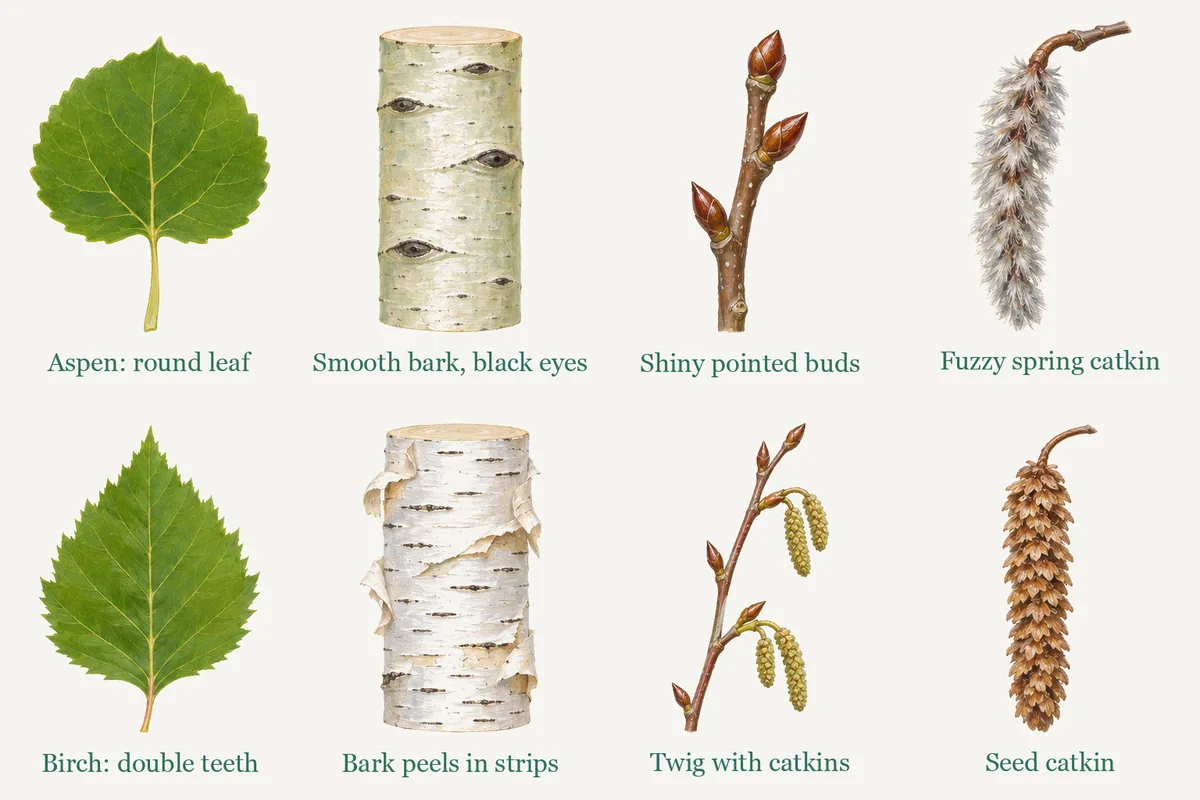
Aspen is the commonest mix-up in the field, because both grow on burns and clearings across the North. The birch vs aspen comparison settles it with the peel test and the flat aspen leaf stalk.
Mountain paper birch and the western forms
Natural Resources Canada treats mountain paper birch (Betula cordifolia) as a species and lists B. papyrifera var. cordifolia as a synonym. Its factsheet describes leaves 6 to 12 cm long, usually heart-shaped at the base, with 7 to 9 vein pairs and numerous tiny resin dots on the upper surface. Its bark peels away in thin layers, white to bronze-white with a copper-colored inner side, and it prefers cool sites: near the tree line in the south of its range, on cool north slopes farther north.
The best test between the two is a seed-catkin scale, which falls to the ground in autumn and can be read with a hand lens. On paper birch, NRCan describes a scale 2 to 3 mm long with two rounded side lobes spreading from a short, pointed middle lobe. On mountain paper birch the scale is 6 to 8 mm and the middle lobe is long, much longer than the two upright side lobes.
In the West the species itself changes. The Forest Service recognizes six varieties of paper birch, and NRCan describes the western form reaching 35 m with peeling orange-white bark, and the northwestern form reaching 20 m with light reddish-brown bark.
Range, seasons and life span
The Forest Service describes a range that follows the northern limit of tree growth from Newfoundland and Labrador to northwest Alaska, south to British Columbia and Washington, east through the Great Lakes into New England, and down the Appalachians from central New York to western North Carolina, with outliers in the Black Hills and Colorado's Front Range. It seldom grows naturally where average July temperatures exceed 70°F.
Through the year:
- Mid-April to early June: flowering; male catkins lengthen and release pollen, female catkins stand upright.
- Early August to mid-September: seed ripens (Forest Service).
- September to November: most seed falls, some continuing through winter.
- Winter: bark, the reddish-brown twig without wintergreen smell and the waiting male catkins.
The Forest Service calls paper birch short-lived: trees mature at about 60 to 70 years and few live beyond 140 to 200, and the bronze birch borer, which attacks old or weakened trees, is its most serious insect pest. Mature stands average about 70 feet tall and 10 to 12 inches in diameter.
For the southern birch with salmon peel, see the river birch page. For black, yellow and the other birches, see the birch identification page. With location turned on, Tree Identifier's Tree Map pins a paper birch you identify, a simple way to return in early autumn, when the seed scales are on the ground.
Look-alikes and how to tell them apart
Gray birch (Betula populifolia)
Gray birch bark is chalky white but smooth, and generally does not peel. Its leaf is a triangle with a long, drawn-out tip, 2 to 3 inches, and the tree is small, rarely over 30 ft, usually with several trunks.
European white birch (Betula pendula)
The planted one. Its fine branchlets droop distinctly, its white bark peels only a little, and the base of older trunks turns nearly black, split into narrow vertical furrows. Paper birch peels freely in sheets.
Quaking aspen (Populus tremuloides)
Aspen bark is smooth, creamy to greenish white, and never peels. Its leaves are nearly round, 1 to 3 inches, on flattened stalks that make them tremble; paper birch leaves are pointed ovals on round stalks.
Mountain paper birch (Betula cordifolia)
Once treated as a variety of paper birch. Its leaves are larger, 6 to 12 cm, usually heart-shaped at the base and dotted with tiny resin glands, and its seed-catkin scales have a long middle lobe, much longer than the two side lobes.
River birch (Betula nigra)
River birch also peels, but in salmon, cream and cinnamon layers, never chalky white, and its leaf is diamond-shaped with a wedge base. It sheds seed in late spring, not fall.
What a photo can't settle
- Young paper, gray and European white birches all start with reddish-brown bark dotted with pale lenticels, so a sapling photo can't settle which birch it is.
- The USDA Forest Service recognizes six intergrading varieties of paper birch, and mountain paper birch is sometimes treated as one of them; a photo can't settle the variety.
- Bark color varies with region: Natural Resources Canada describes orange-white bark on the western form and compact reddish-brown bark on the northwestern form, so white is not universal.
Questions people ask
Is paper birch the same as white birch?
Yes. Natural Resources Canada uses white birch for Betula papyrifera and lists paper birch and canoe birch as synonyms. In the United States, white birch is also used loosely for the planted European white birch and for gray birch, which are different species.
Why is my young paper birch not white?
Because the white comes with age. The USDA Forest Service says paper birch bark stays golden or brown until about age 10 to 12, and Virginia Tech describes very young stems as reddish brown with light lenticels. Many birches look alike at that stage.
Does paper birch bark peel naturally?
Yes. Natural Resources Canada describes thin, smooth bark that often sheds in large sheets, and Virginia Tech describes it peeling in horizontal papery strips. Where sheets come away, the reddish-orange inner bark shows and later turns black, according to Natural Resources Canada.
How long do paper birches live?
Not long for a tree. The USDA Forest Service calls paper birch short-lived: trees mature at about 60 to 70 years and few live beyond 140 to 200. Natural Resources Canada gives a maximum age of 120 years.
How tall does a paper birch get?
The USDA Forest Service gives about 70 feet and 10 to 12 inches in diameter for mature stands, with occasional trees over 100 feet on the best sites. Natural Resources Canada gives up to 25 m in eastern Canada and 35 m for the western form.
Sources
- Paper birch fact sheet — Virginia Tech Dendrology
- Paper Birch (Betula papyrifera), Silvics of North America — USDA Forest Service
- White birch (Betula papyrifera) — Natural Resources Canada, Trees, insects and diseases of Canada's forests
- Mountain paper birch (Betula cordifolia) — Natural Resources Canada, Trees, insects and diseases of Canada's forests
- Gray birch fact sheet — Virginia Tech Dendrology
- European weeping birch fact sheet — Virginia Tech Dendrology
Keep reading
- Tree profileBirches (Betula): how to identify a birch tree
- Tree comparisonBirch vs aspen: how to tell the two white-barked trees apart
- Tree profileRiver birch (Betula nigra): how to identify it
- Clue guideWhich tree has white bark? Sort it by peel, leaf and region
- Tree profileQuaking aspen (Populus tremuloides): how to identify an aspen tree