Tree profile
Sugarberry (Celtis laevigata): the southern hackberry
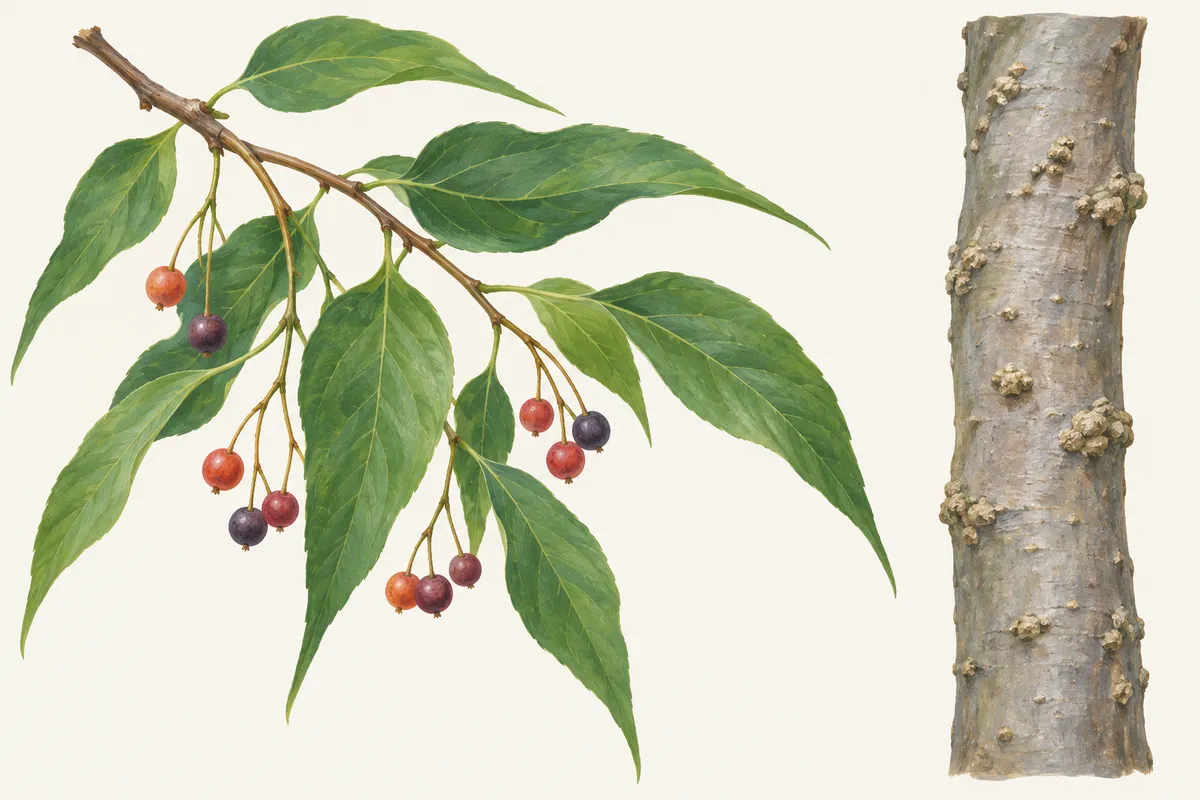
Smooth gray bark dotted with corky warts, a narrow leaf with a lopsided base and few or no teeth, and small round fruit that ripens orange-red to purple on southern river bottoms.
In short
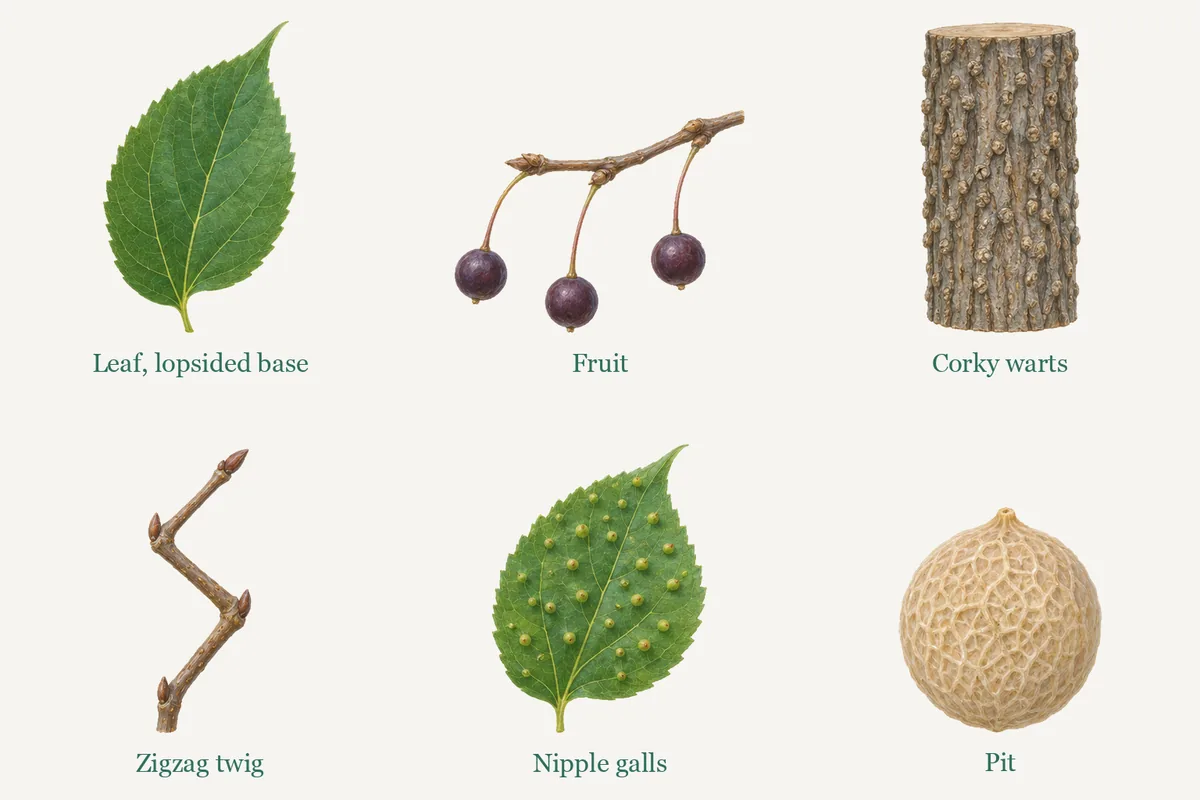
Sugarberry tree identification starts with the bark: gray and mostly smooth, dotted with corky warts that, unlike hackberry's, do not join into ridges. The leaves are 2 to 5 inches long, narrow with a long point, lopsided at the base with three veins meeting there, and toothed only on the upper half or not at all. Round fruits 1/4 to 3/8 inch ripen orange-red to purple in fall.
- Corky warts on smooth gray bark mean a Celtis; warts without ridges, on a southern bottomland, point to sugarberry.
- Hackberry leaves are toothed most of the way round; sugarberry leaves have few teeth, only near the tip, or none.
- Where the two meet, the USDA Forest Service says they are so similar that even their ranges are hard to map.
Field marks at a glance
- Scientific name
- Celtis laevigata
- Family
- Cannabaceae (hemp family); older references file it in the elm family, Ulmaceae
- Type
- Broadleaf, deciduous
- Bark
- Gray to light brown and smooth, with corky, warty patches that do not form ridges as on hackberry; varies a lot between trees.
- Leaves
- Alternate, simple, 2 to 5 inches long and 1 to 2 inches wide, with a long pointed tip; toothed on the upper half or less, or not at all; three distinct veins meet at the lopsided base.
- Fruit
- Round drupe 1/4 to 3/8 inch (Forest Service: up to 1/2 inch), orange-red turning purple, thin sweetish pulp over one stone; ripens September to October, often on the tree into midwinter.
- Flowers
- Very small, about 1/8 inch, greenish, on stalks near the twig tips, with the leaves from mid-March to May.
- Twigs
- Slender, zigzag, reddish brown with pale lenticels; side buds small, triangular and pressed flat against the twig; pith often chambered at the nodes.
- Size
- Up to about 80 to 100 ft, usually 50 to 70 ft in landscapes; broad, open crown with drooping branches.
- Habitat
- Clay soils of broad flats and shallow sloughs on southern river floodplains; also deep, moist limestone soils such as Alabama's Black Belt.
- Range
- Southeastern Virginia to southern Florida, west to central Texas and northeastern Mexico, north to western Oklahoma, southern Kansas, Missouri, southern Illinois and Indiana and western Kentucky; local in Maryland.
Sugarberry is the hackberry of the South: a tall, broad tree of river floodplains and city streets from Virginia to Texas, with gray bark spotted with corky warts. Many people know it simply as hackberry, and the USDA Forest Service lists that name among its others, along with sugar hackberry and southern hackberry. Its botanical name is Celtis laevigata. Bark, leaf edge and habitat separate it from the northern hackberry.
How to identify a sugarberry
Check these four in order; the bark and the leaf edge together usually settle it.
1. The warty bark. Start at the trunk. Virginia Tech's sugarberry fact sheet describes gray to light brown, smooth bark with corky, warty patches, and notes that, unlike hackberry's, it does not form ridges, though it varies considerably. The NC State Extension Plant Toolbox describes light brown to light gray bark with raised, corky warts. Few other southern trees carry corky warts on smooth bark. Our guide to identifying trees by bark shows how that bark type compares with others.
2. The narrow leaf with few teeth. Sugarberry leaves are alternate, 2 to 5 inches long and 1 to 2 inches wide, with a long, tapering tip (Virginia Tech). Three distinct veins meet at a lopsided base. The edge is the key: only the upper half or less is toothed, and some leaves have no teeth at all. NC State describes them as rough and untoothed.
3. The small round fruit. In fall the tree carries round drupes on short stalks. Virginia Tech gives 1/4 to 3/8 inch, orange-red turning purple; the USDA Forest Service's Silvics of North America gives 0.25 to 0.5 inch, ripening in September and October and often hanging on until midwinter. The Forest Service says at least 10 bird species eat them. Never eat a berry, nut, seed or fruit on the strength of a web page or an app; check with a local expert. Other trees with orange fruit are in our guide to trees with orange berries.
4. The site. Sugarberry is a bottomland tree. The Forest Service finds it most common on clay soils in broad flats and shallow sloughs of major southern river floodplains, and also on deep, moist limestone soils such as Alabama's Black Belt. NC State adds that it tolerates periodic flooding, compaction, salt and, once established, drought, which is why it also grows along streets and in yards.
Tree Identifier can name the tree from one photo of the bark or a leaf. It gives one name with no confidence score and no list of look-alikes, and between sugarberry and hackberry the bark and leaf edge are the checks to run yourself.
Sugarberry vs hackberry and the elms
| Tree | Leaf edge | Leaf size | Bark | Typical site |
|---|---|---|---|---|
| Sugarberry | Toothed on the upper half or less, or smooth | 2–5 in, narrow, long tip | Smooth, corky warts, no ridges | Southern bottomlands |
| Hackberry | Toothed most of the way round | 2–5 in, ovate, long tip | Warts that merge into corky ridges | Uplands where both grow |
| Netleaf hackberry | Smooth or a few widely spaced teeth | 2–4 in, leathery, net veins below | Warts, then corky ridges | Small tree, 30–40 ft |
| American elm | Doubly toothed all round | 3–5 in | Ashy gray, diamond fissures | Flats and bottomlands |
Rows come from Virginia Tech's fact sheets for sugarberry, hackberry, netleaf hackberry and American elm.
Hackberry is the twin. The USDA Forest Service's hackberry Silvics says the two are so similar that their exact ranges in the South are hard to establish, and that where they overlap, hackberry is probably restricted to uplands and sugarberry occupies the bottomland. In the field, compare the leaf edges first, then look for ridges on the bark. Our hackberry page covers that tree, its galls and its winter marks.
Netleaf hackberry is a smaller western relative; Virginia Tech lists it among sugarberry's look-alikes and describes leathery leaves rough above with raised, net-like veins below. Some botanists also treat a netleaf form as a variety of sugarberry, so check a regional guide in Texas and the Southwest.
Elms share the lopsided leaf base, which is why sugarberry gets called an elm. Elm leaves are doubly toothed all round, with straight parallel side veins, the bark has no warts and the fruit is a flat papery wafer in spring. See the elm identification page for the elms of the same river bottoms.
Where sugarberry grows
The Forest Service maps sugarberry from southeastern Virginia south to southern Florida, west to central Texas and northeastern Mexico, and north to western Oklahoma, southern Kansas, Missouri, southern Illinois, southern Indiana and western Kentucky, with local stands in Maryland. In the lower South it is also planted as an ornamental and street tree, so it turns up well away from rivers.
Size depends on site. The Forest Service describes mature trees on average sites at about 80 feet tall with trunks about 18 inches across, and NC State lists 50 to 70 feet in landscapes, rounded to vase-shaped. Virginia Tech describes a broad, open crown with drooping branches. The Forest Service calls it short-lived, probably not over 150 years, and notes that its thin bark is easily injured by fire.
Sugarberry through the year
Spring. Tiny greenish flowers, about 1/8 inch, open with the new leaves from mid-March to May depending on latitude (Forest Service, Virginia Tech). Most people never notice them.
Summer. Look at the leaf edge and for galls. NC State lists hackberry nipple galls, which disfigure the leaves without harming the tree, and the Asian woolly hackberry aphid among its pests. NC State also lists sugarberry as a larval host for the American snout, hackberry emperor, tawny emperor, question mark and mourning cloak butterflies.
Fall. The fruit ripens orange-red to purple in September and October; NC State calls the fall color an undistinguished yellow.
Winter. The warty bark shows all year, and fruit often stays on into midwinter. Virginia Tech describes slender, zigzag, reddish-brown twigs with pale lenticels and small triangular buds pressed flat against the twig. A cut twig often shows chambered pith at the nodes. If you find a sugarberry worth checking again in fruit, Tree Identifier's Tree Map pins it if location is on, ready for a return visit in fall.
Look-alikes and how to tell them apart
Hackberry (Celtis occidentalis)
Hackberry leaves are toothed most of the way round, and its corky warts merge with age into rough, irregular ridges. The USDA Forest Service puts hackberry mostly on uplands and sugarberry on bottomlands where the two overlap.
Netleaf hackberry (Celtis reticulata)
Netleaf hackberry is a small tree, usually 30 to 40 ft, with leathery, ovate leaves 2 to 4 inches long that are rough above and show raised, net-like veins underneath. Its old bark grows irregular corky ridges.
American elm (Ulmus americana)
American elm has a lopsided leaf base too, but its leaves are doubly toothed all round with straight parallel side veins, its bark is ashy gray with diamond fissures and no warts, and its fruit is a flat papery wafer in spring.
What a photo can't settle
- Sugarberry and hackberry overlap in the South, intermediate trees occur and the USDA Forest Service says they are hard to separate; a photo app may give the genus, Celtis, without settling the species.
- The leaf edge varies: some sugarberry leaves carry more teeth, and shade leaves differ from sun leaves. Check several leaves, not one.
- Several western varieties (Texas, Uvalde, netleaf sugar hackberry) are recognized by some botanists and not by others; a field guide for your region is the tiebreaker.
Questions people ask
Is sugarberry the same as hackberry?
They are two species of the same genus, Celtis. Sugarberry is Celtis laevigata, the southern bottomland tree; hackberry is Celtis occidentalis, more northern and more often on uplands. The names overlap: the USDA Forest Service lists hackberry, southern hackberry and sugar hackberry as other names for sugarberry.
How do you tell sugarberry from hackberry?
Check the leaf edge and the bark. Sugarberry leaves are toothed only near the tip or not at all, and its bark stays smooth with scattered warts. Hackberry leaves are toothed most of the way round, and its warts merge into rough ridges. In the South, intermediate trees occur.
What are the warts on sugarberry bark?
Corky outgrowths of the bark. Virginia Tech and NC State Extension both describe smooth gray bark with raised, corky warts; NC State notes they give the tree winter interest. They are normal for the species and for hackberries in general, not a disease.
Can you eat sugarberry fruit?
Do not eat any fruit on the strength of a web page or an app; check with a local expert. The USDA Forest Service describes the fruit as dry and sweet and says at least 10 bird species eat it, along with other game and nongame animals.
What are the bumps on sugarberry leaves?
Probably hackberry nipple galls, raised bumps caused by a tiny insect. NC State Extension lists them as a problem of sugarberry and says they disfigure the leaves but do not harm the tree.
Sources
- Sugarberry fact sheet — Virginia Tech Dendrology
- Sugarberry (Celtis laevigata), Silvics of North America — USDA Forest Service
- Celtis laevigata (sugarberry) — North Carolina Extension Gardener Plant Toolbox, NC State University
- Hackberry fact sheet — Virginia Tech Dendrology
- Hackberry (Celtis occidentalis), Silvics of North America — USDA Forest Service
- Netleaf hackberry fact sheet — Virginia Tech Dendrology
- American elm fact sheet — Virginia Tech Dendrology
Keep reading
- Tree profileHackberry tree identification: warty bark, lopsided leaves
- Tree profileElms (Ulmus): how to identify an elm tree
- Tree profileAmerican elm (Ulmus americana): how to identify it
- Field guideTree bark identification: seven bark types and the trees that have them
- Clue guideWhich tree has orange berries? Check the leaf, the thorns and where you are