Tree profile
Weeping willow (Salix babylonica): how to identify it
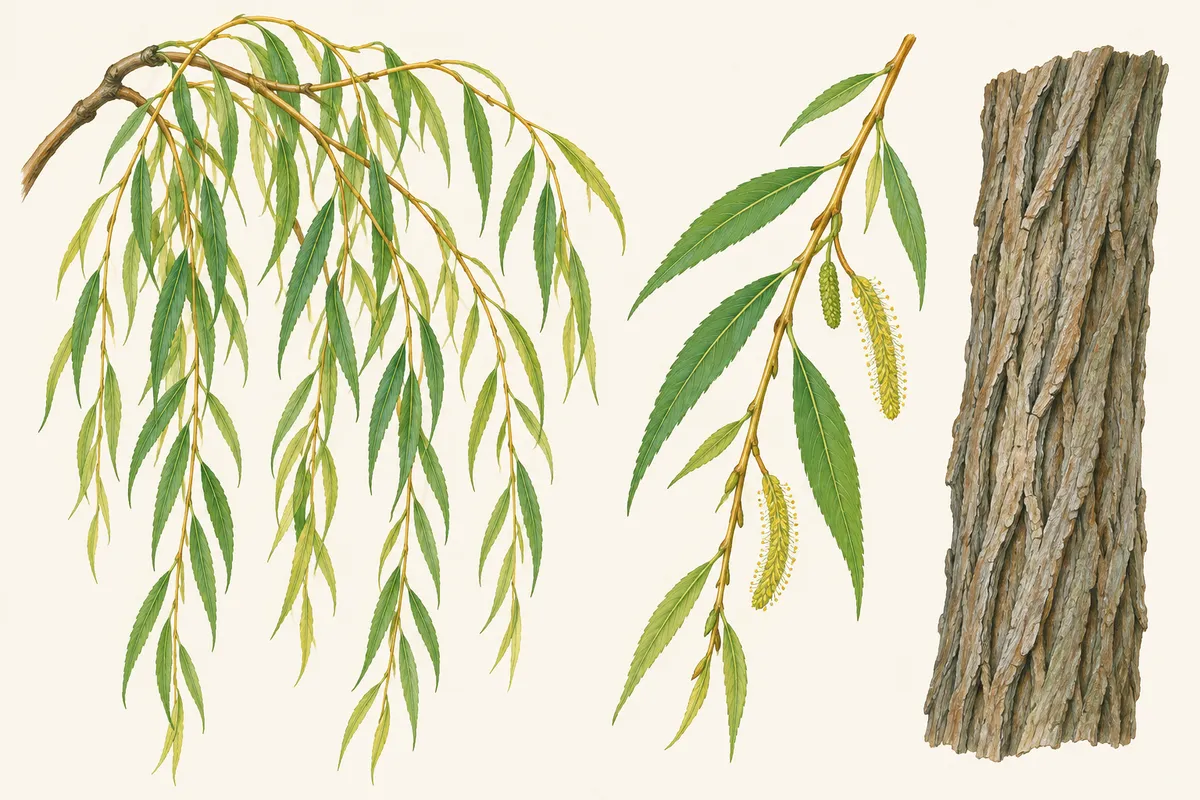
Long, slender twigs hanging like a curtain to the ground, narrow leaves gray-green beneath, and a broad round crown by water. Most weeping willows in yards are hybrids, and the twig color tells you which.
In short
Weeping willow tree identification starts with the twigs: very slender, olive-green to yellowish brown, hanging straight down like rope from a broad, rounded crown 30 to 50 feet tall. The leaves are narrow and lance-shaped, 3 to 6 inches long and under an inch wide, finely toothed, light green above and gray-green beneath, and each bud is covered by a single cap-like scale.
- Narrow, finely toothed leaves 3 to 6 inches long on hanging, rope-like twigs: weeping willow.
- Bright golden-yellow twigs in late summer and winter point to the golden weeping willow, a hybrid with white willow.
- A small weeping tree with pink blossom, a grafted trunk and broader leaves is a weeping cherry, not a willow.
Field marks at a glance
- Scientific name
- Salix babylonica
- Family
- Salicaceae (willow family)
- Type
- Broadleaf, deciduous
- Form
- Broad, rounded crown on a stout trunk, with long branches sweeping down to the ground; 30 to 50 ft tall and about as wide.
- Twigs
- Very slender, smooth, olive-green to pale yellowish brown or reddish brown, hanging like rope for long distances.
- Leaves
- Alternate, simple, very narrow, lance-shaped, 3 to 6 inches long and 3/8 to 3/4 inch wide, with a long tapering tip and finely toothed edges.
- Leaf color
- Light or yellow-green above, gray-green to milky green beneath; fall color usually a dull greenish yellow.
- Buds
- Small, pressed against the twig, covered by a single cap-like scale; no end bud at the twig tip.
- Bark
- Gray-brown to gray-black, irregularly furrowed.
- Flowers and seed
- Silvery-green catkins about 1 inch long, April to May, male and female on separate trees; capsules release cottony seed in late May to early June.
- Origin
- Native to China; planted in North America and naturalized in parts of the Southeast, such as North Carolina.
The weeping willow is the curtain of green at the edge of a pond: a broad, rounded tree whose slender branches hang straight down, sometimes into the water. That outline is the first clue, but several unrelated trees weep, and many weeping willows in yards are not pure Salix babylonica but hybrids. The leaf, the bud and the twig color settle both questions. For willows in general, start with the willow identification page.
How to identify a weeping willow
Check these in order.
1. The twigs: rope-like and hanging. The Virginia Tech fact sheet describes very slender, smooth twigs, olive-green to pale yellowish brown, hanging or drooping for long distances, almost rope-like. NC State Extension describes them as reddish brown to yellowish brown, smooth and weak, breaking easily.
2. The leaves: long, narrow and finely toothed. Virginia Tech gives very narrow, lance-shaped leaves 3 to 6 inches long and 3/8 to 1/2 inch wide, finely serrated, yellow-green above and milky green below. NC State gives up to 3/4 inch wide, light green above and grayish green beneath. The tip tapers to a long point. A leaf an inch or more wide is not a weeping willow.
3. The bud: one cap-like scale. Look closely where a leaf meets the twig. Willow buds are small, pressed against the twig and covered by a single cap-like scale, and there is no end bud at the twig tip (Virginia Tech). This one-scale bud is the mark of every willow and the best test in winter.
4. The size and the site. NC State gives 30 to 40 feet tall and wide, Virginia Tech 40 to 50 feet, and the Missouri Botanical Garden 30 to 50 feet, sometimes to 60, with a stout trunk under a broad, rounded crown. The tree prefers very moist soil and tolerates standing water, so it is most often by ponds and streams.
5. The bark. Gray-brown to gray-black and irregularly furrowed (Virginia Tech, NC State). Bark alone is weak evidence: many trees look similar.
If the tree hangs over water, a photo of the whole tree or of a few leaves is enough to get a name from Tree Identifier. Weeping willow (Salix babylonica) is one of the 138 species in the app's Collection. The app gives one name, with no confidence score or list of look-alikes, and it names a species, not a hybrid, so check the twig color below.
Babylon willow or golden weeping willow
Many weeping willows in North America and Europe are hybrids. The Missouri Botanical Garden reports that some experts believe the true species no longer exists in the wild in China, and that plants sold as Salix babylonica are mainly hybrids or misidentified similar species.
The commonest hybrid is between white willow (Salix alba) and Babylon willow. Trees and Shrubs Online, from the International Dendrology Society, groups these crosses as Salix × sepulcralis and says the golden weeping willow, 'Chrysocoma', is the most frequently planted of all pendulous trees. How to tell it:
| Feature | Babylon weeping willow | Golden weeping willow (hybrid) |
|---|---|---|
| Young twigs | Olive-green to yellowish or reddish brown | Clear yellow by late summer, grayish yellow in the second year |
| Hanging branchlets | Long and very slender | Thicker and shorter |
| Size and build | 30–50 ft | Taller and sturdier, as grown in Europe |
| Catkins | Silvery green, about 1 in | Stouter, hairier, on longer stalks |
In winter the difference is easy to see: a weeping willow glowing golden-yellow against a gray sky is the hybrid. A greener or browner weeper is closer to Babylon willow, though hybrids vary.
Catkins, cotton and seasons
Weeping willow is dioecious, with male and female flowers on separate trees. NC State gives silvery-green catkins in April and May; the male catkins are 1 to 2 inches long. Virginia Tech describes fuzzy catkins about 1 inch long, appearing before or with the leaves.
The female catkins become clusters of small, light brown capsules that ripen in late May to early June and release fine, cottony seeds. If fluff is drifting across a lawn in early summer, the willow is only one candidate: aspens and the eastern cottonwood release cotton-wrapped seed at the same season. The guide to trees with white fluff sorts them.
Fall color is variable, usually a greenish yellow (Missouri Botanical Garden), sometimes golden yellow (NC State).
Weeping willow vs white willow, black willow and weeping cherry
White willow is one parent of the golden hybrid. The Virginia Tech white willow fact sheet describes an upright tree up to 80 feet with a wide, spreading crown, golden-brown flexible twigs that do not hang like rope, and leaves 2 to 4 inches long that are shiny green above and nearly white and silky beneath.
Black willow is the native tree willow of eastern streams. Virginia Tech's black willow fact sheet gives leaves 3 to 6 inches long and finely toothed, like weeping willow's, but dark and shiny above and light green below, on slender orange-brown twigs that do not weep. Its bark is darker, brown to gray-black with thick, scaly ridges and deep furrows.
Weeping cherry is the small weeper of front yards. NC State describes light pink flowers in early spring before the leaves, oval to oblong leaves 2 to 4 inches long and 1 to 2 inches wide with double teeth, a coppery trunk with lenticels, and a graft at 4 to 5 feet on a straight stem. One leaf separates them.
Our guide to weeping tree identification covers weeping beech, birch, hemlock, mulberry and the other drooping trees.
Where it grows, and its problems
The weeping willow is native to China. The Missouri Botanical Garden explains the name: Linnaeus called it babylonica believing it was the willow of Babylon in the Bible, but the tree probably traveled west along the Silk Road, reaching Europe by the early 1700s, and the trees by the Euphrates in biblical times were probably Euphrates poplars. NC State lists it as introduced in states from Alabama and Arkansas to California and Virginia, and says it has naturalized throughout North Carolina. The Missouri Botanical Garden gives USDA zones 6 to 8.
It is a tree for big, wet spaces. Both NC State and the Missouri Botanical Garden list weak wood that cracks and breaks under ice and snow, heavy litter of leaves and twigs, a long list of pests and diseases, and roots that seek out cracks in water and sewer pipes; neither recommends it for an ordinary home landscape. A big, healthy weeping willow is usually on a pond bank or a stream with room around it.
With location turned on, Tree Identifier's Tree Map pins a weeping willow you identify, so you can return in winter to check its twig color, the quickest way to tell Babylon willow from the golden hybrid.
Look-alikes and how to tell them apart
Golden weeping willow (Salix × sepulcralis 'Chrysocoma')
Usually treated as a hybrid of white willow and Babylon willow, and called the most planted pendulous tree by Trees and Shrubs Online. Its young twigs turn clear yellow by late summer, and its hanging branchlets are thicker and shorter. Babylon willow twigs are olive-green to brown.
White willow (Salix alba)
Upright, up to 80 ft, with a wide crown and golden twigs that do not hang like rope. Its leaves are 2 to 4 inches and nearly white and silky beneath; weeping willow leaves are longer and gray-green beneath.
Black willow (Salix nigra)
The native willow of eastern streams. Its leaves are also 3 to 6 inches and finely toothed, but its twigs are orange-brown and do not hang, and its bark is dark, in thick, scaly ridges with deep furrows.
Weeping cherry (Prunus × subhirtella 'Pendula')
A smaller tree, usually grafted at 4 to 5 ft, with pink blossom before the leaves in early spring and oval, doubly toothed leaves 2 to 4 inches long and 1 to 2 inches wide, far broader than a willow leaf.
What a photo can't settle
- Babylon willow, its hybrids with white willow and other weeping willows look much alike, and the Missouri Botanical Garden notes that many trees sold as Salix babylonica are hybrids. A photo app gives a weeping willow name; the exact hybrid often needs catkins and an expert.
- Male and female trees look the same except in flower and seed, so a summer photo can't tell you whether a tree will shed cottony seed.
- In winter, a bare weeping willow is identified by twig color and buds; a distant photo of the outline alone can't separate it from other weeping trees.
Questions people ask
How do I know if my tree is a weeping willow?
Check three things: twigs very slender and hanging straight down like rope, often to the ground; leaves narrow and lance-shaped, 3 to 6 inches long and under an inch wide, finely toothed and gray-green beneath; and buds covered by a single cap-like scale. A broad, rounded tree 30 to 50 feet tall near water fits.
Is the weeping willow native to North America?
No. Salix babylonica is native to China, according to NC State Extension and the Missouri Botanical Garden. It is planted widely and NC State says it has naturalized throughout North Carolina. The common native tree willow of the eastern United States is black willow, which does not weep.
Why is it called Babylon willow?
The Missouri Botanical Garden says Linnaeus named it after the willows of Babylon in the Bible, believing it was that tree. It actually came from China, probably traveling west along the Silk Road, and the trees by the Euphrates in biblical times were probably Euphrates poplars.
Are most weeping willows hybrids?
Many are. The Missouri Botanical Garden reports that some experts believe the true species no longer exists in the wild in China and that plants sold as Salix babylonica are mainly hybrids or misidentified species. Trees and Shrubs Online calls the golden weeping willow hybrid the most frequently planted of all pendulous trees.
Do weeping willows have invasive roots?
Both NC State Extension and the Missouri Botanical Garden warn that the roots are aggressive and can damage or clog water and sewer pipes. The Missouri Botanical Garden adds that the shallow roots make gardening underneath difficult, and both note weak wood that breaks in snow and ice.
Sources
- Weeping willow (Salix babylonica) fact sheet — Virginia Tech Dendrology
- Salix babylonica (Babylon Weeping Willow, Weeping Willow) — North Carolina Extension Gardener Plant Toolbox, NC State University
- Salix babylonica, Plant Finder — Missouri Botanical Garden
- Salix × sepulcralis — Trees and Shrubs Online (International Dendrology Society)
- White willow (Salix alba) fact sheet — Virginia Tech Dendrology
- Black willow fact sheet — Virginia Tech Dendrology
- Japanese Weeping Cherry, Prunus x subhirtella 'Pendula' — North Carolina Extension Gardener Plant Toolbox, NC State University