Garden guide
Dwarf fruit trees, and the rootstock that makes them small
How dwarfing rootstocks work, the heights the RHS and Oregon State and Kentucky extension give for apple, pear, cherry, plum and citrus, and why a dwarf tree still needs a partner to fruit.
In short
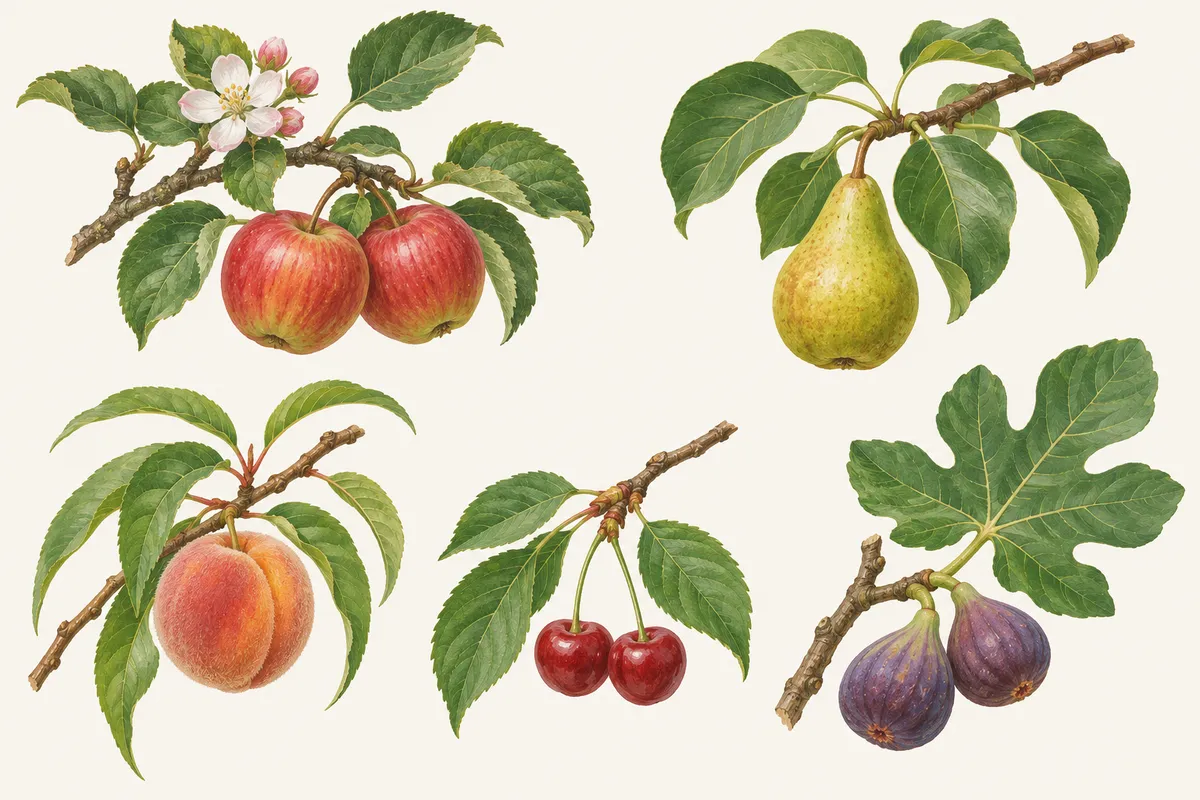
Dwarf fruit trees are ordinary fruit varieties grafted onto a dwarfing rootstock, which sets the final size. Apples have the most choice: M.27 keeps a tree under 25 percent of seedling size, M.9 at 25 to 35 percent (1.8 to 2.4 m as a bush, per the RHS) and M.26 at 40 to 50 percent. Cherries dwarf on Gisela 5, citrus on Flying Dragon, and dwarf trees need permanent staking.
- The variety gives the fruit; the rootstock gives the size. A seedling-rooted apple can grow over 30 feet, Kentucky and Oregon State extension note.
- The RHS gives M.27 apples 1.2 to 1.8 m and M.9 apples 1.8 to 2.4 m as bushes, both needing a stake for life.
- Most apples and pears need a second, pollen-compatible variety within 100 feet, dwarf or not.
A dwarf fruit tree is not a dwarf species. It is a normal apple, pear, cherry, plum or citrus variety grafted onto a rootstock chosen to keep it small. Kentucky Cooperative Extension's Growing Tree Fruits chapter, adapted from Oregon State University, puts it plainly: the variety you choose for flavor is grafted onto a genetically different root system, and the rootstock was selected mostly to control size. The same chapter says dwarf trees are always the best choice for home orchards, because few people can spray, thin and pick a tree over 30 feet tall.
Dwarfing rootstocks and the sizes they give
Apples have the widest choice. Kentucky and Oregon State give each Malling (M) and Malling-Merton (MM) rootstock as a percentage of a tree on seedling roots, and the Royal Horticultural Society gives the height of a bush tree:
| Apple rootstock | Size vs seedling tree (KY/OSU) | Height × spread as a bush (RHS) | Staking (RHS) | First fruit (RHS) |
|---|---|---|---|---|
| M.27 | Under 25% | 1.2–1.8 m × 1.5 m | Permanent | After two years |
| M.9 (and Bud 9, KY/OSU) | 25–35% | 1.8–2.4 m × 2.7 m | Permanent | After two or three years |
| M.26 (and G.11, KY/OSU) | 40–50% | 2.4–3 m × 3.6 m | Permanent | After two or three years |
| M.7 (and G.30, KY/OSU) | 55–65% | Not listed | Usually none (KY/OSU) | Not listed |
| MM.106 | 60–75% | 3–4 m × 4 m | 5 years | After three or four years |
| MM.111 | 90% | 4–4.5 m × 4.5 m | Only for older transplants | After four or five years |
In feet, Kentucky and Oregon State describe the Malling range as running from dwarf (4 to 12 feet) to semidwarf (16 to 18 feet), and note that higher numbers do not mean taller trees. The RHS adds the soil catch: M.27 and M.9 need good, weed- and grass-free soil, while MM.106 tolerates poor soil and grass but is unsuitable for small gardens.
Other fruits have fewer options:
- Cherries: the RHS lists Gisela 5 as semi-dwarfing, 2.4 to 3 m, permanently staked, against 6 m on Colt. Kentucky gives Gisela 5 at 50 percent of a standard Mazzard-rooted tree.
- Pears: Quince C is the RHS's dwarfing choice at 2.5 to 3 m, Quince A semi-vigorous at 3 to 4.5 m.
- Plums: Pixy is semi-dwarfing, 3 to 4 m, with a permanent stake (RHS).
- Peaches, nectarines and apricots: the RHS gives Torinel at 2.4 to 3 m, good for containers. Kentucky extension says there are no suitable dwarfing rootstocks for peaches in its state.
- Citrus: UF/IFAS explains that dwarf citrus stay small because they are grafted onto a dwarfing rootstock such as Flying Dragon. Some tropical fruits, such as dwarf papaya and banana, are bred small instead.
Staking, spacing and planting depth
Small trees on dwarfing rootstocks need support. Kentucky extension says dwarf trees should be supported by stakes, poles or wires, and the RHS asks for a permanent stake on M.27, M.9, M.26, Gisela 5 and Pixy. Semidwarf M.7 normally needs no staking, and MM.106 and MM.111 trees need none once established.
Planting depth matters more than with most trees. Kentucky extension says to keep the graft union above ground: if it is buried, the rootstock can send up shoots that overpower the variety, and the variety can root on its own, cancelling the dwarfing effect. Orchard trees want full sun and deep, well-drained soil, with at least four feet of soil above hardpan or the water table; raised beds help on poor ground.
Spacing follows size. The RHS spaces M.27 apples 1.2 to 1.5 m apart and M.9 apples 2.4 to 3 m apart. Kentucky notes that apple trees go anywhere from six feet apart in high-density plantings to more than 20 feet, and that tight spacing brings earlier fruit but more pruning and more disease, because foliage dries more slowly.
Pollination: a dwarf still needs a partner
Size does not change how a variety sets fruit. Kentucky extension says most apple varieties fruit only with pollen from another compatible variety, giving Red Delicious and Golden Delicious as a pair that pollinate each other. Rome Beauty, Newtown and Transparent are exceptions that set their own fruit. Most pears need a partner too. Tart cherries and the sweet cherries Lapins, Black Gold and Sweetheart are self-fruitful, and so are most European plums.
Plant pollen-compatible trees within 100 feet of each other, with bloom periods that overlap by several days. Where only one tree fits, Kentucky suggests grafting a compatible variety onto it, or setting a bucket of cut blooms from another variety beside the tree while it flowers. In a very small garden, a compatible tree in a neighbor's yard counts if it stands within that distance.
Recognising dwarf fruit trees and their rootstocks
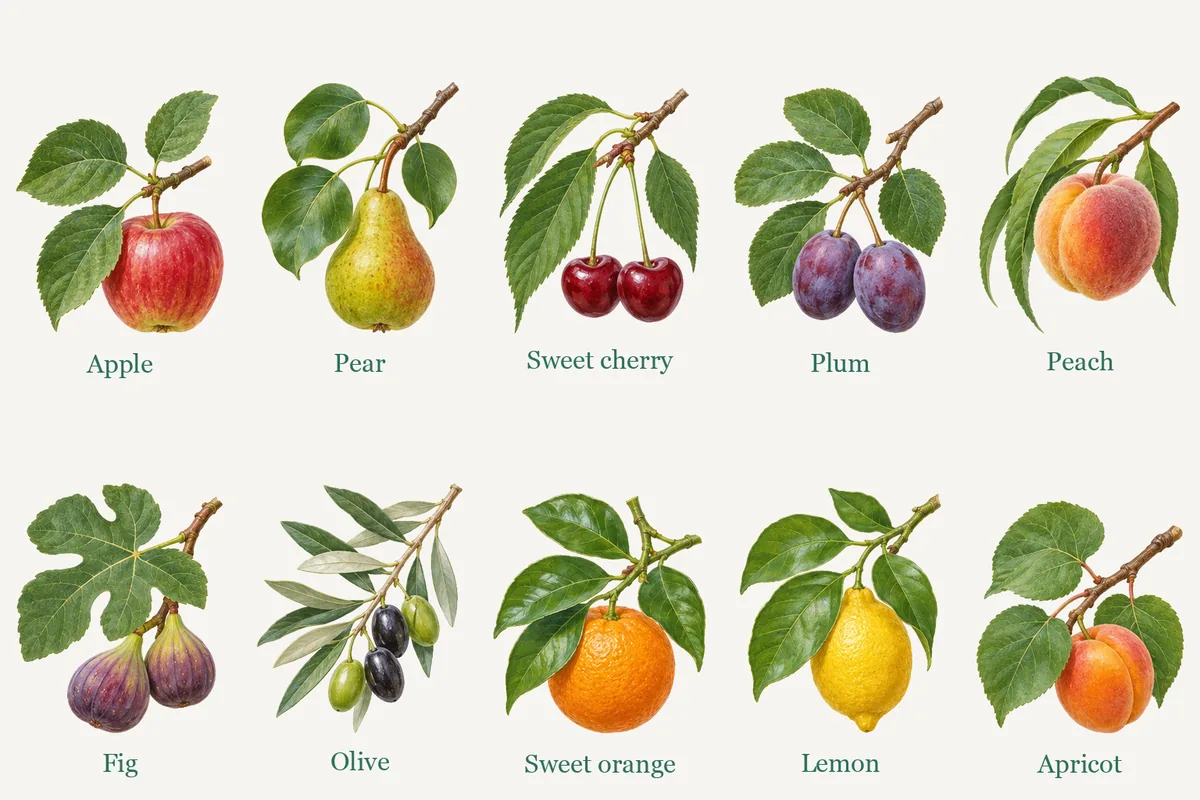
A dwarf apple is still an apple, so the leaf, bark and blossom marks are those of the species. The fruit tree identification guide separates apple, pear, plum, cherry and peach by leaf glands, bark lenticels and blossom timing. In short:
- Apple: dense, rounded crown; white blossoms tinged pink, in clusters; firm round fruit in late summer or fall.
- Pear: upright habit; white blossom clusters; leaves turning yellow in fall.
- Cherry: strong horizontal lines (lenticels) on the bark and, on sweet cherry, two small glands at the base of the leaf blade. The cherry page covers sweet and sour cherries.
- Plum: white blossoms before the leaves; blue to black fruit in late summer. See the plum tree page.
- Peach: long, narrow, pointed leaves and pink blossoms before the leaves.
The graft is the clue to a dwarf. Look low on the trunk for a bulge or a change in bark where the variety joins the rootstock. A tree that fruits while only head-high, or one tied to a permanent stake or trellis wire, suggests a dwarfing rootstock. Shoots coming from below the graft are the rootstock's own and, as Kentucky extension warns, can take over if left.
If your space is too small even for a dwarf fruit tree, the small garden trees guide lists ornamental trees that fit under 8 m.
Using a photo of an unlabelled fruit tree
Inherited fruit trees rarely come with labels. Tree Identifier names a tree from one photo of a leaf, blossom, fruit or the bark, which settles whether it is an apple, pear, plum or cherry. It cannot name the variety or the rootstock, which no photo shows. Its Care Guide gives growing notes for the species, and the follow-up chat under the result can answer questions such as whether that fruit usually needs a pollination partner. For the variety itself, a regional pomology society or extension office can compare the fruit with known types.
What a photo can't settle
- Rootstock percentages are rough: Kentucky extension notes that a variety's own vigor, soil and pruning all change the final size, so a tree can outgrow its label.
- Kentucky extension says there are no suitable dwarfing rootstocks for peaches there; dwarf peaches sold elsewhere may be genetic dwarfs, which this page does not cover in depth.
- No photo shows a tree's rootstock. A label, a nursery record or the graft union's height above soil hints at it, but the rootstock name itself cannot be read from leaves or fruit.
Questions people ask
How tall do dwarf fruit trees get?
It depends on the rootstock. The RHS gives apples on M.27 1.2 to 1.8 m and on M.9 1.8 to 2.4 m as bushes, and cherries on Gisela 5 2.4 to 3 m. Kentucky and Oregon State extension put dwarf apples at 4 to 12 feet and semidwarf at 16 to 18 feet.
Do dwarf fruit trees produce full-size fruit?
The fruit is the grafted variety's own, so a dwarf 'Gala' bears 'Gala' apples; the rootstock changes the tree's size, not the variety. Kentucky and Oregon State extension stress that the grafted variety is what you choose for flavor, while the rootstock was selected mainly to control size.
Do I need two dwarf fruit trees?
For most apples and pears, yes: Kentucky extension says most varieties set fruit only with pollen from another compatible variety, planted within 100 feet with overlapping bloom. Tart cherries, some sweet cherries such as Lapins, and most European plums are self-fruitful.
Can you grow dwarf fruit trees in pots?
Yes, with the right rootstock. Kentucky extension names M.27 as the only choice for apples in containers, with spur-type varieties. The RHS lists M26 apples and Torinel for peaches and apricots as good for containers, and UF/IFAS suggests container growing to keep any fruit tree smaller.
Sources
- Rootstocks for fruit — Royal Horticultural Society
- Growing Tree Fruits (HO-104), adapted from Oregon State University Extension — University of Kentucky Cooperative Extension
- Dwarf Fruit Trees — UF/IFAS Gardening Solutions, University of Florida
Keep reading
- Field guideFruit tree identification by leaf, bark and blossom
- Tree profileCherry trees (Prunus): how to identify them
- Tree profilePlum trees (Prunus): how to identify a plum tree
- Tree profileCrabapple tree (Malus): how to identify it
- Garden guideBest trees for small gardens, from the RHS and extension lists