Tree profile
Plum trees (Prunus): how to identify a plum tree
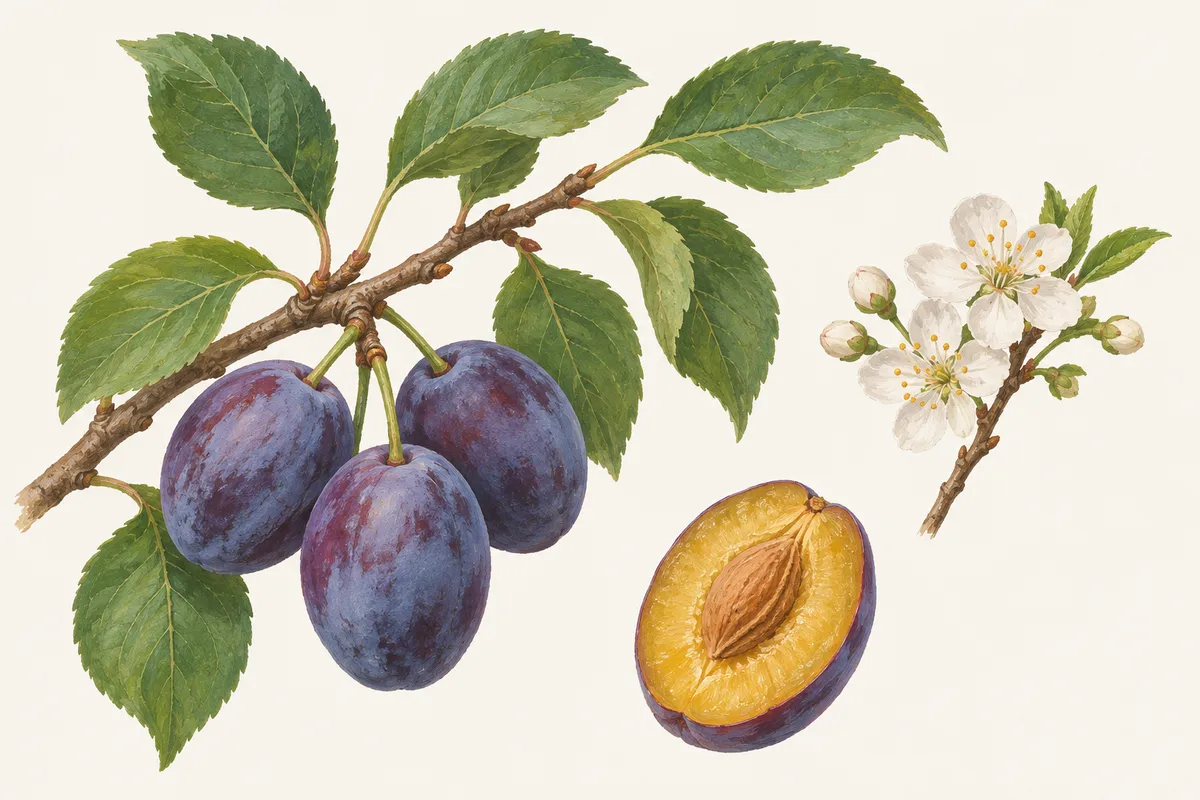
A small tree with toothed oval leaves, white five-petaled flowers early in spring, horizontal lines on young bark and, in summer, a fleshy fruit with a single flattened stone.
In short
Plum tree identification starts with the blossom and the bark. Plums flower in early spring with white, five-petaled flowers about 1 inch across, singly, in pairs or in small clusters, often before the leaves. Young bark is smooth with horizontal lenticels. Leaves are alternate, oval and finely toothed, 1 1/2 to 6 inches long, and the fruit is a drupe with one stone, from 1 to 3 inches across.
- A single hard stone in the fruit means a plum, cherry or peach (Prunus); a core of small seeds means an apple, crabapple or pear.
- Purple leaves all summer on a small tree usually mean purple-leaf plum, a cultivar of cherry plum.
- Thorny twigs, suckers and thickets point to American plum; a tidy orchard tree with blue-black fruit to European plum.
Field marks at a glance
- Scientific name
- Prunus (P. domestica, P. americana, P. cerasifera)
- Family
- Rosaceae (rose family)
- Type
- Broadleaf, deciduous
- Leaves
- Alternate, simple, oval to elliptic or obovate, finely toothed. European plum 2 to 4 inches, hairy above; American plum 3 to 4 inches, sharply pointed; cherry plum 1 1/2 to 3 inches, shiny.
- Flowers
- White, five petals, about 1 inch across (3/4 to 1 inch on cherry plum), early spring; European plum singly or in pairs before the leaves; American plum in clusters of 2 to 5, fragrant.
- Fruit
- A drupe with one stone. European plum 2 to 3 inches, blue or black (cultivars purple, red, yellow), September. American plum about 1 inch, red-purple. Cherry plum up to 1 1/4 inches, yellow or red.
- Bark
- Young bark smooth, reddish gray to red-brown, with horizontal lenticels; older bark rough, furrowed or peeling in curling strips (American plum). European plum stays thin and smooth.
- Twigs
- European plum may carry some spines. American plum: side branchlets thorn-like, buds sharp-pointed, twigs with a gray peeling film.
- Form
- Small tree or large shrub. European plum 10 to 20 ft; American plum up to 30 ft, suckering into thickets; cherry plum 15 to 30 ft.
- Origin
- European plum: cultivated; NC State gives its origin as Europe and Turkey. American plum: native, Canada to Florida and west to Oregon (NC State). Cherry plum: southeast Europe and Asia, naturalized in parts of the US.
Plum trees are small trees of yards, orchards and fencerows, and the name covers several species of Prunus. Three are the ones you are most likely to meet in North America: the European or common plum of orchards, the native American plum of thickets and roadsides, and the cherry plum, best known as the purple-leaf plum planted in front yards. They share the same family features with cherries and peaches. Never eat a berry, nut, seed or fruit on the strength of a web page or an app; check with a local expert.
How to identify a plum tree in four checks
1. The blossom. Plums flower early in spring, with white, five-petaled flowers about an inch across. The NC State profile of the common plum describes showy white flowers singly or in pairs before the leaves, and calls it the latest-blooming of the plums. American plum carries fragrant white flowers in clusters of 2 to 5, and cherry plum flowers in April as the leaves emerge.
2. The bark. Young plum bark is smooth, reddish gray to red-brown, with numerous horizontal lenticels, the short lines that mark the whole Prunus group. With age, American plum bark becomes rough with irregular ridges and curling, peeling strips; cherry plum bark splits and becomes furrowed. European plum keeps thin, smooth, dark brown bark on mature trees.
3. The leaves. Plum leaves are alternate, simple, oval to elliptic and finely toothed. European plum leaves are 2 to 4 inches long and 1 to 2 inches wide, wider toward the tip, with a wedge-shaped base and hairs on the upper surface. American plum leaves are 3 to 4 inches with a sharply pointed tip. Cherry plum leaves are smaller, 1 1/2 to 3 inches, and shiny.
4. The fruit. Every plum is a drupe: fleshy around a single hard, flattened stone. That one stone separates plums from apples, crabapples and pears, whose fruit has a core of small seeds.
Tree Identifier can say plum from one photo of a blossom, a leaf or the fruit. European plum (Prunus domestica) is in the app's Collection; American plum and cherry plum are not. It cannot name the variety, and it shows one name without a confidence score, so check the bark and the stone yourself. Our guide to fruit tree identification sets plums beside apple, pear, cherry and peach.
European, American and cherry plum compared
| Feature | European plum (P. domestica) | American plum (P. americana) | Cherry plum (P. cerasifera) |
|---|---|---|---|
| Height | 10–20 ft | Up to 30 ft, often a thicket | 15–30 ft |
| Leaves | 2–4 in, hairy above | 3–4 in, sharply pointed | 1 1/2–3 in, shiny |
| Flowers | White, single or paired, before leaves; latest plum to bloom | White, fragrant, clusters of 2–5 | White (pink or lavender on cultivars), April, as leaves emerge |
| Fruit | 2–3 in, blue or black; cultivars purple, red, yellow | About 1 in, red-purple, yellow flesh | Up to 1 1/4 in, yellow or red |
| Ripens | September | July–August | Mid to late summer |
| Thorns | May have some spines | Thorn-like side branchlets | None noted |
Figures from NC State's profiles of common plum, American plum and cherry plum, with Virginia Tech's American plum fact sheet.
American plum: the wild plum of thickets
American plum is the native plum, and it rarely looks like an orchard tree. Virginia Tech describes a multi-stemmed, shrubby small tree up to 30 feet with a spreading crown and numerous rigid, spiny branches, which readily sprouts suckers from its roots; NC State adds that it can form large colonies or thickets. Some twigs become thorns, the buds are sharp-pointed, and slender reddish-brown twigs later develop a grayish, peeling film.
The fruit is a nearly round drupe about 1 inch across, reddish purple to yellow-brown, some with a waxy bloom, ripening in mid to late summer; NC State gives July to August and describes bright yellow, juicy pulp under a thick skin. NC State maps the species from Canada south to Florida and west to Oregon. Virginia Tech lists Chickasaw plum, Mexican plum, black cherry and chokeberry as look-alikes.
The sources differ on one point: NC State has the flowers opening before the leaves, Virginia Tech in early spring together with them. In practice the leaves are just emerging, or not yet out, when an American plum thicket turns white.
Purple-leaf plum and the yard plums
The small purple tree in so many front yards is a cultivar of cherry plum. NC State describes the species with green leaves, but its cultivars have purple to coppery-red foliage that holds its color until the leaves fall, and white flowers on the species turn pale pink or lavender on many cultivars. Fruit is not produced in great quantities. The species is native to southeast Europe, Central Asia and the Himalayas, and NC State notes that it has naturalized in parts of the Northeast and the far West.
Plum vs cherry, crabapple and Bradford pear
Cherry. Sweet cherry is the closest look-alike, a Prunus too. NC State's sweet cherry profile describes "very distinct horizontal lenticels" on the bark, hairless leaves 1 to 3 inches with two small red or green glands at the base of the blade, white flowers in rounded clusters that open with the leaves, and fruit under an inch on a long stem. A European plum's fruit is far larger, 2 to 3 inches. The cherry page covers the cherries in full.
Crabapple. Crabapples flower at the same time, in white, pink or red, in clusters. The NC State Malus profile describes the fruit as a rounded pome 1/2 to 5 inches across: cut one and you find a core with several seeds, never a single stone. The crabapple page separates the ornamental crabs.
Bradford pear. Callery pear, sold as Bradford pear, is the white-flowered street tree that blooms with the plums, from February to April. NC State's Callery pear publication gives it glossy dark green oval leaves that turn red or purple in fall, small hard fruit and flowers with a pungent odor often compared to rotting fish. Its wild offspring carry thorns up to 4 inches long. The Bradford pear page has the full test.
Toxicity and the fruit
NC State Extension reports that the pits of American plum and cherry plum contain cyanogenic compounds, more toxic when crushed or chewed, and lists the leaves, seeds and stems as the toxic parts. It also reports the common plum as a problem for dogs, cats and horses. Tree Identifier's Toxicology tool gives AI-written notes for people, dogs and cats, but for any question about eating fruit from a tree you have just identified, ask your county extension office or a local expert. With location turned on, the app's Tree Map pins each identification, so you can return in summer to see the fruit that confirms the species.
Look-alikes and how to tell them apart
Sweet cherry (Prunus avium)
Bark with very distinct horizontal lenticels on red-brown to gray bark; leaves hairless with two small red or green glands at the base of the blade; flowers in clusters as the leaves emerge; fruit under 1 inch on a long stem.
Crabapple (Malus)
Flowers often pink or red as well as white, in clusters; the fruit is a small apple, a pome with a core of several seeds, not a drupe with one stone. Bark brown to gray and fissured, without strong horizontal lines.
Callery or Bradford pear (Pyrus calleryana)
White flowers in dense clusters from February to April with a pungent smell often compared to rotting fish; glossy, dark green oval leaves that turn red or purple in fall; small, hard fruit. Wild offspring carry thorns up to 4 inches.
What a photo can't settle
- A photo can say plum but rarely the variety: plum varieties differ mainly in fruit size, color, flavor and ripening date.
- Sources disagree on timing: NC State has American plum blooming before the leaves, Virginia Tech with the leaves. Use bloom timing as a hint, not a rule.
- Without fruit, an ornamental plum and an ornamental cherry can look much alike; check the bark, the leaf glands and the flower clusters.
Questions people ask
How do you tell a plum tree from a cherry tree?
Look at the flowers and the fruit stalk. European plum flowers open singly or in pairs before the leaves, while sweet cherry flowers open in clusters with the leaves. Sweet cherries hang on long stems and are under 1 inch; European plums are 2 to 3 inches. Cherry bark also shows very distinct horizontal lenticels.
What does a plum tree leaf look like?
Alternate, simple, oval to elliptic, finely toothed. European plum leaves are 2 to 4 inches with a wedge-shaped base, a pointed tip and hairs on the upper surface. American plum leaves are 3 to 4 inches with a sharply pointed tip. Cherry plum leaves are smaller, 1 1/2 to 3 inches, and shiny.
Why does my plum tree have purple leaves?
It is probably a purple-leaf plum, a cultivar of cherry plum (Prunus cerasifera) such as 'Thundercloud' or 'Newport'. NC State says the cultivars hold their purple to coppery-red color until the leaves drop, and bear fruit only in small quantities.
Are plum pits poisonous?
NC State Extension reports that the pits of American plum and cherry plum contain cyanogenic compounds, more toxic when crushed or chewed, and lists the leaves, seeds and stems as the poisonous parts. For anything about eating fruit from an unknown tree, ask a local expert.
When do plum trees bloom?
Early spring. NC State gives American plum March to April and cherry plum April, and describes European plum as the latest-blooming of the plums, which suits it to northern climates.
Sources
- Prunus domestica (common plum) — North Carolina Extension Gardener Plant Toolbox, NC State University
- Prunus americana (American plum) — North Carolina Extension Gardener Plant Toolbox, NC State University
- American plum fact sheet — Virginia Tech Dendrology
- Prunus cerasifera (cherry plum, purple leaf plum) — North Carolina Extension Gardener Plant Toolbox, NC State University
- Prunus avium (sweet cherry) — North Carolina Extension Gardener Plant Toolbox, NC State University
- Callery Pear, Bradford Pear, Other Varieties and Their Invasive Offspring — NC State Extension
- Malus (crabapple) — North Carolina Extension Gardener Plant Toolbox, NC State University
Keep reading
- Field guideFruit tree identification by leaf, bark and blossom
- Tree profileCherry trees (Prunus): how to identify them
- Tree profileCrabapple tree (Malus): how to identify it
- Invasive tree profileBradford pear and Callery pear (Pyrus calleryana): how to identify them
- Clue guideWhich trees have purple leaves? Tell the cultivars apart