Tree profile
Crabapple tree (Malus): how to identify it
A small tree with clouds of pink, red or white blossom in spring and fruit that looks like a miniature apple. The fruit, the flower buds and the twigs separate it from pears, cherries and hawthorns.
In short
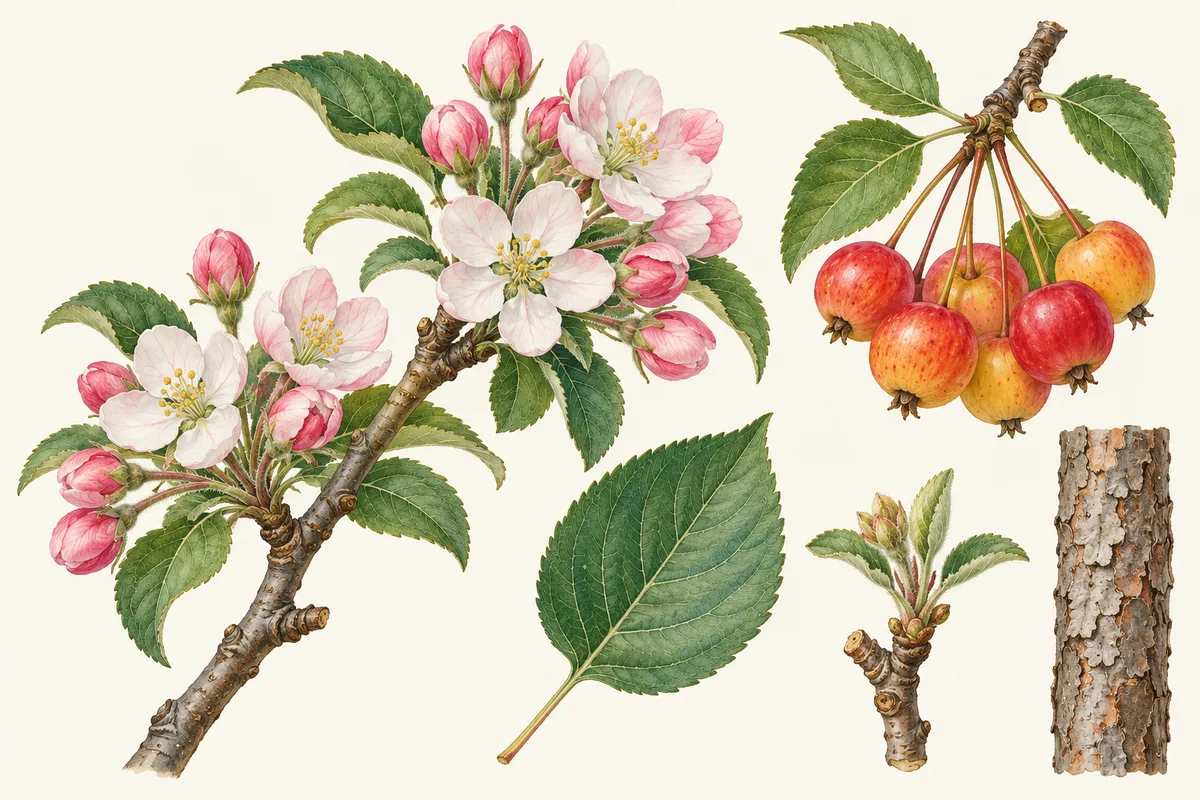
Crabapple tree identification rests on the fruit: small apples, 2 inches or less across (most under 1 inch), red, orange, yellow or yellow-green, ripening July to November and often hanging on into winter. In spring, red or pink buds open to five-petaled pink or white flowers, usually in May. The leaves are alternate, oval and toothed, 1 to 3 inches long, green or purple-red.
- A crabapple is an apple tree whose fruit stays at 2 inches or less; bigger fruit makes it an apple, by the Morton Arboretum's rule.
- Cut a fruit open: a crabapple shows a small apple core with several seeds, while a cherry has one hard stone.
- Planted crabapples come in dozens of cultivars, so naming the genus is easy and naming the cultivar from a photo rarely is.
Field marks at a glance
- Scientific name
- Malus spp. (M. coronaria, M. angustifolia, M. sylvestris, M. sargentii and many hybrid cultivars)
- Family
- Rosaceae (rose family)
- Type
- Broadleaf, deciduous
- Fruit
- Small apples, about 1/4 inch to 2 inches across; above 2 inches the tree counts as an apple. Red, orange, yellow or yellow-green, ripening July to November; persistent cultivars keep fruit through winter.
- Flowers
- Five petals, pink, red-pink or white, often opening from red or pink buds and fading paler; single, semi-double or double; usually in May.
- Leaves
- Alternate, simple, oval to elliptic, toothed, often 1 to 3 inches long. Green in wild species; dark purple-red or bronze in some cultivars. Native American crabapple sometimes has lobed leaves.
- Twigs
- Wild trees often have spiny twigs or thorns on larger branches; many garden cultivars do not.
- Bark
- Gray to reddish-brown, breaking into narrow scaly ridges or irregular scales with age; often covered in lichens on old wild trees.
- Size and form
- Usually 15 to 20 feet (4.5 to 6 m) in gardens; cultivars from about 5 to 40 feet; native American crabapples 15 to 30 feet. Crowns rounded, upright, spreading or weeping.
- Wild species
- North America: American (sweet) crabapple and southern (narrowleaf) crabapple, both with yellow-green fruit. Britain and Europe: the native crab apple, Malus sylvestris.
Crabapples are apple trees with small fruit. They belong to the same genus as the orchard apple, Malus, and the line between them is simply size: the Morton Arboretum classes a Malus tree with fruit over 2 inches as an apple, and anything smaller as a crabapple. Most crabapples you meet are planted cultivars in yards, parks and parking lots, chosen for their spring blossom. Native crabapples grow wild in eastern North America, and Britain has its own wild crab apple in woods and hedges.
Never eat a berry, nut, seed or pod on the strength of a web page or an app; check with a local expert.
How to recognize a crabapple
1. The fruit is a small apple. Look for round fruit shaped like a tiny apple on a slender stalk. The Morton Arboretum's crabapple page gives fruit from about 1/4 inch to 2 inches, ripening between July and November, in red, orange or yellow. Cut one open and you will see a miniature apple core with several seeds. Persistent cultivars keep their fruit through the winter, which is why a bare tree hung with small red or yellow apples in January is so often a crabapple.
2. In spring, the blossom. Crabapples flower in spring, usually in May. Morton notes that the buds are often red and open to pink or white, and that each bloom passes from tight bud to balloon to full flower, often changing color as it goes. Each flower has five petals, though many cultivars have semi-double or double flowers with more.
3. The leaves. The leaves are alternate, simple, oval and toothed, often 1 to 3 inches long. Some cultivars have dark purple-red or bronze leaves all summer.
4. Thorns on wild trees. NC State notes that the larger branches of American crabapple tend to produce thorns, and the Woodland Trust's crab apple profile describes the British tree's "crabbed", spiny look from gnarled, twisted twigs. Garden cultivars are usually thornless.
Tree Identifier can name a crabapple from one photo of the blossom, the fruit or a leafy branch. It shows no confidence score and no list of look-alikes, so cut a fruit open or check the flowers yourself when a pear or cherry is also possible. The app's Collection, the 138-species catalog that fills in as you identify, includes the orchard apple, Malus domestica, the crabapple's closest relative.
Native crabapples of North America
Two wild crabapples are worth knowing in the East, and both have yellow-green fruit rather than the bright red of many planted cultivars.
- American crabapple (Malus coronaria), also called sweet or garland crabapple. NC State's American crabapple profile describes a 15 to 30 foot tree native from southern Ontario through the North Central and southeastern states. Pink buds open in May to fragrant white to pinkish flowers 1 to 1.75 inches across, in clusters of 4 to 6. Leaves are 1.5 to 3 inches long, toothed and sometimes lobed, on stalks that can be bright red. The fruit is round, waxy, yellowish-green and 0.75 to 1.5 inches across, from August to October.
- Southern crabapple (Malus angustifolia), also called narrowleaf crabapple. NC State's southern crabapple profile gives a 20 to 30 foot tree from Florida to southeast Texas, north to New Jersey, Kentucky, southern Illinois and Arkansas. Its leaves are narrower, 1 to 3 inches, elliptic to oblong with wavy, sawtoothed edges; its fragrant pink flowers open in April and May; and its yellow-green fruit, 3/4 to 1 inch, hangs on a long stalk from August to September. The bark is gray or brown, furrowed into narrow scaly ridges.
Crab apple in Britain and Ireland
The British wild crab apple is Malus sylvestris. The Woodland Trust describes a tree up to about 10 m (33 ft) with a rounded, spreading crown, greyish-brown flecked bark often covered in lichens, glossy oval leaves up to 6 cm with rounded teeth, and sweetly scented flowers from pure white to deep pink. The fruit is small, yellow-green and 2 to 3 cm across, sometimes flushed red. The Trust also notes that many apple trees growing wild are self-seeded domestic apples, some crossed with true crabs; trees closer to the domestic parent tend to have larger, sweeter fruit. A wild apple tree by a road is often one of these.
Crabapple or pear, cherry or hawthorn
Several small trees in the rose family bloom white or pink in spring and carry small fruit later. These are the checks that settle it:
| Tree | Spring flowers | Fruit | The one test |
|---|---|---|---|
| Crabapple | Pink, red or white from red or pink buds, usually May | Small apple, 1/4–2 in, red, orange, yellow | Apple core with several seeds |
| Callery pear | Creamy white, foul-smelling, very early | Hard round ball, 1/2–1 in, brown to yellowish-green | Glossy, wavy-edged leaves |
| Black cherry | White, in narrow hanging clusters 3–6 in long | Purple-black cherry, 3/8 in | One stone; twig smells of almonds |
| Hawthorn | White, in clusters, mid to late spring | Red haw, about 1/4 in | Stiff thorns about 1 in long |
| Serviceberry | White, strap-like petals, early spring | Purple-black berry, about 3/8 in, early summer | Smooth silver-gray bark |
Callery pear and black cherry details come from NC State's Callery pear and black cherry profiles. NC State lists Callery pear as invasive in North Carolina and elsewhere in the Southeast. For more on each, see the Bradford pear page, the cherry page and the hawthorn page. For fruit trees in general, including orchard apples, pears and plums, see fruit tree identification.
Crabapples in fall and winter
A crabapple is one of the few small trees still decorated in December. Persistent cultivars hold their fruit until birds eat it, and Morton notes that non-persistent ones drop it in a mess on drives and sidewalks. Leaves that yellow, spot and fall in midsummer are a common sight too: Morton names apple scab as the most serious crabapple disease, causing early leaf drop. If you spot a crabapple with fruit you like in winter, Tree Identifier's Tree Map keeps the identification with its location so you can find the tree again when it blooms in spring.
Look-alikes and how to tell them apart
Callery pear, including Bradford pear (Pyrus calleryana)
Callery pear blooms earlier, among the first trees in spring, with creamy white, foul-smelling flowers. Its leaves are glossy, hairless and wavy-edged, and its fruit is a hard, round, yellowish-green to brown ball of 1/2 to 1 inch.
Black cherry and other cherries (Prunus spp.)
A cherry holds one hard stone, not an apple core. Black cherry flowers hang in long, narrow clusters 3 to 6 inches long, its fruit is 3/8 inch and purple-black, and its scratched twigs smell of bitter almonds.
Hawthorn (Crataegus spp.)
Hawthorns carry stiff thorns about an inch long, and their red haws are about 1/4 inch, smaller than most crabapples. The leaves are often lobed, and the flowers are white.
Serviceberry (Amelanchier spp.)
Serviceberry blooms earlier, with long, narrow, strap-like white petals, and its berries ripen purple-black in early summer. Its bark is smooth and silver-gray.
What a photo can't settle
- Crabapples are grown as many cultivars and hybrids, and wild trees in Britain often cross with domestic apples; a photo can say crabapple, rarely which cultivar or whether a wild tree is a pure crab.
- Without fruit or flowers, crabapple, pear and plum leaves can look alike; photograph a spur shoot, the bark and any fruit on the ground too.
- The 2-inch line between crabapple and apple is a convention, and a seedling apple with small fruit can sit right on it.
Questions people ask
What is the difference between a crabapple and an apple tree?
Fruit size. Both are Malus, and the Morton Arboretum classes Malus trees with fruit over 2 inches as apples and those with smaller fruit as crabapples. The best ornamental crabapples have fruit under half an inch.
How do I tell a crabapple from a Bradford pear?
Smell the flowers and look at the fruit. Callery pear, which includes Bradford, blooms earlier with foul-smelling creamy white flowers and bears small, hard, brown to yellowish-green balls. Crabapple flowers are often pink, open from red or pink buds, and become small apples in red, orange or yellow.
How do I tell a crabapple from a cherry tree?
Cut a fruit open. A cherry has one hard stone; a crabapple has a small apple core with several seeds. In spring, black cherry flowers hang in long, narrow clusters, while crabapple flowers sit in small rounded bunches, often pink in bud.
Are crabapples poisonous?
This page gives no edibility or toxicity advice for any fruit. Several trees with small red or yellow fruit grow in the same yards and hedges. Never eat a berry, nut, seed or pod on the strength of a web page or an app; check with a local expert.
Why does my crabapple lose its leaves in summer?
Often apple scab. The Morton Arboretum names apple scab as the most serious crabapple disease, causing early leaf drop, and lists cedar-apple rust, powdery mildew and fire blight too. Tree health is beyond this page; an arborist or extension office can confirm the cause.
Sources
- Crabapple — The Morton Arboretum
- Malus coronaria (American Crabapple) — NC State Extension Gardener Plant Toolbox
- Malus angustifolia (Southern Crabapple) — NC State Extension Gardener Plant Toolbox
- Crab apple (Malus sylvestris) — Woodland Trust
- Pyrus calleryana (Callery Pear) — NC State Extension Gardener Plant Toolbox
- Prunus serotina (Black Cherry) — NC State Extension Gardener Plant Toolbox
Keep reading
- Invasive tree profileBradford pear and Callery pear (Pyrus calleryana): how to identify them
- Tree profileCherry trees (Prunus): how to identify them
- Tree profileHawthorn (Crataegus): how to identify it
- Tree profileServiceberry (Amelanchier): juneberry, shadbush and saskatoon
- Field guideFruit tree identification by leaf, bark and blossom