Tree profile
Serviceberry (Amelanchier): juneberry, shadbush and saskatoon
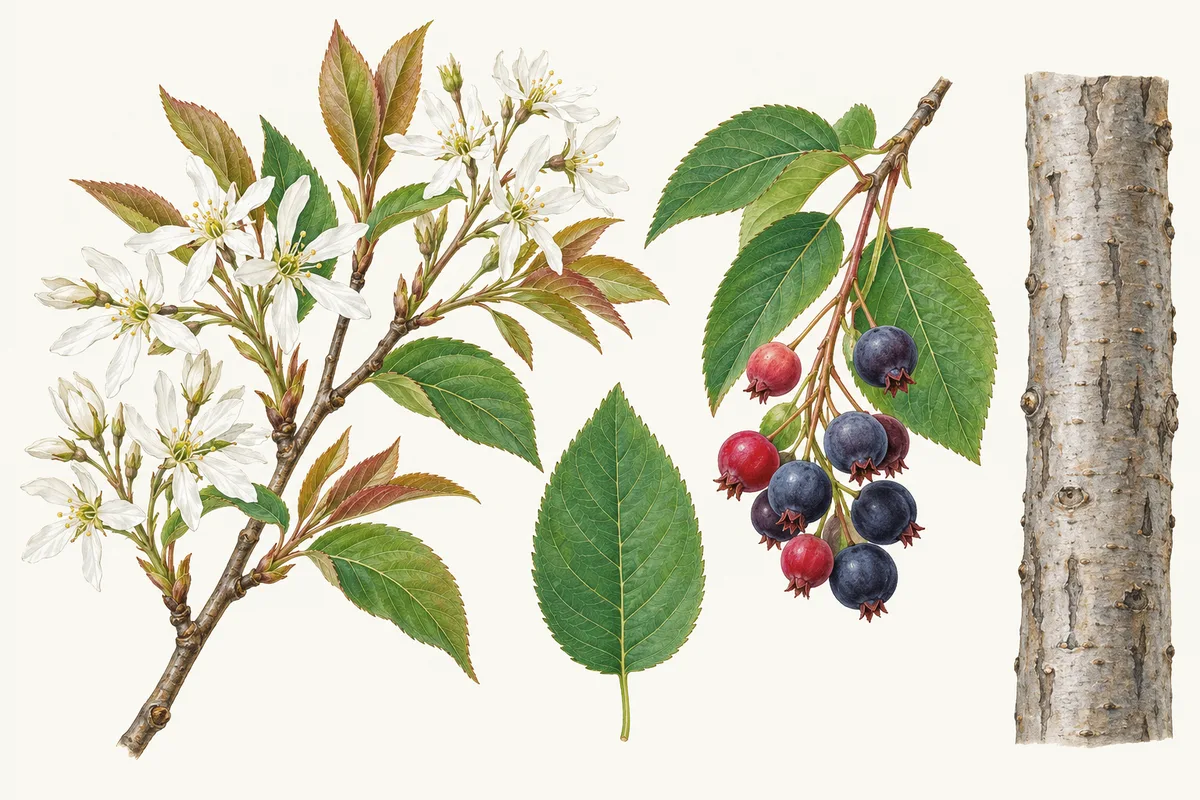
An early bloomer: loose, hanging clusters of white flowers with five narrow petals, then small berries that go from green to red to purple-black by early summer.
In short
Serviceberry tree identification is easiest in early spring, when loose, drooping clusters of white flowers with five narrow, strap-like petals open before or with the leaves. The leaves are alternate, oval and finely toothed, about 1 to 3 inches long; the bark is smooth and silver-gray with faint vertical stripes; and the small round berries turn green, then red, then purple-black in June or July.
- Serviceberry, juneberry, shadbush, shadblow and saskatoon are names for trees and shrubs of one genus, Amelanchier.
- The narrow, strap-like petals and smooth silver-gray bark separate a serviceberry from Callery pear, cherries and crabapples in spring.
- The fruit changes colour on the tree, green to red to purple-black, so one branch can carry berries of three colours at once.
Field marks at a glance
- Scientific name
- Amelanchier spp. (A. arborea, A. laevis, A. alnifolia and hybrids)
- Family
- Rosaceae (rose family)
- Type
- Broadleaf, deciduous
- Flowers
- White, sometimes pale pink, with five narrow, strap-like petals, in loose drooping or upright clusters of about 5 to 15 flowers. They open early, March to May depending on latitude, before or with the leaves.
- Leaves
- Alternate, simple, oval to elliptic, finely toothed, about 1 to 3 inches (2.5 to 7.5 cm) long. New leaves are purplish-brown or red-tinged in Allegheny serviceberry and downy and gray in downy serviceberry.
- Fruit
- Small round pomes about 1/4 to 3/8 inch (6 to 11 mm), green, then red, then purple-black, ripening from June in the East to July and August in the West; birds strip them fast.
- Bark
- Smooth, silver-gray when young, often with faint vertical stripes; older trunks develop long, shallow vertical fissures.
- Buds
- Numerous and pink-tinged on downy serviceberry, easy to see on bare winter twigs.
- Fall color
- Yellow, orange and red, often all three on one tree.
- Form and size
- Often multi-stemmed. Downy and Allegheny serviceberry 15 to 25 feet (4.5 to 7.5 m), up to about 40 feet in the wild; saskatoon a shrub or small tree up to 7 m (23 ft) that forms thickets.
- Names
- Eastern US: serviceberry, shadbush, shadblow, juneberry. Western US and the Canadian Prairies: saskatoon or western serviceberry.
Serviceberry is a genus, Amelanchier, of small trees and shrubs in the rose family, and it collects names the way it collects birds. In the eastern United States it is serviceberry, shadbush, shadblow or juneberry. On the Canadian Prairies and through the West it is saskatoon. The species differ in detail, but the whole genus shares the same spring flowers, smooth gray bark and colour-changing berries.
Never eat a berry, nut, seed or pod on the strength of a web page or an app; check with a local expert.
How to recognize a serviceberry
1. In early spring, the flowers. The NC State Extension profile of downy serviceberry describes fragrant, star-shaped white flowers, sometimes pale pink, in drooping clusters of 6 to 14 flowers that open from March to May, before or with the leaves. Look closely at a single flower: the five petals are long and narrow, like little straps, with gaps between them. Crabapple petals, by contrast, are wide ovals.
2. All year, the bark. Serviceberry bark is smooth and silver-gray. The Morton Arboretum describes Allegheny serviceberry bark as smooth and silver-gray with light vertical stripes; NC State notes that older trunks develop long vertical splits and furrows. Many serviceberries grow as clumps of several slim gray stems.
3. In early summer, the berries. The fruit is a small round pome that starts green, turns red, then ripens purple-black. Because it ripens unevenly, a single branch in June can carry green, red and dark berries together, which is unusual among small native trees. The Morton Arboretum gives about 1/3 to 3/8 inch for the eastern species and notes that birds usually eat them quickly.
4. The leaves. Alternate, simple, oval to elliptic and finely toothed, typically 1 to 3 inches long. NC State describes young downy serviceberry leaves as purplish-brown and hairy underneath, and the Morton Arboretum notes that Allegheny serviceberry's new leaves come out with a distinctive red tinge. Fall color runs from yellow through orange to red.
Tree Identifier can name a serviceberry from one photo of a flowering branch, the berries or the bark. It shows no confidence score and no list of look-alikes, so check the petal shape yourself in spring; it settles most cases.
The serviceberries you are most likely to meet
| Serviceberry | Where | Young leaves | Size |
|---|---|---|---|
| Downy serviceberry (A. arborea) | Eastern North America, New Brunswick to Florida, west to Minnesota and Texas | Purplish-brown, hairy underneath | 15–25 ft, to about 40 ft wild |
| Allegheny serviceberry (A. laevis) | Midwest and northeastern US | Distinctly red-tinged | 15–25 ft |
| Saskatoon (A. alnifolia) | Alaska to California, east to Minnesota and Iowa, Ontario and Quebec, north into the Northwest Territories | Oval to nearly round, coarsely toothed, sometimes only near the tip | Shrub or tree to 7 m (23 ft) |
Ranges and sizes come from NC State, the Morton Arboretum's downy serviceberry page and the USDA NRCS saskatoon plant guide. Nurseries also sell hybrids and many cultivars, so a planted tree may sit between two rows of this table.
Saskatoon: the serviceberry of Canada and the West
In Alberta, Saskatchewan, Manitoba and the western states the serviceberry you meet is usually saskatoon, Amelanchier alnifolia. The USDA plant guide describes a native shrub or small tree up to 7 m (23 ft) high that forms thickets, mats or clumps from a massive root crown and spreading rhizomes. Its leaves are nearly round to oval, about 2.5 to 3 cm long, with 8 to 13 pairs of parallel side veins. The edges carry coarse teeth that reach to below the middle of the leaf, or sometimes only a few small teeth at the tip, so a saskatoon leaf often looks rounder and blunter than the pointed leaves of downy serviceberry.
The same guide gives white, strap-like petals 1 to 2 cm long in short, dense, upright clusters of 5 to 15 flowers, flowering from April to June and fruiting from June to August. The fruits are 6 to 11 mm, smooth, purple-black and slightly waxy blue-gray. Saskatoon grows from low-elevation conifer forests up to timberline and, on the prairies, in wooded draws, fencerows, clearings and along streams. The name comes from the city of Saskatoon, in the heart of the species' range. For the other trees of the Prairies and the boreal forest, see tree identification in Canada.
Serviceberry and the other white-flowering trees of early spring
Early spring brings several small trees into white bloom at once, and serviceberry is often the one people are trying to tell apart. Our trees with white flowers guide has a bloom-month table; these are the quick tests against a serviceberry:
- Callery pear: dense clusters of creamy white flowers with a foul smell, glossy wavy-edged leaves. NC State lists it as invasive in North Carolina and elsewhere in the Southeast, and names common serviceberry among the native alternatives. See the Bradford pear page.
- Black cherry and other cherries: flowers in long finger-like clusters as the leaves open, and twigs that smell of bitter almonds when scratched. See the cherry page.
- Crabapples: broad petals from pink or red buds, later in spring, and fruit that is a tiny apple. See the crabapple page.
- Hawthorns: thorns, later bloom, flat flower clusters.
Finding a serviceberry again
A serviceberry in bloom is easy to spot from across a park, but in summer it disappears among other small trees. Tree Identifier's Tree Map saves each identification with its location, so you can find the tree again when the berries ripen or the leaves turn in fall. The app's Tree Expert assistant can answer follow-up questions about the tree you identified, such as which serviceberries grow in your region.
Look-alikes and how to tell them apart
Callery pear, including Bradford pear (Pyrus calleryana)
Callery pear's creamy white flowers sit in dense clusters about 3 inches long and smell foul. Its leaves are glossy, hairless and wavy-edged, and the small fruit is brown, not purple-black.
Black cherry (Prunus serotina)
Black cherry flowers sit in long, narrow, finger-like clusters 3 to 6 inches long that open with the leaves, in late April to May. Scratch a twig: cherry smells of bitter almonds, serviceberry does not.
Hawthorn (Crataegus spp.)
Hawthorns carry stiff thorns about an inch long and bloom in mid to late spring, after the leaves, with clusters of white flowers at the twig ends. Serviceberry has no thorns.
Crabapple (Malus spp.)
Crabapple petals are wide ovals, usually opening from red or pink buds in May, and the fruit is a small apple, red, orange, yellow or yellow-green rather than purple-black.
What a photo can't settle
- Serviceberries hybridize freely, and many planted ones are hybrids or cultivars; a photo can usually say Amelanchier but often not which species.
- Out of flower and fruit, a serviceberry leaf looks much like many other finely toothed leaves in the rose family; photograph the bark and the buds too.
- Saskatoon and low serviceberry intergrade in the field, so the shrubby western forms may not match any one description.
Questions people ask
Is a saskatoon the same as a serviceberry?
Yes. Saskatoon is the usual name for Amelanchier alnifolia, the western serviceberry of the Prairies, the Rockies and the Pacific coast. The USDA lists saskatoon service-berry, juneberry and shadbush as other names, and notes the name comes from the city in Saskatchewan, in the heart of the species' range.
When do serviceberries bloom and fruit?
Early. NC State gives March to May for downy serviceberry, before or with the leaves, and the Morton Arboretum gives blue-black fruit in June, which is where the name juneberry fits. Saskatoon in the West flowers from April to June and fruits from June to August, according to the USDA.
Is serviceberry a tree or a shrub?
Both. Downy and Allegheny serviceberry are small trees of 15 to 25 feet, often with several stems. Saskatoon is usually a shrub or small tree up to about 7 m (23 ft) that spreads into thickets from its roots.
How do I tell serviceberry from Bradford pear in spring?
Look at the petals and smell the flowers. Serviceberry petals are long and narrow, and its flowers hang in loose clusters. Callery pear, which includes Bradford, has rounded petals in dense clusters with a foul smell and glossy, wavy-edged leaves.
Are serviceberry berries safe to eat?
This page does not give edibility advice. Several unrelated trees and shrubs carry small dark berries in summer. Never eat a berry, nut, seed or pod on the strength of a web page or an app; check with a local expert.
Sources
- Amelanchier arborea (Downy Serviceberry) — NC State Extension Gardener Plant Toolbox
- Downy serviceberry — The Morton Arboretum
- Allegheny serviceberry — The Morton Arboretum
- Saskatoon (Amelanchier alnifolia) Plant Guide — USDA NRCS
- Pyrus calleryana (Callery Pear) — NC State Extension Gardener Plant Toolbox
- Prunus serotina (Black Cherry) — NC State Extension Gardener Plant Toolbox
Keep reading
- Clue guideWhich tree has white flowers? Start with the month
- Invasive tree profileBradford pear and Callery pear (Pyrus calleryana): how to identify them
- Tree profileCherry trees (Prunus): how to identify them
- Tree profileCrabapple tree (Malus): how to identify it
- Canada field guideTree identification in Canada, region by region