Garden guide
Best trees for small gardens, from the RHS and extension lists
Small-garden trees named by the Royal Horticultural Society and by Oregon State, Illinois and Florida extension services, with their mature sizes, the limits of each list and how to recognise each tree.
In short
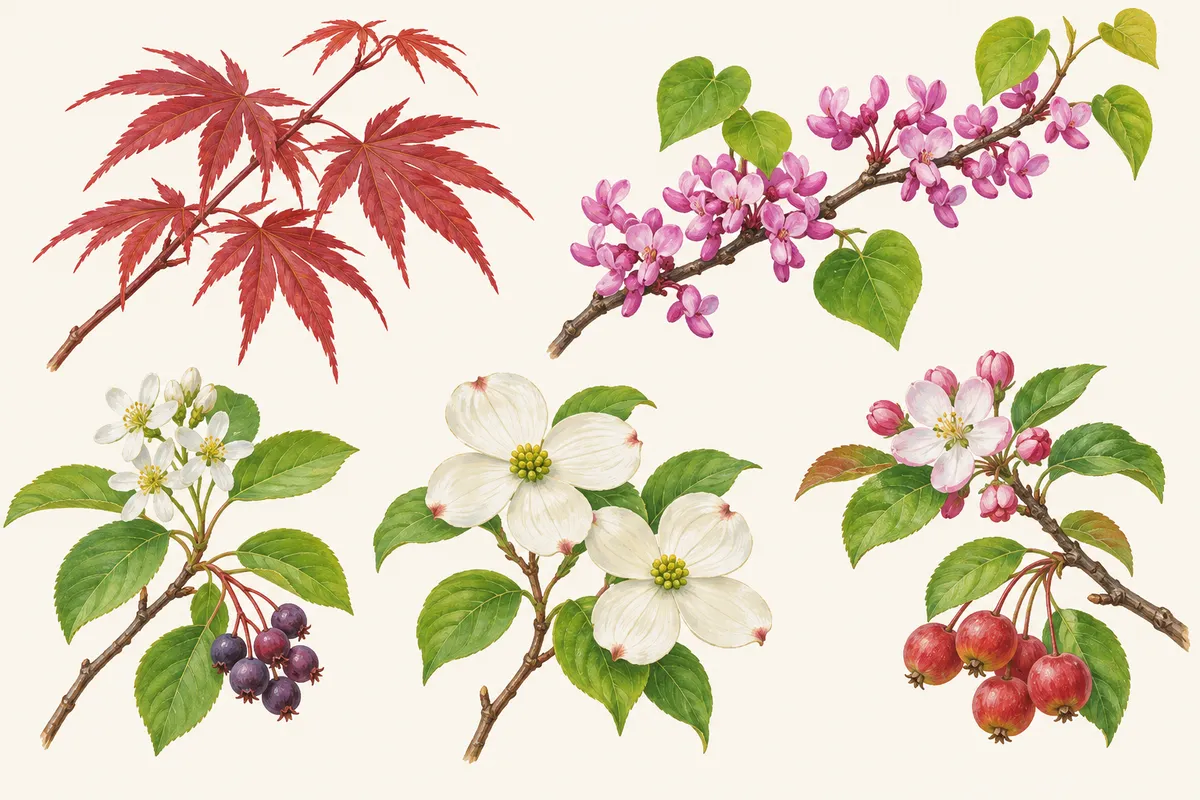
The best trees for small gardens on published lists are serviceberry (Amelanchier), eastern redbud, Japanese maple, flowering crabapple, hawthorn and dogwood. The RHS treats trees up to 8 m (26 ft) as small, Oregon State Extension favours trees of 20 to 30 feet, and narrow columnar or weeping forms such as Prunus 'Amanogawa' fit where width or height is short.
- Mature height and spread matter most: the RHS calls them probably the most important factor, and plots them on a scale plan.
- Serviceberry, redbud, dogwood, crabapple and hawthorn appear on more than one list, in the UK and in the US.
- Near power lines, Illinois Extension recommends a mature height under 15 feet and never a tree that could reach 25 feet.
Most published small-tree lists agree on a short group: serviceberry, redbud, Japanese maple, flowering crabapple, hawthorn and dogwood. The lists below come from the Royal Horticultural Society in the UK and from three US extension services, each writing for its own climate. Every size on this page is the figure the source gives; none is ours.
Small trees named by the RHS and extension services
| Tree | Mature size given | Recommended by | Notes from the source |
|---|---|---|---|
| Serviceberry, Amelanchier × grandiflora 'Ballerina' | 5–6 m tall, 6–7 m wide | RHS | White mid-spring flowers, autumn tints |
| Juneberry, Amelanchier lamarckii | About 5 m | RHS (award list) | White spring flowers, berries for birds, fiery autumn colour |
| Serviceberry, Amelanchier spp. | Not given | Illinois Extension | Listed for confined spaces |
| Eastern redbud, Cercis canadensis | 'Forest Pansy' 4–5 m; weeping 'Ruby Falls' 2–2.5 m | RHS, Illinois Extension | Purple-leaved and weeping cultivars |
| Japanese maple, Acer palmatum | Cultivars 10–25 ft | Oregon State Extension | Hardy to Zone 5 or 6 |
| Flowering crabapple, Malus | Most 20 ft or less; 'Evereste' about 2 m | Oregon State, RHS | Full sun; disease-resistant cultivars named |
| Hawthorn, Crataegus persimilis 'Prunifolia' | About 5–6 m | RHS, Illinois Extension (Crataegus spp.) | White flowers, crimson fruit that persists |
| Kousa dogwood, Cornus kousa | About 25 ft (OSU); 'John Slocock' about 4 m (RHS) | Oregon State, RHS | White bracts in June, red strawberry-like fruit |
| Pagoda dogwood, Cornus alternifolia | Not given | Illinois Extension | Listed for confined spaces |
| Japanese tree lilac, Syringa reticulata | Not given | Illinois Extension | Listed for confined spaces |
| Red buckeye, Aesculus pavia | Up to 20 ft | Illinois Extension, UF/IFAS | Native; flowers draw hummingbirds |
| Fringetree, Chionanthus virginicus | Up to 20 ft | UF/IFAS | North Florida; moist acid soil |
| Purpleleaf plum, Prunus cerasifera | 15–25 ft | Oregon State Extension | Dark purple leaves, pale pink flowers |
| Paperbark maple, Acer griseum | 8–10 m | RHS | Peeling cinnamon bark |
| Cherry, Prunus 'Amanogawa' | 8 m tall, 3 m wide | RHS | Narrow and columnar |
The RHS profile on trees for smaller gardens gives its top five (paperbark maple, Amelanchier 'Ballerina', hawthorn 'Prunifolia', Sorbus 'Joseph Rock' and Prunus 'Amanogawa') and works with trees up to 8 m (26 ft). Its award-winning flowering trees list adds juneberry, strawberry tree, kousa dogwood, crab apple 'Evereste', Japanese apricot and Chinese mountain ash, most around 4 m. In Oregon, OSU Extension picks Japanese maple, dogwood, flowering crabapple, whitebeam and purpleleaf plum, and calls trees of 20 to 30 feet ideal for small gardens. Illinois Extension offers eastern redbud, serviceberry, pagoda dogwood, Japanese tree lilac, red buckeye and hawthorn as "a starting point". For Florida lots, UF/IFAS lists red buckeye, fringetrees, flatwoods plum, Walter's viburnum and three hollies, most at 20 feet or less.
How the sources say to choose
The RHS calls height and spread "probably the most important factor" and suggests drawing the garden to scale and plotting each tree's mature size on it. Three shapes solve three different problems:
- Short of width: a columnar tree. The RHS lists Prunus 'Amanogawa' (3 m wide), and columnar crab apples 'Adirondack' and 'Red Obelisk' at about 1.5 m wide.
- Short of height: a weeping form, which the RHS says rarely gains much height, such as redbud 'Ruby Falls' or Kilmarnock willow (Salix caprea 'Kilmarnock', 1.5 to 2 m).
- Room for one tree only: a tree with more than one season, for example flowers then fruit or autumn colour. Serviceberry, hawthorn and crabapple all give spring flowers and fall fruit.
Oregon State adds a site-first checklist: sun, soil, and the distance to power lines, fences, patios and foundations, with height and width measured before buying. Illinois Extension stresses the space roots need below ground: too little soil shortens a tree's life, and a large tree in a small site can outcompete other plants and damage nearby paving or pipes as it grows.
Overhead wires set a hard ceiling. Illinois Extension's tree planting safety page says never to plant a tree that could reach 25 feet or more near a power line, and recommends a mature height under 15 feet there. In the US, call 811 before digging.
Recognising the trees on these lists
Many gardens already hold one of these trees, often unnamed. These field marks separate them quickly:
- Serviceberry: white flowers with five narrow, strap-like petals in early spring, smooth silver-gray bark, and small berries that turn red, then purple-black, in early summer. The serviceberry page covers the species.
- Eastern redbud: heart-shaped leaves with a smooth edge, and pink pea-like flowers that open on bare twigs and even on the trunk before the leaves. See the redbud page.
- Japanese maple: opposite leaves cut into five to seven deep, pointed lobes, often red or purple, sometimes finely dissected like a fern. The Japanese maple page tells it from other maples.
- Flowering crabapple: five-petalled pink, red or white flowers in May and small apples, often red, that may hang on into winter.
- Hawthorn: thorny twigs, toothed or lobed leaves, flat clusters of small white five-petalled flowers and red haws in fall.
- Dogwoods: most have opposite leaves whose veins curve toward the tip. Pagoda dogwood is the exception, with alternate leaves crowded at the twig ends. Kousa dogwood opens bold white bracts in June, then carries red, strawberry-like fruit.
- Whitebeam: leaves dark green above and white and felted beneath, flashing silver in wind.
If you are trying to name a tree you inherited, the guide to identifying trees in your yard walks through leaves, bark and shape in order.
Where these lists stop
None of these lists is universal. Oregon State gives Japanese maple as hardy only to Zone 5 or 6, crabapple and purpleleaf plum need full sun, and UF/IFAS's fringetree wants moist acid soil. Hardiness zones are given where the source gives them; if yours is not covered, your county extension office or a regional botanic garden has the local version of this list. Local rules matter too: some towns restrict planting in the strip between sidewalk and street, and homeowners' associations may keep approved lists.
Size figures also drift. The RHS warns that soil, location and weather change a tree's final height, and that even small ornamental trees may reach 6 to 8 m or more over time. A cultivar can differ sharply from its species: 'Evereste' crab apple is listed at about 2 m, while flowering crabapples as a group reach 20 feet.
Using a photo of an existing tree
Before planting, it helps to know what is already in the garden and next door. Tree Identifier names a tree from one photo of a leaf, the bark, flowers or fruit, and shows its common and scientific names, origin and growing conditions. Its Care Guide gives growing notes for the tree it named, and the follow-up chat under a result can answer a question such as how large that species usually grows. Tree Identifier cannot read a cultivar from a photo, so treat any size it suggests as the species average and check the nursery label for the cultivar.
What a photo can't settle
- Every list here is regional: the RHS writes for the UK, Oregon State for western Oregon, Illinois Extension for the Midwest and UF/IFAS for Florida. Check your own hardiness zone and county extension office before choosing.
- Mature heights are averages. The RHS warns that soil, location and weather change a tree's final size, and a cultivar can be much smaller or larger than its species.
- A photo app can name a tree, but it cannot tell you how big a nursery cultivar will get; the cultivar label and the grower's figures settle that.
Questions people ask
What is the best tree for a small garden?
No source names a single winner. Serviceberry (Amelanchier) comes closest: it is on the RHS short list, the RHS award-winning flowering list and the Illinois Extension list, with white spring flowers, berries and autumn colour. Choose by your climate zone, sun and the space you have.
How tall is a small tree?
The RHS uses up to 8 m (26 ft) for its small-tree lists. Oregon State Extension calls trees of 20 to 30 feet ideal for small gardens. UF/IFAS lists Florida trees that mostly stay at 20 feet or less.
What tree can I plant close to my house?
Pick a tree whose mature spread fits the gap, and keep it away from foundations and narrow planting strips, as Oregon State Extension advises. The RHS points readers to its separate advice on trees near buildings. Check local rules and call 811 in the US before digging.
What is a good small tree for a narrow space?
A columnar form. The RHS lists Prunus 'Amanogawa', a cherry about 8 m tall and only 3 m wide, and columnar crab apples such as Malus 'Adirondack' and 'Red Obelisk' at about 3 to 4 m tall and 1.5 m wide.
Sources
- Trees for smaller gardens — Royal Horticultural Society
- 10 award-winning flowering trees for small gardens — Royal Horticultural Society
- Choose small trees that fit city yards — Oregon State University Extension Service
- Planting in tight spaces: trees for confined spaces — University of Illinois Extension
- Small Trees for Small Lots — UF/IFAS Gardening Solutions, University of Florida
- Tree planting safety — University of Illinois Extension
Keep reading
- Tree profileServiceberry (Amelanchier): juneberry, shadbush and saskatoon
- Tree profileRedbud tree (Cercis canadensis): how to identify it
- Tree profileJapanese maple identification: the species, then the leaf group
- Tree profileCrabapple tree (Malus): how to identify it
- Yard guideHow to identify the trees in your yard