Tree facts
How long do trees live? Lifespans by species
A tree's lifespan depends mostly on its species: willows and boxelders are old at 60 to 85 years, while oaks, hemlocks and bristlecone pines are measured in centuries.
In short
How long trees live depends on the species. The USDA Forest Service gives boxelder an average of 60 years, black willow a recorded maximum of 85, and red maple seldom more than 150. Sugar maple reaches 300 to 400 years, white oak 600, eastern hemlock a recorded 988, and giant sequoia 3,200. A Great Basin bristlecone pine was estimated at about 4,900 years.
- Fast-growing, sun-loving trees such as willows, boxelder, aspen and paper birch are short-lived: often under 100 to 150 years.
- Slow-growing, shade-tolerant trees such as sugar maple, beech and eastern hemlock live 300 years or more.
- The oldest dated non-clonal trees are Great Basin bristlecone pines, estimated at up to about 4,900 years.
- The species is the best predictor of lifespan, so identify the tree before guessing its age.
How long trees live varies more between species than almost anything else about them. A black willow is old at 70. A sugar maple can reach 400. Some bristlecone pines in the mountains of Nevada and California have lived through almost five millennia. The figures below come from the USDA Forest Service's Silvics of North America, the standard reference on how North American trees grow and die, with the National Park Service and the Woodland Trust for two extremes.
Lifespans of 21 trees
| Tree | Lifespan | Source |
|---|---|---|
| Black willow | Mature at about 55 years; oldest sound tree recorded 70, unsound 85 | Forest Service |
| Boxelder | Averages 60 years, rarely 100 | Forest Service |
| Pin oak | Short-lived; physiological maturity at 80 to 100 years | Forest Service |
| Silver maple | 130 years or more | Forest Service |
| Paper birch | Rarely more than 140 years; oldest recorded 225 | Forest Service |
| Red maple | Seldom more than 150 years | Forest Service |
| Tamarack | Generally 150 to 180 years; one tree 335 | Forest Service |
| Quaking aspen | Stems up to about 200 years (oldest 226); clones may be thousands of years old | Forest Service |
| American basswood | Maximum generally over 200 years | Forest Service |
| Loblolly pine | Medium-lived; one tree recorded at 245 years | Forest Service |
| Black cherry | Declines after 80 to 100 years; a 258-year-old tree recorded | Forest Service |
| Bur oak | 200 to 300 years on good sites; bears acorns up to 400 | Forest Service |
| American beech | 300 to 400 years | Forest Service |
| Sugar maple | 300 to 400 years | Forest Service |
| Eastern white pine | Commonly 200 years; may exceed 450 | Forest Service |
| White oak | Trees 600 years old recorded | Forest Service |
| Sweet chestnut | Up to 700 years | Woodland Trust |
| Eastern hemlock | 800 years or more; recorded maximum 988 | Forest Service |
| Baldcypress | 400 to 600 years common in old stands; a few about 1,200 | Forest Service |
| Giant sequoia | Many 2,000 to 3,000 years; greatest known age 3,200 | Forest Service |
| Great Basin bristlecone pine | Prometheus tree estimated at about 4,900 years | National Park Service |
Read on 10 November 2026. Where the Forest Service gives a maturity age rather than a maximum (pin oak, black willow), the table says so. The northern red oak and eastern cottonwood chapters give no lifespan figure; cottonwood is described only as short-lived and the fastest-growing commercial forest species in North America.
Short-lived trees: under about 150 years
The short-lived trees share a pattern: they grow fast, need full sun, and are replaced by slower, shade-tolerant trees.
- Black willow is short-lived, says the Forest Service: the average tree is mature at 55 years, and the greatest recorded age is 70 for a sound tree and 85 for an unsound one.
- Boxelder attains an average age of 60 years and rarely 100. It starts producing seed at 8 to 11 years, which is why it spreads so freely. The boxelder page shows how to tell it from poison ivy and ash by its three to five leaflets.
- Pin oak is the short-lived oak. The Forest Service gives physiological maturity at 80 to 100 years, although trees in one old-growth stand in Kentucky averaged 138.
- Silver and red maple. Silver maple may live 130 years or more, and red maple seldom lives longer than 150, maturing at 70 to 80 years.
- Paper birch rarely lives more than 140 years; trees mature at 60 to 70, and the oldest recorded, on Mount Washington in New Hampshire, was 225.
- Quaking aspen stems reach a maximum of about 200 years in Alaska and the Rocky Mountains, with an oldest recorded tree of 226. The Forest Service adds that the clone, the root system that sends up the stems, may be thousands of years old.
Long-lived trees: centuries
The long-lived trees of eastern North America are mostly slow growers that tolerate shade:
- Sugar maple. The Forest Service says mature trees and stands reach 300 to 400 years. Height growth stops at about 140 to 150 years, so an old sugar maple keeps thickening long after it stops getting taller.
- American beech may attain 300 to 400 years. In a Forest Service ranking of longevity, beech was exceeded only by white oak and sugar maple.
- White oak is a large, long-lived tree. Individual trees 600 years old have been recorded, and they usually bear acorns between 50 and 200 years of age. See the white oak page for how to recognise it by its rounded lobes.
- Bur oak lives 200 to 300 years on better sites, and bears acorns up to an age of 400.
- Eastern white pine commonly reaches 200 years if undisturbed, and may exceed 450.
- Eastern hemlock may need 250 to 300 years to reach maturity and can live 800 years or more. The Forest Service reports a maximum of 988 years. Saplings in deep shade can be 100 to 200 years old, so a small hemlock is not necessarily a young one. The hemlock page covers identification.
- Baldcypress. Trees 400 to 600 years old were common in virgin stands, and a few reached about 1,200.
The oldest trees in the world
Two trees stand apart. The Forest Service chapter on giant sequoia gives a greatest known age of 3,200 years, from a ring count on a stump, and age estimates of 2,000 to 3,000 years for many living trees; the General Sherman tree is about 2,500.
The same chapter notes that one species lives longer: the Great Basin bristlecone pine. The National Park Service calls it the oldest non-clonal species on the planet. Its Prometheus tree in Great Basin National Park, Nevada, was once recorded as the oldest living thing in the world. It had 4,862 growth rings and was estimated at about 4,900 years, because rings are sometimes skipped in hard years. The park says older bristlecones may exist that have not been dated. You can recognise a bristlecone by needles about one inch long in bundles of five and cones whose scales each end in a claw-like bristle.
In Europe the record-holder is the yew. The Woodland Trust calls it one of the longest-lived native species in Europe, not considered ancient until it reaches 900 years, and says ten British yews are believed to predate the 10th century. The Woodland Trust also gives sweet chestnut a lifespan of up to 700 years, and says the oldest known chestnut, on Mount Etna in Sicily, is said to be between 2,000 and 4,000 years old. Yew leaves, bark and seeds are poisonous, according to the same source; keep children and animals away from them.
Why some trees live longer than others
The Silvics chapters point to a few recurring reasons, all visible in the table above:
- Growth rate. Fast starters (cottonwood, willow, aspen, boxelder, silver maple) are short-lived. Black cherry keeps its growth advantage for 60 to 80 years, and beyond 80 to 100 years its diameter growth slows and mortality increases rapidly.
- Shade tolerance. Trees that can wait in shade (eastern hemlock, sugar maple, beech, white oak) are also the long-lived ones. White oak seedlings can persist under a forest canopy for more than 90 years.
- Site. Bur oak lives 200 to 300 years on better sites but is short-lived on poorer sites in Minnesota; on dry limestone ridges it may be under 25 feet tall at 150 years of age.
How old is your tree?
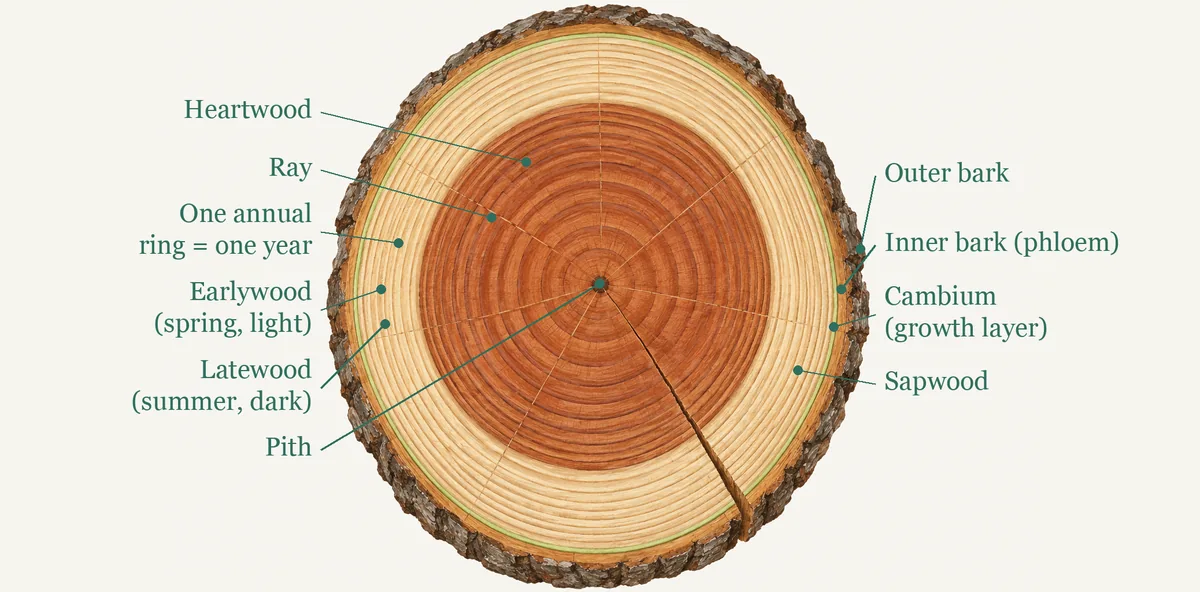
Age and lifespan both depend on knowing the species. A 20-inch trunk could belong to a fast-growing silver maple a few decades old or a slow white oak more than a century old. Foresters count rings on a stump or on a thin core taken with an increment borer; for a living tree, the tree age calculator estimates age from the trunk's circumference and a growth factor for the species. Treat the result as an estimate.
Tree Identifier names a tree from one photo of a leaf, the bark, a flower or the fruit, which gives you the species to put into the calculator. The follow-up chat under each result can answer questions such as how long that species usually lives, and the Diagnose tool gives a health assessment with a severity level if an old tree is declining. Neither replaces a ring count or an arborist's inspection of a large tree near a house.
What a photo can't settle
- The ages on this page are maximums and typical ages recorded in forests. A tree in a lawn, by a road or in poor soil can die far younger from storms, disease, root damage or drought.
- Some figures are records from a single tree, and ring counts can be wrong: the Forest Service notes that ring counts on baldcypress averaged about 1.6 times the actual age.
- A photo can name the species, but it cannot date a tree. Age needs a ring count, a core or a trunk measurement with a species growth factor.
Questions people ask
What tree lives the longest?
Among single, non-clonal trees, the Great Basin bristlecone pine. The National Park Service estimated the Prometheus tree in Nevada at about 4,900 years when it was cut in 1964. Giant sequoia follows, with a greatest known age of 3,200 years. Clonal aspen stands can be older still, but their individual stems are short-lived.
How long do oak trees live?
It depends on the oak. The USDA Forest Service records white oaks 600 years old, gives bur oak 200 to 300 years on good sites, and calls pin oak short-lived, reaching physiological maturity at 80 to 100 years. Northern red oak has no lifespan figure in its Forest Service chapter.
How long do maple trees live?
Sugar maple reaches 300 to 400 years, according to the Forest Service. Red maple seldom lives longer than 150 years, silver maple may live 130 years or more, and boxelder, a maple too, averages 60 years and rarely reaches 100.
How long do pine trees live?
Eastern white pine commonly reaches 200 years and may exceed 450, according to the Forest Service. Loblolly pine is medium-lived; one tree in North Carolina reached 245 years. Great Basin bristlecone pine is the extreme, with a tree estimated at about 4,900 years by the National Park Service.
Can you tell how old a tree is without cutting it?
Yes, roughly. Foresters take a thin core with an increment borer and count the rings. Without one, measure the trunk's circumference at chest height and use a growth factor for the species, as the tree age calculator on this site does. Both need the species to be right.
Sources
- Silvics of North America (species chapters) — USDA Forest Service
- Bristlecone Pines — Great Basin National Park, U.S. National Park Service
- Yew (Taxus baccata) — Woodland Trust
- Sweet Chestnut (Castanea sativa) — Woodland Trust