Leaf vocabulary
Parts of a leaf: a labelled diagram and what each part tells you
Blade, tip, base, margin, midrib, veins, leaf stalk, stipules and the bud at its base, each defined in one line and tied to a tree you can check it on.
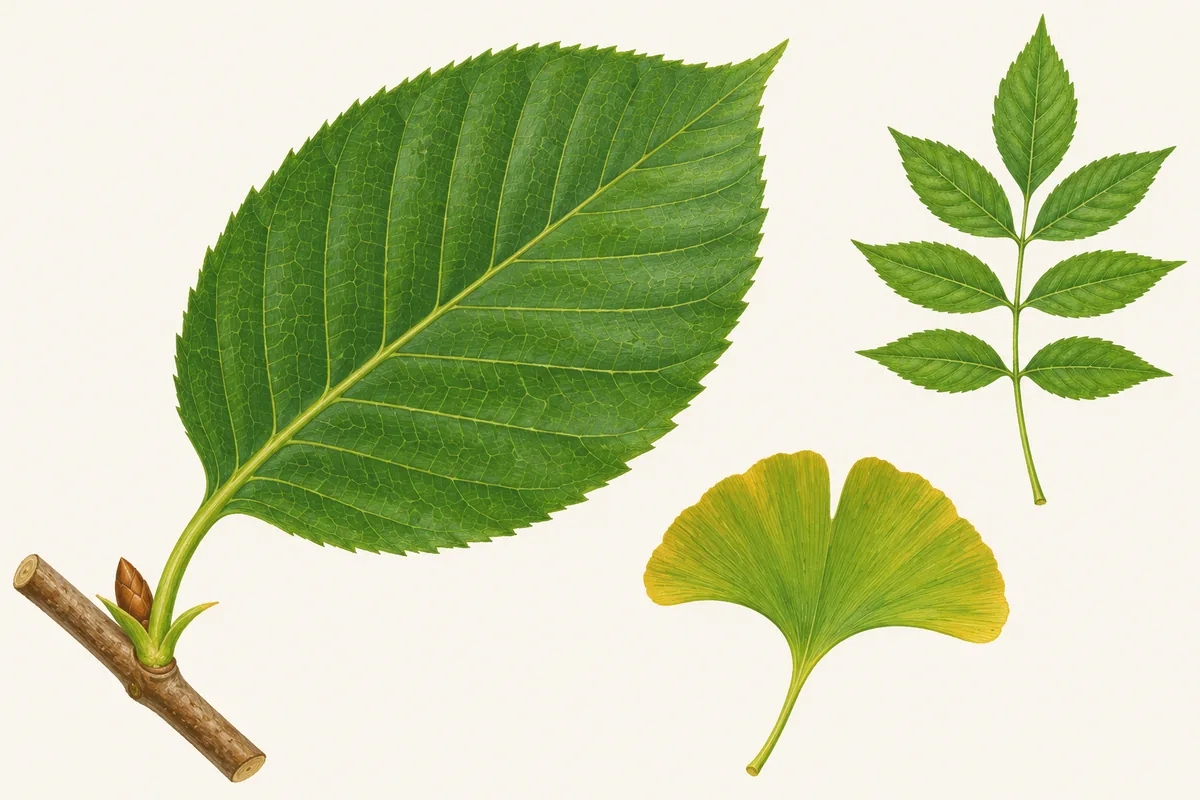
In short
The parts of a leaf are the blade (lamina), with its tip (apex), base and margin; the midrib and side veins; the leaf stalk (petiole); the stipules, small paired flaps where the stalk meets the twig; and the axillary bud in that angle. A compound leaf adds leaflets on a central axis, the rachis. The bud is the key part: it marks where one whole leaf begins.
- Find the bud first: it sits in the angle of each whole leaf, never at the base of a leaflet.
- Vein pattern is a fast first split: one midrib (pinnate), several main veins from one point (palmate), curved veins (arcuate) or forking veins (ginkgo).
- The leaf stalk and stipules carry clues a loose leaf hides: a sycamore's stalk base covers its bud, and its stipule scar rings the twig.
- Read the tip and base on several sunlit leaves before you name them: one leaf can mislead.
Every leaf description in a field guide names the same handful of parts: the blade, its tip, base and margin, the veins, the leaf stalk, the stipules and the bud. This page labels each part on one tree leaf, says what to look at, and names a tree where that part is the giveaway. The words for outlines, edges and leaf arrangement have their own page, leaf shapes and types; the step-by-step method of naming a tree from a leaf is on how to identify trees by their leaves.
The parts of a leaf, labelled
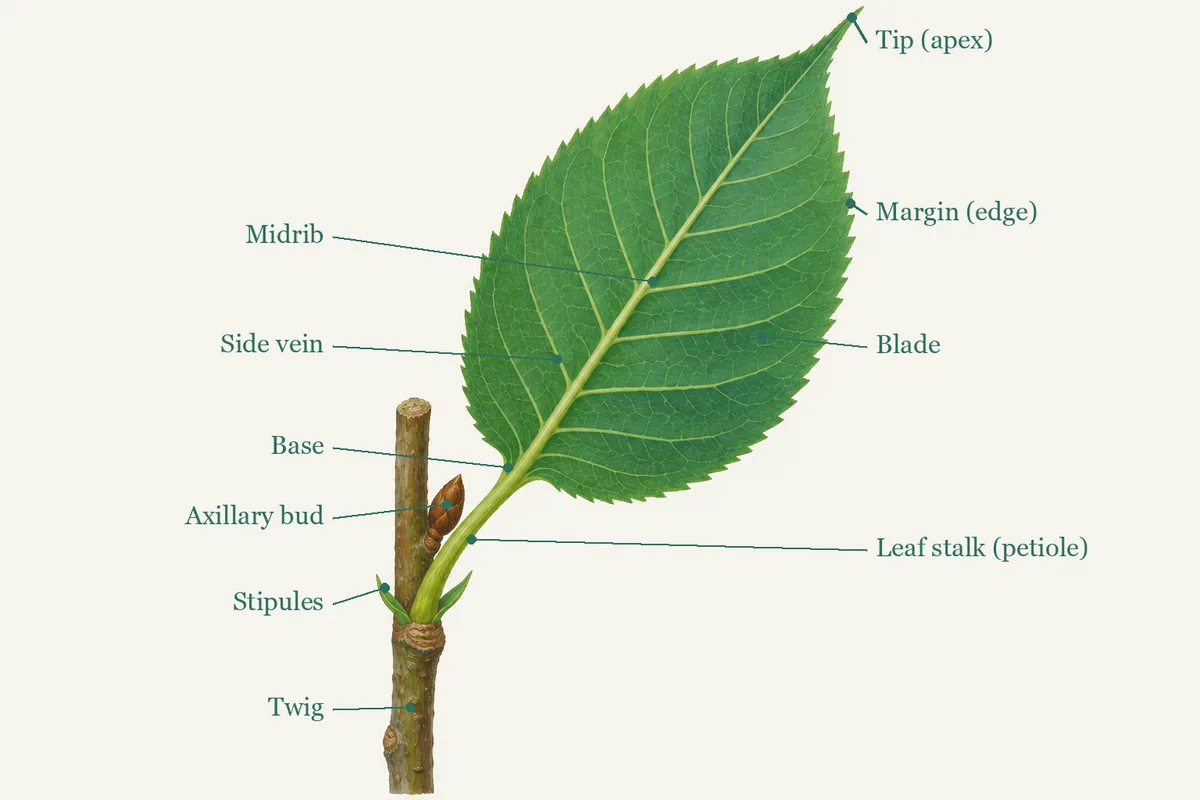
Read a leaf from the twig outward, because the parts nearest the twig decide what you are holding. The definitions below follow the University of Illinois Woody Plants Tutorial glossary.
| Part | What it is | What to check |
|---|---|---|
| Blade (lamina) | The flat, expanded part of the leaf | Size, outline, lobes, texture, color above and below |
| Tip (apex) | The far end of the blade | Long-pointed, sharp, rounded, notched or bristle-tipped |
| Base | The end of the blade nearest the stalk | Heart-shaped, rounded, wedge-shaped, straight across or lopsided |
| Margin | The edge of the blade | Smooth (entire), toothed, wavy or lobed |
| Midrib (midvein) | The main vein, usually down the center | Whether side veins leave it along its length or several main veins start at the base |
| Side veins | Veins branching from the midrib | Straight to the teeth, or curving toward the tip |
| Leaf stalk (petiole) | The stalk joining the blade to the twig | Length, flattened or round, swollen base, glands |
| Stipules | Small appendages at the base of the stalk, usually in pairs | Present, fallen, or only a scar on the twig |
| Axillary bud | The bud in the angle (axil) between stalk and twig | Its presence tells you this is one whole leaf |
Two terms help with the rest of the page. A node is the point where a leaf and its bud join the twig, and a leaf scar is the mark left on the twig when the leaf falls. A leaf with no stalk, attached straight to the twig, is sessile.
Tip and base: the two ends of the blade
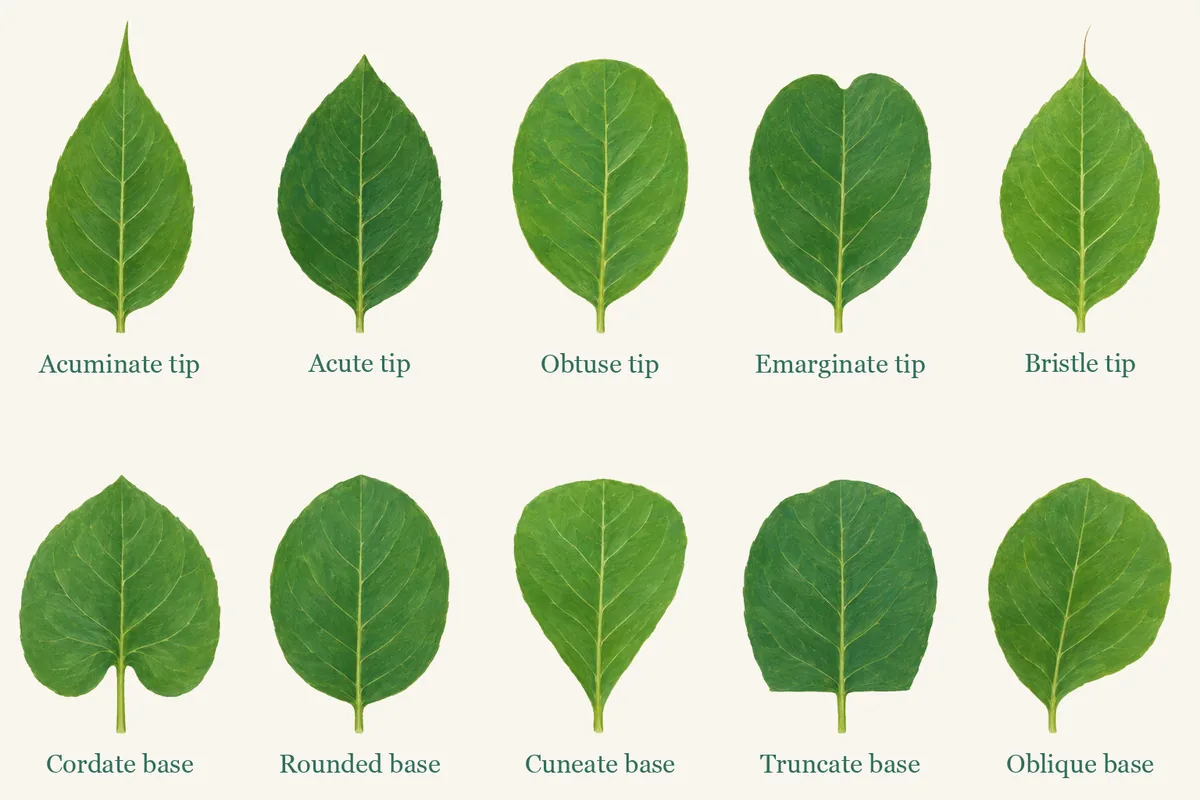
Keys ask about both ends of the blade because they often separate trees whose outlines look alike. The glossary terms:
- Acuminate tip: the sides curve inward and taper to a long, fine point.
- Acute tip: a sharp point with straight sides, at an angle under 90°.
- Obtuse tip: blunt, wider than 90°, close to rounded.
- Emarginate tip: notched at the midvein, as if a bite were taken from the end.
- Bristle tip: a hair-like extension at the end of the blade or of each lobe. On oaks it splits the genus: bristle-tipped lobes mean the red oak group, rounded lobes the white oak group (see how to identify oaks).
- Cordate base: heart-shaped, notched where the stalk joins.
- Rounded base: a broad curve, flatter than obtuse but not straight across.
- Cuneate base: a narrow wedge tapering to the stalk.
- Truncate base: straight across, at right angles to the stalk.
- Oblique base: the two sides of the blade meet the stalk at different points. On elms the lopsided base is the first thing to check; hackberry shares it.
Check the base on three or four leaves from the sunny side of the crown. A single shade leaf or a leaf from a stump sprout can be wider, longer-pointed or more lopsided than the tree's normal leaves.
Veins and venation: the pattern behind the blade
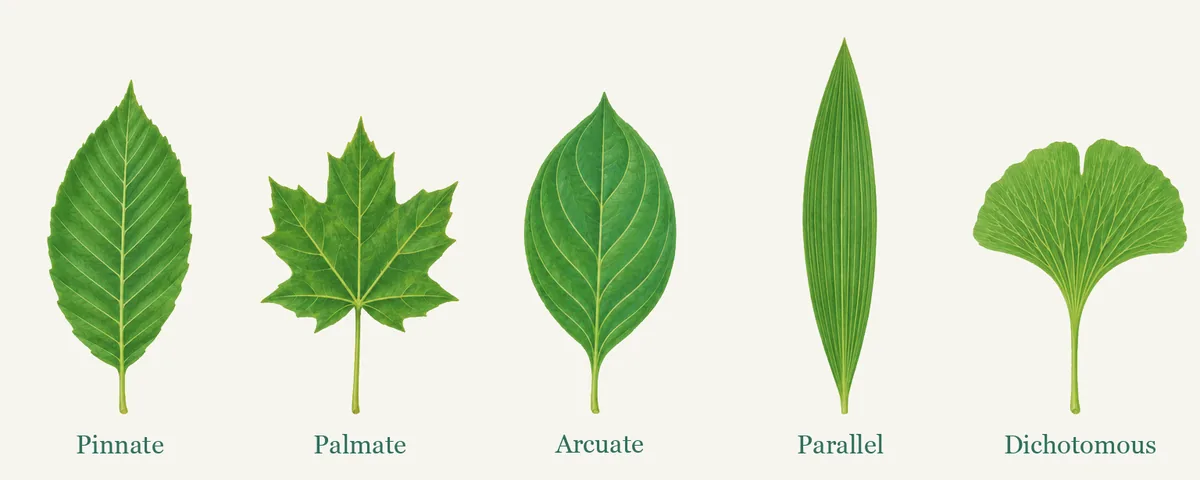
Venation is the pattern of the veins in a leaf. Hold the leaf up to the light and follow the thickest veins from the stalk; the pattern is often clearer from below.
- Pinnate: one prominent midvein with side veins along both sides, like a feather. Then look at where the side veins end: straight into the teeth, or looping before the edge.
- Palmate: three or more main veins spread from one point at the base, like fingers from a palm. American sycamore is a clear case: Virginia Tech's sycamore fact sheet describes a palmately veined leaf 4 to 8 inches wide with three to five lobes and coarse teeth. Maples share the pattern.
- Arcuate: the side veins curve toward the tip and run almost parallel to the margin. It is the fast field test for dogwoods: Virginia Tech describes flowering dogwood leaves as opposite, simple, 3 to 5 inches long, oval, with an entire or slightly wavy margin and arcuate veins.
- Parallel: veins running nearly parallel to the leaf axis or to each other. You will rarely meet it on a broadleaf tree.
- Dichotomous: veins forking in two, again and again, from the base. Ginkgo is the tree to know: the University of California Museum of Paleontology describes its fan-shaped, flat, irregularly notched leaves, often split into two lobes, with open dichotomous venation whose veins fork in pairs from the base.
Venation is useful because it survives damage. A torn, insect-eaten or half-brown leaf still shows its main veins, and a dogwood leaf can be named as a dogwood from its curved veins long before you count anything else.
Leaf stalk, stipules and bud: the parts on the twig
These three parts sit where the leaf meets the twig, which is why a loose leaf on the ground often lacks them. They carry some of the best clues on the whole tree.
Leaf stalk (petiole). Note its length against the blade, whether it is round or flattened, and whether its base is swollen. American sycamore shows how much a stalk can tell you: Virginia Tech notes that the petiole bases encircle and enclose the buds, so you only see the bud after the leaf falls, and the leaf scar then surrounds the bud. Pull a sycamore leaf off in summer and you find the bud hidden inside the hollow end of the stalk. Look on the stalk, too, for glands: small bumps or projections that can secrete oils or sticky substances.
Stipules. The glossary defines them as appendages at the base of the leaf stalk, usually in pairs. On many trees they are small and drop soon after the leaves open, so the scar they leave is what you look for. On sycamore, the stipule scar runs all the way around the twig, a clue that still works in winter.
Axillary bud. A bud sits in the angle between each leaf stalk and the twig. It is the part that tells you where one whole leaf begins. If you are not sure whether you hold a leaf, a leaflet or a twig, look for this bud before anything else.
Compound leaves: leaflets, rachis and the one bud
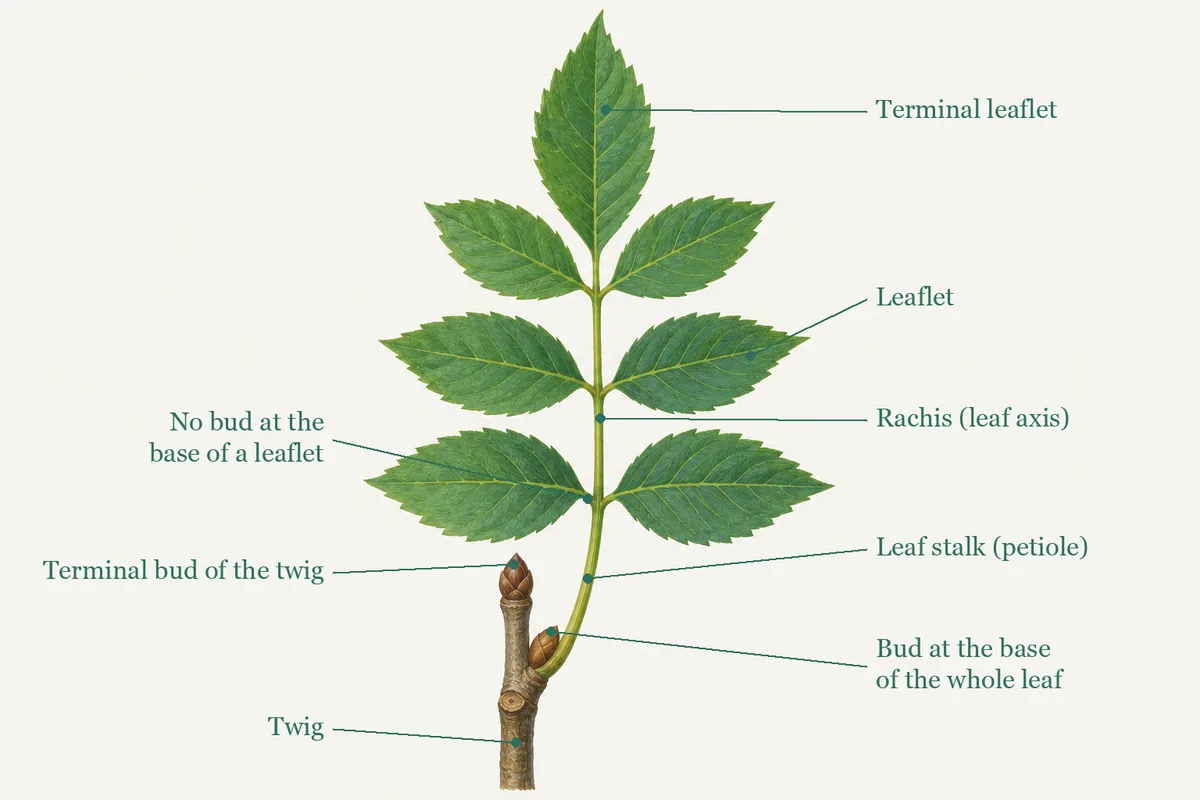
A compound leaf has its blade divided into separate leaflets. On a pinnately compound leaf, the leaflets sit along both sides of a central axis, the rachis, which continues the leaf stalk; each leaflet may have its own tiny stalk, the petiolule. A leaf that ends in a single leaflet has a terminal leaflet at the tip. Virginia Tech gives black walnut as its example of a compound leaf and northern red oak as a simple one.
The bud settles every doubt. Virginia Tech's primer notes that the rachis has no buds, is not particularly woody and is shed in the fall. So the bud sits only at the base of the whole leaf, where its stalk meets the twig, never under a leaflet. A single walnut or ash leaflet looks like a complete leaf until you find there is no bud under it. A twig, by contrast, carries buds along its length and ends in a terminal bud.
Pinnately compound trees are sorted by leaflet count on trees with compound leaves. Count the leaflets on several leaves, because the number varies within one tree.
Reading a leaf part by part
Use the parts in this order on any broadleaf tree, still on the branch if you can reach it:
- Bud: find the bud in the leaf axil. It tells you whether you hold a whole leaf or a leaflet.
- Stalk and stipules: note the stalk length and shape, any glands, and stipules or their scars on the twig.
- Venation: pinnate, palmate, arcuate or forking. This alone points to sycamore and maples, dogwoods or ginkgo.
- Tip and base: name both ends on several sunlit leaves, and check the base for a lopsided elm-like shape.
- Margin and outline: finish with the terms on the leaf shapes page.
A short line written this way, such as "opposite, simple, oval, entire, arcuate veins, 3 to 5 inches", is already close to a species in most keys.
Where a photo app fits
Tree Identifier, an iPhone app, names a tree from one photo of a leaf, the bark, a flower, a fruit or the whole tree, and shows the common and scientific name with key traits. It does not label the parts of the leaf for you and shows no confidence score, so the parts on this page are how you check its answer. If the app suggests a dogwood and your leaf has straight side veins running into teeth, look again.
For the best photo, keep the leaf on the twig, lay it against a plain background and make sure the stalk and the bud at its base are in the frame; take a second photo of the underside if the veins are faint. The follow-up chat under each result in Tree Identifier is the place to ask what the stipules or the leaf base of the suggested species should look like.
What a photo can't settle
- A photo of a loose leaf loses the parts that sit on the twig: the bud, the stipules and the arrangement. Photograph the leaf still attached, with its stalk and bud in view.
- Stipules on many trees fall soon after the leaves open, so their absence in summer proves little. Look for the scars they leave on the twig.
- Tip and base vary on one tree, between sun and shade leaves and on sprouts. The terms narrow the list; they rarely settle a species alone.
Questions people ask
What are the main parts of a leaf?
A typical tree leaf has a flat blade (lamina) with a tip, a base and a margin; a midrib with side veins; a leaf stalk (petiole) joining it to the twig; often a pair of stipules at the stalk's base; and an axillary bud in the angle between stalk and twig.
What is the petiole of a leaf?
The petiole is the leaf stalk, the axis that joins the blade to the twig. A leaf without one is called sessile. On a compound leaf, the petiole runs on into the rachis, and each leaflet may have its own tiny stalk, the petiolule.
What are stipules?
Stipules are small appendages at the base of the leaf stalk, usually in pairs. On many trees they fall early and leave scars. On American sycamore the stipule scar runs right around the twig, a clue you can read even in winter.
How do I know if I am holding a leaf or a leaflet?
Follow the stalk back to the twig and look for a bud. A bud sits in the angle of each whole leaf. A leaflet has none at its base, and the axis that carries leaflets, the rachis, has no buds and falls in autumn with the leaf.
What is the midrib of a leaf?
The midrib, or midvein, is the main vein, usually running down the centre of the blade from the stalk to the tip. In pinnate venation the side veins branch off it along both sides, like the barbs of a feather.
Sources
- Glossary, Woody Plants Tutorial — University of Illinois, Department of Natural Resources and Environmental Sciences
- Basics of Tree ID: leaf type — Virginia Tech Dendrology
- American sycamore (Platanus occidentalis) fact sheet — Virginia Tech Dendrology
- Flowering dogwood (Cornus florida) fact sheet — Virginia Tech Dendrology
- Ginkgoales: More on Morphology — University of California Museum of Paleontology
Keep reading
- Leaf vocabularyLeaf shapes and types: the terms, with charts and real trees
- Field guideHow to identify trees by their leaves
- Clue guideWhich tree has compound leaves? Count the leaflets, then check the twig
- Tree profileSycamore tree: the British maple and the American plane tree
- Tree profileOak trees (Quercus): how to identify them