Leaf vocabulary
Leaf shapes and types: the terms, with charts and real trees
Eight leaf types, eight shapes, six margins and three arrangements, each defined in one line and matched to trees you can find in a US or UK street.
In short
Leaf shapes are named by the outline of the blade: linear, lanceolate, elliptic, ovate, obovate, heart-shaped, round and triangular. Field guides add three more sets of terms: the leaf type (simple, lobed or compound), the margin (entire, serrate, doubly serrate, dentate, crenate, wavy) and the arrangement on the twig (alternate, opposite, whorled). An ovate, doubly serrate, alternate leaf with a lopsided base is an elm.
- Before you name a shape, find the bud: it sits where a whole leaf meets the twig, never at the base of a leaflet.
- A lobed leaf is still a simple leaf. Only separate leaflets on one stalk make a leaf compound.
- Serrate teeth point forward like a saw; dentate teeth point straight out; crenate teeth are rounded.
- Arrangement is read on the twig, not on a loose leaf: check three or four nodes before you call a tree opposite or alternate.
Every field guide and identification key describes a leaf with the same four sets of words: its type, its shape, its margin and its arrangement on the twig. This page defines each term in one line, shows it on a labelled chart and names one or two trees you can check it on, US trees first, then UK ones. For the method of naming a tree from a leaf, step by step, see how to identify trees by their leaves.
Leaf types: simple, lobed or compound
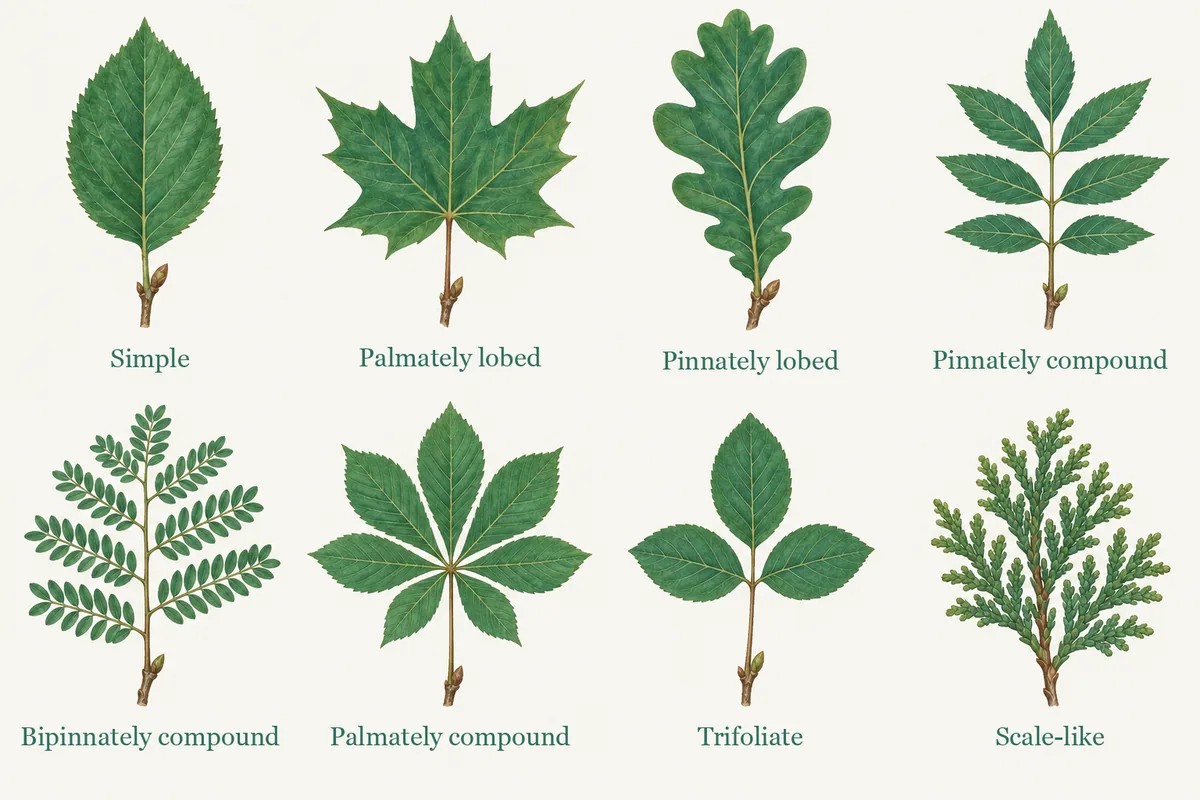
Start here, because the type decides what you are looking at. A simple leaf is a single blade; it may be lobed or toothed and still be simple. A compound leaf is split into separate leaflets on one stalk. The definitions below follow the University of Illinois Woody Plants Tutorial glossary.
| Term | What it means | Trees that show it |
|---|---|---|
| Simple | One undivided blade on its stalk | Eastern redbud, American elm; in the UK, beech and alder |
| Palmately lobed | One blade with lobes spreading from one point, veins fanning from the base | Sweetgum: 5 to 7 deeply separated, pointed, star-shaped lobes (NC State Extension). American sycamore: 3 to 5 lobes, 4 to 8 inches wide (Virginia Tech). UK: field maple, five lobes |
| Pinnately lobed | One blade with lobes along both sides of the midrib | White oak: 7 to 10 rounded, finger-like lobes on a leaf 4 to 7 inches long (Virginia Tech). UK: English oak, 4 to 5 deep lobes, about 10 cm, almost no stalk (Woodland Trust) |
| Pinnately compound | Leaflets along both sides of a central axis (the rachis), like a feather | Honeylocust: 15 to 30 oval leaflets, each 1 to 1 1/2 inches, on a leaf 5 to 8 inches long. UK: rowan, 5 to 8 pairs of long, oval, toothed leaflets (Woodland Trust) |
| Bipinnately compound | A pinnate leaf whose leaflets are divided again into smaller leaflets | Honeylocust again: NC State Extension notes leaves that are twice divided, with 4 to 7 pairs of minor leaflets |
| Palmately compound | Leaflets all spreading from the tip of the stalk, like fingers | Ohio buckeye: 5 to 7 leaflets with saw-toothed edges, leaves opposite (NC State Extension). UK: horse chestnut, 5 to 7 pointed, toothed leaflets (Woodland Trust) |
| Trifoliate | A compound leaf with exactly three leaflets | Hoptree, a small tree or large shrub: alternate, three-part leaves with elliptical leaflets 2 1/2 to 4 inches long that smell bad when crushed (NC State Extension). UK gardens: laburnum |
| Scale-like | Tiny leaves overlapping like roof tiles along the twig | Eastern redcedar: scales about 1/16 inch long in four ranks; young shoots carry prickly, needle-like leaves about 1/4 inch long instead (NC State Extension) |
The trap: a compound leaf taken for a twig of simple leaves. Follow the stalk back to the twig and look for the bud. A bud sits in the angle where a whole leaf joins the twig, never at the base of a leaflet. A single honeylocust or ash leaflet looks like a complete leaf until you notice there is no bud under it. The second trap runs the other way: an oak or maple leaf with deep lobes is still one blade, with one bud at its base. All compound-leaved trees, sorted by leaflet count, are on trees with compound leaves; twice-divided, feathery leaves are on trees with fern-like leaves.
Leaf shapes: the outline of the blade
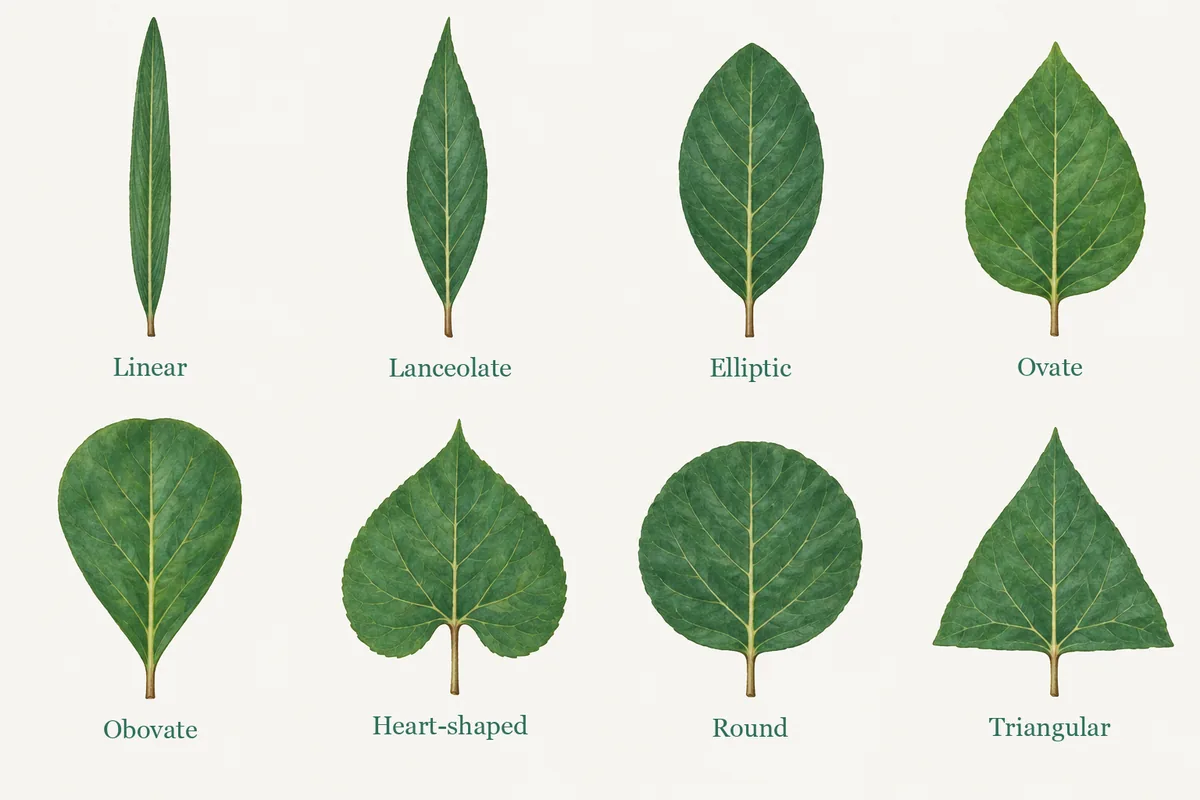
Shape terms describe the outline of a simple leaf, or of one leaflet of a compound leaf. Two questions settle most of them: how long is the leaf for its width, and where is it widest?
| Term | What it means | Trees that show it |
|---|---|---|
| Linear | Long and narrow with parallel sides, more than 4 times as long as wide | Willow oak: slender, willow-like leaves about 4 to 5 inches long and 1 inch wide; NC State Extension lists the shape as linear to lanceolate |
| Lanceolate | Longer than wide, widest below the middle, tapering to both ends | Shingle oak: broadly lanceolate, unlobed, 3 to 7 inches, with one bristle at the tip (Virginia Tech). American chestnut: 4 to 9 inches long, 1 1/2 to 3 inches wide (NC State Extension) |
| Elliptic | Widest in the middle, narrowing evenly to both ends | Black cherry: 3 to 6 inches long, listed as elliptical to lanceolate (NC State Extension). UK: beech, 4 to 9 cm, oval and pointed |
| Ovate | Egg-shaped, the broad end at the stalk | Hackberry: oval to lance-shaped, 2 to 5 inches, with an uneven base (NC State Extension). American elm: ovate-elliptic, 4 to 6 inches |
| Obovate | Egg-shaped the other way round, the narrow end at the stalk | Pawpaw: 6 to 12 inches long and 2 to 3 inches wide, with a green-pepper smell when crushed. Black gum: elliptic to obovate, 3 to 6 inches (both NC State Extension) |
| Heart-shaped | A notch at the base where the stalk joins (cordate) | Eastern redbud: 3 to 5 inches long and wide, smooth edges (NC State Extension). UK: small-leaved lime, 3 to 8 cm, with reddish-brown tufts in the vein angles underneath (Woodland Trust) |
| Round | Almost as wide as long, circular in outline (orbicular) | Quaking aspen: heart-shaped to nearly round, 1 to 3 inches, finely toothed, on a flattened stalk that makes the leaf tremble (Virginia Tech). UK: alder, 3 to 9 cm, tip never pointed and often indented (Woodland Trust) |
| Triangular | Widest at the base with nearly straight sides (deltoid) | Eastern cottonwood: triangular, 3 to 6 inches long and up to 4 inches wide, on a 2 1/2 to 4 inch stalk (NC State Extension). UK: silver birch, small, triangular, toothed (Woodland Trust) |
The trap: one tree, several shapes. Sources disagree at the edges. NC State lists American elm as ovate-elliptic and flowering dogwood as oval to ovate, and quaking aspen sits between heart-shaped and round. Measure the length and width of three or four sunlit leaves and note where each is widest; a range ("ovate to elliptic") is a better description than one forced term. Heart-shaped leaves have their own clue page: trees with heart-shaped leaves separates redbud, catalpa, basswood and the others.
Leaf margins: the edge of the blade
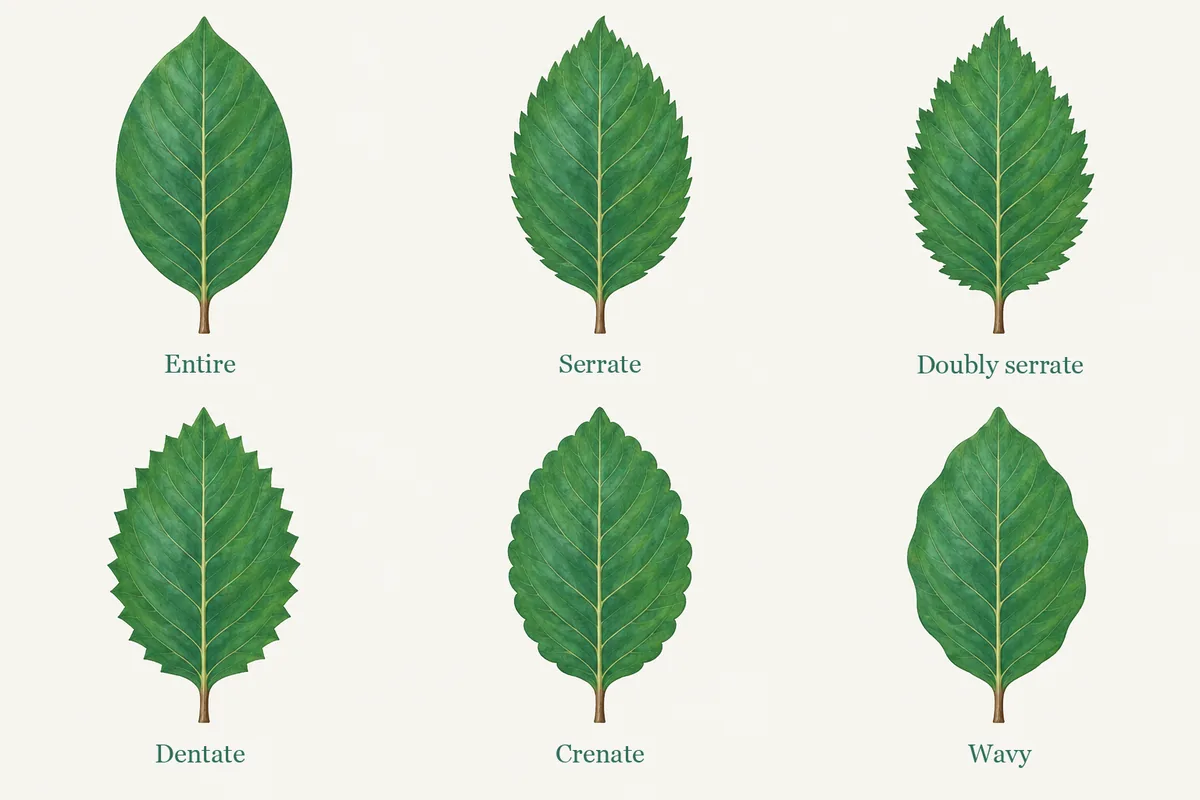
Run a fingertip along the edge, then look at one tooth closely. The direction and shape of the teeth decide the term.
| Term | What it means | Trees that show it |
|---|---|---|
| Entire | Smooth, with no teeth, notches or lobes | Eastern redbud, pawpaw, the leaflets of honeylocust |
| Serrate | Sharp teeth pointing forward toward the tip, like a saw | Black cherry: fine, incurved teeth (NC State Extension). Sweetgum lobes are toothed too |
| Doubly serrate | Each forward-pointing tooth carries smaller teeth | American elm, which adds a lopsided base (NC State Extension). UK: hornbeam, whose doubly serrated edge separates it from beech (Woodland Trust) |
| Dentate | Teeth pointing straight outward from the edge | Witch-hazel: toothed, listed as dentate, 3 to 6 inches, with an oblique base. American chestnut: coarse teeth with bristly tips (both NC State Extension) |
| Crenate | Rounded teeth, like a row of scallops | Eastern cottonwood: coarse, curved teeth described as dentate or crenate; NC State also lists quaking aspen as crenate. UK: field maple, five lobes with rounded teeth (Woodland Trust) |
| Wavy | An edge that rises and falls in waves (undulate) | Willow oak: entire and wavy (NC State Extension). UK: beech, oval with a wavy edge and hairy margins when young (Woodland Trust) |
The trap: teeth that change along one leaf. Hackberry is coarsely toothed only from the middle to the tip, and black gum leaves are mostly entire with a few teeth near the tip of some leaves (NC State Extension). Read the margin on the middle third of several leaves. Beech against hornbeam is the classic UK test: a wavy, nearly smooth edge is beech, a finely double-toothed edge is hornbeam.
Leaf arrangement: how leaves sit on the twig
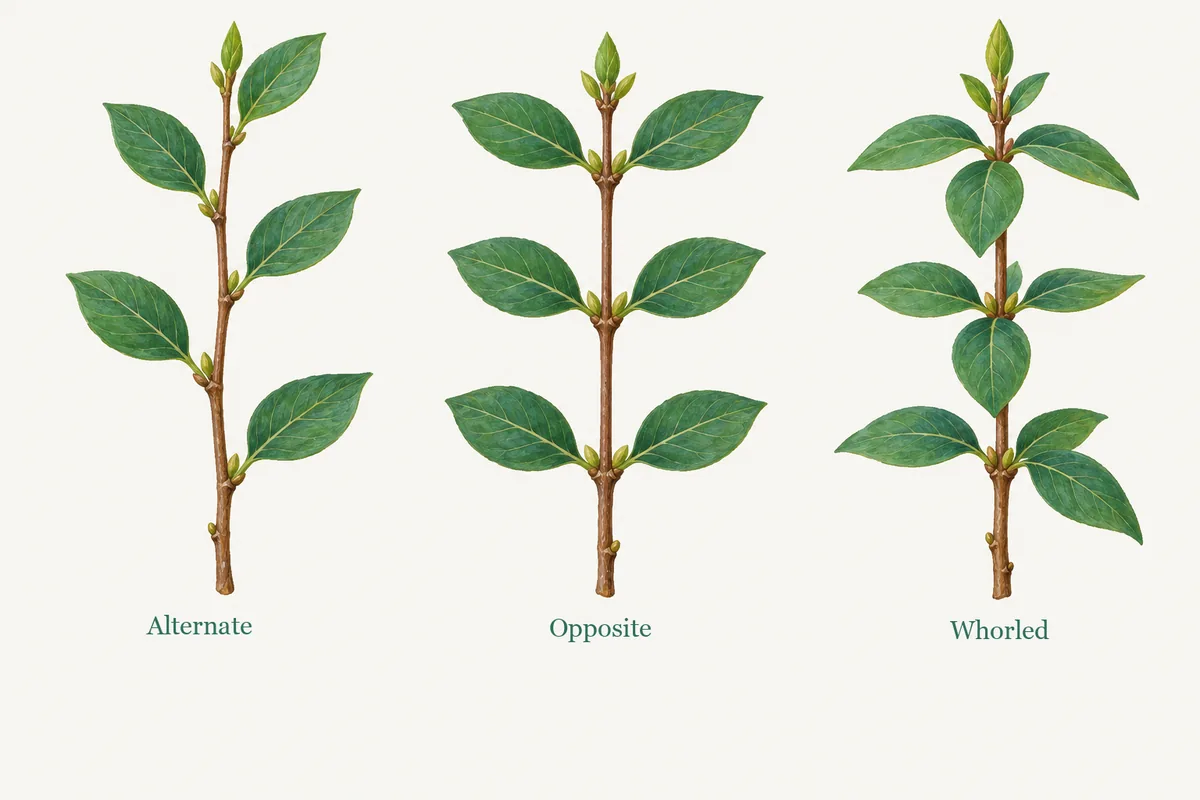
Arrangement is read on the twig, not on a loose leaf, so it is the term most often missing from a photo. A node is the point where a leaf, and its bud, joins the twig.
| Term | What it means | Trees that show it |
|---|---|---|
| Alternate | One leaf at each node, staggered along the twig | Most broadleaf trees: white oak, American elm, black cherry, eastern redbud, honeylocust, eastern cottonwood |
| Opposite | Two leaves at the same node, facing each other | Ohio buckeye and flowering dogwood, both listed as opposite by NC State Extension; maples and ashes |
| Whorled | Three or more leaves at the same node | Catalpas: NC State lists northern catalpa as whorled or opposite, and Virginia Tech says the same of southern catalpa. Eastern redcedar scales can also sit three to a node |
The trap: a missing leaf. A broken or fallen leaf makes an opposite tree look alternate, and short spur shoots crowd leaves into tufts that look whorled. Check three or four twigs, and look at the buds and leaf scars, which keep the pattern after the leaves fall. Opposite leaves are rare enough among large trees that they make a fast first split; the short list is on trees with opposite leaves.
Putting the terms together
A full description strings one term from each chart, plus the size, in the order a key asks for them:
- Alternate, simple, ovate-elliptic, doubly serrate, 4 to 6 inches, lopsided base: American elm.
- Opposite, palmately compound, 5 to 7 serrate leaflets: a buckeye, or a horse chestnut in a UK park.
- Alternate, pinnately lobed, rounded lobes without bristles, 4 to 7 inches: white oak.
- Alternate, simple, heart-shaped, entire, 3 to 5 inches: eastern redbud.
- Alternate, simple, triangular, crenate to dentate, on a long stalk: eastern cottonwood.
Once you can write a line like these, the tree identification key asks for the same features one question at a time and names the tree. The vocabulary also makes field guides and extension fact sheets readable: "alternate, simple, obovate, entire" stops being jargon and becomes a picture.
Where a photo app fits
Tree Identifier, an iPhone app, names a tree from one photo of a leaf, the bark, a flower, a fruit or the whole tree, and shows the common and scientific name with key traits. It shows no confidence score and does not label the leaf with these terms, so use the charts to check its answer: if the app says elm and your leaf is opposite and smooth-edged, look again. The follow-up chat under each result in Tree Identifier is the place to ask "is this leaf serrate or dentate?" or how the species differs from the one you expected.
A photo is most useful when the leaves are out of reach or the tree is a planted species your field guide leaves out. Lay one typical leaf flat on a plain background, upper side up, and take a second photo of the twig so the arrangement shows.
What a photo can't settle
- One tree can show several shapes. Sprouts, shade leaves and young trees often have bigger or oddly lobed leaves, so name the shape of sunlit leaves from the outer crown.
- Sources draw the lines between terms differently: one glossary's ovate is another's elliptic, and a tree can be listed as both. Use the terms to narrow the list, not to settle a species alone.
- A photo shows outline and margin well but can hide the arrangement and the buds. Look at the twig itself before you decide between simple and compound or opposite and alternate.
Questions people ask
What are the main types of leaves?
Field guides sort leaves into simple (one blade, which may be palmately or pinnately lobed) and compound (separate leaflets on one stalk: pinnately compound, bipinnately compound, palmately compound or trifoliate). Conifers add needles and scale-like leaves, as on eastern redcedar.
What is the difference between pinnate and palmate?
Pinnate parts sit along both sides of a central axis, like a feather: white oak lobes, honeylocust leaflets. Palmate parts spread from one point, like fingers from a palm: sweetgum lobes, buckeye and horse chestnut leaflets.
What is the difference between serrate and dentate?
Both are toothed margins. Serrate teeth are sharp and point forward toward the leaf tip, like a saw (black cherry). Dentate teeth point straight outward from the edge (witch-hazel). Crenate teeth are rounded rather than sharp.
How do I tell a compound leaf from a twig of simple leaves?
Look for buds. A bud sits in the angle where each whole leaf joins the twig, but never at the base of a leaflet. If the small blades share one stalk with no buds between them, you are holding one compound leaf. A twig also ends in a bud; a compound leaf does not.
What leaf shape is a heart?
Botanists call it cordate: a notch at the base where the stalk joins. Eastern redbud has heart-shaped leaves 3 to 5 inches long and wide with smooth edges. In the UK, small-leaved lime has heart-shaped leaves 3 to 8 cm long with a pointed tip.
Sources
- Glossary, Woody Plants Tutorial — University of Illinois, Department of Natural Resources and Environmental Sciences
- Gleditsia triacanthos (honeylocust) — North Carolina Extension Gardener Plant Toolbox, NC State University
- Aesculus glabra (Ohio buckeye) — North Carolina Extension Gardener Plant Toolbox, NC State University
- Ptelea trifoliata (hoptree) — North Carolina Extension Gardener Plant Toolbox, NC State University
- Juniperus virginiana (eastern red cedar) — North Carolina Extension Gardener Plant Toolbox, NC State University
- Quercus phellos (willow oak) — North Carolina Extension Gardener Plant Toolbox, NC State University
- Quaking aspen fact sheet — Virginia Tech Dendrology
- Beech (Fagus sylvatica) — Woodland Trust