South Africa field guide
South African indigenous trees and how to tell them apart
Start with the tree's number on the national list, then the spines, leaves and fruit. Ten trees cover most of what a visitor to the bushveld, the forests and the Cape meets first.
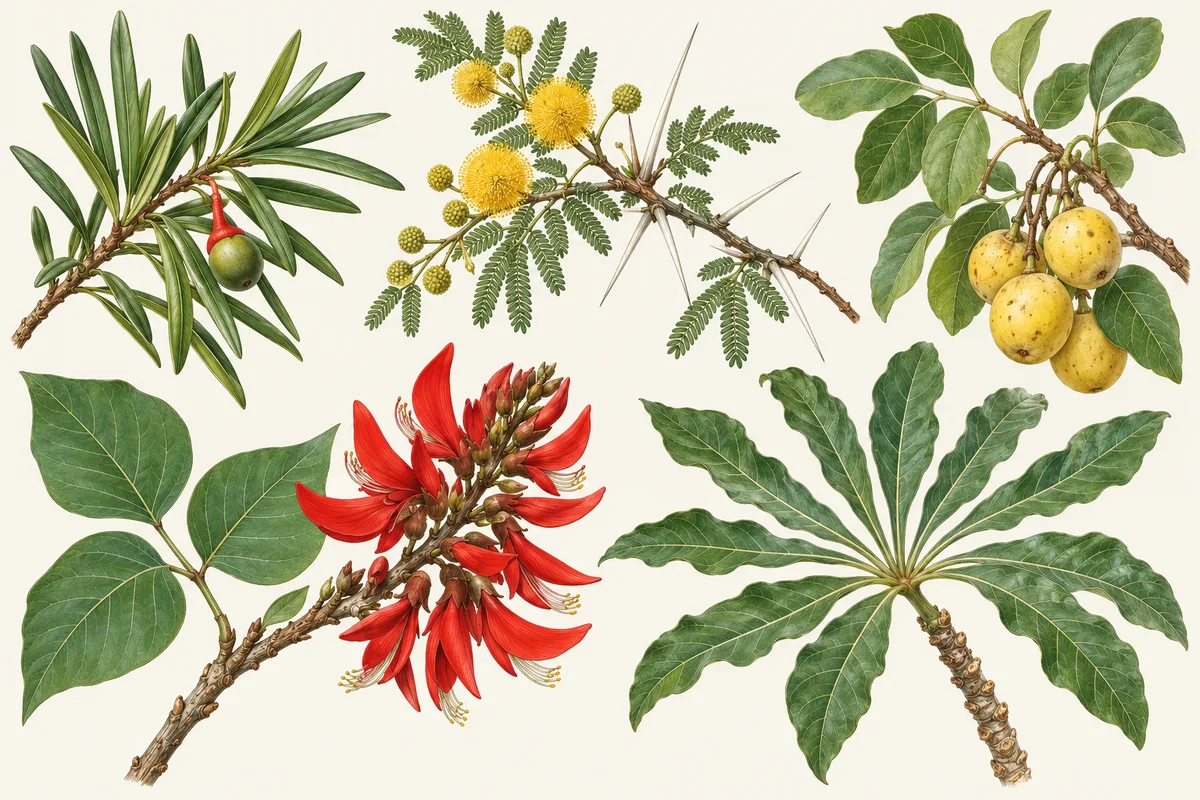
In short
South African indigenous trees are easiest to learn through ten common or famous species. The real yellowwood, SA Tree No. 18, is the national tree; the baobab (No. 467) has 5–7 finger-like leaflets; sweet thorn (No. 172) carries long, straight, paired white spines; and the marula (No. 360) drops fruit that turns yellow from February to June. Jacaranda is planted, not indigenous.
- Every indigenous tree has a number on the National List of Indigenous Trees; SANBI's PlantZAfrica shows it as "SA Tree No" (real yellowwood is 18, baobab 467).
- The 2018 list of protected trees under the National Forests Act names 47 species; four more were added in March 2022.
- Jacaranda comes from South America and is listed as a NEMBA Category 3 invasive, according to the Stellenbosch University Botanical Garden.
South Africa's trees run from the yellowwood forests of the southern Cape to the baobabs of Limpopo, and a short list of famous species covers most of what people ask about. The national tree numbers used on every SANBI profile are the quickest way to keep names straight. Never eat a berry, nut, seed or pod on the strength of a web page or an app; check with a local expert.
Ten indigenous trees to learn first
Each tree below has its SA Tree No., the number on the National List of Indigenous Trees that SANBI's PlantZAfrica prints on every profile. The same numbers appear in the government's list of protected trees, so a number is the safest way to match a tree across a field guide, a nursery label and the law. Clues come from the PlantZAfrica profile of each species.
| Tree | SA Tree No. | One clue that settles it | Where you meet it |
|---|---|---|---|
| Real yellowwood (Podocarpus latifolius) | 18 | Long, narrow, glossy leaves; grey bark peeling in strips; new growth pale green or bronze | Mountain forests in the south, east and north |
| Outeniqua yellowwood (Afrocarpus falcatus) | 16 | Leaves with a sharply pointed tip; old bark flaking; large yellow fleshy fruit | Forests; can reach 45 m in nature |
| Baobab (Adansonia digitata) | 467 | Huge squat trunk; leaves of 5–7 finger-like leaflets; leafless in winter | Only the warm parts of Limpopo |
| Marula (Sclerocarya birrea) | 360 | Compound leaves crowded at branch tips; fruit green on the tree, yellow after falling | Woodland on sandy soil, Limpopo, Mpumalanga, KwaZulu-Natal |
| Sweet thorn (Vachellia karroo) | 172 | Long, straight, paired white spines; yellow pompon flowers in early summer | Almost everywhere |
| Camel thorn (Vachellia erioloba) | 168 | Spines up to 60 mm with swollen bases; velvety grey half-moon pods | Dry west, Northern Cape to Limpopo |
| Common coral tree (Erythrina lysistemon) | 245 | Scarlet flowers on bare branches in August–September; leaves of three leaflets; hooked prickles | North West and Limpopo to KwaZulu-Natal and the Eastern Cape; street trees |
| Wild olive (Olea europaea subsp. africana) | 617 | Leaves grey-green above, greyish below; small purple-black fruit March to July | Rocky hillsides and stream banks |
| Leadwood (Combretum imberbe) | 539 | Pale grey to white trunk with snakeskin-like bark; opposite leathery leaves; four-winged fruit | All bushveld regions |
| Shepherd's tree (Boscia albitrunca) | 122 | Smooth white trunk; small grey-green leaves 20–50 mm in clusters | Low-rainfall areas, Northern Cape to Limpopo |
The real yellowwood profile calls it South Africa's national tree and one of its most valued timber trees. Male trees carry catkin-like cones from July to September; female trees carry round grey-blue seeds on fleshy stalks that turn purple from December to February. All Podocarpus species are protected in South Africa, PlantZAfrica notes, after logging made them almost extinct in some areas.
Thorn trees: sweet thorn and camel thorn
Most visitors to the bushveld meet thorn trees first, and the two most famous are easy to separate once you look at the pods and spines.
Sweet thorn was long known as Acacia karroo. The PlantZAfrica profile describes a rounded crown branching low on the trunk, up to about 12 m where water is good, with red bark on young branches. The spines are paired, greyish to white, long and straight, though they may be quite short on mature trees. Masses of yellow pompon flowers open in early summer, followed by flat, crescent-shaped pods that split open.
Camel thorn ranges from a 2 m shrub to a 16 m tree. The camel thorn profile gives spines up to 60 mm long, often with swollen bases, twice-divided leaves with 2–5 pairs of pinnae, and the giveaway: thick half-moon pods up to 130 mm long and 50 mm wide, covered in velvety grey hairs, that do not open even when ripe. It grows inland in the western half of the country, from the Northern Cape through to Limpopo.
Spine shape matters across the whole group. PlantZAfrica explains that straight, paired spines grow from modified stipules, while the short, curved, rose-like thorns of some other species are prickles from the bark's skin. Our guide to trees with thorns covers the northern-hemisphere thorn trees with the same test.
Bushveld giants: baobab, marula and leadwood
Baobab. SANBI calls it the largest succulent plant in the world. The baobab profile gives trunks of up to 28 m in girth on trees that seldom exceed 25 m tall, bark 50–100 mm thick, and branches that look like roots, hence "upside-down tree". White, sweetly scented flowers up to 200 mm across open in the late afternoon from October to December and fall within 24 hours; the egg-shaped fruit, often over 120 mm, is covered in yellowish-brown hairs.
Marula. A medium-sized to large deciduous tree with an erect trunk and rounded crown. The marula profile explains that male and female flowers grow on separate trees, so only female trees fruit. The fruit is green on the tree and turns yellow after falling, from February to June. PlantZAfrica says the tree is more dominant around Phalaborwa in Limpopo and very sensitive to frost.
Leadwood. The tallest South African combretum, up to 20 m, with a pale grey to almost white trunk and snakeskin-like bark that stays readable all year. Dead branches often remain on old trees, and dead leadwoods stand for a long time.
When a tree is too tall to reach, Tree Identifier can suggest a name from one photo of the trunk, a leaf, a flower or a fruit; the baobab is in the app's Collection. The app shows one name, not a list of alternatives, so check the clue in the table above before you settle on it.
Protected trees and the national list
South Africa protects named tree species under section 12 of the National Forests Act of 1998. The 2018 list of protected tree species (Notice 536, Schedule A) names 47 species with their national tree numbers, among them the baobab (467), camel thorn (168) and grey camel thorn (169), marula (360), the four yellowwoods (15–18), stinkwood (118), silver tree (77), shepherd's tree (122), leadwood (539), white milkwood (579), wild teak (236) and three mangroves.
On 30 March 2022, SAnews reported that four species were added to the annual list: red and pink ivory (Berchemia zeyheri), jackal berry (Diospyros mespiliformis), manketti (Schinziophyton rautanenii) and umtiza (Umtiza listeriana). Without a licence or exemption, nobody may cut, damage or destroy a protected tree, or collect, transport, buy or sell one or its products; breaking the rule is a first category offence. The list is updated every year, so check the current notice before relying on any one species' status.
Trees you see that are not indigenous
Many of the most visible trees in South African towns came from elsewhere.
- Jacaranda. The lavender-blue street tree of Pretoria, nicknamed Jacaranda City, comes from South America. The Stellenbosch University Botanical Garden lists it as a NEMBA Category 3 invasive that may not be propagated or transported. Its fern-like leaves set it apart from the indigenous trees above; see trees with purple flowers.
- Gum trees. Eucalyptus come from Australia; our eucalyptus page covers how to recognise them.
- Pines and oaks. Plantation pines and garden oaks were brought in; among the ten trees above, the only conifers are the two yellowwoods.
Indigenous and planted trees grow side by side in gardens, so a name from an app or a book still leaves the question of origin open; the SA Tree No. is a quick check, since only indigenous trees have one.
What a photo can't settle
- A photo cannot tell whether a tree is protected or whether a licence applies; the list and the provincial forestry office settle that.
- Many thorn trees in the Vachellia and Senegalia groups look alike; PlantZAfrica notes that sweet thorn alone has different forms in different places, so pods, spines and flowers together are needed.
- Young yellowwoods have larger leaves than mature ones, and the four yellowwood species overlap; female cones or fruit make a name far more certain.
Questions people ask
What is the national tree of South Africa?
The real yellowwood, Podocarpus latifolius, SA Tree No. 18. SANBI's PlantZAfrica describes it as a slow-growing evergreen of 20–30 m with long, narrow, glossy leaves, grey bark that peels in strips, and, on female trees, grey-blue seeds on fleshy stalks that turn purple from December to February.
What is the SA Tree No?
It is the tree's number on the National List of Indigenous Trees. SANBI's PlantZAfrica prints it on every indigenous tree profile, and the protected-tree list under the National Forests Act uses the same national tree numbers, so a number such as 467 (baobab) identifies one species across books, lists and websites.
Which trees are protected in South Africa?
The 2018 list under the National Forests Act names 47 species, among them the baobab, camel thorn, marula, four yellowwoods, stinkwood, leadwood, shepherd's tree, silver tree and white milkwood. In March 2022 SAnews reported four additions, including the jackal berry and the umtiza. Protected trees may not be cut or damaged without a licence.
Are jacaranda trees indigenous to South Africa?
No. The Stellenbosch University Botanical Garden gives its home as South America and lists it as a NEMBA Category 3 invasive that may not be propagated or transported. Pretoria is still nicknamed Jacaranda City for its planted street trees.
How do you tell sweet thorn from camel thorn?
Look at the pods. Sweet thorn has flat, crescent-shaped pods that split open on the tree. Camel thorn has thick, half-moon-shaped pods up to 130 mm long, covered in velvety grey hairs, that never split and fall to the ground in winter.
Sources
- Podocarpus latifolius (real yellowwood) — SANBI PlantZAfrica
- Adansonia digitata (baobab) — SANBI PlantZAfrica
- Vachellia karroo (sweet thorn) — SANBI PlantZAfrica
- Vachellia erioloba (camel thorn) — SANBI PlantZAfrica
- Sclerocarya birrea (marula) — SANBI PlantZAfrica
- National Forests Act, 1998: List of Protected Tree Species (2018), Notice 536, Schedule A — acts.co.za (reproducing the Government Gazette)
- Four tree species added to list of protected trees — SAnews, Government Communication and Information System
- Jacaranda mimosifolia — Stellenbosch University Botanical Garden