Seasonal guide
Spring tree identification, from first flowers to full leaf
Spring hands you a new clue every few weeks. Read the order in which flowers, catkins and leaves appear, and most trees name themselves before summer.
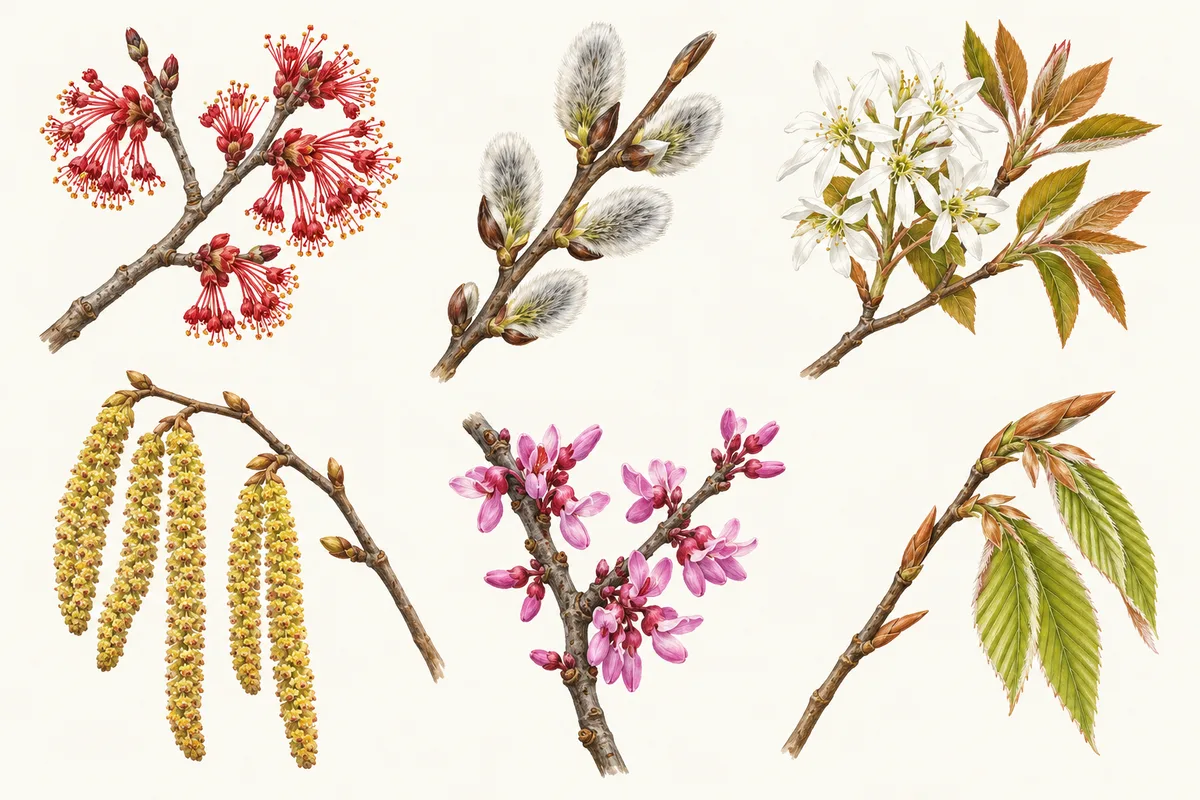
In short
For spring tree identification, note what opens first and whether the leaves are out yet. Red and silver maples flower on bare twigs, often in March, weeks before their leaves. American elm flowers 2 to 3 weeks before leaf flush. Redbud, serviceberry and flowering dogwood bloom before leafing, while black cherry waits until its leaves are nearly full-grown. Catkins point to aspens, birches, willows and oaks.
- Flowers on bare twigs in March are usually red or silver maple; American elm flowers on long drooping stalks at about the same time.
- Redbud, serviceberry and flowering dogwood bloom before their leaves; tulip tree, black locust and black cherry bloom after the leaves are out.
- Hanging catkins on bare branches point to aspens, poplars, birches and willows; oak catkins come out with or just before the leaves.
Spring is the season when trees change fastest, and that is what makes it useful. In the space of three months most trees flower, put out new leaves and, in some species, already drop their first seeds. The order in which these things happen is itself a clue: a tree in full flower on bare twigs in March narrows the list to a handful of names. This guide walks through spring in the order trees wake up, with sourced field marks for each stage.
What to look at in spring, in order
Work through these checks on any tree you can't name between March and June:
- Are the leaves out? If not, are flowers open on the bare twigs? Only some trees bloom before leafing.
- Are there catkins? Hanging, tassel-like flower spikes point to a short list of wind-pollinated trees.
- If flowers and leaves are out together, note the flower's color and build, and whether it came before, with or after the leaves.
- Read the new leaves once they have expanded, especially their arrangement on the twig.
- Look for early seeds on the tree and the ground: some trees ripen seed in spring.
- Fall back on winter clues if nothing is open yet: buds, twigs and bark (see the winter tree identification guide).
The quick calendar below sorts common eastern North American trees by when they flower relative to their leaves.
| Tree | Flowers | Relative to leaves | Typical timing | Settles it |
|---|---|---|---|---|
| Red maple | Small, red (sometimes yellowish) | Several weeks before | March to May | Red haze on bare crown, opposite buds |
| Silver maple | Red to yellow-green | Before | Late winter, early spring | Same time as red maple; widely spread two-winged seeds in late spring |
| American elm | Tiny, on long drooping stalks | 2 to 3 weeks before | Early spring | Flat, notched seeds by late spring |
| Quaking aspen | Catkins 1.5 to 2.5 in | Before | Mid-March to April (New England) | Hanging catkins across a whole clonal grove |
| Eastern redbud | Purple-pink, pea-like | Before | April | Flat pods 2 to 4 in long follow the flowers |
| Serviceberry | White, narrow strap-like petals | Before | Early spring | Strap-like petals in bunches 2 to 4 in long |
| Flowering dogwood | Four white bracts | Before | Mid-March (South) to late May (North) | Opposite leaves, square bark blocks |
| Northern red oak | Catkins | Before or with | April or May | Bristle-tipped lobes on the new leaves |
| Sugar maple | Yellow-green, inconspicuous | As leaves expand | Spring | Opposite, lobed leaves |
| Black cherry | White, in racemes | After, leaves nearly full-grown | Mid-May (Pennsylvania, New York) | Leaves still reddish at bloom |
Early spring: flowers on bare twigs
The first trees to flower in the East are the maples. The USDA Forest Service's Silvics of North America calls red maple "one of the first trees to flower in the spring, generally several weeks before vegetative bud break", with red, occasionally yellowish flowers from March through May depending on latitude and elevation. Seen from a distance, a red maple in flower gives a bare crown a red haze.
Silver maple flowers alongside it. At the Arnold Arboretum near Boston, Jake Grossman recorded both species in flower by the first week of March in 2020, with leaves emerging only around April 15: a gap of about five weeks between flowers and leaves, which he notes no other maple there matched. Sugar maples at the arboretum showed no bud swelling until the middle of April.
American elm flowers at about the same time and is easy to miss. The Forest Service says the flowers "appear 2 to 3 weeks before leaf flush" and hang on "long, slender, drooping pedicels", with bright red anthers. Look for a faintly reddish fringe on the twigs of a large, vase-shaped tree.
A little later come the showy small trees. Utah State University Extension's TreeBrowser describes eastern redbud flowers as purple-pink and pea-like, appearing before the leaves in April, and downy serviceberry as white with narrow, strap-like petals, in small bunches 2 to 4 inches (5 to 10 cm) long, "appearing early, before leaves". Flowering dogwood's white "petals" are four bracts around a cluster of small yellowish flowers; the Forest Service gives flowering dates from mid-March in the South to late May in the North, before the leaves appear. Redbud has its own identification page, and the white-flowering trees guide separates serviceberry, dogwood, cherries and Callery pear.
Catkins: the wind-pollinated trees
Catkins are dense, often hanging spikes of tiny flowers with no showy petals. Aspen's, for one, are pollinated by wind, and many catkins open before the leaves.
- Quaking aspen. The Forest Service describes pendulous catkins 1.5 to 2.5 inches (3.8 to 6.4 cm) long that open before the leaves expand: mid-March to April in New England, May to June in the central Rockies. Aspen is primarily dioecious, and trees in one clone are usually all male or all female, so a whole grove may carry only one kind of catkin.
- Paper birch. Its male catkins form the summer before and lengthen to 1.5 to 4 inches (4 to 10 cm) in spring, with flowering from mid-April to early June depending on location (Forest Service).
- Willows. USU describes black willow's male catkins as sometimes bright yellow, from early spring.
- Oaks. The male flowers of northern red oak hang in catkins that "emerge before or at the same time as the current leaves in April or May". Hanging tassels among the opening leaves in April or May point to an oak; the leaves then settle which one.
Mid to late spring: flowers with or after the leaves
Once the canopy greens up, flowers come with leaves attached, and the leaves become your second clue.
Norway and sugar maples flower "as leaves expand", according to USU. Norway maple's flowers are yellow-green to yellow and fairly showy; sugar maple's are yellow-green and inconspicuous.
Black cherry is a useful contrast with the ornamental cherries. The Forest Service notes that "unlike domestic cherries, which flower before the leaves appear, black cherry flowers late in relation to leaf development". In Pennsylvania and New York its white flowers open in mid-May, when the leaves are nearly full-grown but still reddish. Flowering runs from the end of March in Texas to early June in Quebec.
Late spring brings the big showy flowers that open among full leaves. USU gives black locust's white, pea-like, very fragrant flowers in May to early June; horse chestnut's white flowers with red spots in large cone-shaped clusters in May; and tulip tree's large green-yellow flowers in May or June, "after the leaves are open". The guide to identifying trees by their flowers sorts all of these by flower build and color.
New leaves and early seeds
Young leaves are not miniature summer leaves. They are often softer, smaller and tinged red or bronze, as with black cherry at bloom time. Wait until a leaf has fully expanded before measuring it or running it through a key, and use the arrangement on the twig, which does not change: opposite leaves still mean a maple, ash, dogwood or buckeye in eastern North America.
Some trees ripen seed before summer, which gives you a second chance to name a tree you missed in flower:
- Red maple fruit ripens from April through June, before leaf development is complete (Forest Service).
- Silver maple samaras, with two widely spread wings about 1.5 inches (4 cm) long, mature in late spring and germinate immediately (USU).
- American elm seed fall is usually complete by mid-March in the South and mid-June in the North (Forest Service). USU describes the seed as about 0.5 inch (1.3 cm) long and oval, with a flat, thin wing all around it, notched at the tip.
Never eat a berry, nut, seed or pod on the strength of a web page or an app; check with a local expert.
Where a photo app helps in spring
Spring flowers do not last, so a photo taken on the day is worth having. Tree Identifier, an iPhone app, identifies trees from one photo of the whole tree, a leaf, the bark, the flowers or the fruit, and gives the common and scientific names, origin and key traits. It uses a cloud AI model and needs an internet connection.
Flowers on bare twigs can be tiny and high up, so photograph a fallen twig or a low branch if you can. Tree Identifier does not give a confidence score or a list of look-alikes; check its answer against the calendar above, and ask the follow-up chat under the result how to confirm it once the leaves are out. If you allow location, the Tree Map pins the find so you can return in summer for leaves and fruit.
What a photo can't settle
- Flowering dates shift by weeks with latitude, elevation and the weather of a given year, so a calendar can only say what is likely, not what is certain.
- A tree flowers only when mature and not every year; the Arnold Arboretum notes that some maples do not flower at all in a given year.
- Young spring leaves are often smaller, softer and differently colored than mature ones, which can mislead a photo app or a key until the leaves have expanded.
Questions people ask
Which trees flower first in spring?
In eastern North America, red and silver maples are usually first, flowering on bare twigs in late winter or early spring. At the Arnold Arboretum near Boston they were in flower by the first week of March in 2020. American elm, aspens and willows follow soon after, all before their leaves.
What tree has red flowers before the leaves in early spring?
Usually red maple. The USDA Forest Service describes it as one of the first trees to flower in spring, generally several weeks before its leaf buds open, with red or occasionally yellowish flowers from March to May. Silver maple flowers at the same time but its flowers run from red to yellow-green.
How do you identify a tree before its leaves come out?
Use the flowers if they are open, and the winter clues if they are not: whether buds sit opposite or alternate, bud shape, bark and any fruit left from last year. Flowers on bare twigs narrow the field a lot, because only some trees bloom before leafing.
Why do some trees flower before their leaves?
Timing differs by species. The USDA Forest Service describes quaking aspen and American elm, both wind-pollinated, as flowering before the leaves expand. Not every early bloomer relies on wind: redbud and flowering dogwood also bloom before leafing, while black cherry, which is insect-pollinated, flowers after its leaves.
Sources
- Red Maple (Acer rubrum), Silvics of North America — USDA Forest Service
- American Elm (Ulmus americana), Silvics of North America — USDA Forest Service
- Quaking Aspen (Populus tremuloides), Silvics of North America — USDA Forest Service
- Black Cherry (Prunus serotina), Silvics of North America — USDA Forest Service
- Spring comes to the maples — Arnold Arboretum of Harvard University (Jake J. Grossman, 2020)
- TreeBrowser: Redbud, Eastern — Utah State University Extension
- Northern Red Oak (Quercus rubra), Silvics of North America — USDA Forest Service
Keep reading
- Winter field guideWinter tree identification, from buds to bark
- Field guideFlowering tree identification, by color, build and timing
- Clue guideWhich tree has white flowers? Start with the month
- Clue guideWhich tree has pink flowers? Spring and summer are two different lists
- Tree profileRedbud tree (Cercis canadensis): how to identify it