Field guide
Flowering tree identification, by color, build and timing
Color gets you to a short list. The shape of each flower, how they are grouped and whether the leaves are out yet usually settle the name.
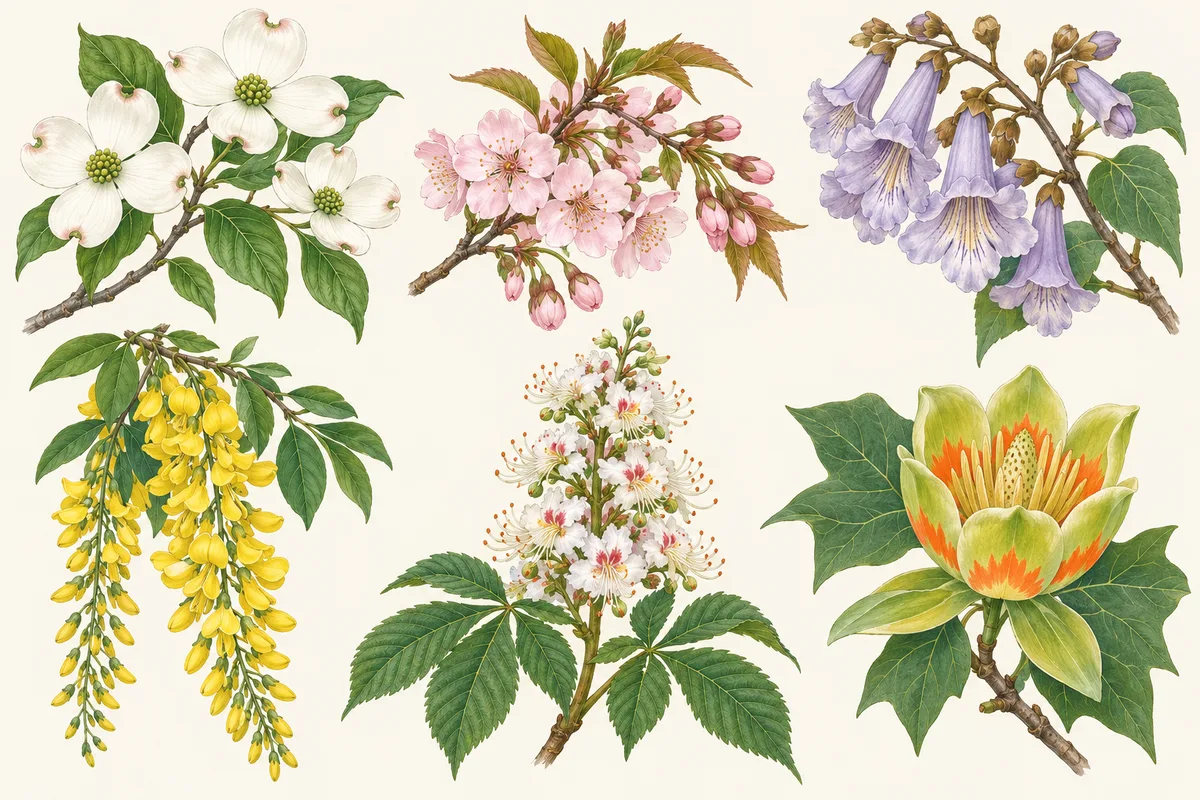
In short
For flowering tree identification, check three things: the color, the flower's build and its timing. Pea-shaped purple-pink flowers on bare twigs in April point to redbud. Four white "petals" that are really bracts point to flowering dogwood. White trumpets with yellow and purple spots in upright clusters in late spring point to catalpa. Hanging catkins point to oaks, birches, aspens or willows.
- Color narrows the list; the flower's build (pea flower, trumpet, catkin, bract) and whether the leaves are out usually settle it.
- Showy 'petals' are sometimes bracts: flowering dogwood's four white ones surround a small cluster of yellowish true flowers.
- The flower predicts the fruit: pea flowers become flat pods, catalpa trumpets become pods 8 to 20 inches long.
A tree in flower is the easiest tree to notice and, often, one of the easiest to name. Color gets you to a short list, and this guide links to a separate page for each color. But two trees with white flowers can be as different as a dogwood and a black locust, so the step that settles most names is looking closely at a single flower: how it is built, how the flowers are grouped and whether the leaves were out when it opened.
Start with color, then read the flower's build
Start with the color you see from a distance, then open the guide for that color. Each one sorts its candidates by bloom month and region and gives the field test that settles each.
| Flower color | Common candidates | Guide |
|---|---|---|
| White | Callery pear, serviceberry, flowering dogwood, cherries, magnolias, black locust, catalpa | Trees with white flowers |
| Pink | Flowering cherries, crabapples, redbud, pink dogwood, mimosa, crape myrtle | Trees with pink flowers |
| Yellow | Golden rain tree, tulip tree, golden chain, palo verde | Trees with yellow flowers |
| Purple | Redbud, jacaranda, royal paulownia, crape myrtle, chaste tree | Trees with purple flowers |
| Red | Red maple, red buckeye, bottlebrush and other red bloomers | Trees with red flowers |
Color has two traps. Cultivars stretch it: Utah State University Extension's TreeBrowser lists crabapple cultivars with white, pink, red or purplish flowers. And some showy "petals" are not petals at all. The USDA Forest Service's Silvics of North America notes that flowering dogwood's "showy petal-like bracts are not in fact flowers": the true flowers are small and yellowish, crowded inside four snow-white bracts that span 2 to 4 inches (5 to 10 cm).
So after color, look closely at one flower and its cluster. The next section groups common North American flowering trees by build, using USU TreeBrowser's descriptions unless another source is named.
Eight flower builds that narrow the list
1. Catkins: tiny flowers in tassels. No showy petals, just dense spikes, often hanging. Quaking aspen's catkins are 1.5 to 2.5 inches (3.8 to 6.4 cm) long and wind-pollinated, according to the Forest Service. White oak's male flowers are yellow-green, in slender catkins 2 to 4 inches (5 to 10 cm) long that appear with the leaves in mid-spring (Virginia Tech Dendrology). Birches, black walnut and willows carry catkins too; black willow's male catkins can be bright yellow.
2. Pea flowers: the legume family. Flowers shaped like a garden sweet pea. Eastern redbud has purple-pink pea-like flowers before the leaves in April. Black locust has white, very fragrant pea-like flowers in hanging groups 4 to 8 inches (10 to 20 cm) long, in May to early June.
3. Apple-like blossoms. Rounded white or pink blossoms in clusters, the build of cherries, crabapples, pears and hawthorns. USU describes crabapple flowers as "similar to apple", Callery pear's as showy and white, 0.5 to 1 inch across, and Washington hawthorn's as white, about 0.5 inch. Yoshino cherry carries pink or white fragrant flowers 1 to 1.5 inches across, in March to April. Downy serviceberry belongs here but with narrow, strap-like petals.
4. Large cups and stars: magnolias and tulip tree. Saucer magnolia flowers are 5 to 10 inches (13 to 25 cm) across, white to pink to purplish, and open before the leaves. Southern magnolia's are white, fragrant, 6 to 10 inches across with 6 to 12 petals, in May to June among evergreen leaves. Tulip tree's flowers are large and green-yellow, opening in May or June after the leaves.
5. Trumpets. Northern catalpa has showy, trumpet-like white flowers about 2.5 inches (6 cm) wide, spotted with yellow and purple, in upright clusters 4 to 8 inches long in May to June.
6. Powder puffs. Mimosa (silk tree) has pink flowers whose many stamens, an inch or more long, form small heads at the branch tips, from May to August.
7. Plumes and cones of flowers. Horse chestnut holds white to light yellow flowers with red spots in large cone-shaped clusters in May. Golden rain tree's bright yellow flowers, about 0.5 inch wide, hang in loose bunches 12 to 15 inches (30 to 38 cm) long from early June to early July.
8. Flowers on a leafy wing, or inside bracts. American basswood (linden) hangs bunches of 5 to 10 light yellow flowers from a light green, leaf-like bract 3 to 4 inches long, in late June or early July. Flowering dogwood's bracts, described above, belong in the same group: in both, the showy part is not a petal.
Before, with or after the leaves
The second check is timing. Some trees flower on bare twigs, others only once the canopy has filled in, and the difference splits look-alikes.
- Before the leaves: red and silver maples, American elm, quaking aspen, eastern redbud, downy serviceberry, saucer magnolia and flowering dogwood. The Forest Service says American elm flowers "2 to 3 weeks before leaf flush", on long, slender, drooping stalks.
- With the leaves: Norway and sugar maples flower as leaves expand (USU); oak catkins come with the new leaves.
- After the leaves: black cherry, tulip tree, black locust, horse chestnut, catalpa, golden rain tree, basswood and mimosa. The Forest Service contrasts black cherry with domestic cherries, "which flower before the leaves appear"; black cherry's white flowers, in racemes, open when its leaves are nearly full-grown.
Timing also tells you the season to look. The spring tree identification guide walks through the order from March to June.
Flowers most people miss
Many tree flowers are green, small or high up. USU describes sugar maple's flowers as yellow-green and "fairly inconspicuous", sweetgum's as small and in small heads with no petals, and American sycamore's as small round heads in spring. Elm flowers are tiny, with bright red anthers (Forest Service). Black walnut's male flowers hang in long catkins.
You find these by looking for something that seems out of place: a reddish or yellow haze on a bare crown, tassels under the opening leaves, or fallen catkins on a car windshield. Pick up a fallen twig rather than straining at the crown.
From flower to fruit: confirm later in the year
A flower predicts the fruit that follows, which gives you a second chance to confirm a name weeks later. Never eat a berry, nut, seed or pod on the strength of a web page or an app; check with a local expert.
| Flower build | Fruit that follows (USU TreeBrowser) |
|---|---|
| Pea flowers (redbud, black locust) | Flat pods: redbud 2 to 4 in, black locust 3 to 5 in |
| Trumpets (northern catalpa) | Slender pods 8 to 20 in long that hang on through winter |
| Powder puffs (mimosa) | Thin, flat, strap-shaped pods 4 to 6 in, often persisting into winter |
| Large cups (saucer magnolia) | Upright aggregate fruit maturing in August to September |
| Green-yellow cups (tulip tree) | Upright aggregate of winged seeds, 2.5 to 3 in |
| Cone-shaped clusters (horse chestnut) | Round, leathery, prickly capsule with 1 to 3 shiny brown seeds |
| Bracts (flowering dogwood) | Bright red fruit about 1/3 in long in compact clusters |
| Leafy bract (basswood) | Round, nut-like fruit hanging from the dried bract |
Where a photo app helps with flowers
A clear photo of an open flower is one of the best photos to give an identification app, because one open flower shows its build, color and cluster at once. Tree Identifier, an iPhone app, identifies trees and other plants from one photo of the flowers, a leaf, the bark, the fruit or the whole tree, and returns the common and scientific names, origin and key traits. It uses a cloud AI model and needs an internet connection.
Fill the frame with one flower cluster and, if you can, include a leaf. Tree Identifier does not show a confidence score or list look-alikes, so compare its answer with the build and timing above, and use the follow-up chat under the result to ask which feature separates it from the closest look-alike. The flower will be gone in a few weeks; the Tree Map keeps the location of the find so you can come back for the fruit.
What a photo can't settle
- A tree carries flowers for only a short part of the year, so a flower is a clue you will often not have.
- Garden cultivars come in colors and double-flowered forms the wild species never has; crabapple cultivars, for example, can be white, pink, red or purplish.
- Small green flowers high in the crown (maples, oaks, elms) are hard to see and hard to photograph, so they rarely help without a fallen twig in hand.
Questions people ask
How do I identify a flowering tree?
Note the flower color, then look closely at one flower: pea-shaped, trumpet-shaped, a powder puff of stamens, a large cup, or tiny flowers in catkins. Then check whether the leaves were out when it bloomed and what month it is. Those three clues usually narrow a flowering tree to two or three names.
What tree has white flowers that are not really petals?
Flowering dogwood. The USDA Forest Service explains that its four snow-white, petal-like bracts are not flowers; the true flowers are small and yellowish, crowded in a cluster at the center. The bracts span 2 to 4 inches. Trees with pink or salmon bracts occasionally occur in the wild.
Do all trees have flowers?
Broadleaf trees do, but many of their flowers are small and green. Oaks, maples, elms and walnuts flower in spring in catkins or small clusters that few people notice, as the USDA Forest Service and Utah State University Extension describe. Conifers such as pines and spruces carry cones rather than showy flowers.
What tree has pink powder-puff flowers in summer?
Usually mimosa, or silk tree (Albizia julibrissin). Utah State University Extension describes pink flowers with many pink stamens an inch or more long, in small heads at the branch tips, opening continuously from May to August. Thin, flat pods 4 to 6 inches long follow and often hang on through winter.
Sources
- TreeBrowser (species catalog: flowers and fruit) — Utah State University Extension
- Flowering Dogwood (Cornus florida), Silvics of North America — USDA Forest Service
- Black Cherry (Prunus serotina), Silvics of North America — USDA Forest Service
- Quaking Aspen (Populus tremuloides), Silvics of North America — USDA Forest Service
- American Elm (Ulmus americana), Silvics of North America — USDA Forest Service
- White oak fact sheet — Virginia Tech Dendrology
Keep reading
- Clue guideWhich tree has white flowers? Start with the month
- Clue guideWhich tree has pink flowers? Spring and summer are two different lists
- Clue guideWhich tree has yellow flowers? Region first, then the flower shape
- Clue guideWhich tree has purple flowers? Check the month, then the leaves
- Seasonal guideSpring tree identification, from first flowers to full leaf