Clue guide
Which tree has red flowers? The month and the flower shape decide
Red-flowering trees split cleanly by season and climate. In cold-winter states the list is short; in Florida, Hawaii and California it grows long. Start with the month, then the shape of the flower.
In short
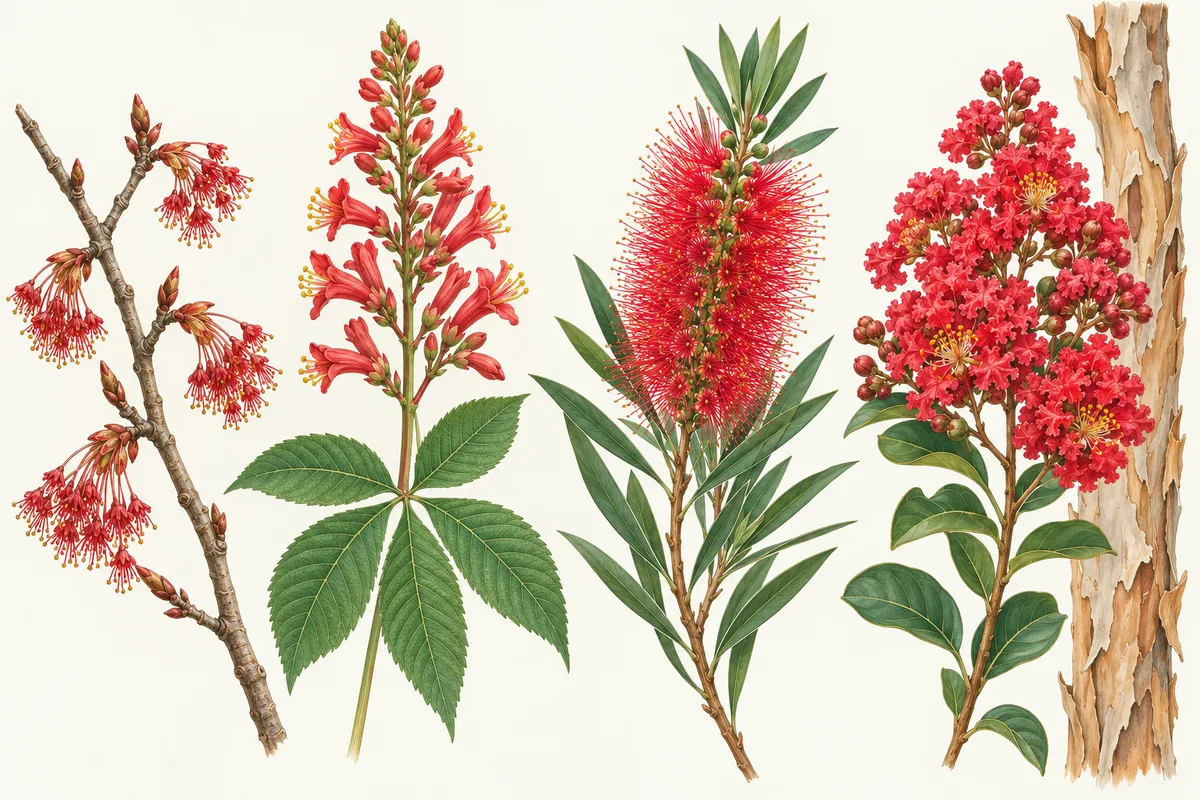
A tree with red flowers in early spring, before the leaves, is usually a red maple (tiny red clusters on bare twigs, January to March in the South). Red tubular spikes in March and April mean red buckeye; crinkled red clusters from July to September, a crape myrtle. In frost-free areas, red bottlebrush spikes mean Callistemon, and a crown of red-orange flowers from May to July means royal poinciana.
- A haze of tiny red flowers on bare branches in late winter is red maple; nothing else that common blooms red that early in eastern North America.
- Red flowers in summer on a tree with smooth, peeling bark are crape myrtle; on a tree with fern-like leaves in south Florida, royal poinciana.
- In Britain and Ireland, double red flowers in May on a small thorny tree are usually the hawthorn cultivar 'Paul's Scarlet'; in New Zealand, crimson brushes at Christmas are pōhutukawa.
A tree with red flowers is easiest to name if you note the month and look closely at one flower cluster: tiny tufts, upright tubes, crinkled petals, a brush of stamens or big cups. Never eat a berry, nut, seed or pod on the strength of a web page or an app; check with a local expert. Red buckeye, one of the commonest native red-flowering trees in the South, is listed as poisonous in all its parts.
Red-flowering trees at a glance
| Tree | When | Flower shape | The feature that settles it | Where |
|---|---|---|---|---|
| Red maple (Acer rubrum) | Late winter to early spring (January–March in North Carolina) | Tiny, under 1 in, in drooping clusters | Blooms on bare twigs; 3- to 5-lobed leaves follow | Newfoundland to Florida, west to Minnesota and Texas |
| Red buckeye (Aesculus pavia) | March–April | Upright clusters of red tubes, 6–10 in | Leaves divided like a hand into 5 (sometimes 7) leaflets | Southeast, west to Texas and Missouri |
| Crape myrtle (Lagerstroemia indica) | July–September | Crinkled, crepe-paper petals in clusters 6–18 in | Smooth bark that peels in patches | Planted across the South |
| Bottlebrush (Callistemon citrinus) | Spring to fall; almost all year where frost-free | Crimson spikes 4–5 in of bristly stamens | Leathery leaves that smell of lemon when bruised | USDA zones 9–10 |
| Royal poinciana (Delonix regia) | May–July | Large red or orange flowers covering the crown | Fern-like leaves, pods 1–2 ft | South Florida, zones 10B–11 |
| African tulip tree (Spathodea campanulata) | Late winter to spring, some all year | Ruffled orange-red bells with yellow edges | Large once-divided leaves; boat-shaped pods | South Florida, zones 10B–11 |
| 'Paul's Scarlet' hawthorn (Crataegus × media) | May | Fully double, light red | Small thorny tree with lobed, glossy leaves | UK and Ireland gardens and streets |
| Pōhutukawa (Metrosideros excelsa) | Around Christmas | Brushes of red stamens | Leaf undersides covered in hairs | Northern North Island, New Zealand |
Data are from NC State Extension (red maple, red buckeye, crape myrtle, bottlebrush), UF/IFAS (royal poinciana, African tulip tree), the RHS and New Zealand's Department of Conservation, read on 21 October 2026.
Late winter and early spring: red maple and red buckeye
Red maple is the first red bloom of the year across eastern North America, and the one most people never notice up close. The NC State profile describes small red flowers, under an inch, in short-stemmed, drooping clusters that open from January to March in North Carolina, before the leaves appear. From a distance the whole crown takes on a red haze. Paired, winged seeds about 3/4 inch long follow in red, pink or yellow, turning tan by summer. The leaves have three to five triangular lobes, the lower two much smaller. Red maple grows from Newfoundland south to Florida and west to Minnesota, Oklahoma and Texas. The red maple vs sugar maple page shows how to tell the two once the leaves are out.
Red buckeye is a small native tree or large shrub of the Southeast, 15 to 25 feet tall. According to NC State, it carries upright clusters of red to orange-red tubular flowers 6 to 10 inches long in March and April, just as its leaves open. Each leaf is divided like a hand into 5, sometimes 7, leaflets. NC State gives its natural range from North Carolina's coast and Piedmont west to Texas, Oklahoma, Missouri and Illinois. NC State rates it as highly toxic: all parts, including the seeds, are listed as poisonous if eaten. The chestnut vs buckeye page shows how to tell buckeye seeds and husks from chestnuts. Red horse chestnut, a planted hybrid with pink to red spikes, is covered on the pink flowers page.
Summer: crape myrtle
From July to September across the South, a small tree covered in red flower clusters is almost always a crape myrtle. NC State describes terminal clusters 6 to 18 inches long of flowers with six crinkled, crepe-paper petals, and cultivars in white, pink, red or purple. The leaves are small, 1 to 2.75 inches, and mostly opposite. The surest field mark is the bark: thin, smooth, pale brown to gray, peeling in patches. Crape myrtle is native to eastern Asia and the Himalayas and ranges from 6 to 30 feet depending on the cultivar. The crape myrtle page covers the plant through the year.
Frost-free states: bottlebrush, royal poinciana, African tulip tree
In Florida, south Texas, southern California and Hawaii, the red-flowering list is longer, and each candidate has a flower you cannot confuse once you see it up close.
Bottlebrush looks exactly like its name. The NC State profile describes bright crimson spikes 4 to 5 inches long with up to 40 flowers, each mostly long, bushy stamens. It blooms in spring, summer and fall, and nearly all year where there is no frost. The leaves are leathery, 1 to 3 inches long, coppery when new, and smell of lemon when bruised. After flowering, woody cup-shaped capsules about 1/4 inch stay stuck along the stem. It comes from eastern Australia and is hardy to USDA zones 9 and 10.
Royal poinciana turns the whole crown red. The UF/IFAS fact sheet describes bright red or orange flowers at the branch ends, covering the treetop from May to July, over fern-like leaves 8 to 20 inches long. Dark brown pods 1 to 2 feet long hang on through winter. It grows outdoors only in zones 10B to 11.
African tulip tree has big, ruffled, bell-shaped flowers. UF/IFAS describes yellow to orange-red flowers with yellow tips in clusters at the branch ends, mainly from late winter to spring, on a tree 50 to 60 feet tall. The evergreen leaves are once-divided, about 1.5 feet long, with 6 to 8 pairs of leaflets about 4 inches long. Woody, boat-shaped capsules 6 to 12 inches long follow. UF/IFAS lists it as a "caution" species in south Florida, to be managed to prevent escape, and not a problem species in central and north Florida.
UK, Ireland and New Zealand
Britain and Ireland. A small, rounded, thorny tree with fully double red flowers in May is usually the hawthorn 'Paul's Scarlet', common on streets and in gardens. The RHS describes it as 4 to 8 m tall with lobed, glossy leaves and orange-red berries in autumn, and notes that the fruit should not be eaten. Wild hawthorns in hedges flower white.
New Zealand. Brushes of red stamens around Christmas on a coastal tree mean pōhutukawa. New Zealand's Department of Conservation calls it the country's Christmas tree, says the mainland species grows naturally in the upper half of the North Island, north of New Plymouth and Gisborne, and gives the field test that separates it from rātā: pōhutukawa leaves have hairs on the underside.
Narrow it down in four questions
- Are the leaves out? No: red maple, or in the tropics African tulip tree. Yes: everything else.
- What month is it? Late winter, red maple. March to May, red buckeye or a red hawthorn. July to September, crape myrtle. Almost any month in frost-free areas, bottlebrush.
- What shape is one flower? Tiny tufts (maple), upright tubes (buckeye), crinkled petals (crape myrtle), bristly brush (bottlebrush, pōhutukawa), big bells (African tulip tree).
- What are the leaves like? Hand-shaped (buckeye), fern-like (royal poinciana), small and opposite with peeling bark (crape myrtle), leathery and lemon-scented (bottlebrush).
Using a photo
A close photo of one flower cluster with a few leaves in the frame is the most useful single picture. Tree Identifier names a tree from one photo, and red maple, crape myrtle, crimson bottlebrush, royal poinciana, African tulip tree and cockspur coral tree are among the species in its Collection. It shows no confidence score or list of alternatives, so check the result against the table above. The follow-up chat can answer a question such as how red buckeye differs from red horse chestnut. Toxicology notes in the app are AI-written; for anything about a child or a pet eating part of a tree, call poison control or a vet.
What a photo can't settle
- Crape myrtles, crabapples and bottlebrushes are sold as many cultivars; a photo can name the tree but not the cultivar.
- Red maple's flowers are small and high in the crown. A photo of the twig, or of the red seeds that follow, is often more useful than one of the whole tree.
- Tropical red-flowering trees vary widely by country; this page covers the ones planted in the US, plus a short note for the UK, Ireland and New Zealand.
Questions people ask
What tree has red flowers and no leaves?
In the eastern US and Canada, a red maple in late winter or early spring: NC State says its small red clusters open before the leaves appear. In south Florida and other frost-free places, check African tulip tree and royal poinciana too, since both can flower while partly bare.
What tree has red flowers in spring?
Red maple first, from January to March in the South and later farther north. Then red buckeye in March and April, with upright clusters of tubular red flowers 6 to 10 inches long, and red horse chestnut and red-flowered crabapples in mid-spring among the leaves.
What tree has red flowers in summer?
Across the South, crape myrtle, which NC State says flowers from July to September in clusters 6 to 18 inches long. In south Florida, royal poinciana from May to July. In California and Florida, bottlebrush flowers through much of the year.
What tree has red flowers and long seed pods?
Royal poinciana: UF/IFAS describes dark brown pods 1 to 2 feet long that hang on through winter. African tulip tree has boat-shaped woody capsules 6 to 12 inches long. Both grow outdoors only in USDA zones 10B to 11.
Is red buckeye poisonous?
NC State rates red buckeye as highly toxic and lists all parts, including the seeds, as poisonous if eaten. Never eat any part of a tree because a page or an app named it; if a child or pet has eaten a seed, call poison control or a vet.
Sources
- Acer rubrum (red maple) — North Carolina Extension Gardener Plant Toolbox, NC State University
- Aesculus pavia (red buckeye) — North Carolina Extension Gardener Plant Toolbox, NC State University
- Lagerstroemia indica (crape myrtle) — North Carolina Extension Gardener Plant Toolbox, NC State University
- Callistemon citrinus (crimson bottlebrush) — North Carolina Extension Gardener Plant Toolbox, NC State University
- Delonix regia: Royal Poinciana (ENH-391/ST228) — UF/IFAS Extension, University of Florida
- Spathodea campanulata: African Tuliptree (ENH-758/ST600) — UF/IFAS Extension, University of Florida
- Crataegus × media 'Paul's Scarlet' — Royal Horticultural Society
- Pōhutukawa — Department of Conservation (New Zealand)
Keep reading
- Clue guideWhich tree has pink flowers? Spring and summer are two different lists
- Clue guideWhich tree has fern-like leaves? Count the divisions first
- Tree comparisonRed maple vs sugar maple: how to tell them apart
- Tree comparisonChestnut vs buckeye: chestnut tree identification
- Clue guideWhich tree has long seed pods? Sort it by leaf, pod and region