Tree profile
Crape myrtle tree: peeling bark, crinkled flowers and winter capsules
The summer-flowering tree of the American South. Smooth, mottled, peeling trunks, crinkled petals in long clusters from July to September, and round brown seed capsules that hang on all winter.
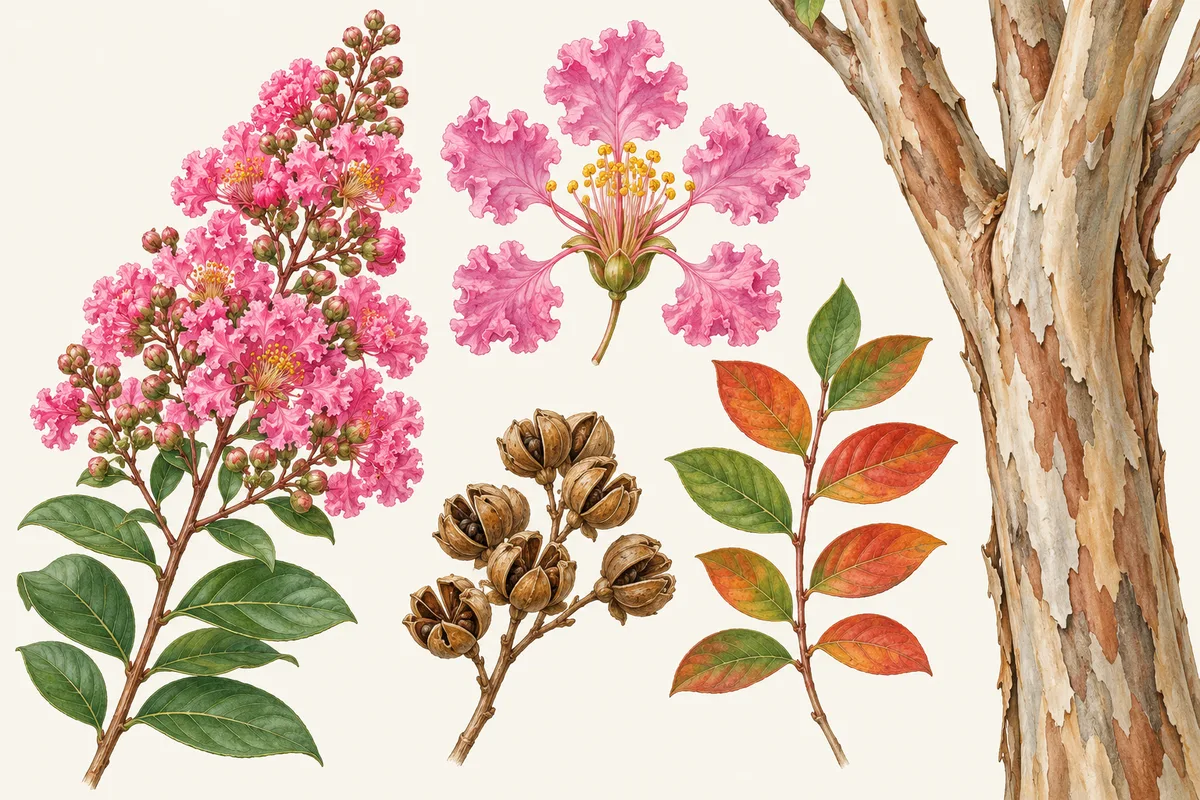
In short
A crape myrtle tree is a small, usually multi-trunked tree with thin, smooth bark that peels in patches of tan, gray and cinnamon. From July to September it carries long clusters of flowers with six crinkled, crepe-paper petals in white, pink, red or purple. Leaves are small, smooth-edged and mostly opposite, and round six-part seed capsules stay on the twigs all winter.
- Bark first: smooth, thin, peeling, mottled trunks, often several from one base, identify crape myrtle all year.
- The flower has six crinkled, clawed petals like crepe paper, in clusters 6 to 18 inches long at the branch tips.
- In winter, round brown capsules about half an inch wide, split into six parts, hang at the tips of the branches.
Field marks at a glance
- Scientific name
- Lagerstroemia indica and hybrids with L. fauriei
- Family
- Lythraceae (loosestrife family)
- Type
- Broadleaf, deciduous
- Bark
- Thin, smooth and exfoliating, peeling in patches to show pale brown, tan and gray; most noticeable in winter.
- Trunks and form
- Usually several trunks from the base, vase-shaped and dense; from under 4 feet (dwarfs) to about 30 feet, old specimens up to 40 feet.
- Flowers
- July to September, in terminal clusters 6 to 18 inches long. Each flower 1 to 1.5 inches wide with six crinkled, clawed petals like crepe paper. White, pink, red, lavender or purple.
- Leaves
- Small, 1 to 2.75 inches long, oblong to oval, glossy, with smooth edges and almost no stalk. Mostly opposite, the upper ones alternate or in threes. Reddish when new.
- Fall color
- Yellow, orange or red. White-flowered cultivars often turn yellow; pink and red ones yellow, orange and red.
- Twigs
- Slender, green to brown, nearly square in cross-section with small wings or ridges running down them.
- Fruit
- Round, brown, six-part capsules about 1/2 inch wide that persist through winter, then split to release small winged seeds.
- Where
- Native to China, Korea and nearby Asia; planted in USDA zones 6 to 9; NC State notes winter injury to top growth in zones 5 and 6.
Crape myrtle is the summer-flowering tree of the American South, planted in yards, parking lots and street medians; NC State lists it for USDA zones 6 to 9. In July, when most trees are done flowering, it turns white, pink, red or purple, and in winter its bare, peeling, multi-colored trunks are almost as recognizable. Two checks settle it in any season: the bark and the flower or seed capsule.
How to identify a crape myrtle tree
1. The bark. Crape myrtle trunks are thin-barked, smooth and peeling. The NC State Extension profile describes the bark as exfoliating, pale brown to gray, and the Clemson HGIC fact sheet notes that the peeling bark is most noticeable in winter. The trunks are often muscular-looking and smooth to the touch, with patches of tan, gray and cinnamon where older bark has flaked off.
2. The trunks. Most crape myrtles grow several trunks from one base into a vase shape. A single trunk usually means a nursery or gardener trained it that way.
3. The flowers, July to September. Crape myrtle blooms on clusters 6 to 18 inches long at the tips of the current year's shoots. Each flower is 1 to 1.5 inches across with six crinkled, ruffled petals on narrow claws, which NC State compares to crepe paper. The wild species is rose to red; cultivars come in white, pink, red, lavender and purple.
4. The leaves. Small, 1 to 2.75 inches long, glossy, with smooth edges and almost no stalk. Most sit in opposite pairs, but NC State notes the upper leaves can be alternate or in threes, so check several twigs before you decide.
5. In winter, the capsules and twigs. Round, brown seed capsules about half an inch wide, split into six parts, stay at the branch tips through winter. Young twigs are nearly square in cross-section, with small wings running along the corners.
Tree Identifier can name a crape myrtle from one photo of the flowers, the bark or a twig with capsules. It shows no confidence score, so confirm the answer with the six crinkled petals or the square twigs.
Crape myrtle in every season
| Season | What gives it away |
|---|---|
| Spring | New leaves light green tinged red, small and smooth-edged |
| Summer | Long clusters of crinkled six-petaled flowers, July to September |
| Fall | Yellow, orange or red leaves; Clemson notes white-flowered types often turn yellow |
| Winter | Peeling, mottled trunks; brown six-part capsules at the branch tips |
Tree or bush: sizes and cultivars
Crape myrtle is sold in every size from a 2-foot shrub to a 30-foot tree, and the size tells you about the cultivar, not the species. The UF/IFAS Gardening Solutions page describes dwarf types under four feet and tree-sized types over twenty feet, with examples such as 'Chickasaw' (a dense bush about three feet tall), 'Acoma' (white, weeping, just over ten feet) and 'Miami' (dark pink, about 35 feet). NC State lists 'Natchez' at up to 30 feet. Clemson gives 10 to 30 feet for most cultivars, with old specimens up to 40 feet.
Two species are planted. Clemson names Lagerstroemia indica, from China and Korea, as the most common in the US, and Japanese crape myrtle, L. fauriei, as the other; Clemson calls hybrids of the two generally excellent, and NC State lists many mildew-resistant cultivars, among them 'Natchez' and 'Muskogee'.
Problems that change how a crape myrtle looks
Some things you see on a crape myrtle are not part of the tree:
- Knobby stubs at the top of the trunks: the result of cutting the branches back hard every winter. Clemson warns that severe pruning ruins the natural form, and UF/IFAS advises avoiding "crape murder." The tree then grows clusters of whip-like shoots from the stubs.
- White powder on leaves: powdery mildew, most common in spring and fall according to Clemson.
- Black film on leaves and bark: sooty mold growing on aphid honeydew.
- White, felt-like patches on bark: possibly crapemyrtle bark scale, an introduced Asian pest that Clemson says was first found in South Carolina in 2019.
Tree health is outside this page; a county extension office can confirm a pest. Tree Identifier's Diagnose tool gives a health note with a severity level from a photo, which is a starting point for that conversation, not a diagnosis.
Crape myrtle look-alikes
Peeling bark and summer flowers each point to a short list of other trees:
- Lacebark elm: the same mottled, flaking trunk, but toothed, alternate leaves and no showy flowers. Our guide to trees with peeling bark compares the two with birch, sycamore and paperbark maple.
- Mimosa: pink in summer, but fluffy pom-pom flowers over fern-like leaves, then flat pods. See trees with pink flowers.
- Chaste tree: purple summer spikes on a small tree, but hand-shaped compound leaves. See trees with purple flowers.
- River birch: peels in curling papery sheets and has toothed, triangular leaves.
Crape myrtle (Lagerstroemia indica) is one of the species in Tree Identifier's Collection, the 138-species catalog that fills in as you identify. The app's follow-up chat under each result can answer questions such as whether a tree in your yard is a dwarf or a tree-form cultivar.
Look-alikes and how to tell them apart
Lacebark elm (Ulmus parvifolia)
Lacebark elm has the same mottled, flaking trunk, but its small leaves are toothed and alternate, and it never carries showy flower clusters or six-part capsules.
Chaste tree (Vitex agnus-castus)
Chaste tree also blooms purple in summer on a small multi-trunked tree, but its leaves are compound, like a hand of narrow leaflets, and its flowers are small and tubular in upright spikes, not crinkled six-petaled flowers.
Mimosa or silk tree (Albizia julibrissin)
Mimosa flowers pink in summer too, but as fluffy pom-poms of long threads over feathery, twice-compound leaves, followed by flat bean-like pods. Its bark does not peel.
River birch (Betula nigra)
River birch peels too, but in curling, papery, salmon-pink sheets, and it has toothed, triangular, alternate leaves and catkins instead of summer flower clusters.
What a photo can't settle
- Crape myrtles come in dozens of cultivars that differ mainly in flower color, height and mildew resistance; a photo can name the plant but rarely the cultivar.
- Many trees sold as crape myrtle are hybrids of Lagerstroemia indica and Japanese crape myrtle (L. fauriei); bark color hints at the parentage but does not prove it.
- Without flowers, a severely pruned crape myrtle with knobby stubs can be hard to read from a photo; photograph a seed capsule or a square twig as well.
Questions people ask
Is it crape myrtle or crepe myrtle?
Both spellings name the same plant. NC State Extension lists crape myrtle, crepe myrtle, crape flower, Indian crape myrtle and lilac of the South as common names of Lagerstroemia indica. Extension services mostly write crape myrtle or crapemyrtle; the name refers to the crinkled, crepe-paper petals.
Is a crape myrtle a tree or a bush?
Both, depending on the cultivar. UF/IFAS describes dwarf types under four feet and tree-sized types over twenty feet, and Clemson gives 10 to 30 feet for most, with old specimens up to 40 feet. Larger cultivars are usually grown as multi-trunked small trees.
Why is the bark peeling off my crape myrtle?
Peeling is normal. NC State describes the bark as thin, smooth and exfoliating, and Clemson notes that the brown-to-gray peeling bark is most noticeable in winter. Shedding bark is one of the features that identify the tree, not a sign of disease on its own.
What is the black film on crape myrtle leaves and bark?
Usually sooty mold. Clemson explains that it grows on the sticky honeydew left by aphids, and it also lists crapemyrtle bark scale, an introduced Asian pest first found in South Carolina in 2019, which leaves white felt-like patches on bark. A local extension office can confirm which one you have.
When do crape myrtles bloom?
From July to September in North Carolina, according to NC State, on clusters at the tips of the current year's shoots. Clemson describes bloom from early summer into fall, and UF/IFAS says crapemyrtle blooms all summer in Florida.
Sources
- Lagerstroemia indica (Common Crape Myrtle) — NC State Extension Gardener Plant Toolbox
- Crape Myrtle (HGIC 1008) — Clemson Cooperative Extension, Home & Garden Information Center
- Crapemyrtle — UF/IFAS Extension Gardening Solutions
Keep reading
- Clue guideWhich tree has peeling bark? Sort it by the color underneath
- Clue guideWhich tree has pink flowers? Spring and summer are two different lists
- Clue guideWhich tree has purple flowers? Check the month, then the leaves
- Yard guideHow to identify the trees in your yard
- Tree profileRedbud tree (Cercis canadensis): how to identify it