Garden guide
Trees for privacy, and why a mixed screen outlasts a single row
The evergreen trees that University of Maryland, Clemson, NC State and WSU extension pages name for privacy screens, with their sizes, their weak points and how to recognise each one.
In short
The trees for privacy that extension services list most are evergreens: arborvitae (American and 'Green Giant'), eastern redcedar, Norway spruce, American and hybrid hollies, Arizona cypress, Japanese cryptomeria and southern magnolia. University of Maryland Extension, Clemson and NC State all advise mixing several species instead of one long row, because a single disease or pest can take out a whole screen of Leyland cypress or arborvitae.
- Leyland cypress grows 60 to 70 feet tall and suffers Seiridium canker, Botryosphaeria dieback and bagworms, according to Clemson.
- Maryland Extension lists 17 evergreen screen trees with height, width, sun and deer resistance, and tells readers to mix them.
- WSU Master Gardeners say to leave at least 2 feet, preferably 3 feet or more, between screen plants and to check HOA and city height rules first.
A privacy screen is the one garden job where people usually want a single kind of tree in a straight line, and it is the one extension services most often warn against. The lists below come from four extension pages written for different regions, and every size given is theirs.
Privacy trees named by extension services
University of Maryland Extension gives the most complete list, with mature height, width, light and a deer-resistance rating for each:
| Tree | Height | Width | Light | Deer resistant (UMD) |
|---|---|---|---|---|
| American arborvitae (Thuja occidentalis) | 40–60 ft | 10–15 ft | Full sun | No |
| 'Green Giant' arborvitae (Thuja 'Green Giant') | 40–50 ft | 12–18 ft | Full sun to part shade | Yes |
| Eastern redcedar (Juniperus virginiana) | 40–50 ft | 8–20 ft | Full sun to part shade | Yes |
| Norway spruce (Picea abies) | 40–60 ft | 25–30 ft | Full sun | Yes |
| Eastern white pine (Pinus strobus) | 50–80+ ft | 20–40 ft | Full sun | No |
| American holly (Ilex opaca) | 15–30 ft | 10–20 ft | Sun to shade | Yes |
| Nellie Stevens holly | 15–25 ft | 8–12 ft | Sun to part shade | No |
| Arizona cypress (Cupressus arizonica) | 40–50 ft | 25–30 ft | Full sun to part shade | Yes |
| Japanese cryptomeria | 50–60 ft | 20–30 ft | Full sun | Yes |
| Southern magnolia 'Bracken's Brown Beauty' | 20–30 ft | 15–25 ft | Full sun | Yes |
| Hollywood juniper | 20–30 ft | 6–10 ft | Sun to part shade | Yes |
| Leyland cypress | 60–70 ft | 15–25 ft | Full sun | No |
For narrow spaces the same page lists 'Emerald' arborvitae (10 to 15 feet tall, 3 to 4 feet wide) and columnar Rocky Mountain junipers 'Blue Arrow' and 'Skyrocket' (12 to 20 feet tall, 2 to 3 feet wide). Clemson's Leyland cypress alternatives adds, for the Southeast, Arizona cypress for dry sunny sites, cryptomeria for part shade, tall narrow southern magnolia cultivars ('Alta', 'Bracken's Brown Beauty', 'Edith Bogue'), sweetbay magnolia for moist soil, and narrow hollies such as Foster's, Savannah and Dragon Lady where width is short. Clemson also notes that screens of 6 to 15 feet suffice in many cases, which brings wax myrtle and tall yaupon holly into play.
Why one long row of one tree fails
Clemson describes Leyland cypress as a very rapidly growing screen that reaches 60 to 70 feet, and lists what follows once it is planted everywhere: Seiridium canker, Botryosphaeria dieback, Cercosporidium needle blight, bagworms, spider mites and root rot in wet soil. Its lower branches thin and drop in shade, and overcrowded trees lose air circulation, which raises the risk of disease.
Arborvitae is no safe swap. Writing for N.C. Cooperative Extension in Craven County, Thomas Glasgow reports Botryosphaeria dothidea dieback on a 'Green Giant' arborvitae, with several others in the same screen showing the same symptoms. He calls the cypress family, which includes arborvitae, Leyland cypress and junipers, problem prone, and notes that the NC State plant clinic sees it as the fourth most common group in problem samples. His advice: plant a Leyland cypress or two, not a large number, and the same for 'Green Giant'.
All three eastern sources reach the same answer: mix species. Clemson suggests clusters of three or five of each plant. Maryland suggests tall plants at the back, medium plants in front and between them, and lower plants at the edges, so that losing one species does not open a gap in the whole screen.
Planning the screen before planting
The WSU Skagit County Master Gardeners give a practical order of work:
- Check the rules first. Homeowners' associations, cities and counties may limit the height or type of planting, and a screen must not block drivers' views of traffic.
- Mark the line of sight. Use stakes or a ladder to find where the screen has to stand and how tall it must be, then make sure its mature width fits.
- Space for the roots. Leave at least 2 feet between plants, preferably 3 feet or more; only slender plants that take years to fill in go closer.
- Choose mostly evergreens. They screen all year; a few deciduous plants add seasonal colour.
- Shape it wider at the base. A clipped screen that is wider at the bottom lets light reach the lower leaves.
Maryland adds: confirm the mature height against overhead wires, call the utility locate service before digging, keep mulch no more than 2 to 3 inches deep and off the trunks, and expect plants to take one to two years to establish.
Recognising the common screen trees
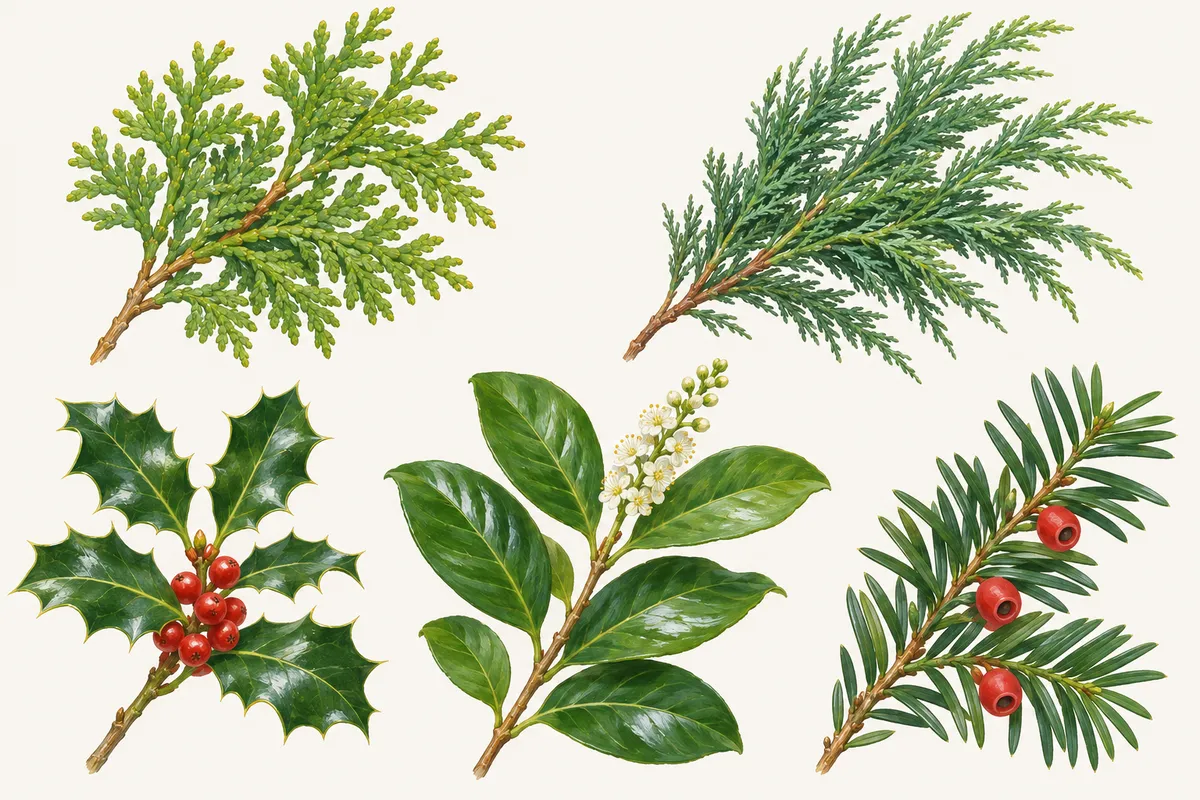
Screens are often bought unlabelled or inherited, and the usual suspects look alike from a distance. Up close:
- Arborvitae: scale leaves in very flat, fan-like sprays, with a citrusy smell when crushed, and small upright cones about 1/2 inch long. See the arborvitae page.
- Leyland cypress: scale leaves in flattened sprays too, but less fan-like and with a resinous smell, and round woody cones about 1/2 to 3/4 inch.
- Eastern redcedar: tiny scale leaves mixed with sharp, prickly juvenile needles, blue berry-like cones on female trees, and red-brown bark peeling in long strips. The eastern red cedar page separates it from arborvitae.
- Norway spruce: single stiff, four-sided needles on woody pegs, side branchlets that droop from the main branches, and long hanging cones 4 to 6 inches. See the Norway spruce page.
- Hollies: thick, leathery, spiny-edged leaves, and red berries on female trees only. The holly page tells American from English holly.
Using a photo of a struggling screen
When one tree in a screen browns, the first question is what the tree is, because the likely diseases differ between arborvitae, Leyland cypress and juniper. Tree Identifier names a tree from one photo of a branch tip, and its Diagnose tool rates visible problems such as browning or dieback by severity. A close photo of a single shoot works better than a wide shot of the hedge. For cankers like the Botryosphaeria case NC State describes, a sample sent through your county extension office settles what an app cannot.
What a photo can't settle
- These lists are regional: Maryland and the Carolinas in the East, Skagit County in western Washington. Cold-winter regions need hardier choices; ask your county extension office.
- Deer-resistance ratings are guidance only. Maryland Extension says any plant may be browsed when deer are hungry.
- A photo app can tell an arborvitae from a Leyland cypress or a juniper, but it cannot diagnose a canker inside a branch with certainty; send a sample to a plant clinic before removing a screen.
Questions people ask
What is the fastest growing tree for privacy?
Leyland cypress and 'Green Giant' arborvitae are the usual answers, and Clemson calls Leyland a very rapidly growing screen. Both extension sources warn against planting many of either: Leyland reaches 60 to 70 feet and suffers canker, and NC State found Botryosphaeria dieback in a 'Green Giant' screen.
What trees are best for privacy in a small yard?
Narrow ones. Maryland Extension lists 'Emerald' arborvitae at 10 to 15 feet tall and 3 to 4 feet wide, and 'Blue Arrow' or 'Skyrocket' Rocky Mountain juniper at 12 to 20 feet tall and only 2 to 3 feet wide. Clemson names Foster's, Savannah and Dragon Lady hollies where width is limited.
Are arborvitae good privacy trees?
They are widely used, but with limits. Maryland Extension rates American arborvitae as not deer resistant and 40 to 60 feet tall. NC State calls the cypress family, which includes arborvitae, problem prone and advises against planting large numbers of any one kind, 'Green Giant' included.
How far apart should privacy trees be planted?
It depends on the plant's mature width. WSU Master Gardeners give a minimum of 2 feet between plants, preferably 3 feet or more, with tighter spacing only for slender plants. Maryland Extension warns that crowded plants compete for water, nutrients and light and decline over time.
Sources
- Plants for Mixed Privacy Screens — University of Maryland Extension, Home & Garden Information Center
- Leyland Cypress Alternatives (HGIC 1025) — Clemson Cooperative Extension, Home & Garden Information Center
- Privacy Screens and Plant Disease — N.C. Cooperative Extension, Craven County Center
- Privacy Screens (Everett Chu, WSU Skagit County Master Gardeners) — Washington State University Extension
Keep reading
- Tree profileArborvitae: how to identify it and tell the hedge types apart
- Tree profileEastern red cedar (Juniperus virginiana): how to identify it
- Tree profileNorway spruce (Picea abies): how to identify it
- Tree profileHolly tree (Ilex): how to identify American and English holly
- Field guideEvergreen tree identification: needles, scales or broad leaves