Also in Español
Field guide
Evergreen tree identification: needles, scales or broad leaves
An evergreen is any tree that stays leafy through winter. First decide whether it carries needles, scales or broad leaves; then a few marks name the common ones.
In short
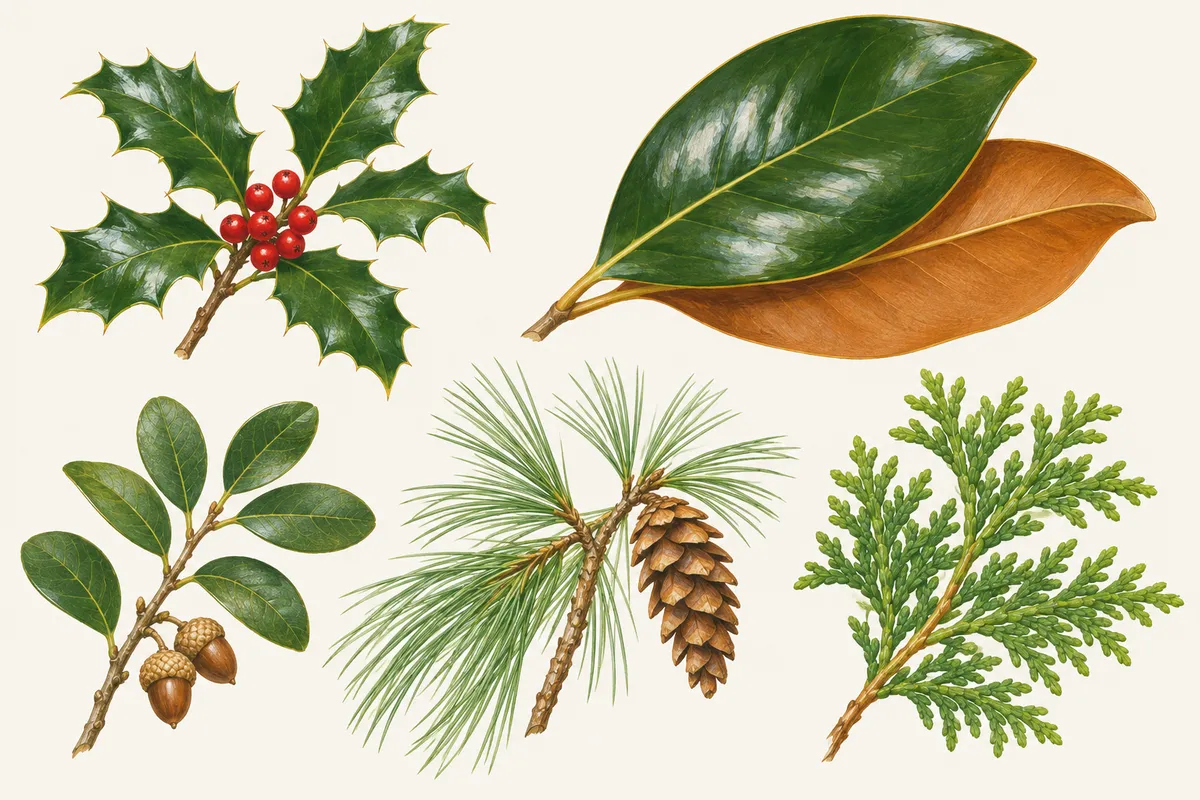
Evergreen tree identification starts with the leaf. Needles or tiny scales mean a conifer: pine, spruce, fir, juniper or cedar. Broad, leathery leaves in winter mean a broadleaf evergreen: spiny leaves and red berries point to holly, leaves 5 to 10 inches with rusty undersides to southern magnolia, small leaves with curled-under edges on a spreading tree to live oak.
- Evergreen describes leaves, not a family: pines and hollies are both evergreen, while larch, bald cypress and dawn redwood are conifers that go bare.
- Evergreen leaves do not last forever; Iowa State Extension says most conifers shed their oldest, innermost needles every fall.
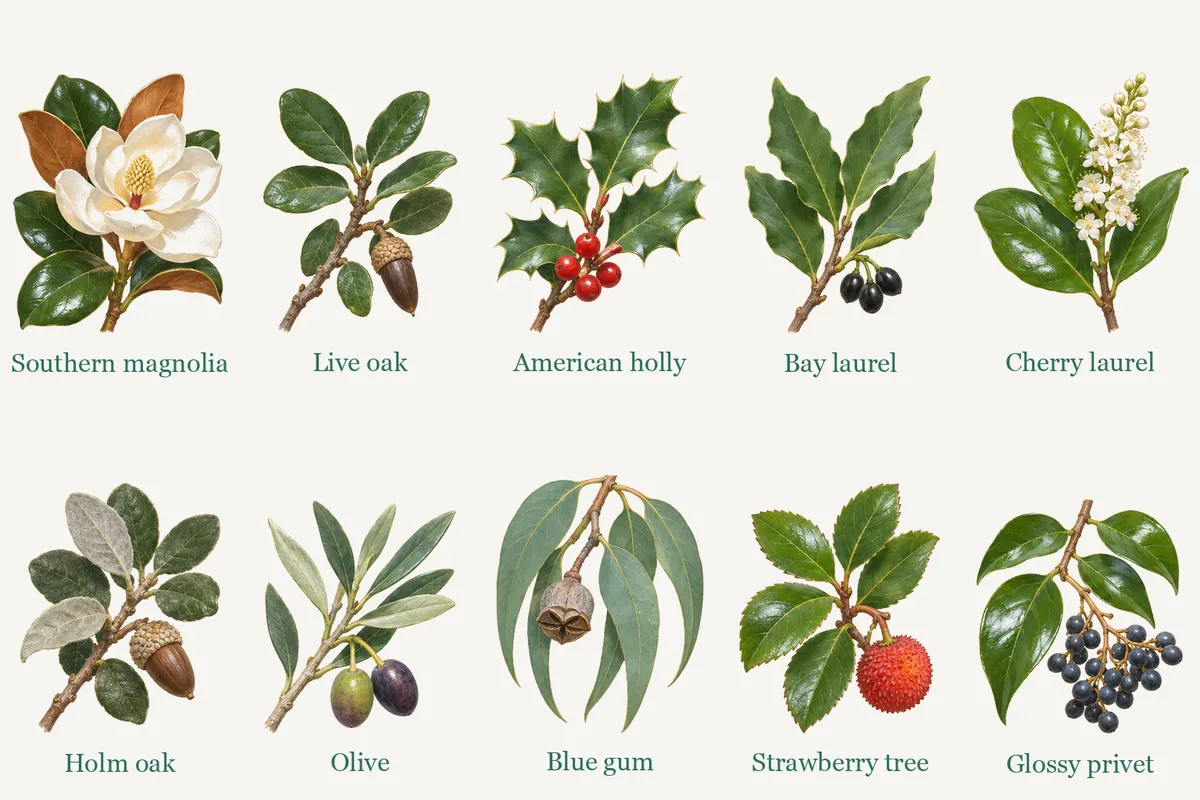
- American holly, southern magnolia, live oak and Carolina cherry laurel are four broadleaf evergreen trees native to the Southeast.
"Evergreen" is not a kind of tree. It means a tree that keeps green leaves through winter, and it includes two very different groups: the conifers, with needles or scales, and the broadleaf evergreens, with ordinary leaves that happen to be thick and long-lived. Sorting your tree into one of those groups takes a few seconds. Naming it then depends on which group, and in the case of broadleaf evergreens, on where you live.
Sort an evergreen in three questions
1. Needles, scales or broad leaves? Look at a single leaf.
- Needles, long and thin, singly or in bundles: a conifer such as a pine, spruce, fir, hemlock or yew.
- Tiny scales pressed flat to the twig: a conifer of the cypress family, such as a juniper, eastern red cedar, arborvitae or cypress.
- Broad leaves with a blade and a stalk: a broadleaf evergreen. Go to question 3.
2. For needles and scales, use the needle key. Whether the needles are bundled, square or flat sorts conifers to genus, and the cone confirms it. That key, with a cone table and pine needle counts, is in the conifer identification guide, so it is not repeated here. For a cut tree in your living room, the Christmas tree identification guide runs the same tests on the 16 trees sold on lots.
3. For broad leaves, check the edge, the size and the underside.
| Tree | Leaf | Other marks | Native range |
|---|---|---|---|
| American holly (Ilex opaca) | 2–4 in, thick, leathery, dull dark green, long sharp spines evenly spaced | Red or orange berries under 1 in on female trees, Sept–Feb; smooth light gray bark | Massachusetts and Pennsylvania south to Florida, west to Texas |
| English holly (Ilex aquifolium) | Shiny, dark green; spiny low down, often smooth higher in the crown | Scarlet berries through winter on female trees; smooth bark with small brown warts | Native to Britain (Woodland Trust) |
| Southern magnolia (Magnolia grandiflora) | 5–10 in, stiff, leathery, glossy above, rusty-brown and fuzzy below | Creamy white flowers 8–12 in across; cone-like fruit with red seeds | Coastal plain, North Carolina to Florida and Texas |
| Southern live oak (Quercus virginiana) | 2–5 in, leathery, glossy above, pale and downy below, edges curled under | Acorns 3/4–1 in on long stalks; broad, spreading crown; often hung with Spanish moss | Coastal plain, southeastern Virginia to Florida and east Texas |
| Carolina cherry laurel (Prunus caroliniana) | 2–3 in, glossy, smooth-edged; maraschino-cherry smell when crushed | Small white flowers in March–April; shiny black fruit under 1 in | Southern United States |
Leaf and fruit figures come from NC State Extension's Plant Toolbox profiles for each tree, and English holly from the Woodland Trust, read on 10 November 2026.
Hollies: spines and red berries
A small evergreen tree with spiny, leathery leaves is usually a holly. NC State's American holly profile describes a slow-growing, conical tree 40 to 60 feet tall with thick, leathery, dull dark green leaves 2 to 4 inches long, edged with long, sharp, evenly spaced spines. The bark is smooth and light gray, sometimes warty or splotched with lichens. Only female trees bear berries, bright red or sometimes orange, from about September to February, and they need a male tree nearby.
English holly is the native holly of Britain. The Woodland Trust describes shiny, dark green leaves that are spiky on young plants and low branches but often smooth on older trees and high in the crown, scarlet berries that can last all winter on female trees, and smooth, thin bark with small brown warts; mature trees reach 15 m and can live 300 years. Its glossier leaf is the quickest split from American holly's dull one. The holly page compares the two in detail.
Holly berries are not food. NC State lists American holly's fruits as poisonous, with nausea, vomiting and diarrhea, and flags the plant for cats, dogs and horses. Call poison control if a child swallows berries.
Southern magnolia: big leaves with rusty backs
The other big broadleaf evergreen of the South is southern magnolia. NC State's southern magnolia profile describes a tree 60 to 80 feet tall with stiff, leathery, laurel-like leaves 5 to 10 inches long, glossy dark green above and rusty-brown and fuzzy underneath. Turn a leaf over: that brown felt is the fastest field mark.
In late spring it opens fragrant, creamy white flowers 8 to 12 inches across, with a few more through summer. From September to October the cone-like fruit clusters, 3 to 5 inches long, split to hang out red-coated seeds on slender threads. It is native to coastal plains and moist woods from North Carolina to Florida and Texas. The magnolia page covers its seed pods and look-alikes.
Live oak and cherry laurel
Southern live oak is the broad, spreading oak of the Southern coastal plain. NC State's live oak profile describes alternate, thick, leathery leaves 2 to 5 inches long, glossy green above and pale with gray down below, mostly smooth-edged with the edges curled under; young trees and new growth can have toothed leaves. NC State gives a height of 40 to 80 feet and a crown 30 to 100 feet wide, and the tree is often hung with Spanish moss. NC State adds that it is not a true evergreen: it holds its leaves through winter and drops them as the new ones come out. The acorns are 3/4 to 1 inch, egg-shaped, often several together on a long stalk. The live oak page tells it from its relatives.
Carolina cherry laurel is a native Southern evergreen with glossy leaves. NC State's Carolina cherry laurel profile gives a tree up to 35 feet with glossy leaves 2 to 3 inches long, smooth-edged on mature plants and toothed on seedlings, with a pair of small glands near the base of the blade; crushed leaves smell of maraschino cherry. Small white flowers appear in March and April, and shiny black fruits under 1 inch in September and October. NC State rates the plant's poison severity as high: stems, leaves and seeds contain cyanogenic glycosides, and wilting leaves are the most toxic.
Evergreen does not mean every leaf stays
Two facts trip up evergreen identification.
Evergreens shed too. Iowa State Extension's seasonal needle loss page explains that conifers drop their oldest, innermost needles in autumn: they turn yellow or brown and fall gradually. Scots and Austrian pines keep their needles about three years, spruces and firs longer, while white pine and arborvitae shed a whole year's set of inner needles at once in autumn and can look alarmingly brown. NC State's Christmas Tree Species gives Fraser fir needles 3 to 6 growing seasons. Iowa State warns that browning of the newest, outermost needles, or of whole branches, is the sign of a real problem.
Some conifers are not evergreen. Larch, bald cypress and dawn redwood lose all their needles every fall, turning yellow, russet or reddish brown first (Iowa State). In summer they look like any other conifer; in winter they are bare. If a "dead pine" turns orange in October and leafs out in April, it was one of these.
Using a photo for evergreens
For a broadleaf evergreen, photograph one leaf flat, top side and underside, with a berry or flower if the tree has one. For a conifer, photograph a twig close enough to show whether the needles are bundled, single or scales. Tree Identifier names a tree from one photo of the leaf, twig, bark or fruit, and it shows one name with no confidence score or look-alike list, so check the result against the table above. Tree Identifier's Toxicology tool gives AI-written notes on people, dogs and cats, which are not a safety verdict: for berries, ask a local expert or poison control.
What a photo can't settle
- Garden evergreens include hundreds of cultivars and hybrid hollies; NC State lists hybrid hollies and false holly (Osmanthus) as easily confused with American holly, and a photo rarely settles which.
- A single needle or leaf photo cannot show whether a conifer drops its needles in winter, so larch, bald cypress and dawn redwood can be named as evergreens in summer.
- Rhododendrons, mountain laurel and other evergreen shrubs share leathery leaves with the trees here; this guide covers trees only.
Questions people ask
What is the difference between an evergreen and a conifer?
Evergreen means the tree keeps green leaves through winter; conifer means it bears seeds in cones. Most conifers are evergreen, but larch, bald cypress and dawn redwood drop their needles each fall. Many evergreens are not conifers: holly, southern magnolia and live oak are broadleaf evergreens.
Do evergreen trees lose their leaves?
Yes, a few at a time. Iowa State Extension says conifers shed their oldest, innermost needles in fall; Scots and Austrian pines keep needles about three years, and white pine sheds a whole year's set of inner needles at once. NC State gives Fraser fir needles 3 to 6 growing seasons.
Is a live oak really evergreen?
Almost. NC State Extension says southern live oak is not a true evergreen: it keeps its leaves through winter and sheds them as the new leaves emerge in spring, so it is green all year except for a short changeover.
What evergreen tree has red berries?
Usually a holly. American holly carries bright red or orange berries under 1 inch from about September to February, only on female trees, according to NC State Extension. Do not eat them: NC State lists the fruits as poisonous, with nausea and vomiting among the symptoms.
How do I tell a holly from a southern magnolia?
By size and edge. American holly leaves are 2 to 4 inches with sharp, evenly spaced spines. Southern magnolia leaves are 5 to 10 inches, smooth-edged, glossy above and rusty-brown and fuzzy below, and the tree has huge white flowers in late spring.
Sources
- Seasonal Needle Loss — Iowa State University Extension and Outreach, Yard and Garden
- Christmas Tree Species — NC State Extension (C. McKinley, D. Hazel, W. Kohlway)
- Ilex opaca (American Holly) — North Carolina Extension Gardener Plant Toolbox, NC State University
- Holly (Ilex aquifolium) — Woodland Trust
- Magnolia grandiflora (Southern Magnolia) — North Carolina Extension Gardener Plant Toolbox, NC State University
- Quercus virginiana (Southern Live Oak) — North Carolina Extension Gardener Plant Toolbox, NC State University
- Prunus caroliniana (Carolina Cherry Laurel) — North Carolina Extension Gardener Plant Toolbox, NC State University
Keep reading
- Field guideConifer identification: three questions about the needles, then the cone
- Tree profileHolly tree (Ilex): how to identify American and English holly
- Tree profileMagnolia tree identification: southern magnolia and its relatives
- Tree profileLive oak (Quercus virginiana): how to identify it
- Winter field guideWinter tree identification, from buds to bark