Tree profile
Alder buckthorn (Frangula alnus): how to identify it
A thornless native shrub or small tree of wet heaths, bogs and open woods, food plant of the brimstone butterfly, and the same species North Americans call glossy buckthorn.
In short
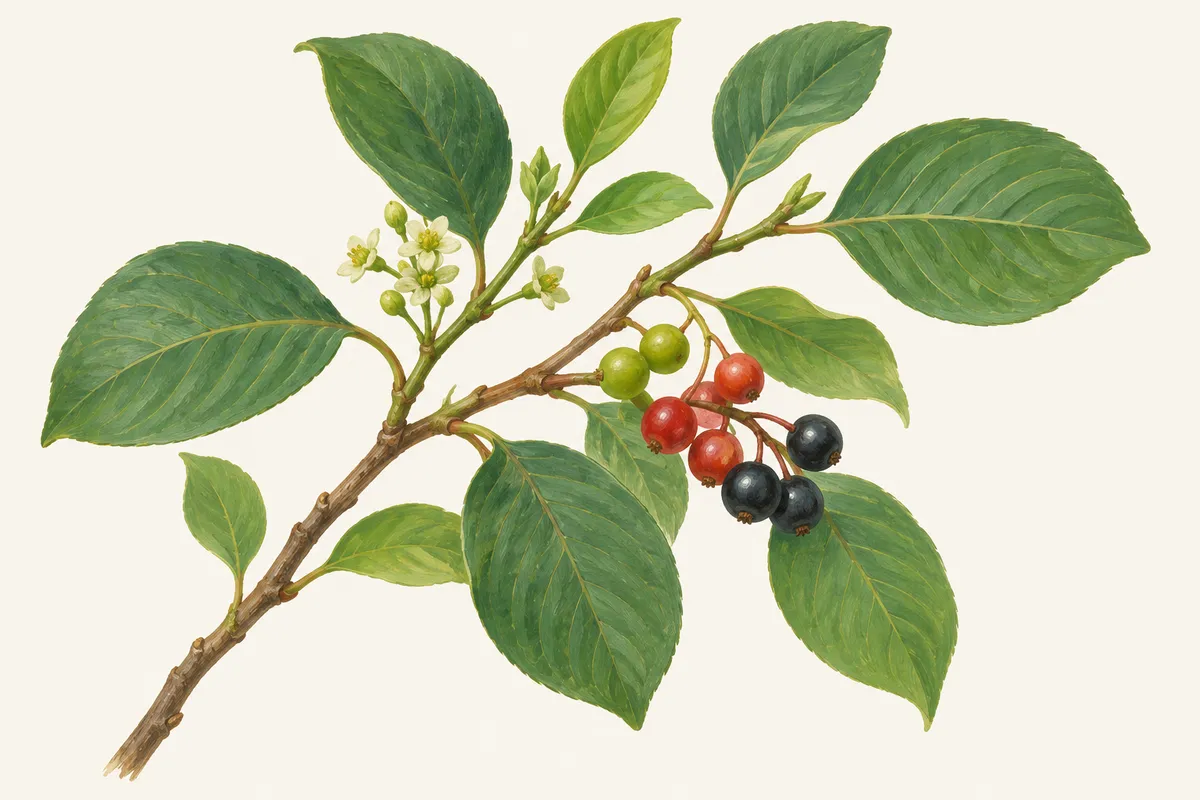
Alder buckthorn identification starts with the twig: leaves alternate along a smooth, thornless, purple-brown twig, while purging buckthorn has opposite leaves and spines. The leaves are oval, 3 to 7 cm long, untoothed, with a rounded tip; winter buds have no scales and are hairy; and berries ripen from green to red in late summer, then to purple-black, often both colours on one branch.
- No thorns and alternate leaves separate alder buckthorn from purging buckthorn, its only close look-alike in Britain.
- Red and black berries on the same branch in late summer are a strong alder buckthorn clue.
- In North America the same species, Frangula alnus, is called glossy buckthorn and is treated as invasive.
Field marks at a glance
- Scientific name
- Frangula alnus (syn. Rhamnus frangula)
- Family
- Rhamnaceae (buckthorn family)
- Type
- Broadleaf, deciduous
- Leaves
- Alternate, oval, 3 to 7 cm long, rounded at the tip and tapering to the stalk, edges smooth, matt to glossy dark green and slightly hairy; usually 6 to 10 pairs of side veins. Yellow or red in autumn.
- Twigs
- Smooth, straight, purple-brown with fine white streaks (lenticels), no thorns.
- Buds
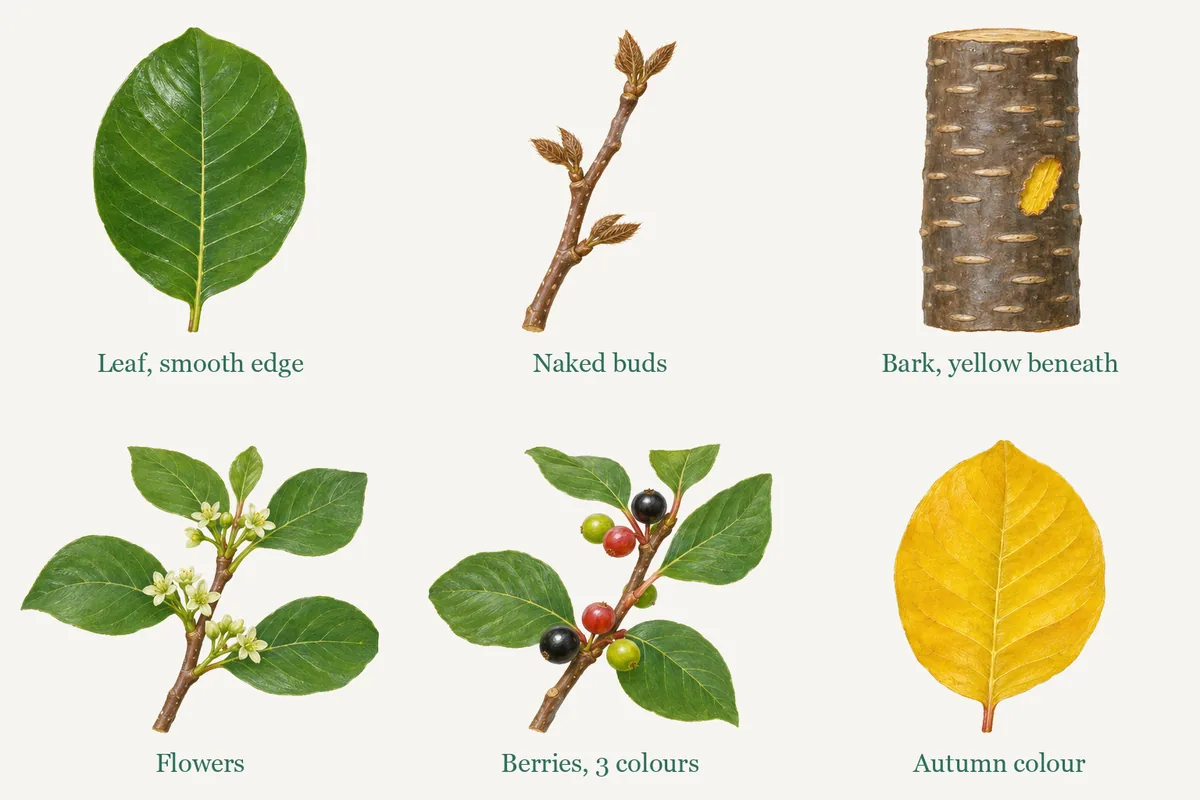
- Naked: no bud scales, just small hairy leaves folded together; tan and fuzzy (Virginia Tech).
- Bark
- Dark brown outside; scrape it and the inner bark is bright yellow.
- Flowers
- Star-shaped, 3 to 5 mm across, five greenish-white triangular petals, in small clusters in the leaf axils, May to June; each flower has male and female parts.
- Berries
- Small, about 1/4 inch, green, then red in late summer, then purple-black in early autumn; red and black often together.
- Size
- Shrub or small tree up to about 6 m (Woodland Trust); the RHS gives 4 to 8 m. Virginia Tech gives up to 20 ft for North American plants.
- Where
- Wet soils: open woods, scrub, hedgerows, wet heath, riverbanks and bogs, mostly on acid soils. Native to most of Europe east to western China.
Alder buckthorn is an unremarkable-looking shrub until late summer, when its berries ripen unevenly and one branch carries green, red and black fruit at once. It grows on wet, mostly acid ground across Britain and Europe, and it is the food plant that brings brimstone butterflies to gardens. North Americans know the same species as glossy buckthorn, an invasive escape. Its one real look-alike in Britain is purging buckthorn, and two checks on a single twig settle that.
How to identify alder buckthorn
Work through these on one twig. The first two separate it from purging buckthorn, the others confirm it.
1. Leaves alternate, not opposite. The Woodland Trust describes leaves arranged alternately along the twig: oval, 3 to 7 cm long, rounded at the tip and tapering towards the stalk, slightly hairy, usually with 6 to 10 pairs of side veins. The edges are smooth. Virginia Tech describes the same species as shiny green above, 2 to 4 inches long, with parallel veins that turn to follow the leaf edge near the margin.
2. No thorns. The twigs are smooth, straight and purple-brown with fine white streaks, and they are thornless. Purging buckthorn's twigs carry spines, which is where the "thorn" in buckthorn comes from.
3. Naked, hairy buds. In winter, alder buckthorn's buds have no protective scales: they are small, folded, hairy leaves. Virginia Tech calls them naked, tan and fuzzy. Purging buckthorn's buds are scaly, dark and pressed to the twig.
4. Yellow inner bark. The outer bark is dark brown; scrape a little away and the inner bark shows bright yellow.
5. Berries that change colour. The berries ripen from green to red in late summer, then to dark purple or black in early autumn, so mixed colours on one branch are typical. They are about 1/4 inch across.
When the shrub is in a bog or over a ditch, Tree Identifier can name it from one photo of a leafy twig. It gives the common and scientific names but no list of look-alikes, so check the leaf arrangement and the thorns yourself.
Alder buckthorn vs purging buckthorn and dogwood
| Feature | Alder buckthorn | Purging buckthorn | Dogwood |
|---|---|---|---|
| Leaf arrangement | Alternate | Opposite | Opposite |
| Leaf edge | Smooth | Finely toothed | Smooth |
| Veins | 6–10 pairs | 3–5 pairs, curving to meet at the tip | Curving strongly towards the tip |
| Twigs | Thornless, purple-brown | Spiny | Thornless, crimson in sun |
| Buds | Naked, hairy | Scaly, black-brown | Black, bristle-like |
| Fruit | Green → red → black | Purple-black, 6–10 mm | Small black berries |
| Soil | Wet, acid | Mostly calcareous | Many soil types |
The purging buckthorn column comes from the Woodland Trust's purging buckthorn profile, which gives a tree of about 10 m with opposite, glossy, toothed leaves, 3 to 5 pairs of curved veins meeting at the tip, spiny twigs, orange under-bark and purple-black berries 6 to 10 mm across on female trees only. The Woodland Trust names dogwood as a look-alike for both buckthorns; its dogwood profile describes oval leaves about 6 cm long with curving veins, crimson young twigs and small black berries. Our buckthorn page covers purging buckthorn under its North American name, common buckthorn, along with glossy buckthorn's invasive status state by state.
The soil is a useful hint in the field. Butterfly Conservation notes that purging buckthorn grows mainly on calcareous soils and alder buckthorn on moist acid soils and wetlands. A buckthorn on a chalk down is probably purging buckthorn; one in a heathland bog is probably alder buckthorn. Check the leaves anyway.
Flowers, berries and the brimstone butterfly
The flowers open from May to June in small clusters where the leaves meet the twig. Each is star-shaped, 3 to 5 mm across, with five greenish-white triangular petals, and contains both male and female parts, so every alder buckthorn can fruit. Purging buckthorn, by contrast, has separate male and female trees.
The RHS describes bright red berries that ripen to black, and leaves that turn yellow or red in autumn. The Woodland Trust says the fruit is an important food for birds, especially thrushes, and the flowers are valuable to bees.
The leaves are the main food of the brimstone butterfly's caterpillars. Butterfly Conservation lists the two buckthorns as the species' only food plants and says the butterfly is common in England and Wales, less common in Ireland and very rare in Scotland. Look for small holes chewed in alder buckthorn leaves in early summer.
The RHS lists alder buckthorn as potentially harmful to people and pets, especially dogs, if eaten. The Woodland Trust notes that the bark and fruit were once used as a laxative. Never eat a berry on the strength of a web page or an app. Dark fruit on shrubs and trees is the subject of our guide to trees with black berries.
Where it grows, size and the gunpowder wood
Alder buckthorn is native to most of Europe, reaching as far as western China, and the Woodland Trust calls it widespread but rare in Britain. It grows on wet soils in open woods, scrub, hedgerows, wet heathland, riverbanks and bogs, preferring acid soils but growing on neutral ones too. The "alder" in its name reflects the wet places it shares with alder and a roughly similar leaf; our alder page covers that tree's toothed leaves and cones.
It reaches about 6 m as a mature tree according to the Woodland Trust; the RHS gives a height of 4 to 8 m for garden plants and describes a large, bushy shrub to about 5 m. In North America, Virginia Tech describes an upright shrub or small tree to 20 feet with a spreading, open crown. Old names listed by the RHS include berry-bearing alder, black alder and butcher's prickwood.
Its charcoal was once the best wood for gunpowder, the Woodland Trust says, especially for time fuses, because it burns at a very even rate. The bark and leaves gave yellow dye, unripe fruit green and ripe berries blue or grey, and the hard wood was used for wooden nails, shoe pegs, arrows and skewers.
Alder buckthorn is one of the native shrubs on our UK native trees list. If you plant or find one for brimstones, Tree Identifier's Tree Map pins it when location is on, and the follow-up chat under a result can answer questions such as which other shrubs feed brimstone caterpillars.
Look-alikes and how to tell them apart
Purging buckthorn (Rhamnus cathartica)
Purging buckthorn's leaves are in opposite pairs, finely toothed, with 3 to 5 pairs of veins curving to meet at the tip, and many twigs end in a spine. Its winter buds have dark scales. Alder buckthorn has alternate, untoothed leaves and no thorns.
Dogwood (Cornus sanguinea)
Dogwood leaves grow in opposite pairs, about 6 cm long, with veins that curve towards the tip, and its young twigs are crimson in sun. Its buds are black and bristle-like, and its small black berries follow clusters of four-petalled flowers, without a red stage.
Alder (Alnus glutinosa)
The name comes from a similar leaf, and both grow on wet ground. Alder leaves are toothed, with a rounded or notched tip, and it bears catkins and small woody cones that stay on all winter instead of berries.
What a photo can't settle
- Without the twig, a single oval, untoothed leaf matches many shrubs; a photo that shows several leaves along a twig shows the alternate arrangement that matters.
- A photo cannot show the yellow inner bark or the naked, hairy bud up close; those take a knife and a hand lens.
- Cultivars such as the narrow-leaved 'Aspleniifolia' and the columnar 'Fine Line' look different from the wild shrub; a photo app names the species, not the cultivar.
Questions people ask
How do you tell alder buckthorn from purging buckthorn?
Look at the leaf arrangement and the twig tips. Alder buckthorn's leaves alternate along a thornless twig and have smooth edges; purging buckthorn's leaves are opposite and toothed, with veins curving to meet at the tip, and its twigs carry spines. The Woodland Trust uses exactly these differences.
Is alder buckthorn the same as glossy buckthorn?
Yes. Both names refer to Frangula alnus, also filed as Rhamnus frangula. It is a native shrub in Britain and Europe, and in North America, where it was introduced, it is called glossy buckthorn and listed as a noxious weed in states such as Minnesota and Pennsylvania.
Is alder buckthorn poisonous?
The RHS lists alder buckthorn as potentially harmful to people and pets, especially dogs, if eaten, and advises gloves when handling. The Woodland Trust notes the bark and fruit were once used as a laxative because they contain anthraquinones. Never eat any berry on the strength of a web page or an app.
Why plant alder buckthorn?
Mostly for wildlife. Butterfly Conservation lists it as one of the two food plants of the brimstone butterfly's caterpillars, the Woodland Trust says its flowers are valuable to bees and its fruit to thrushes, and the RHS lists it as a plant for pollinators.
Sources
- Alder buckthorn (Frangula alnus) — Woodland Trust
- Purging buckthorn (Rhamnus cathartica) — Woodland Trust
- Frangula alnus (alder buckthorn) — Royal Horticultural Society
- Glossy buckthorn fact sheet — Virginia Tech Dendrology
- Dogwood (Cornus sanguinea) — Woodland Trust
- Brimstone — Butterfly Conservation
Keep reading
- Invasive tree profileBuckthorn identification: common and glossy buckthorn
- Field guideNative trees of the UK: the full list with one clue for each
- Clue guideWhich tree has black berries? Sort it by leaf and cluster
- Tree profileAlder (Alnus): how to identify it
- Tree profileSea buckthorn (Hippophae rhamnoides): how to identify it