Tree profile
Sea buckthorn (Hippophae rhamnoides): how to identify it
A spiny, suckering shrub of coastal dunes with narrow silver leaves and, on female plants, bright orange berries crowded along the twigs from September into winter.
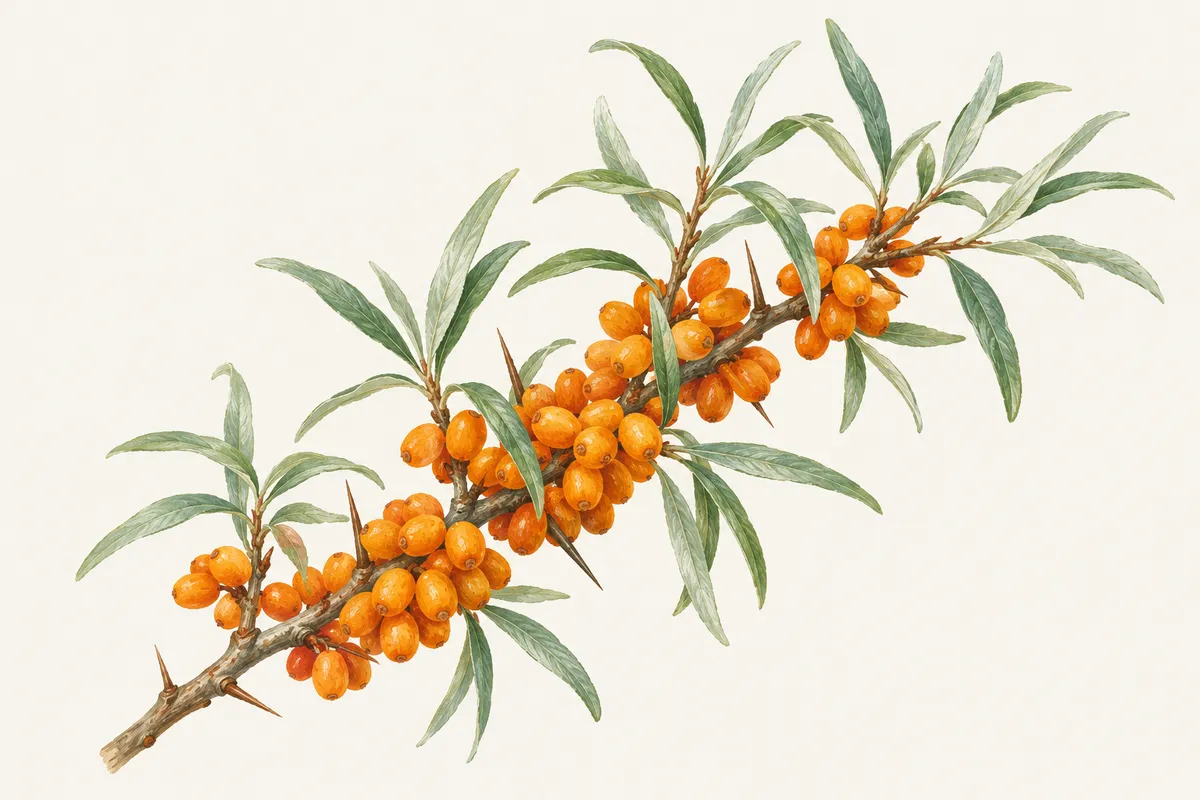
In short
Sea buckthorn identification rests on three features: narrow, almost stalkless leaves up to 8 cm long, silver-scaled underneath and on both sides when young; stiff twigs that often end in a spine; and bright orange berries 6 to 8 mm across packed along the stems of female plants from September. In Britain it grows wild mainly on the sand dunes of England's east coast.
- Silver scales are the key: rub a young leaf or twig and the silvery coating is what you see, not hairs.
- Only female plants carry berries; in winter, male buds are larger and conical, female buds smaller and rounded.
- The Wildlife Trusts treat it as native on England's east coast and invasive in other dune systems where it was planted.
Field marks at a glance
- Scientific name
- Hippophae rhamnoides
- Family
- Elaeagnaceae (oleaster family)
- Type
- Broadleaf, deciduous
- Leaves
- Alternate, almost stalkless, linear, up to 8 cm long (SAPS); 1 to 3 in long and 1/8 to 1/4 in wide, tapering at both ends (Trees and Shrubs Online). Dark greyish green above, silvery grey and scaly beneath.
- Scales
- Young leaves and shoots are covered in silvery-grey scales on both surfaces; the upper side loses them with age and turns dull green.
- Twigs
- Stiff, silver-scaled when young, often ending in a spine; the plant forms dense, thorny thickets.
- Berries
- Bright orange, round to egg-shaped, 6 to 8 mm across, crowded on short stalks along the twigs of female plants; coloured by September and often on the branches until February.
- Flowers
- Tiny, greenish, without petals, wind-pollinated, in short clusters in March and April before the leaves; male and female flowers on separate plants.
- Winter buds
- Male flower buds are conical and conspicuous; female buds are smaller and rounded, so a bush can be sexed in winter.
- Size
- Usually a shrub of 1 to 3 m on dunes (SAPS); the Wildlife Trusts give 1 to 8 m and the RHS 4 to 8 m for garden plants.
- Where
- Sand dunes and sea cliffs, spreading by suckers into large patches; native on England's east coast, planted elsewhere and spread into other dune systems.
Sea buckthorn is the silver-grey, spiny shrub that forms thickets on coastal dunes, and in autumn its female plants are so packed with orange berries that the twigs look encrusted. Despite its name it is not a true buckthorn: it belongs to the oleaster family, with Russian olive and buffaloberry. Three things identify it at any season you have leaves: narrow silver-scaled leaves, spiny twigs, and the dune or cliff habitat.
How to identify sea buckthorn
Check these in order. Leaves and scales settle it in summer; berries and buds help from autumn to spring.
1. Leaves: narrow, silver underneath. The leaves are alternate, almost stalkless and long and narrow. SAPS gives up to 8 cm; Trees and Shrubs Online gives 1 to 3 inches long and only 1/8 to 1/4 inch wide, tapering at both ends. The upper side is dark greyish green, the underside silvery grey.
2. Scales, not hairs. Young leaves and shoots are covered on both surfaces with silvery-grey scales. With age the upper surface loses them and turns dull green, while the underside stays silver. A hand lens shows tiny flattened scales, the mark of the oleaster family.
3. Spines. The twigs are stiff and often spine-tipped, and the Wildlife Trusts describe a very spiny shrub that forms dense thickets. Wear gloves if you handle it.
4. Berries on female plants. From September, female bushes carry bright orange berries 6 to 8 mm across, round to egg-shaped, on very short stalks crowded along the twigs. Trees and Shrubs Online says they colour by September and can stay on the branches until February.
5. Place. In Britain, look on sand dunes and sea cliffs. SAPS describes it forming large patches by suckering; inland it turns up as a planted ornamental that sometimes escapes.
If you can photograph a twig with leaves and berries together, Tree Identifier can put a name on it from that one photo. The app shows the common and scientific names but no list of look-alikes, so compare the result with the scales and spines above.
Flowers, berries and male and female bushes
Sea buckthorn is dioecious: male and female flowers grow on separate plants. The flowers are tiny, petalless and greenish, opening in March and April before the leaves, and are pollinated by wind. Trees and Shrubs Online places flowering in April, in short clusters, each flower in the axil of a small bract. Few people notice them.
Only female plants fruit, and they need a male nearby. The RHS says both sexes must be grown for a good crop of berries, and Trees and Shrubs Online suggests about six females to one male in plantings. A bush without berries in October is most likely male.
Winter is when you can sex a bush without fruit. SAPS and Trees and Shrubs Online both note that male flower buds are larger and conical, while female buds are smaller and rounded.
The berries feed wintering thrushes that arrive from the continent in autumn (Wildlife Trusts); SAPS adds fieldfares and starlings. Whether any fruit is fit to eat is outside the scope of this page: never eat a berry on the strength of a web page or an app, and check with a local expert.
Sea buckthorn vs willow, oleaster and buffaloberry
| Plant | Leaf | Twig | Fruit | Where |
|---|---|---|---|---|
| Sea buckthorn | Narrow, alternate, silver-scaled beneath, up to 8 cm | Spine-tipped | Bright orange, 6–8 mm, crowded on female plants | Dunes and sea cliffs; planted inland |
| Narrow-leaved willows | Narrow, often finely toothed, green above, no scales | No spines | Catkins, then fluffy seed | Wet ground, riversides |
| Russian olive (oleaster) | Narrow, silvery on both faces | Silvery, sometimes thorny | Olive-shaped, silvery to yellowish | Planted; invasive in parts of North America |
| Silver buffaloberry | Silvery both sides, opposite | Thorny | Reddish-orange, about 1/4 in | North American prairies |
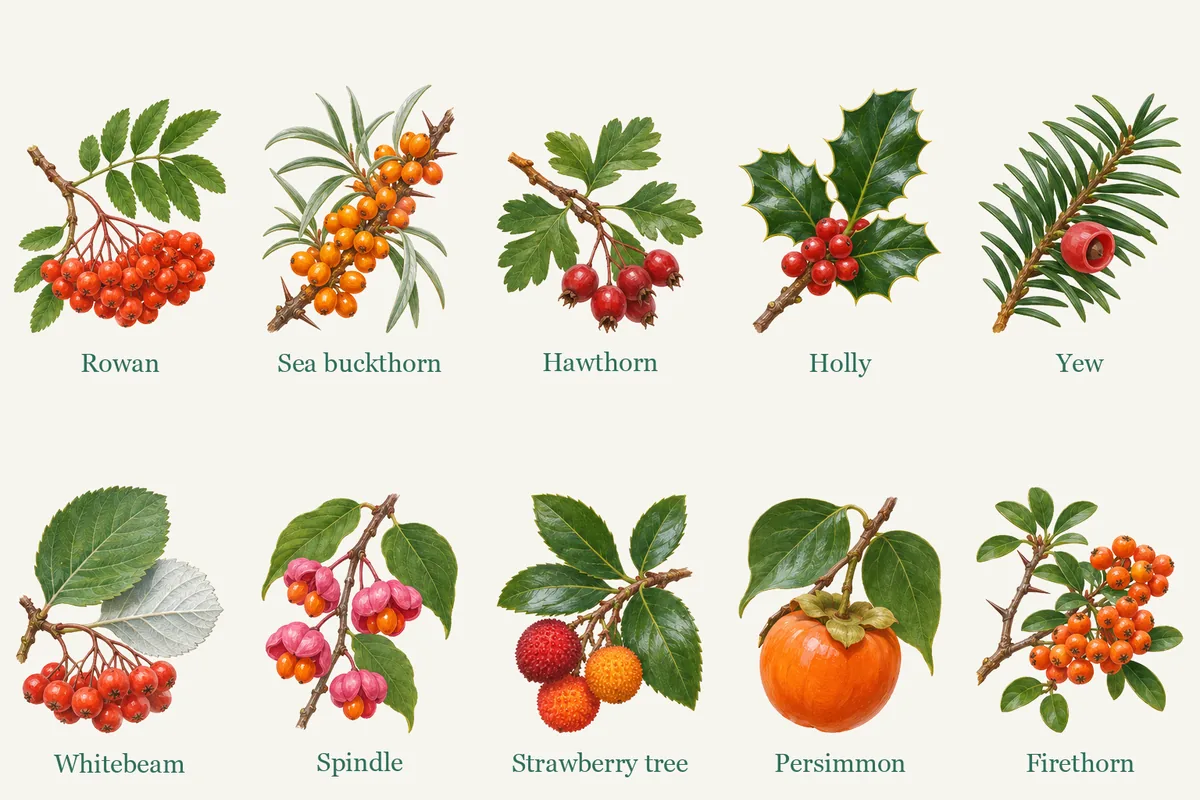
The willow confusion is the common one in Britain, because a sea buckthorn without berries looks like a small grey willow from a distance. Close up, willow leaves are usually toothed and carry hairs, not scales, and there are no spines; our willow page covers the bud and catkin checks. Russian olive is a planted relative with the same silver scales: its full profile is on the Russian olive page. For the North American prairie shrub with orange fruit, and for rowan and firethorn, see our guide to trees with orange berries.
Where sea buckthorn grows, and why it spreads
Trees and Shrubs Online gives a native range across Europe, including Britain, and temperate Asia, with its centre in the steppes of central Asia. In north-west Europe it is mainly coastal, often on dunes; further south it grows along rivers and reaches about 6,000 ft in the Alps. SAPS notes that elsewhere in Europe it colonises gravel beds left by glaciers and rivers.
In Britain, the Wildlife Trusts describe it growing wild along the east coast of England. It was planted on other dune systems to stabilise the sand and spread from there, and in those places it is treated as invasive: its dense thickets shade out the smaller plants of mobile dunes. The RHS lists it as an invasive non-native species in Northern Ireland, where planting it or letting it grow in the wild is an offence.
Height depends on where it grows. SAPS gives 1 to 3 m on dunes, the Wildlife Trusts 1 to 8 m, and the RHS 4 to 8 m for a garden plant, with 20 to 50 years to reach that size. In its Asian range Trees and Shrubs Online reports trees of 30 to 40 ft.
Gardens and hedges are where most inland sea buckthorn is found, often as named cultivars chosen for berries or for male pollinators. The RHS rates it H7, hardy in the coldest European continental climates.
If you find a stand on a walk, Tree Identifier's Tree Map pins the identification if location is on, so you can return in September to check which bushes fruit. The follow-up chat under a result can answer questions such as how sea buckthorn differs from Russian olive, and our UK tree identification guide sets it among the other British trees and shrubs.
Look-alikes and how to tell them apart
Willows (Salix)
Narrow-leaved willows look similar from a distance, but willow leaves are green on top, usually finely toothed and carry no silver scales, the twigs have no spines, and willows bear catkins and fluffy seed, never orange berries.
Russian olive or oleaster (Elaeagnus angustifolia)
A relative in the same family, also silvery, scaly and sometimes thorny. Its leaves stay silvery on both faces, and its fruit is olive-shaped, silvery to yellowish and about 1/4 to 1/2 inch long, not a bright orange berry crowded along the stem.
Silver buffaloberry (Shepherdia argentea)
The North American counterpart of the prairies. Its leaves and twigs grow in opposite pairs, and its reddish-orange fruit is about 1/4 inch long. Sea buckthorn leaves alternate along the twig.
What a photo can't settle
- A photo of a bare twig in late winter, before the leaves, can show buds and spines but not the silver leaves or berries that make the identification easy.
- Many garden cultivars of sea buckthorn exist; a photo app names the species, not the cultivar or the plant's sex.
- Whether a stand is native or planted on a given stretch of coast is a question for local records, not a photograph.
Questions people ask
Is sea buckthorn a tree or a shrub?
Mostly a shrub. SAPS describes a much-branched shrub of 1 to 3 m on dunes, the Wildlife Trusts give 1 to 8 m, and Trees and Shrubs Online says it is sometimes a tree of 30 to 40 ft, with plants up to 60 ft recorded in western China.
Why does my sea buckthorn have no berries?
It is probably a male plant, or a female with no male nearby. Male and female flowers grow on separate plants, the flowers are wind-pollinated, and the RHS says both sexes must be grown for a good crop. In winter, male buds are larger and conical.
Is sea buckthorn native to the UK?
On England's east coast, yes, according to the Wildlife Trusts; elsewhere it was planted to hold dunes and has spread, and is treated as invasive. The RHS lists it as an invasive non-native species in Northern Ireland, where planting it or letting it grow in the wild is an offence.
Is sea buckthorn related to common buckthorn?
No. Despite the name, sea buckthorn belongs to the oleaster family, Elaeagnaceae, with Russian olive and buffaloberry. Common (purging) buckthorn and alder buckthorn belong to the buckthorn family, Rhamnaceae, and have black berries.
Sources
- Hippophae rhamnoides (sea buckthorn) — Royal Horticultural Society
- Sea-buckthorn (Hippophae rhamnoides) — The Wildlife Trusts
- Hippophae rhamnoides — Trees and Shrubs Online (International Dendrology Society)
- Buckthorns: sea-buckthorn — Science and Plants for Schools (SAPS)
Keep reading
- Clue guideWhich tree has orange berries? Check the leaf, the thorns and where you are
- Tree profileRussian olive (Elaeagnus angustifolia): how to identify it
- Tree profileWillow trees (Salix): how to identify them
- Clue guideWhich tree has thorns? Look at where they grow
- Field guideTree identification in the UK: British trees by leaf, bark and picture