Tree comparison
Hophornbeam vs American hornbeam: how to tell the two ironwoods apart
Two small birch-family trees of eastern forests share the name ironwood and nearly the same leaf. The trunk, the winter twig and the fruit each settle it.
In short
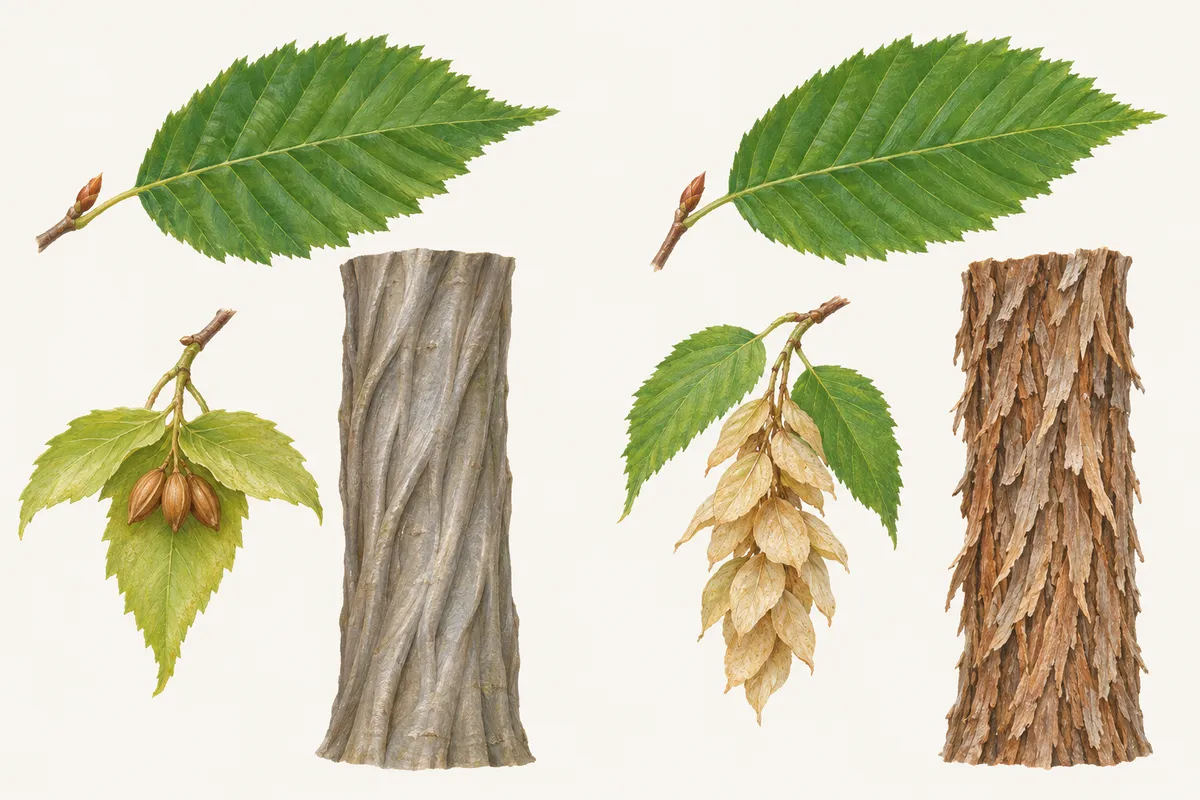
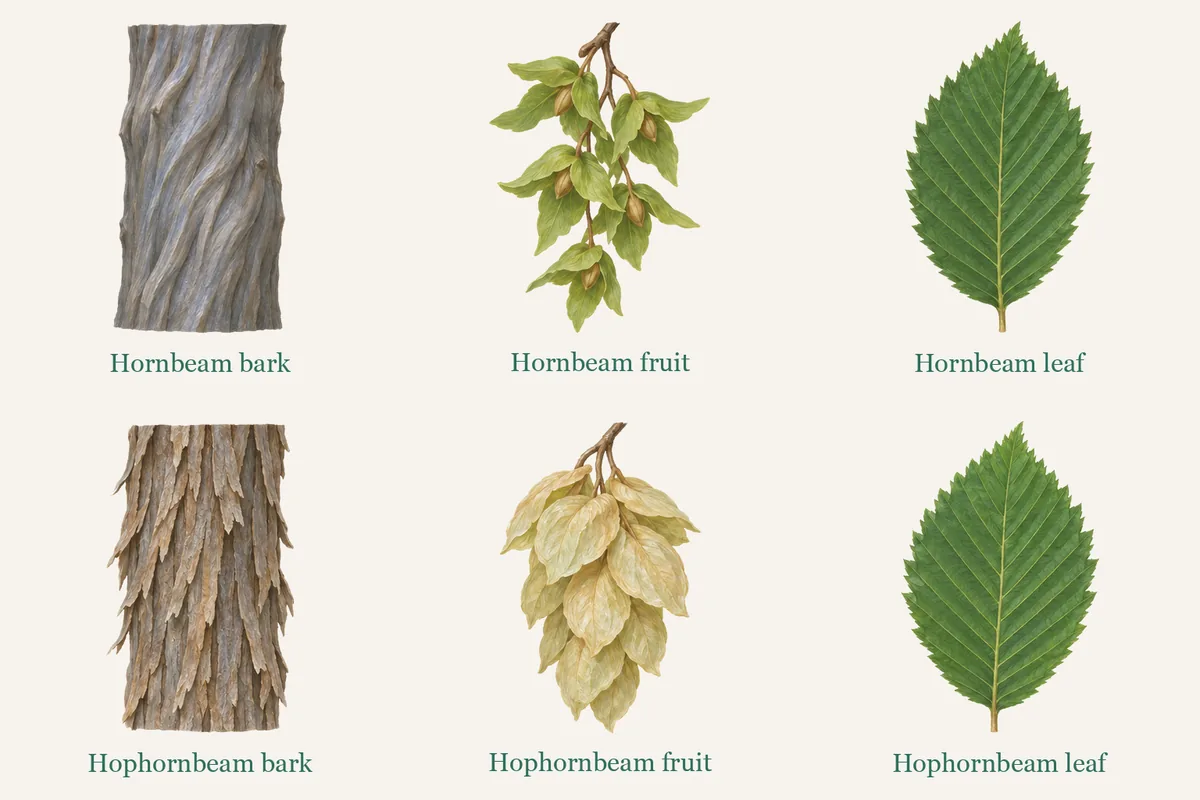
Hophornbeam vs American hornbeam comes down to the trunk: eastern hophornbeam (Ostrya virginiana) has light brown bark that breaks into small shreddy plates, while American hornbeam (Carpinus caroliniana) keeps smooth blue-gray bark over a fluted, muscle-like trunk at every age. In winter, hophornbeam shows bare male catkins in threes at the twig tips; hornbeam shows only small angled buds.
- Shreddy bark that flakes off by hand: hophornbeam. Smooth, blue-gray, fluted bark: American hornbeam, also called musclewood or blue beech.
- Winter twig test: small catkins in clusters of three on bare twigs mean hophornbeam; hornbeam's catkins stay hidden in the buds until spring.
- Fruit: papery sacs like hops on hophornbeam; nutlets on open, three-lobed leafy bracts on hornbeam.
Field marks at a glance
- Scientific name
- Ostrya virginiana and Carpinus caroliniana
- Family
- Betulaceae (birch family)
- Type
- Broadleaf, deciduous
- Bark
- Hophornbeam: smooth and reddish brown with horizontal, cherry-like lenticels when young, then light brown and shreddy, in small plates that come off by hand. Hornbeam: thin, smooth, gray to bluish gray at every age, over a heavily fluted trunk.
- Winter catkins
- Hophornbeam: male catkins 1/2 to 1 inch long in clusters of three, visible on the bare twig tips all winter. Hornbeam: no exposed catkins in winter; they open in mid to late spring, 1 to 2 inches long.
- Buds
- Hophornbeam: small, plump, egg-shaped, scales green and red-brown with fine vertical grooves. Hornbeam: brown, angled, about 1/4 inch or less, each scale edged in tan silk so the bud looks lined (Virginia Tech).
- Fruit
- Hophornbeam: a 1/4-inch nutlet inside an inflated papery sac, the sacs in hop-like clusters 1½ to 2½ inches long that last into winter. Hornbeam: a small ribbed nutlet on a three-lobed leafy bract about 1 inch long, bracts along a drooping stalk 4 to 6 inches long.
- Leaves
- Both alternate, simple, doubly toothed, about 3 to 5 inches long (Virginia Tech). Hophornbeam: paler below, fuzzy on the leaf stalk and in the vein angles. Hornbeam: waxy and smooth, glossy green above.
- Size and form
- Hophornbeam: up to about 40 feet, usually one trunk and a round crown of fine branches. Hornbeam: 20 to 30 feet (Morton Arboretum), often several twisted stems, about as wide as tall.
- Habitat
- Hophornbeam: upland hardwood forests, well-drained slopes and ravines, absent from the wettest sites. Hornbeam: best on rich, moist sites such as stream banks and bottomlands.
- Range
- Both eastern North America. Hophornbeam reaches farther west, into North Dakota, the Black Hills and northeastern Wyoming. Hornbeam stops just beyond the Mississippi River and is absent from the southern two-thirds of Florida.
- In the app's Collection
- Neither Ostrya virginiana nor Carpinus caroliniana is in Tree Identifier's 138-species Collection; European hornbeam (Carpinus betulus) is.
Eastern hophornbeam and American hornbeam grow in the same eastern forests, reach about the same small size and carry nearly identical doubly toothed leaves. Both are also called ironwood. The ironwood page introduces them; this page goes part by part, including the winter twig, so you can name either tree in any season.
The quick test: trunk first, then twig tips
- Look at the trunk. If the bark is light brown and broken into small, shreddy plates or loose scales that come off in your hand, it is hophornbeam (Ostrya virginiana). If it is thin, smooth and gray to bluish gray, stretched over a trunk that ripples with long ridges, it is American hornbeam (Carpinus caroliniana). The USDA Forest Service describes hornbeam bark as smooth, slate gray and ridged like the muscles of a flexed arm, which is where the name musclewood comes from.
- Look at the twig tips. From late summer through winter, hophornbeam holds its male catkins out in the open: Virginia Tech Dendrology describes them as 1/2 to 1 inch long, in clusters of three that look like a bird's toes. Hornbeam has no exposed catkins in winter.
- Look for fruit. Hop-like clusters of papery sacs mean hophornbeam; open, three-lobed leafy bracts mean hornbeam.
Two of the three checks almost always agree. If they do not, the tree is probably young: read the section on saplings below.
Bark: shreddy plates against a smooth, fluted trunk
Bark is the most reliable difference on any tree older than a sapling.
Hophornbeam. Virginia Tech gives young bark as smooth and reddish brown with horizontal lenticels, "cherry like". As the trunk thickens, the bark turns light brown and becomes shreddy, breaking into small plates or loose scales that come off easily by hand. The Morton Arboretum describes the mature bark as gray-brown and forming long vertical shredding strips. The trunk itself is round.
American hornbeam. The Virginia Tech hornbeam fact sheet says the bark is thin and smooth, gray to bluish gray at every age and size, and the trunk is heavily fluted, giving a muscular look. It never turns shreddy or furrowed. The trunk is often short, crooked or twisted, and many trees have several stems.
If you know other smooth gray trunks, such as beech or red maple, the guide to trees with smooth gray bark puts hornbeam among them. For shreddy bark in general, the bark identification guide compares hophornbeam with shagbark hickory.
Winter twigs, buds and catkins
Winter is when the two trees are easiest to confuse at a distance and easiest to separate up close.
| Feature | Eastern hophornbeam | American hornbeam |
|---|---|---|
| Male catkins in winter | Exposed, 1/2 to 1 in, in clusters of three | None showing; open in spring, 1 to 2 in |
| Buds | Small, plump, egg-shaped; green and red-brown scales with fine vertical grooves | Brown, angled, 1/4 in or less; scales with tan silky edges, so the bud looks lined |
| Twig | Slender, reddish brown, smooth or slightly hairy | Slender, somewhat zigzag, brown to gray |
| Fruit in winter | Hop-like sac clusters often still hanging | Bracts disperse through winter, a few may remain |
All entries come from the Virginia Tech fact sheets for the two species. A hand lens helps with the bud scales: hophornbeam's grooves run lengthwise up each scale, while hornbeam's scales are outlined by a pale, silky edge. For a method that works on any bare tree, see the winter tree identification guide.
Fruit: hops or three-lobed bracts
Hophornbeam. Virginia Tech describes a 1/4-inch nutlet enclosed in a dried, leafy, inflated sac. Several sacs hang together in a cluster 1½ to 2½ inches long that looks like the hops used in brewing; they mature in late summer and stay on through winter. The Forest Service measures the sac at about 0.8 inch (20 mm) and says it helps the wind carry the seed. The Morton Arboretum notes the clusters age from creamy green to tan.
American hornbeam. The fruit is a small ribbed nutlet, 5 to 8 mm long according to the Forest Service, carried at the base of a three-lobed, slightly folded leafy bract about 1 inch long. Virginia Tech compares the bract to a small maple leaf; the bracts line a drooping stalk 4 to 6 inches long, ripen in late summer and fall and disperse through the winter. The Morton Arboretum dates nutlet ripening to October and compares each bract to an umbrella over its nut.
From a distance, hophornbeam fruit looks like pale, compact cones; hornbeam fruit looks like a loose chain of small green or yellow leaves.
Leaves: the weakest clue
Both leaves are alternate, simple, oval with a pointed tip and doubly toothed, and Virginia Tech gives both as 3 to 5 inches long. The Morton Arboretum gives 2 to 5 inches for hophornbeam and 2½ to 5 inches for American hornbeam. The small differences:
- Hophornbeam leaves are paler below and fuzzy on the leaf stalk and where the veins meet. Fall color is a plain yellow.
- American hornbeam leaves are waxy and smooth, glossy green above and paler below. The Morton Arboretum notes that new leaves open reddish purple and turn yellow to orange-red in fall; the Forest Service calls the fall color orange and scarlet.
A leaf alone is enough to say "one of the two ironwoods", not which one.
Size, habitat and range
Hophornbeam grows to about 40 feet, usually with a single trunk and a round crown of fine branches. The Forest Service records trees of 50 to 60 feet in east Texas and south Arkansas. It is a scattered understory tree of upland hardwood forests, best on well-drained floodplains, ravines and lower slopes, also on dry, rocky upper slopes in the North, and absent from the wettest sites. Its range runs from Cape Breton and Prince Edward Island west to southeastern Manitoba, into North Dakota, the Black Hills and northeastern Wyoming, and south through the mountains of Mexico to Honduras and El Salvador.
American hornbeam is smaller and often shrubby. The Forest Service gives mature heights of 15 to 20 feet in Canada and 25 to 35 feet in the South; the Morton Arboretum gives 20 to 30 feet tall and wide. It grows best on rich, moist sites, but the Forest Service says it is eliminated from sites flooded more than a quarter of the time. Its range covers most of the eastern United States and southern Quebec and Ontario, with a western limit just beyond the Mississippi River, and reaches central Mexico and Central America.
In practice: a small tree on a dry ridge or upland slope is more often hophornbeam; one leaning over a creek is more often hornbeam. Both are shade tolerant and can grow side by side in southern forests, so habitat is a hint, not proof.
Saplings and when a photo helps
Young trees are the hard case. A hophornbeam sapling has smooth, reddish-brown bark with horizontal lenticels before the shreddy plates form, and young hornbeam bark is also smooth. On a sapling, check the bud scales with a lens, look for catkins in threes at the twig tips, and look at the color: reddish brown with lenticels for hophornbeam, gray to blue-gray without them for hornbeam.
Tree Identifier names a tree from one photo, and for this pair the trunk or a fruit cluster is the shot to take. A single leaf carries too little difference. Neither eastern hophornbeam nor American hornbeam is in the app's 138-species Collection, so a result goes to History and Wild Discoveries. The app shows no confidence score and no list of look-alikes, so check its answer against the bark and twig tests above. In Britain and in parks, the planted European hornbeam is the usual hornbeam; the beech vs hornbeam page separates it from beech. Tree Identifier's follow-up chat can answer narrower questions, such as how long hophornbeam bark takes to turn shreddy.
Look-alikes and how to tell them apart
American beech (Fagus grandifolia)
Beech bark is smooth and gray like hornbeam's, but the trunk is round, not fluted, and the tree grows far larger. Beech buds are long, slender and sharply pointed like small cigars, many times the length of hornbeam's buds, which are 1/4 inch or less.
European hornbeam (Carpinus betulus)
The planted Eurasian hornbeam has the same smooth gray, ridged trunk and three-lobed bracts. A hornbeam in a street, park or hedge may be European; a wild understory tree along an eastern stream is almost always American hornbeam.
Elm (Ulmus)
Elm leaves are doubly toothed too, but the leaf base is clearly lopsided, the fruit is a flat, round papery wafer rather than sacs or bracts, and the bark is ridged and furrowed rather than shreddy or smooth and fluted.
What a photo can't settle
- The leaves are nearly the same size and shape and both are doubly toothed, so one leaf photo rarely separates the two; photograph the trunk or the fruit instead.
- A young hophornbeam has smooth bark with horizontal lenticels before it turns shreddy, so a sapling can pass for a young hornbeam or a cherry; check the winter catkins or the buds.
- Neither tree is in Tree Identifier's 138-species Collection, and the app shows no list of look-alikes, so confirm its answer with the bark and fruit checks on this page.
Questions people ask
Is hophornbeam the same as American hornbeam?
No. They are two genera of the birch family: hophornbeam is Ostrya virginiana and American hornbeam is Carpinus caroliniana. Both are small understory trees with doubly toothed leaves, and both are called ironwood, which is why they get mixed up. The bark and the fruit separate them.
Which one is called musclewood?
American hornbeam. Its smooth, slate-gray bark is ridged in a way the USDA Forest Service compares to the muscles of a flexed arm. Blue-beech, water-beech and ironwood are other names for it. Hophornbeam is also called ironwood and leverwood, but not musclewood.
How do you tell them apart in winter?
Look at the twig tips. Hophornbeam carries small male catkins, 1/2 to 1 inch long, in clusters of three all winter, and often a few hop-like fruit clusters. Hornbeam has no exposed catkins, only small angled buds with silky-edged scales. The trunk works in winter too: shreddy for hophornbeam, smooth and fluted for hornbeam.
Which is better for a yard, hophornbeam or hornbeam?
It depends on the site. The Morton Arboretum says hophornbeam tolerates dry and alkaline sites but not salt, while American hornbeam takes full sun to full shade and wet or clay soils. Both are slow growers and hard to transplant. Ask your local extension office what suits your soil.
Do both trees have hard wood?
Both are called ironwood for their tough wood. The Forest Service says eastern hophornbeam produces an extremely hard wood. The Forest Service lists ironwood among American hornbeam's names too, and describes it as a small, slow-growing, short-lived understory tree.
Sources
- American Hornbeam, Silvics of North America — USDA Forest Service
- Eastern Hophornbeam, Silvics of North America — USDA Forest Service
- Hophornbeam (Ostrya virginiana) fact sheet — Virginia Tech Dendrology
- American hornbeam (Carpinus caroliniana) fact sheet — Virginia Tech Dendrology
- Ironwood (Ostrya virginiana) — The Morton Arboretum
- American hornbeam (Carpinus caroliniana) — The Morton Arboretum
Keep reading
- Tree profileIronwood tree identification: hophornbeam and musclewood
- Tree comparisonHornbeam vs beech: how to tell them apart
- Winter field guideWinter tree identification, from buds to bark
- Clue guideWhich tree has smooth gray bark? Sort it by trunk size, shape and leaf
- Field guideTree bark identification: seven bark types and the trees that have them