Tree profile
Austrian pine and black pine (Pinus nigra): how to identify it
One species under three names: Austrian pine in American yards, black pine and Corsican pine in British forests. Count two needles, measure them, then look at the bark.
In short
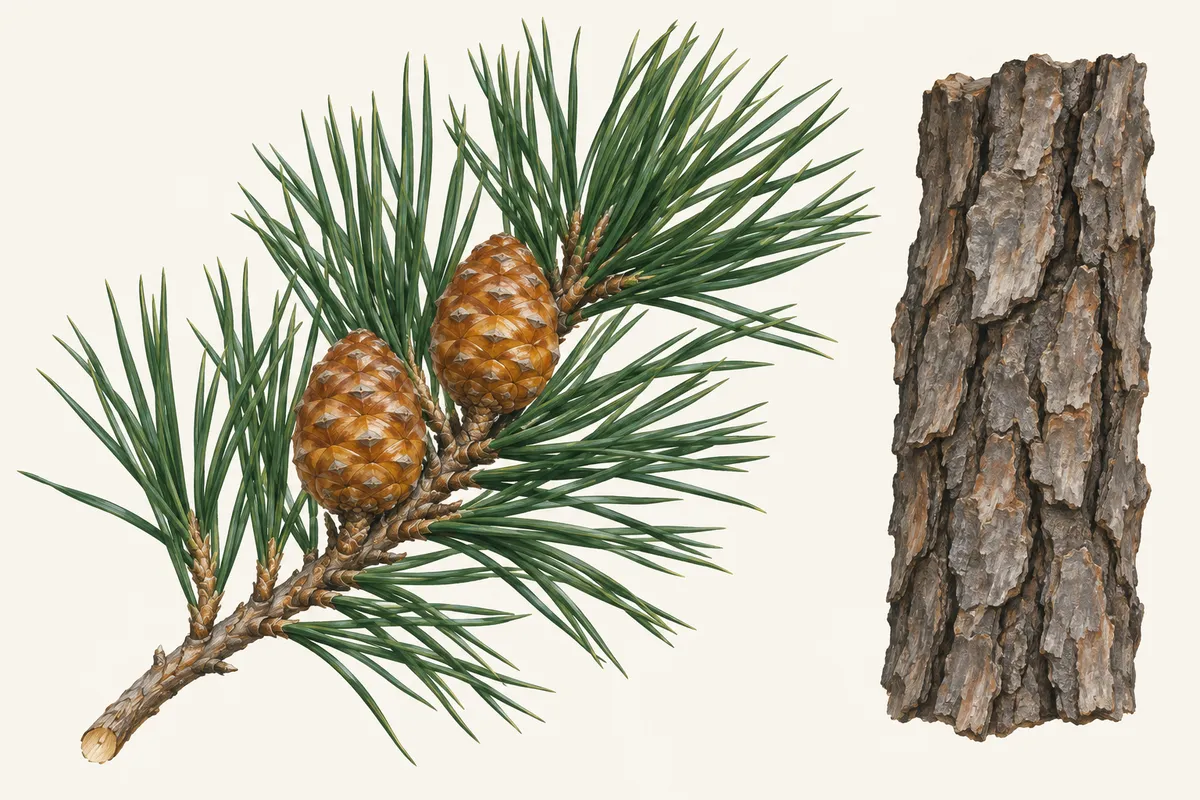
Austrian pine identification, or black pine in Britain, starts with a needle bundle: two thick, stiff, dark green needles about 10 to 15 cm (4 to 6 in) long. The cones are egg-shaped, 5 to 8 cm, yellow-brown, with a tiny prickle on each scale, and the bark is grey-brown to black in rough ridges, with none of the orange upper trunk of Scots pine.
- Austrian pine, black pine and Corsican pine are all Pinus nigra; Corsican pine is the subspecies laricio, Austrian pine the subspecies nigra.
- Two long, dark needles and a dark trunk all the way up separate it from Scots pine, whose needles are half as long and blue-green and whose upper trunk is orange.
- In the American Midwest the Morton Arboretum no longer recommends planting Austrian pine because of Diplodia tip blight and other pests; in Britain, red band needle blight has stopped new Corsican pine planting.
Field marks at a glance
- Scientific name
- Pinus nigra
- Family
- Pinaceae (pine family)
- Type
- Conifer, evergreen
- Needles
- In pairs, thick, stiff, dark green, with finely toothed edges and a sharp point. Length: 10 to 15 cm (Woodland Trust; Virginia Tech's 4 to 6 in), 3 to 6 in (Morton Arboretum), 12 to 18 cm (Field Studies Council). Kept up to 4 years (Virginia Tech).
- Cones
- Egg-shaped, 5 to 8 cm (2 to 3 in), stalkless, yellow-brown to pale brown, each scale with a minute prickle; mature in the second autumn.
- Bark
- Grey-brown to black, rough (Woodland Trust); grey-brown ridges between dark brown furrows (Virginia Tech); plate-like and dark brown to black (Morton Arboretum). No orange on the upper trunk.
- Buds and twigs
- Stout, hairless, yellowish-brown, ridged twigs (Woodland Trust) with a large white, egg-shaped end bud (Virginia Tech).
- Shape
- Triangular when young, flat-topped with age (Woodland Trust); a very dense crown (Virginia Tech). Austrian forms spread with long side branches, Corsican forms are columnar with short ones (Field Studies Council).
- Size
- Up to 100 ft (Virginia Tech); 50 to 60 ft in Midwest yards (Morton Arboretum). Woodland Trust gives a lifespan over 500 years.
- Native range
- Central and southern Europe (Woodland Trust, Morton Arboretum); Corsican pine from Corsica and Italy (Forest Research). Planted in Britain and North America.
Black pine is the dark, dense pine of British shelter belts, sand dunes and lowland forests, and the Austrian pine of American windbreaks and old yards. It is one species, Pinus nigra, native to central and southern Europe, with several subspecies: foresters in Britain mostly plant Corsican pine, and gardeners in both countries mostly met Austrian pine. All of them share the same core marks: two long, stiff, dark needles, a mid-sized egg-shaped cone and a dark trunk.
How to identify an Austrian or black pine
- Pull one bundle. Two needles grow together. The Woodland Trust gives them 10 to 15 cm long, very stiff, with slightly serrated edges, straight or curved. Virginia Tech Dendrology gives 4 to 6 inches, thick and dark green. The Morton Arboretum adds toothed edges and a sharp point. Run a finger along a needle and you can feel the teeth.
- Look at the bud. Virginia Tech describes a large, white, egg-shaped bud at the end of a stout, brown to grey twig. In winter it stands out against the dark needles.
- Find a cone. Egg-shaped and stalkless, 5 to 8 cm (Woodland Trust) or 2 to 3 inches (Virginia Tech), yellow-brown, each scale tipped with a very short, minute prickle. The Field Studies Council's conifer key says the cones mature in their second autumn.
- Look up the trunk. The bark is rough and grey-brown to black (Woodland Trust), in grey-brown ridges between dark brown furrows (Virginia Tech). There is no orange on the upper trunk, which rules out Scots pine at once.
- Step back. Young trees are triangular; old ones become flat-topped, with dense branches.
Tree Identifier can suggest a name from one photo of a needle bundle, a cone or the bark. It shows one name and no look-alike list, so check the needle length and the upper trunk against the steps above.
Austrian pine, Corsican pine and black pine: one species
The names cause most of the confusion. The Woodland Trust gives black pine, Austrian pine and Corsican pine as names of Pinus nigra. Botanists split the species into subspecies, and two matter in Britain and North America:
- Austrian pine (Pinus nigra subsp. nigra): the Field Studies Council describes relatively stiff, dark green needles, dense on the shoot, and a spreading crown with long side branches. This is the black pine of American yards, parks and windbreaks.
- Corsican pine (Pinus nigra subsp. laricio): relatively flexible, grey-green needles, well spaced on the shoot, and a columnar crown with short side branches. Its cone scales can be flat or carry a very small prickle or hook.
Forest Research says Corsican pine was the first pine planted at scale in Britain, from 1919, and is still the dominant commercial pine, suited to the drier lowlands. It notes that Austrian pine tolerates chalk, limestone and exposure better, but is less vigorous and has poorer form, so it is used only on particular sites or for shelter belts.
Black pine vs Scots, red and maritime pine
| Pine | Needles | Cone | Bark |
|---|---|---|---|
| Black pine (Austrian, Corsican) | 2, 10–15 cm (4–6 in), stiff, dark green | 5–8 cm, egg-shaped, yellow-brown, minute prickle | Grey-brown to black, ridged |
| Scots pine | 2, 4–8 cm (1 1/2–3 in), twisted, blue-green | 4–6 cm (1 1/2–2 1/2 in), slightly stalked, blunt spine | Orange and peeling in the upper crown |
| Red pine | 2, 10–16 cm, brittle, snap when bent | 4–7 cm, no prickles | Reddish to pinkish, broad flat plates |
| Maritime pine | 2, 12–25 cm, stout | 9–18 cm, glossy chestnut-brown | Thick, deeply fissured, red-brown and blackish |
Scots pine is the comparison British readers need most, and the Scots pine page has the full key. Virginia Tech gives its needles as 1 1/2 to 3 inches, stout, twisted and blue-green, and says its upper crown always shows orange, peeling bark. Black pine is dark from base to crown.
Red pine is the American look-alike. Natural Resources Canada describes needles 10 to 16 cm, shiny dark green, straight and brittle, so they break in half when bent, and cones 4 to 7 cm with no prickles. Bend an Austrian pine needle the same way: Virginia Tech calls them flexible. The red pine vs white pine page adds the other pines of the Great Lakes.
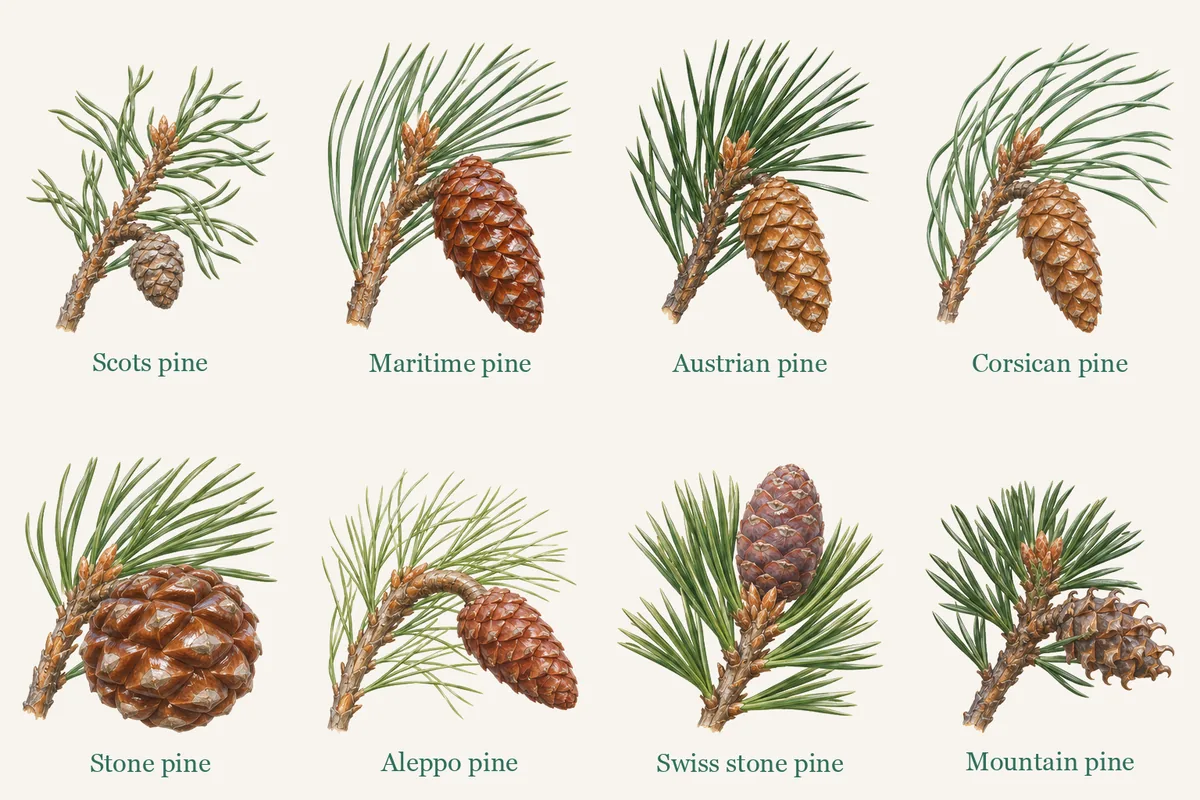
Maritime pine is native to the western Mediterranean, from Portugal and Morocco to Italy. The Gymnosperm Database gives needles 12 to 25 cm and cones usually 9 to 18 cm, glossy chestnut-brown, which can stay closed on the tree for up to 10 years. Its cones are the quickest separation: about twice the length of a black pine's. A round-crowned pine with heavy, nearly spherical cones is more likely a stone pine.
Where black pine grows, and its diseases
The Woodland Trust describes black pine as native to central and southern European coastal areas, widely grown in Britain as an ornamental and in plantations, shelter belts, parks, churchyards and large gardens, and naturalised on heaths and sand dunes in parts of the UK. It tolerates heat, drought, salt, snow and ice, and can live more than 500 years. Forest Research gives the natural range of Corsican pine as 950 to 1,800 m in the mountains of Corsica and Italy.
In the United States, Virginia Tech says Austrian pine is planted widely and may seed into the landscape. The Morton Arboretum lists hardiness zones 3 to 7, a mature size of 50 to 60 feet by 20 to 40 feet, and a dry-soil, full-sun tree that tolerates alkaline and clay soils.
Both countries have turned against it for the same kind of reason. In Britain, Forest Research says red band needle blight (Dothistroma septosporum) has seriously affected Corsican pine, which is very susceptible, and that the subspecies is currently not recommended for planting. In the Midwest, the Morton Arboretum says Austrian pine is not recommended for planting anywhere in the region, and lists Diplodia (Sphaeropsis) tip blight, the pine wilt nematode and the Zimmerman pine moth.
Finding black pine through the year
- Spring: new shoots carry yellow male flowers and red female flowers; the Woodland Trust says the reproductive cones open in May.
- Summer: the crown is at its densest; Virginia Tech describes a very dense crown with needles kept for up to 4 years.
- Autumn: cones ripen in their second autumn (Field Studies Council), turning yellow-brown (Virginia Tech), the best time to collect one for the cone test.
- Winter: the dark, dense crown and the white end buds are easiest to see. The pine cone identification guide helps with cones picked up from the ground.
To compare a black pine with the Scots pines nearby, let Tree Identifier's Tree Map pin each located identification, and ask the follow-up chat under a result how the two differ. For the needle counts of the other common pines, see the pine identification page.
Look-alikes and how to tell them apart
Scots pine (Pinus sylvestris)
Virginia Tech gives Scots pine needles as 1 1/2 to 3 inches (4 to 8 cm), stout, twisted and blue-green, and says upper crowns always show orange peeling bark. Black pine needles are about twice as long and dark green, and its bark stays grey-brown to black all the way up.
Red pine (Pinus resinosa)
Also two long needles, 10 to 16 cm, but brittle: Natural Resources Canada says they break in half when bent. Red pine cones, 4 to 7 cm, have no prickles, and its bark is reddish to pinkish in broad, flat plates.
Maritime pine (Pinus pinaster)
Needle pairs are longer and stouter, 12 to 25 cm, and the cones are much bigger, usually 9 to 18 cm, glossy chestnut-brown, often staying on the tree for years, according to the Gymnosperm Database.
What a photo can't settle
- Two-needle pines planted in yards and windbreaks overlap in needle length; a single photo of foliage may not separate black pine from red pine. A cone, the bark, or a needle bent until it snaps or bends helps.
- Austrian and Corsican pine are subspecies of one species, and published needle lengths differ by source (10 to 18 cm). A photo app gives the species name, not the subspecies.
- Black pine is not one of the 138 species in Tree Identifier's Collection, though the app can still suggest a name from a photo.
Questions people ask
Is Austrian pine the same as black pine?
Yes. Both names mean Pinus nigra. The Woodland Trust lists black pine, Austrian pine and Corsican pine as names of one species. Foresters separate subspecies: Austrian pine is subspecies nigra, Corsican pine subspecies laricio.
How do you tell Austrian pine from Corsican pine?
The Field Studies Council key compares them: Austrian pine has stiff, dark green needles crowded on the shoot and a spreading crown with long side branches; Corsican pine has more flexible, grey-green needles spaced along the shoot and a narrow, columnar crown with short branches. Both have needles in pairs and egg-shaped cones.
How do you tell black pine from Scots pine?
Look up the trunk. Scots pine turns orange and flaky near the crown; black pine bark is grey-brown to black all the way up. Then compare needles: Virginia Tech gives Scots pine pairs as 1 1/2 to 3 inches, twisted and blue-green, while the Woodland Trust gives black pine needles as 10 to 15 cm and very stiff.
Why is my Austrian pine turning brown at the tips?
The Morton Arboretum lists Diplodia (Sphaeropsis) tip blight, the pine wilt nematode and the Zimmerman pine moth among its problems. In Britain, the Woodland Trust and Forest Research name red band needle blight, which makes the needles fall. A pine near a house that is browning fast is a job for an arborist.
Is Austrian pine still recommended for planting?
Not in the Midwest: the Morton Arboretum says it is not recommended for planting anywhere there because of insect and disease problems. In Britain, Forest Research says Corsican pine is currently not recommended for planting because of red band needle blight.
Sources
- Black pine (Pinus nigra) — Woodland Trust
- Corsican pine (CP), Tree species database — Forest Research
- Scots pine fact sheet — Virginia Tech Dendrology
- Austrian pine fact sheet — Virginia Tech Dendrology
- Austrian pine — The Morton Arboretum
- Pinus nigra, Conifers identification key — Field Studies Council
- Red pine factsheet — Natural Resources Canada, Trees, insects and diseases of Canada's forests
- Pinus pinaster — The Gymnosperm Database
Keep reading
- Tree profileScots pine (Pinus sylvestris): how to identify it
- Tree profilePines (Pinus): how to identify a pine tree
- Tree comparisonRed pine vs white pine: how to tell them apart, with jack pine
- Field guidePine cone identification: what tree a cone came from
- Tree profileStone pine (Pinus pinea): how to identify the umbrella pine