Tree profile
Stone pine (Pinus pinea): how to identify the umbrella pine
The flat-topped pine of Mediterranean coasts and old British estates, also called Italian stone pine and umbrella pine. The crown shape is a strong clue; the cone settles it.
In short
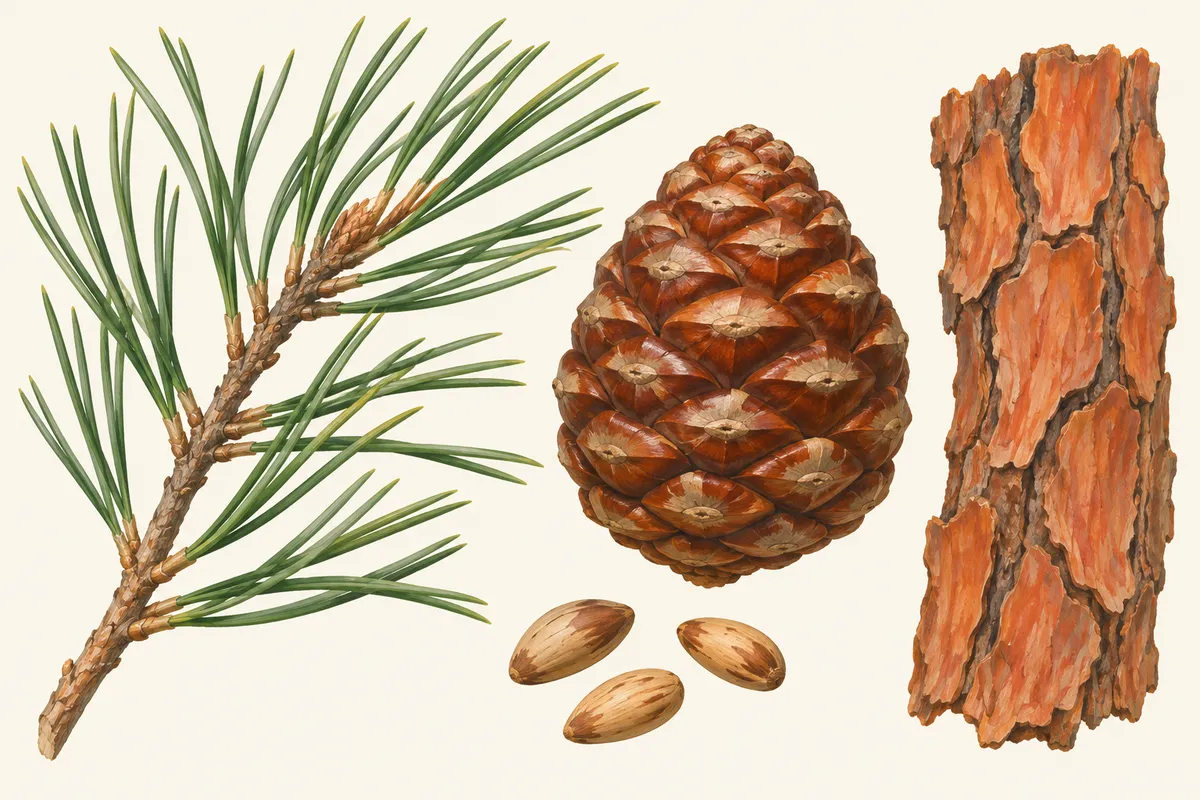
Stone pine identification starts with the shape: a broad, domed crown like an open umbrella on a short trunk. Then check the needles, in pairs, stiff, about 10 to 18 cm long; the bark, thick plates of red-brown to orange with blackish edges; and the cones, heavy, glossy, chestnut-brown and nearly round, 8 to 12 cm long, which take about three years to ripen.
- Seedlings and young trees carry short, single, blue-grey juvenile needles for several years, so a young stone pine looks nothing like its parent.
- A ripe stone pine cone is broad, heavy and glossy, as wide as it is long, unlike the egg-shaped cones of black pine or the long cones of maritime pine.
- Japanese umbrella pine is a different tree altogether, with whorls of long, linear leaves and no needle pairs.
Field marks at a glance
- Scientific name
- Pinus pinea
- Family
- Pinaceae (pine family)
- Type
- Conifer, evergreen
- Shape
- Domed, very broad crown like an umbrella, wider than it is tall on open-grown trees; conical only in the first two years (Gymnosperm Database). Branches rise and turn up at the tips.
- Needles
- In pairs, occasionally threes (Bean), stiff, mid- to dark green, 10 to 18 cm, rarely to 28 cm (Gymnosperm Database); the RHS gives up to 15 cm. Kept 2 to 4 years.
- Juvenile needles
- Single, blue-grey (glaucous), 1.5 to 4 cm, on seedlings and young trees for 3 to 10 years, mixed with adult pairs from the third year (Gymnosperm Database).
- Cones
- Broad egg-shaped to almost round, 8 to 12 cm (to 15 cm) long and 5 to 11 cm wide, on short stout stalks; green, ripening glossy chestnut-brown about three years after pollination.
- Seeds
- Large, 15 to 20 mm, pale brown under a black, sooty powder, with only a tiny, loose wing (Gymnosperm Database).
- Bark
- Thick, plated, deeply fissured, red-brown to orange with blackish plate edges, on a short, often slightly curved trunk.
- Buds
- Egg-shaped and pointed, 7 to 20 mm (Gymnosperm Database), with curly scales fringed with long silvery threads (Bean).
- Size
- 15 to 20 m at maturity (RHS); 12 to 25 m, occasionally 35 m (Gymnosperm Database). Britain's tallest recorded by Bean: 75 ft (about 23 m) at Embley Park, Hampshire, in 1986.
- In the app's Collection
- Yes: stone pine (Pinus pinea) is one of the 138 species in Tree Identifier's Collection.
Stone pine is the umbrella-shaped pine of the Mediterranean, planted in British gardens for centuries and found in parks from Hampshire to north Wales. Its silhouette is the first clue, and from a distance few other trees share it. Up close, the cone is unmistakable: heavy, glossy and nearly round, the slowest-ripening cone of any pine.
How to identify a stone pine
- Step back and look at the crown. The Gymnosperm Database describes a crown that is conical only for the first two years, then domed and very broad, with long branches rising at 30 to 60 degrees and tips turned upward. It says only one other pine, a Mexican species, shares this shape. Bean's account calls it a broad, spreading head of branches, more across than high, on open-grown trees.
- Pull one bundle. Needles come in pairs, occasionally in threes. The RHS describes stiff, dark green needles up to 15 cm; the Gymnosperm Database gives 10 to 18 cm, rarely up to 28, about 1.5 mm thick and mid-green.
- Find a cone. This is the decisive test. The cone is broad egg-shaped to almost round, 8 to 12 cm long and nearly as wide, green at first and ripening glossy chestnut-brown. The RHS describes it as rounded-ovoid, to 15 cm, shiny light brown. It is heavy, with thick, stiff, woody scales.
- Read the bark. Thick, plated and deeply fissured, red-brown to orange, with blackish edges on the plates, on a short trunk that is often slightly sinuous (Gymnosperm Database).
Tree Identifier can suggest a name from one photo of the crown, a cone or the bark, and stone pine is one of the 138 species in its Collection. For a pine, a photo of a cone with a needle bundle beside it is worth more than a distant crown.
Cones and seeds: three years to ripen
The Gymnosperm Database says stone pine cones take about three years to ripen after pollination, the longest maturation of any pine. Each scale carries a double umbo, an inner one from the first year and an outer one from the second, which you can see on the scale tips of a fallen cone. Ripe cones open on the tree or up to a year later.
The seeds are large: 15 to 20 mm long, pale brown under a black, sooty powder, with only a tiny, loosely attached wing that does not carry them far. Bean describes them as kidney-bean shaped and about 3/4 inch long. The Gymnosperm Database notes that, unlike many pines, stone pine relies on huge seed crops in mast years rather than on birds to spread them.
Never eat a seed, nut or cone on the strength of a web page or an app. The pine cone identification guide compares the cones of other pines you may find on the ground nearby.
Young stone pines look like a different tree
A seedling stone pine has no needle pairs at all. The Gymnosperm Database describes single juvenile needles, glaucous blue-grey, 1.5 to 4 cm long, kept for 3 to 10 years, with the first adult pairs appearing among them from the third year. Trees and Shrubs Online, which publishes Bean's account, gives about an inch for these juvenile needles on one- and two-year-old seedlings, and notes that they can reappear on scattered shoots of much older trees.
So a small pot-grown "umbrella pine" with short blue-grey needles may well be a stone pine that has not yet changed. Bean also notes that young plants are apt to be cut by severe frosts and transplant poorly if left in one place more than two or three years.
Stone pine vs maritime pine, black pine and Japanese umbrella pine
| Tree | Needles | Cone | Crown |
|---|---|---|---|
| Stone pine | 2, 10–18 cm, stiff | 8–12 cm, almost round, glossy chestnut-brown, 3 years | Flat umbrella |
| Maritime pine | 2, 12–25 cm, stout | 9–18 cm, ovoid-conic, glossy chestnut-brown | Open, candelabra branches |
| Black pine | 2, 10–15 cm, very stiff | 5–8 cm, egg-shaped, prickled scales | Triangular, flat-topped with age |
| Japanese umbrella pine | Whorls of linear leaves to 12 cm | Ovoid, about 8 cm | Slow-growing, to 20 m |
Maritime pine is the closest match, because its cones are also big and glossy. The Gymnosperm Database gives longer, stouter needles, 12 to 25 cm, and cones longer than wide, ovoid-conic, usually 9 to 18 cm, which can stay closed on the tree for up to 10 years. Stone pine cones are as broad as they are long.
Black pine shares the needle length but not the cone. The Woodland Trust gives black pine cones 5 to 8 cm with prickled scales, and bark that is grey-brown to black. The Austrian pine page covers black pine and its Corsican and Austrian forms.
Japanese umbrella pine shares a name and nothing else. The RHS describes a slow-growing conifer with dense whorls of dark green, linear leaves to 12 cm and ovoid cones 8 cm long. For needle counts of the common pines, see the pine identification page.
Stone pine in Britain and around the Mediterranean
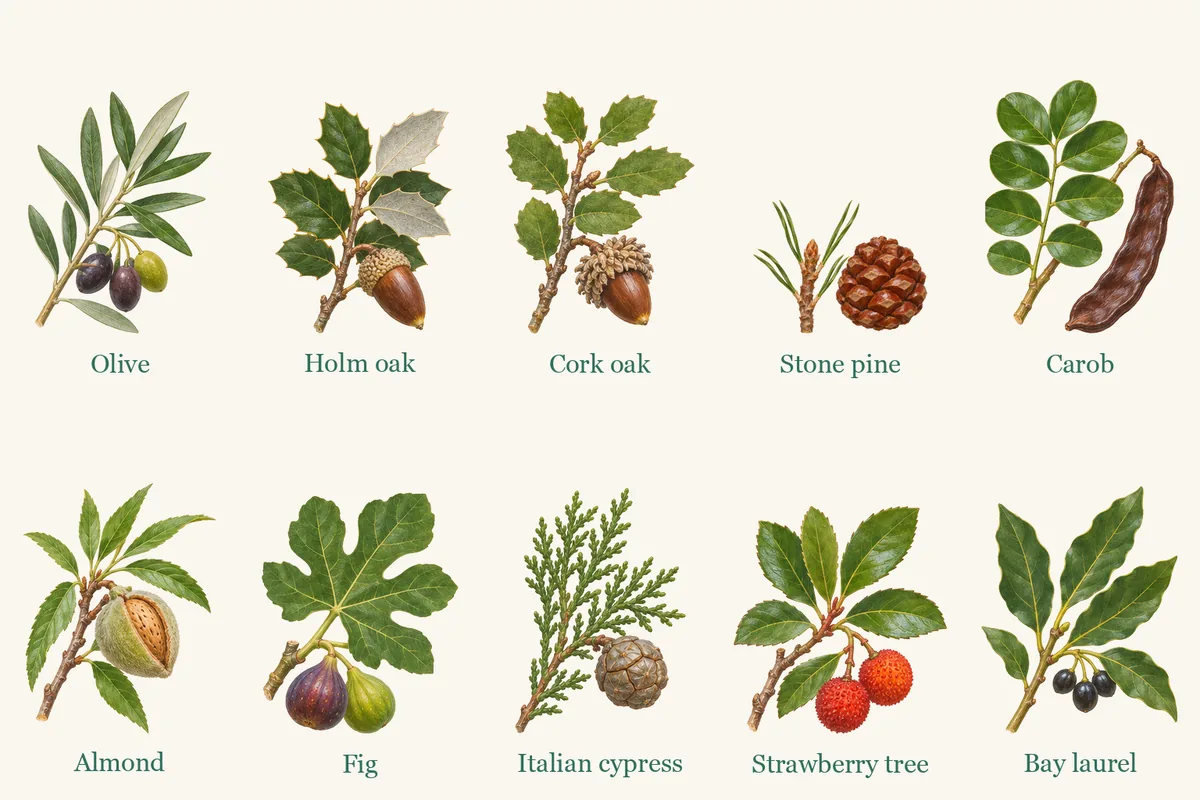
The natural range is uncertain because people have planted stone pine for thousands of years. The Gymnosperm Database thinks it was probably confined to the Iberian Peninsula before that, and now lists it from Portugal and Spain through France, Italy and the Balkans to Turkey, Syria and Lebanon, and in north Africa; it is naturalised in South Africa and California. Bean describes the man-made pine forest at Ravenna, near the Adriatic coast, about 16 miles long, as at least 1,500 years old.
In Britain. Bean says stone pine has been cultivated in England for probably at least four centuries, and that seed husks found in the refuse of Roman camps suggest seeds were sent over for the occupying army. His records include trees of 75 ft at Embley Park, Hampshire (1986), 72 ft at RHS Garden Wisley (1986) and 51 ft at Kew (1981); Trees and Shrubs Online names the current UK champion at Bodysgallen Hall in north Wales. The RHS rates it H4, hardy through most of the UK, and gives 15 to 20 m when fully mature, a size it takes more than 50 years to reach. The Gymnosperm Database places its cold limit at USDA zone 8.
A flat-topped pine in a British park is not always a stone pine: old Scots pines can have flat tops too, as the Scots pine page explains, so check the cone. With location turned on, Tree Identifier's Tree Map pins each identification, so you can come back and check the cones a year later.
Look-alikes and how to tell them apart
Maritime pine (Pinus pinaster)
Also two long needles and big glossy cones, but its needles are longer and stouter, 12 to 25 cm, and its cones are longer than wide, ovoid-conic, usually 9 to 18 cm, and can stay closed on the tree for years. The crown is open and candelabra-like rather than a flat umbrella.
Black pine (Pinus nigra)
Two stiff, dark needles of a similar length, 10 to 15 cm, but the cones are small, 5 to 8 cm, egg-shaped and yellow-brown with a prickle on each scale, and the bark is grey-brown to black, not orange. The crown is dense and flat-topped only with age.
Japanese umbrella pine (Sciadopitys verticillata)
Not a pine at all. The RHS describes dense whorls of dark green, linear leaves up to 12 cm, and ovoid cones about 8 cm. It has no needle pairs and the RHS calls it rather slow-growing.
What a photo can't settle
- A young stone pine, with its single blue-grey juvenile needles, looks like a different conifer; a photo app can misread it. Photograph an older shoot with needle pairs if there is one.
- Pruned or crowded stone pines lose the umbrella shape; Bean notes that trees drawn up by others grow much taller and narrower, so the crown test only works on open-grown trees.
- Tree Identifier gives one name per photo with no look-alike list. For pines, a photo of a cone and a needle bundle beside it gives more to go on than a distant crown.
Questions people ask
Is stone pine the same as umbrella pine?
Yes, when people mean the Mediterranean tree. The RHS lists Italian stone pine and umbrella pine as other names for Pinus pinea. But the RHS also uses umbrella pine for Sciadopitys verticillata, the Japanese umbrella pine, a different conifer with whorls of long, linear leaves. Check the scientific name.
Can stone pine grow in the UK?
Yes. Bean's Trees and Shrubs says it has been cultivated in England for probably at least four centuries, and records trees over 70 ft at Embley Park in Hampshire and at RHS Garden Wisley. The RHS rates it H4, hardy through most of the UK, though Bean notes that severe frosts can cut young plants.
How long do stone pine cones take to ripen?
About three years after pollination, the longest of any pine, according to the Gymnosperm Database. The cones start green, ripen glossy chestnut-brown and open on ripening or up to a year later.
Why does my young stone pine have short blue needles?
They are juvenile needles. The Gymnosperm Database describes single, blue-grey needles 1.5 to 4 cm long that a young stone pine keeps for 3 to 10 years; adult needles, in pairs and much longer, appear among them from the third year. Bean adds that juvenile shoots can turn up on older trees too.
Where is the stone pine native?
Its natural range is uncertain because people have planted it for so long. The Gymnosperm Database thinks it was probably confined to the Iberian Peninsula before people spread it; Bean gives southern Europe from Spain and Portugal east to Greece and Asia Minor. It now grows all around the Mediterranean.
Sources
- Pinus pinea, stone pine — Royal Horticultural Society
- Pinus pinea (pinheiro manso) — The Gymnosperm Database
- Pinus pinea — Trees and Shrubs Online (International Dendrology Society), from Bean's Trees and Shrubs Hardy in the British Isles
- Pinus pinaster — The Gymnosperm Database
- Black pine (Pinus nigra) — Woodland Trust
- Sciadopitys verticillata, umbrella pine — Royal Horticultural Society
Keep reading
- Tree profilePines (Pinus): how to identify a pine tree
- Tree profileAustrian pine and black pine (Pinus nigra): how to identify it
- Field guidePine cone identification: what tree a cone came from
- Tree profileScots pine (Pinus sylvestris): how to identify it
- Field guideConifer identification: three questions about the needles, then the cone