Tree profile
Bigleaf maple (Acer macrophyllum): how to identify it
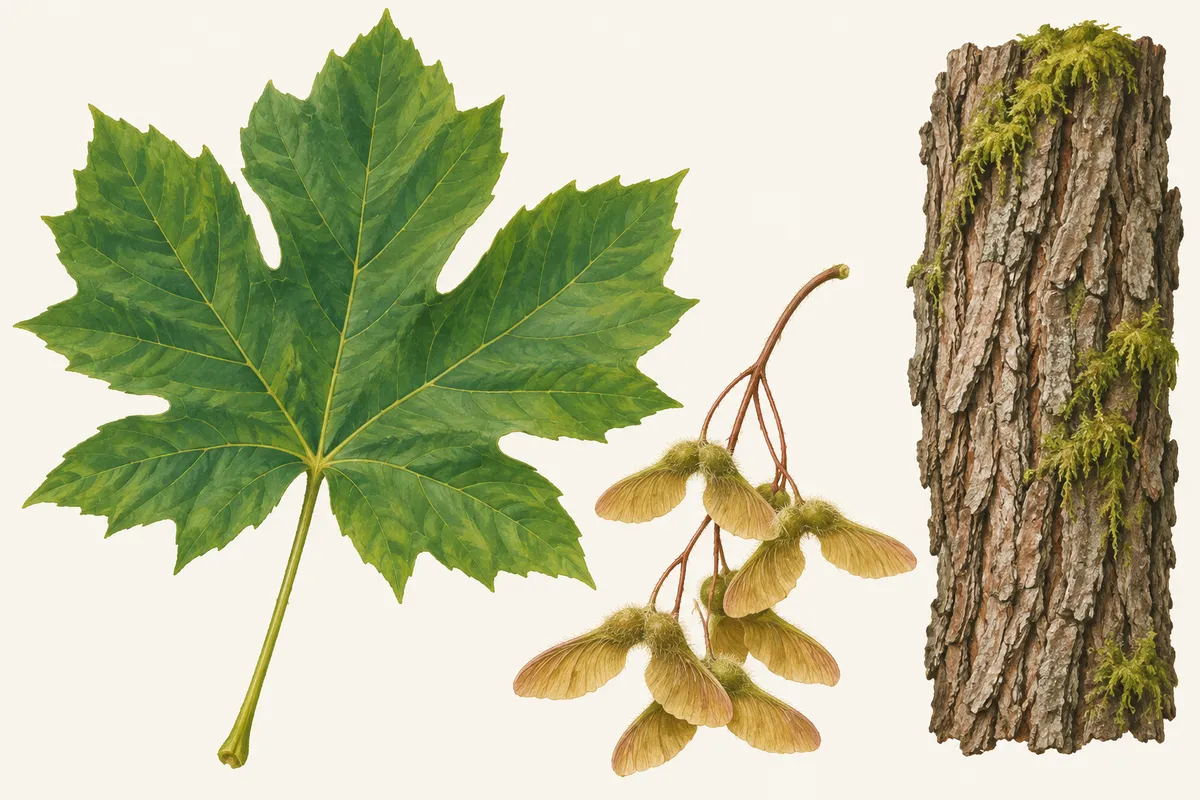
The largest maple leaves in the world, a drop of milky sap when you snap the stalk, fuzzy seed pairs at right angles and a trunk wrapped in moss and ferns: the big maple of the Pacific Coast.
In short
For bigleaf maple identification, measure a leaf: opposite, with five deep lobes, usually 6 to 12 inches across and sometimes up to 24, the largest of any maple. Snap the long leaf stalk and it bleeds milky sap. The paired seeds have wings 1.4 to 2 inches long set at about right angles, with bristly-hairy seeds, and in the wet Pacific Northwest the trunk is often draped in moss and ferns.
- A maple leaf wider than a dinner plate on the Pacific Coast is bigleaf maple; no other western maple comes close.
- Among common maples, milky sap in the leaf stalk is shared only with Norway maple, a planted tree whose leaves are 3 to 6 inches long.
- Vine maple, its common neighbor, has round leaves 2 to 4 inches across with 7 to 9 lobes.
Field marks at a glance
- Scientific name
- Acer macrophyllum
- Family
- Sapindaceae (soapberry family); Virginia Tech lists the older Aceraceae
- Type
- Broadleaf, deciduous
- Leaves
- Opposite, simple, palmately lobed with 5 deep lobes, the middle lobe narrowed at its base like a waist; usually up to 12 inches (30 cm) across, exceptionally 24 inches (61 cm); lustrous dark green above, pale beneath.
- Leaf stalk
- Long; a detached stalk bleeds milky sap.
- Fruit
- Paired samaras about 1.4 to 2 inches (3.5 to 5 cm) long, joined at about right angles, in long hanging clusters; the seed end is densely hairy. Ripe in September and October.
- Flowers
- Small, greenish yellow, fragrant, about 3/8 inch (10 mm) across, in drooping clusters, usually before the leaves; March at low elevations to June at high ones.
- Bark
- Grayish or reddish brown with interlacing ridges and furrows; in wet coastal forests often hidden under mosses, liverworts, licorice fern and lichens.
- Fall color
- Yellow to gold or brown.
- Size
- Most mature trees about 50 ft tall and 20 in across; large trees 100 ft and 3 to 4 ft across. Lives 200 years or more.
- Range
- Pacific Coast from southwestern British Columbia to southern California, always within about 186 miles (300 km) of the ocean, west of the Cascades and Sierra Nevada; sea level to about 7,000 ft in southern California.
Bigleaf maple is the tree that makes a Pacific Northwest forest look like a rainforest: a broad crown of enormous leaves over a trunk thick with moss and ferns. Few trees are easier to recognize once you have seen one. The leaf is the giveaway, routinely a foot across and sometimes two, but on a young tree or a shaded branch it can be smaller, and then two quick checks, the sap and the seeds, confirm it.
How to identify a bigleaf maple
Work through these four checks; any two of them together are enough.
1. Leaf size and shape. Leaves are opposite and simple, with five deep, palmate lobes. The USDA Forest Service's Silvics of North America gives them as usually up to 12 inches (30.5 cm) across and exceptionally 24 inches (61 cm). Oregon State's Trees to Know adds a useful detail: the middle lobe narrows near its base, giving it a noticeable waist. The upper surface is lustrous dark green, the underside pale.
2. Milky sap. Pull a leaf off and look at the end of the long stalk. Oregon State's landscape plant profile notes that the petiole yields milky sap when detached. The only other maple you are likely to meet that does this is planted Norway maple.
3. Hairy seed pairs at right angles. The paired samaras hang in long clusters. The Forest Service gives wings 1.4 to 2 inches (3.5 to 5 cm) long, ripening in September and October, and Oregon State describes the two halves joined at right angles, with fuzzy, hairy seeds. Vine maple, the common small maple below it, has smooth seeds spread flat.
4. Moss on the trunk. The bark is grayish or reddish brown with interlacing ridges and furrows, but in wet forests you may barely see it. Oregon State notes that the bark retains moisture and carries mosses, liverworts and ferns; the Forest Service found that on the Olympic Peninsula these epiphytes weigh nearly four times as much as the tree's leaves, and lists licorice fern and lichens among them.
In spring, look for drooping clusters of small, fragrant, greenish-yellow flowers, usually opening before the leaves. In fall the leaves turn yellow to gold or brown.
When the canopy is high, a fallen leaf on the trail is often enough. Tree Identifier can name a bigleaf maple from one photo of a leaf, the bark or the whole tree; it gives one name without a confidence score or a list of look-alikes, so measure the leaf and check the sap if you can.
Bigleaf maple vs vine, Rocky Mountain and Norway maple
| Maple | Leaf across | Lobes | Samaras | Where |
|---|---|---|---|---|
| Bigleaf maple | Usually 6–12 in, up to 24 in | 5, deep, waisted middle lobe | Right angle, fuzzy seeds | Pacific Coast, wild |
| Vine maple | 2–4 in, round outline | 5–9, usually 7 | Spread flat (180°), smooth | Throughout the Pacific Northwest |
| Rocky Mountain maple | 2–5 in | 3 main lobes | Right angle, smooth | Wild in Oregon and Washington |
| Norway maple | 3–6 in long | 5–7 with long pointed teeth | Widely spread, flat seed | Planted, streets and yards |
Vine and Rocky Mountain maple figures come from Oregon State's maple key. Vine maple is generally under 20 feet with several stems, and its twigs often end in two buds. Norway maple comes from Virginia Tech's Norway maple sheet, which describes leaves with 5 to 7 lobes and long pointed teeth, milky sap from the stalk, widely divergent samaras 1 1/2 to 2 inches long with a flat seed cavity, and large, turban-shaped buds; the Morton Arboretum gives its leaves as 3 to 6 inches long. Outside the Pacific Coast, a maple with milky sap is most likely Norway maple; the Norway maple vs sugar maple page explains the sap test.
For the other eastern maples (sugar, red, silver, boxelder), see the maple identification page. If the big leaves are not maple-shaped, the guide to trees with big leaves covers catalpa, bigleaf magnolia, sycamore and others.
Where bigleaf maple grows
The Forest Service gives a range between latitudes 33° and 51° N, always within 186 miles (300 km) of the Pacific, from near Sullivan Bay in British Columbia to within 10 miles of San Francisco Bay, and on into southern California. It is absent from southeastern Alaska, the Queen Charlotte Islands and California's Central Valley. Oregon State places it on the west side of the Cascades and Sierra Nevada.
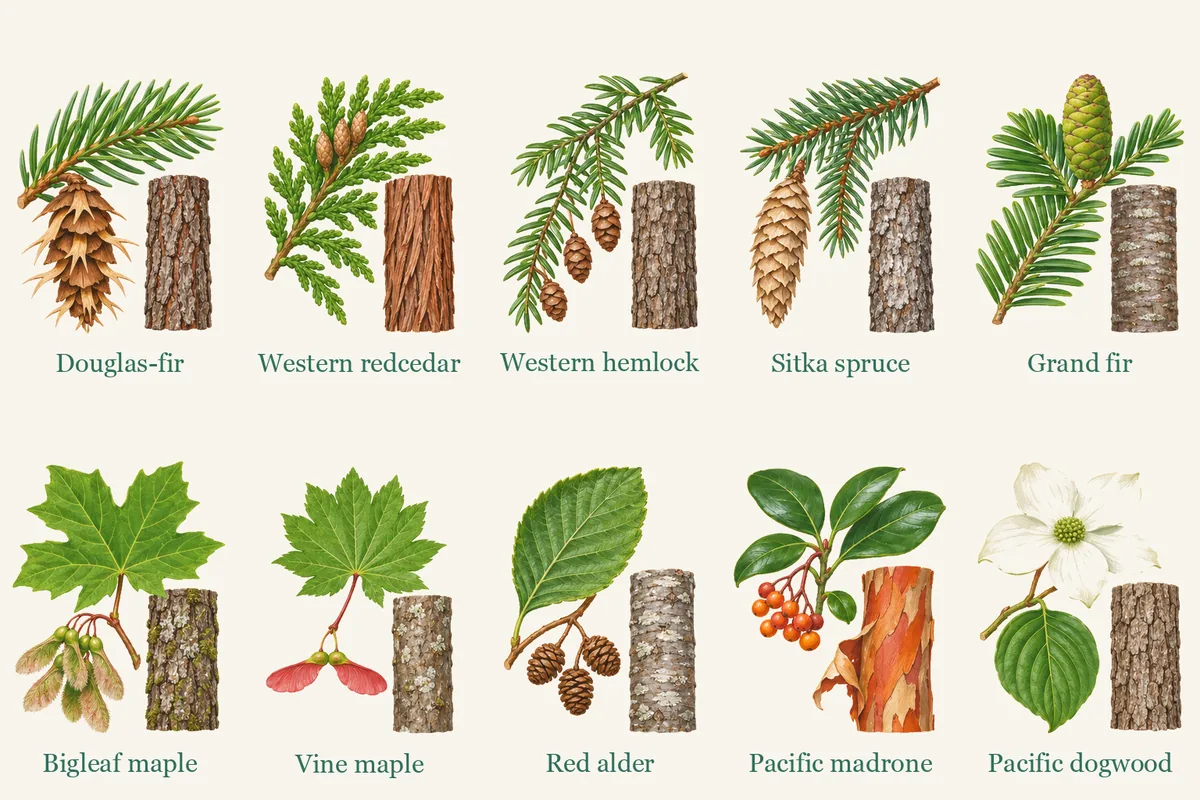
Elevation limits change with latitude: seldom above 1,000 feet (305 m) in coastal British Columbia, up to 1,500 feet (455 m) on the Olympic Peninsula, 3,400 feet in the California Coast Ranges, 5,500 feet in the Sierra Nevada, and up to 7,000 feet (2,135 m) in southern California, where it is usually above 3,000 feet along streams. It grows best on river terraces, flood plains and seepage sites, but also on shallow rocky soils and steep talus slopes. In the Pacific Northwest tree guide it shares the wet coastal forest with Douglas-fir, western redcedar, western hemlock and red alder.
Size, age and sprouting
Most mature trees are about 50 feet tall and 20 inches in diameter, but large ones often reach 100 feet and 3 to 4 feet across. The largest known tree in 1977, in western Oregon, was 101 feet tall with a crown spread of 90 feet. The oldest trees pass 200 years.
Cut a bigleaf maple and it comes back. The Forest Service says it sprouts profusely from the stump: sprout clumps have reached 17 feet tall and 21.5 feet across in three years, with as many as 67 sprouts around one stump. A ring of straight maple poles around an old stump in a West Coast forest is a reason to check for bigleaf maple. Seed production begins at about 10 years, and the tree bears seed most years, released by wind from October to January.
Bigleaf maple is one of the few commercial hardwoods of the Pacific Coast; the Forest Service notes its wood is preferred for piano frames. With location turned on, Tree Identifier's Tree Map pins the find, a simple way to return to the same tree when its seeds ripen in fall.
Look-alikes and how to tell them apart
Norway maple (Acer platanoides)
Norway maple also bleeds milky sap from a snapped leaf stalk, but it is a planted European street tree whose leaves are 3 to 6 inches long (Morton Arboretum), with 5 to 7 lobes ending in long pointed teeth, and widely spread samaras with a flat seed cavity.
Vine maple (Acer circinatum)
Vine maple is a multi-stemmed small tree, generally under 20 feet, with a round leaf only 2 to 4 inches across and 5 to 9 lobes, usually 7. Its samaras spread out flat at 180 degrees like a propeller and have no fuzzy heads.
Rocky Mountain maple (Acer glabrum)
Rocky Mountain maple leaves have 3 main lobes and are only 2 to 5 inches across; its samaras meet at right angles like bigleaf maple, but the seed heads are not fuzzy.
What a photo can't settle
- A young or shaded bigleaf maple leaf can be only a few inches across, close to other maples; measure several leaves, not one.
- The milky sap test needs a fresh leaf stalk; a photo cannot show it.
- Planted bigleaf maples grow outside the native range, so location is a clue, not proof.
Questions people ask
How big are bigleaf maple leaves?
The USDA Forest Service says they are usually up to 12 inches (30.5 cm) across, and exceptionally up to 24 inches (61 cm). Oregon State University calls them the largest leaves of all the maples and gives a common range of 6 to 12 inches.
Why is my bigleaf maple covered in moss?
Its bark holds moisture, so in the wet Pacific Northwest the trunk and big limbs host mosses, liverworts and ferns, Oregon State notes. On the Olympic Peninsula the USDA Forest Service found epiphytes weighing nearly four times as much as the tree's own leaves, with licorice fern and lichens common.
Does bigleaf maple have milky sap?
Yes, in the leaf stalk. Oregon State University notes that a detached stalk yields milky sap. Among maples you are likely to meet, only Norway maple does the same, and Norway maple is a planted tree whose leaves are only 3 to 6 inches long.
Can you make syrup from bigleaf maple?
It can be done. The USDA Forest Service says bigleaf maple sap can be made into syrup, but of lower quality than sugar maple syrup, and Oregon State adds that early spring in its range is usually not warm enough for strong sap flow.
Sources
- Bigleaf Maple (Acer macrophyllum), Silvics of North America — USDA Forest Service
- Maples: bigleaf maple and vine maple — Oregon State University, Trees to Know in Oregon and Washington
- Maple (genus key) — Oregon State University, Trees to Know in Oregon and Washington
- Acer macrophyllum — Oregon State University, Landscape Plants
- Norway maple — The Morton Arboretum
- Norway maple fact sheet — Virginia Tech Dendrology
Keep reading
- Tree profileMaple trees (Acer): how to identify them
- Regional guideTrees of the Pacific Northwest, by region
- Clue guideWhich tree has large leaves? Sort it by size, shape and region
- Tree comparisonNorway maple vs sugar maple: how to tell them apart
- Tree profileDouglas-fir (Pseudotsuga menziesii): how to identify it