Also in Français
Tree profile
Black ash (Fraxinus nigra): how to identify it
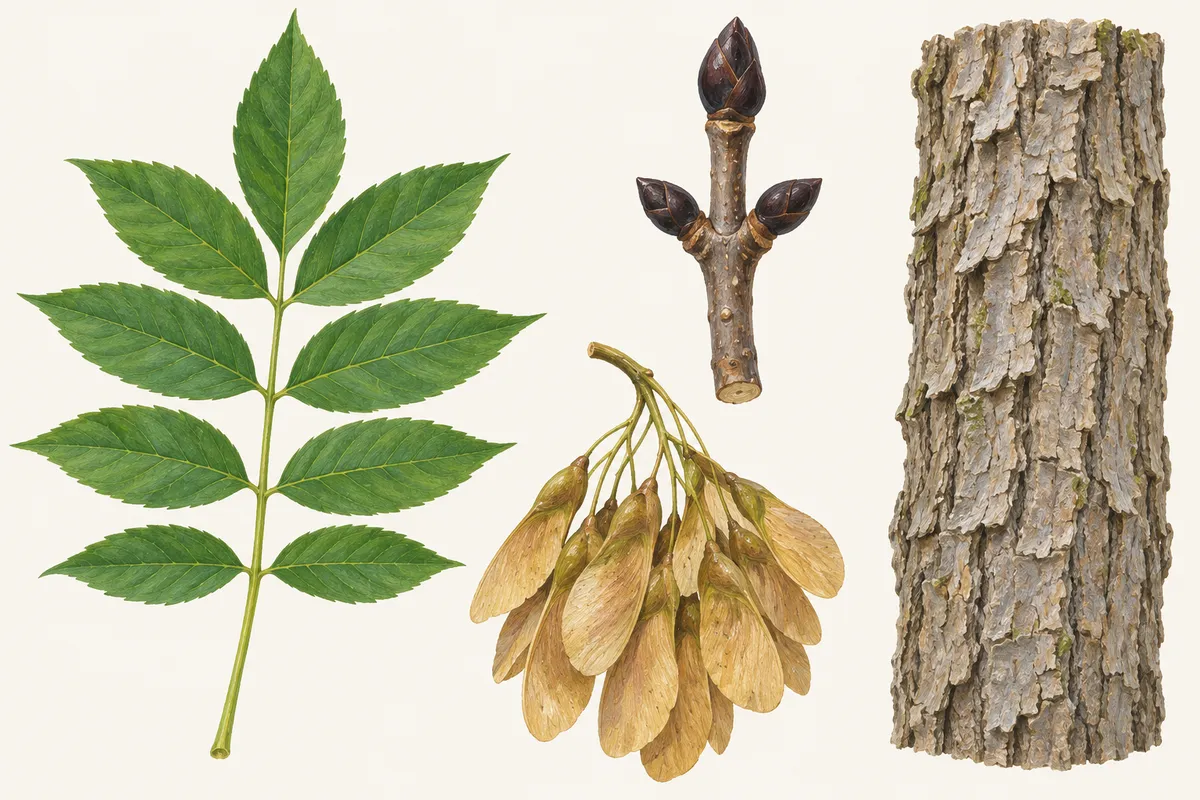
The northern swamp ash: leaflets with no stalks, dark buds with a gap below the end bud, and bark so soft and corky that its ridges rub off under your hand.
In short
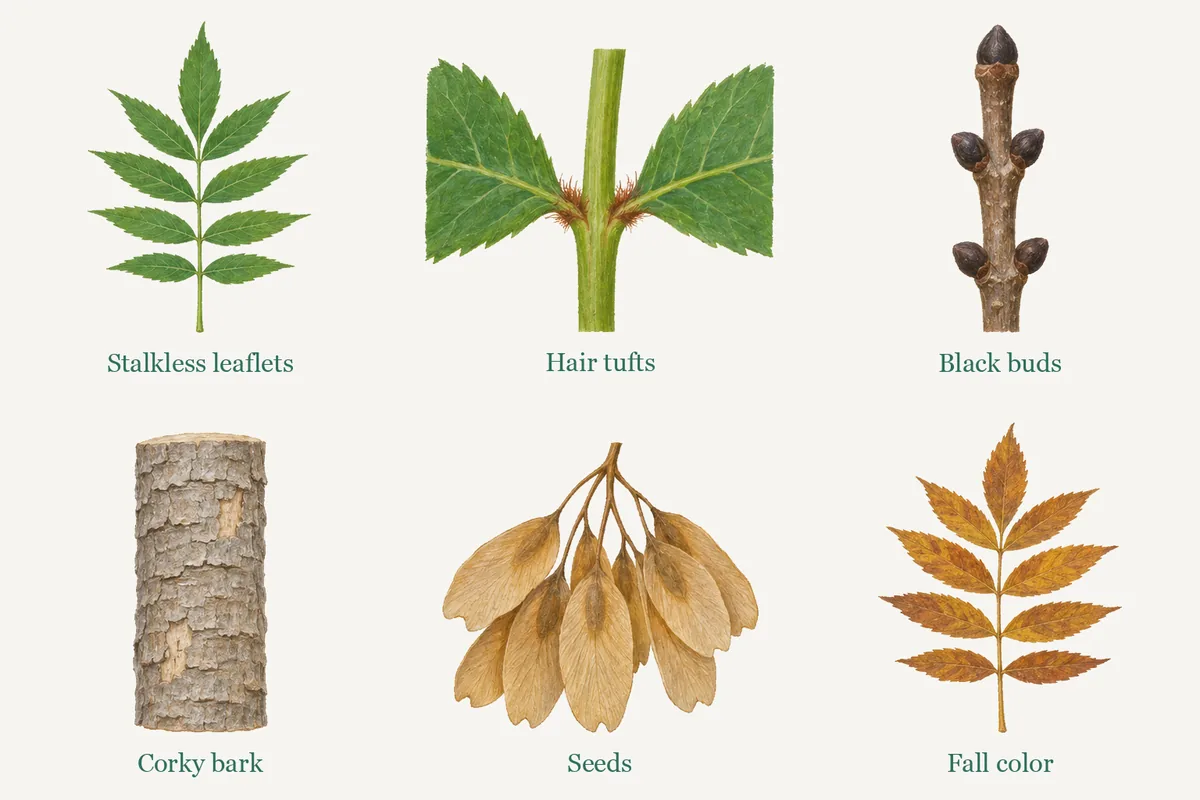
Black ash tree identification comes down to three checks. Its opposite, compound leaves carry 7 to 11 stalkless, finely toothed leaflets with tufts of reddish-brown hair where they join the leaf stalk. The buds are dark, nearly black, with the top side buds set well below the end bud. And the light gray bark is soft and corky enough to rub off by hand.
- Stalkless leaflets set black ash apart from white and green ash, whose leaflets have short stalks.
- Rub the bark with your palm: black ash's corky ridges crumble off, other ashes' firm ridges do not.
- It is a tree of northern swamps, bogs and stream banks, from Newfoundland to Manitoba and south to West Virginia.
Field marks at a glance
- Scientific name
- Fraxinus nigra
- Family
- Oleaceae (olive family)
- Type
- Broadleaf, deciduous
- Leaves
- Opposite, pinnately compound, 10 to 14 inches long (Virginia Tech), with 7 to 11 stalkless leaflets 10 to 14 cm long, oval and tapering to a long slender tip, edges finely and sharply toothed.
- Leaflet base
- Hairless except for dense reddish-brown tufts where each leaflet joins the central stalk; dark green on both sides (Natural Resources Canada).
- Buds and twigs
- Buds nearly black (Virginia Tech) or dark brown (Natural Resources Canada), the end bud broad and pointed, 4 to 10 mm; the top side buds sit well below the end bud, with bare bark between. Leaf scars nearly round; twigs very stout.
- Bark
- Light gray and soft, with corky ridges that rub off easily by hand; smooth when young, scaly with age.
- Seeds
- Samara 2.5 to 4 cm (1 to 1.5 in) long with a broad, often twisted wing that reaches the base of the flat seed case. Ripens June to September, disperses July to October.
- Fall color and leaf drop
- Reported as yellow (NDSU), reddish-brown (Natural Resources Canada) or purplish (Morton Arboretum); whole leaves fall, not single leaflets.
- Form and size
- Slender trunk, sometimes bent or leaning, under a narrow, open crown. Commonly 60 to 70 ft and 12 to 24 in across (USDA Forest Service); 40 to 50 ft in other sources.
- Range
- Western Newfoundland west to southeastern Manitoba and eastern North Dakota, south to Iowa, southern Indiana, Ohio and West Virginia (USDA Forest Service).
- Habitat
- Bogs, stream banks and poorly drained, often seasonally flooded ground, mostly on peat and muck; tolerates standing water for weeks.
Black ash is the ash of cold, wet northern woods: bogs, stream banks and flooded flats from Newfoundland to Manitoba. The USDA Forest Service's tree census ranks it 46th of all species by number of live trees on US forest land. It is a slender, often leaning tree that is easy to pass by, but it has three field marks no other native ash shares: stalkless leaflets with rusty hair tufts, a gap between the end bud and the first side buds, and bark you can rub off with your palm.
How to identify a black ash, step by step
1. Opposite, compound leaves. As on every ash, leaves and buds come in pairs across the twig, and each leaf is pinnately compound. The Virginia Tech black ash fact sheet gives a leaf 10 to 14 inches long with 7 to 11 leaflets, the largest leaf of the three common eastern ashes on Virginia Tech's figures.
2. Look where the leaflets join the stalk. Black ash leaflets have no stalks: they sit directly on the central stalk. Natural Resources Canada describes them as 10 to 14 cm long, oval and tapering to a long slender tip, finely and sharply toothed, dark green on both sides, and hairless except for dense reddish-brown tufts where each leaflet joins the stalk. White and green ash leaflets have short stalks and no such tufts.
3. Check the twig tip. Virginia Tech describes black ash buds as nearly black; Natural Resources Canada calls the end bud dark brown, broad and pointed, 4 to 10 mm long. On both sources the top pair of side buds sits some distance below the end bud, with bare bark showing between them. On white and green ash those side buds sit right next to the end bud. The leaf scars are large and nearly round.
4. Rub the bark. Natural Resources Canada describes light gray, soft bark whose corky ridges rub off easily by hand, becoming scaly with age; Virginia Tech says smooth when young, then scaly to corky and gray-brown. White and green ash have firm diamond ridges that stay put.
5. Consider the ground under your feet. Black ash is a swamp tree. If you are standing on dry, well-drained upland, it is far more likely a white ash.
Tree Identifier can suggest a name from one photo of a leaf or of the bark, which helps when you are wading and do not want to carry a field guide. The app shows no confidence score or list of alternatives, so check the leaflet base and the rub test before you write "black ash" in your notes.
Seeds, flowers and fall
Black ash is polygamous, with flowers that can be male, female or both, according to the USDA Forest Service; Virginia Tech describes it as monoecious or dioecious, and the Morton Arboretum as dioecious, with male and female trees. The small flowers open in May or June, just before or with the leaves, and Natural Resources Canada notes the clusters are more likely than on other ashes to sit at the twig tip.
The seed is the second-best clue after the leaflets. Natural Resources Canada describes a samara 2.5 to 4 cm long with a broad wing, often twisted and sometimes slightly notched at the tip, that runs all the way to the base of the flattened seed case; Virginia Tech gives 1 to 1.5 inches, with an indistinct seed cavity. White ash's wing, by contrast, wraps only the tip of a plump seed. The Forest Service gives ripening from June to September and dispersal from July to October, and says the seeds usually germinate in their second year and can stay viable for 8 years or more.
In fall, Natural Resources Canada notes that whole leaves drop rather than single leaflets. Sources disagree on the color: NDSU Extension says yellow, Natural Resources Canada reddish-brown and the Morton Arboretum purplish. Do not rely on it.
Black ash vs green ash and white ash
| Feature | Black ash | Green ash | White ash |
|---|---|---|---|
| Leaflets | 7–11, stalkless, reddish-brown hair tufts at the base | 5–9, short-stalked | Usually 7, stalked, whitish underneath |
| Top side buds | Set well below the end bud; buds dark, nearly black | Close to the end bud; flat-topped scar | Close to the end bud; notched scar |
| Bark | Soft, corky, rubs off by hand | Firm diamond ridges | Firm diamond ridges |
| Seed | Broad, often twisted wing reaching the seed base | Wing over half or more of the seed case | Wing only at the tip of a plump seed case |
| Habitat | Bogs, swamps, northern stream banks | Bottomlands and stream banks; planted in towns | Rich, well-drained slopes |
Green ash is the look-alike you are most likely to meet in the same wet ground; the green ash page has its full profile. The white ash page covers the upland ash, and the ash genus page the two-step check that separates ashes from hickories, walnuts and boxelder.
Where black ash grows
The USDA Forest Service maps black ash from western Newfoundland west to southeastern Manitoba and eastern North Dakota, south to Iowa, and east to southern Indiana, Ohio and West Virginia. It is the only ash native to Newfoundland. It grows from sea level to high elevations in the north, but in the south only above 2,000 feet (610 m).
It is most common on peat and muck soils in bogs, along streams and in poorly drained areas that flood seasonally. Natural Resources Canada says it tolerates standing water for many weeks, needs sun, and grows in pure stands or mixed with black spruce, balsam fir, eastern white-cedar, speckled alder, red maple and silver maple. NDSU Extension says black ash is native to only a small part of northeastern North Dakota and needs more moisture than green ash.
Black ash is a small, slow-growing tree, the Forest Service says. Common mature trees are 60 to 70 feet tall and 12 to 24 inches across, but in many forests the largest are only 8 to 10 inches in diameter. The largest recorded, in Bath, Ohio, was 87 feet tall with a trunk 58.3 inches across. Natural Resources Canada gives up to 20 m and 50 cm, with a slender trunk that is sometimes bent or leaning, a narrow open crown and shallow, wide-spreading roots.
Basket ash: the wood and the borer
Black ash wood is straight-grained, flexible and splits easily, which is why it is also called basket ash and hoop ash. The Forest Service says it has long been used for baskets, and Natural Resources Canada lists snowshoe frames, barrel hoops, canoe ribs and woven basketware. Deer and moose browse its twigs and leaves, and beavers cut its stems where poplars are scarce.
Emerald ash borer threatens it as much as any ash. The Morton Arboretum calls black ash very susceptible to the beetle, and NDSU Extension says it is not currently recommended for planting. The emerald ash borer guide describes the D-shaped exit holes, S-shaped tunnels and top-down crown dieback to look for, and where to report a find. If you track particular trees, Tree Identifier's Tree Map keeps each located identification so you can come back to the same swamp next season.
Look-alikes and how to tell them apart
Green ash (Fraxinus pennsylvanica)
Green ash leaflets have short stalks and no reddish-brown tufts at their base; its top side buds sit right next to the end bud, its leaf scar is flat-topped, and its firm bark ridges do not rub off.
White ash (Fraxinus americana)
White ash leaflets are stalked and whitish underneath, its side buds sit in a notched leaf scar close to the end bud, and its seed wing wraps only the tip of a plump seed case. It grows on well-drained slopes, rarely in swamps.
Boxelder (Acer negundo)
Boxelder also grows on wet ground with opposite, compound leaves, but it has only 3 to 5 coarsely toothed or lobed leaflets and paired V-shaped maple seeds instead of single broad-winged samaras.
What a photo can't settle
- Fall color is reported differently by different sources (yellow, reddish-brown, purplish), so it is not a reliable clue for black ash.
- The rub test needs your hand on the trunk and the bud test needs a twig; a photo from a distance can show an ash in a swamp but rarely proves which ash.
- Sizes differ between sources: the USDA Forest Service gives 60 to 70 feet for common mature trees, Virginia Tech and the Morton Arboretum 40 to 50 feet, and many swamp trees stay much smaller.
Questions people ask
Why is it called black ash?
The sources here do not explain the name, but the nearly black buds that Virginia Tech describes are the trait most people notice. The tree also goes by swamp ash, basket ash, brown ash, hoop ash and water ash, names the USDA Forest Service lists.
Why is black ash called basket ash?
Its wood splits easily into strips. The USDA Forest Service says it has long been used for baskets, and Natural Resources Canada lists snowshoe frames, barrel hoops, canoe ribs and woven basketware among its uses.
How do you tell black ash from green ash?
Check the leaflets first: black ash leaflets have no stalks and carry reddish-brown hair tufts at their base. Then look at the twig tip: black ash's top side buds sit well below the end bud. Finally rub the bark: black ash's corky ridges come off by hand.
Where does black ash grow?
In wet northern woods. The USDA Forest Service maps it from western Newfoundland to southeastern Manitoba and eastern North Dakota, south to Iowa, southern Indiana, Ohio and West Virginia, mostly in bogs, along streams and on poorly drained peat and muck. In the south of its range it grows only above 2,000 feet.
Is black ash threatened by emerald ash borer?
Yes. The Morton Arboretum calls black ash very susceptible to emerald ash borer, and NDSU Extension says it is not currently recommended for planting because of the beetle.
Sources
- Black Ash (Fraxinus nigra), Silvics of North America — USDA Forest Service
- Black ash (Fraxinus nigra) — Natural Resources Canada, Trees of Canada
- Black ash fact sheet — Virginia Tech Dendrology
- Black Ash (F2215, July 2024) — NDSU Extension
- Black ash — The Morton Arboretum
Keep reading
- Tree profileAsh trees (Fraxinus): how to identify them
- Tree profileGreen ash (Fraxinus pennsylvanica): how to identify it
- Tree profileWhite ash (Fraxinus americana): how to identify it
- Tree healthEmerald ash borer signs: how to check an ash tree
- Tree profileRed maple tree (Acer rubrum): how to identify it