Also in Français
Tree profile
White ash (Fraxinus americana): how to identify it
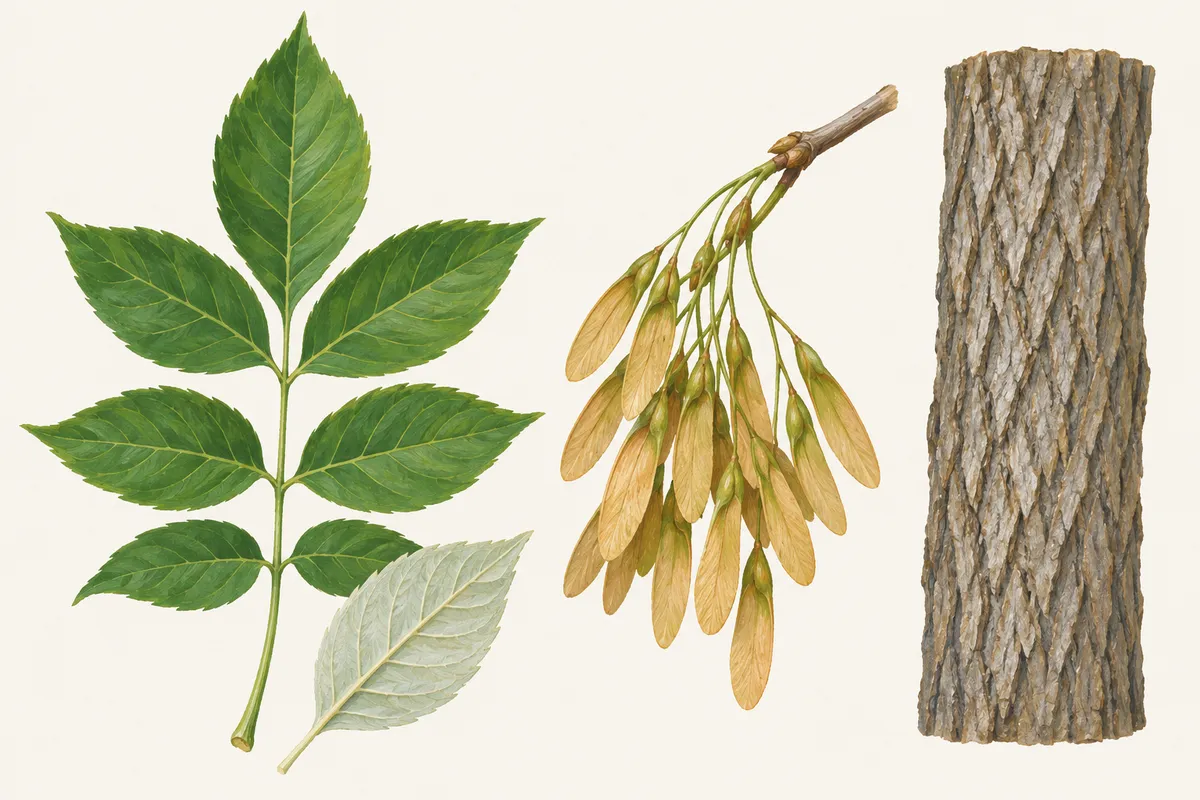
Opposite compound leaves put a tree among the ashes. A notched leaf scar with the bud tucked inside, pale leaflet undersides and a seed whose wing barely wraps the seed make it a white ash.
In short
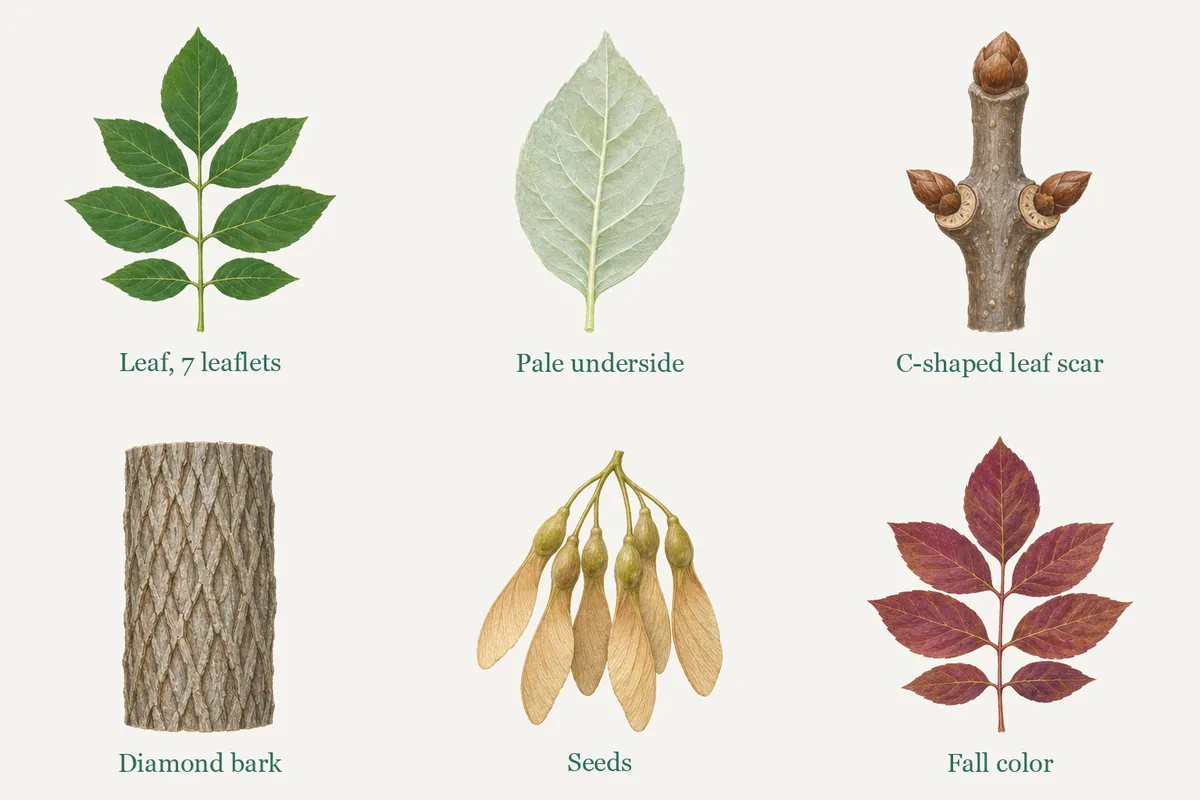
White ash tree identification starts with opposite, compound leaves 8 to 12 inches long, usually with 7 stalked leaflets that are whitish green underneath. The surest check is the twig: each side bud sits inside a notch in a U- or C-shaped leaf scar. Mature bark forms a tight net of diamond-shaped ridges, and fall color runs to purple or bronze.
- Bud in the notch of the leaf scar: white ash. Bud perched on a flat-topped scar: green ash.
- White ash leaflets are pale, almost whitish, underneath and are hairless except along the veins.
- On the seed, the wing wraps only the tip of a plump seed case; green ash's wing runs half way down.
Field marks at a glance
- Scientific name
- Fraxinus americana
- Family
- Oleaceae (olive family)
- Type
- Broadleaf, deciduous
- Leaves
- Opposite, pinnately compound, 8 to 12 inches long (Virginia Tech, NC State), with usually 7 leaflets (5 to 9). Leaflets 3 to 5 inches, oval to lance-shaped, on short stalks, edges smooth or with a few rounded teeth.
- Leaf underside
- Very pale, whitish green, hairless except along the veins (Natural Resources Canada); dark green above.
- Twigs and buds
- Stout, hairless, gray-olive to purplish twigs. Terminal bud blunt, brown, 5 to 14 mm; side buds sit inside the notch of a U- or C-shaped leaf scar.
- Bark
- Light gray to gray-brown, with narrow interlacing ridges that form a regular diamond pattern; scaly on old trees.
- Seeds
- Single-winged samara, 1 to 2 inches (2.5 to 5 cm) long, in drooping clusters; seed case plump and rounded, the wing enclosing only its tip. Falls September to December, on female trees only.
- Fall color
- Yellow with purple shading, or purplish to bronze-purple; leaflets drop one by one.
- Size
- Usually 50 to 80 ft (Morton Arboretum); up to about 100 ft (30 m), 5 ft across and 200 years old (Natural Resources Canada).
- Range
- Cape Breton Island, Nova Scotia, to northern Florida, west to eastern Minnesota and eastern Texas (USDA Forest Service).
- Habitat
- Rich, moist, well-drained soils on lower and middle slopes; rarely in swamps.
White ash is the upland ash of eastern North America: the tall, straight tree of rich, well-drained slopes whose wood made generations of baseball bats. The USDA Forest Service's tree census ranks it 33rd by number of live trees on US forest land, and it is common in yards and along streets too. Most people can tell it is an ash in a few seconds. Telling it from green ash, its closest look-alike, takes one close look at a twig.
How to identify a white ash, step by step
Work from the tree down to the twig. The first two checks place it among the ashes; the next three make it white ash.
1. Opposite branching. Leaves, buds and side twigs come in pairs, directly across the stem from each other. Hickories, walnuts and sumacs, which also have compound leaves, all alternate.
2. A compound leaf with about 7 leaflets. The Virginia Tech white ash fact sheet gives a leaf 8 to 12 inches long, usually with 7 oval to lance-shaped leaflets. NC State Extension gives leaflets 3 to 5 inches long, sometimes 5 or 9 per leaf, with smooth edges or a few teeth.
3. Turn a leaf over. White ash leaflets are dark green above and very pale green below, almost whitish, and hairless except along the veins, according to Natural Resources Canada. NC State calls the underside whitish green. Green ash leaflets are yellowish green above and paler below, and their undersides are often silky-hairy.
4. Read the leaf scar. This is the test to learn. Below each side bud is the scar left by last year's leaf. On white ash that scar is U- or C-shaped, notched at the top, and the bud sits down inside the notch, like a ball in a cupped hand. Virginia Tech, NC State and Natural Resources Canada all describe it this way. You can read it in winter on any twig, or in summer by pulling a leaf off and looking at the fresh scar.
5. Look at a seed. The seed is a single-winged samara, 2.5 to 5 cm long according to Natural Resources Canada, hanging in drooping clusters on female trees. Hold it up to the light: on white ash the seed case is plump and rounded, and the wing encloses only its tip.
When the leaves are out of reach, a photo of a low leaf or of the bark at chest height is enough for Tree Identifier to suggest a name. The app gives no confidence score and no list of look-alikes, so check its answer against the leaf scar. European ash is in the app's Collection; the North American ashes on this page are not listed there, though a photo can still return their names.
Bark, crown and fall color
On a mature white ash the bark is light gray to gray-brown and finely furrowed into thin, firm ridges that cross each other in a regular diamond pattern (Natural Resources Canada). Virginia Tech describes the same interlacing corky ridges and notes that old trees can turn scaly. The diamonds are the same on green ash, so bark tells you "ash" more than "white ash". Elm bark also shows diamond fissures; the ash genus page explains the bark-chip test that separates elm.
In a forest, white ash grows a long, straight trunk that is often free of branches almost to the top, under a narrow crown (Natural Resources Canada; Virginia Tech). The USDA Forest Service measured branches of dominant trees leaving the trunk at about 35 degrees from vertical. Open-grown trees stay single-stemmed to about 30 to 40 feet and old ones can become very broad-crowned.
Fall color is the clue you can read from a car. NC State describes yellow with purple shading, and the Morton Arboretum calls it purplish; Natural Resources Canada says bronze-purple, with leaflets falling one at a time. Green ash, by contrast, turns yellow to bronze. Purple-leaved planted cultivars, such as 'Autumn Purple' and 'Autumn Applause' listed by Morton, push the color further.
White ash vs green ash, blue ash and boxelder
The table compares white ash with the two other ashes most often confused with it. Figures come from Virginia Tech, NC State and Natural Resources Canada.
| Feature | White ash | Green ash | Blue ash |
|---|---|---|---|
| Leaflets | Usually 7, stalked | 5–9, usually 7, short-stalked | 7–11 |
| Leaflet underside | Whitish green, hairless except veins | Paler, smooth or silky-hairy | Duller and paler than the top |
| Leaf scar and bud | Notched scar, bud in the notch | Flat-topped or semicircular scar, bud on top | Notched scar |
| Twig | Stout, hairless | Gray to greenish-brown, smooth or hairy, white dots (lenticels) | Four-angled or winged |
| Seed | Wing encloses only the tip of a plump seed case | Wing encloses half or more of the seed case | Wide wing, 1 to 1.5 in |
Green ash is the tree most people mistake for white ash: same leaf, same bark, same seeds at a glance. Use the leaf scar first, then the leaflet underside. Our green ash page covers it in full. Blue ash is the easy one if you feel the twig: the Virginia Tech blue ash fact sheet describes twigs that are distinctly four-angled or winged, most obviously on fast-growing shoots. Boxelder is a maple with compound leaves: it has only 3 to 5 coarsely toothed, often lobed leaflets and paired V-shaped seeds. Black ash, a swamp tree with stalkless leaflets, rarely shares a site with white ash; see black ash.
Where white ash grows
The USDA Forest Service maps white ash from Cape Breton Island, Nova Scotia, south to northern Florida, and west from eastern Minnesota to eastern Texas. It grows from near sea level on the southeastern Coastal Plain to about 3,450 feet (1,050 m) in the Cumberland Mountains. It does best on rich, moist, well-drained soils: lower and middle slopes in the Northeast, slightly raised ridges in Coastal Plain floodplains, and slopes along major streams in the Central States. The Forest Service says it is rarely found in swamps, which is where black ash and green ash take over.
In North Carolina it grows across the state except the lower coastal region, which NC State attributes to its intolerance of salt air.
Flowers, seeds and the trees with no seeds
White ash is dioecious: male and female flowers grow on separate trees, so only females carry seed. The flowers are small, purple and without petals. The Forest Service says they open with or just before the leaves in April and May; Virginia Tech places them just after the leaves unfold, so expect them around leaf-out. The Forest Service reports good seed crops about every third year and seed falling from September to December, carried by wind up to about 460 feet. NC State notes the clusters, 6 to 8 inches long, can persist into winter, which makes a female white ash easy to spot after leaf fall.
Wood duck, bobwhite, purple finch, pine grosbeak and fox squirrel eat the seeds, according to the Forest Service.
Emerald ash borer and the white ash you meet today
White ash is one of the trees hit hardest by emerald ash borer, an invasive beetle from Asia. The Morton Arboretum calls it very susceptible and does not recommend planting it in its region; NC State says an infestation typically kills an ash within 3 to 5 years. That is why many white ash you find now are dead or declining, with a crown thinning from the top and sprouts along the trunk. The emerald ash borer guide walks through the D-shaped exit holes and other signs, and where to report them. Tree Identifier's Diagnose tool can describe what it sees in a photo of a declining tree, but a report to your state agency is what confirms the beetle; with location turned on, the app's Tree Map pins the tree so you can check it again next season.
Look-alikes and how to tell them apart
Green ash (Fraxinus pennsylvanica)
Look at a leaf scar below a side bud. Green ash has a flat-topped or semicircular scar with the bud sitting on top of it; white ash has a notched scar with the bud inside the notch. Green ash leaflets are yellowish green and often hairy below, not whitish.
Blue ash (Fraxinus quadrangulata)
Roll a young twig between your fingers: Virginia Tech describes blue ash twigs as distinctly four-angled or winged, while white ash twigs are round. Blue ash also has 7 to 11 leaflets, usually more than white ash's 7.
Black ash (Fraxinus nigra)
Black ash leaflets have no stalks and carry tufts of reddish-brown hair at their base. Its bark is soft and corky enough to rub off with your hand, and it grows in northern swamps, where white ash rarely does.
Boxelder (Acer negundo)
Boxelder is also opposite and compound, but it has only 3 to 5 coarsely toothed, often lobed leaflets, green twigs often dusted with a whitish bloom, and V-shaped pairs of maple seeds instead of single paddles.
What a photo can't settle
- White ash and green ash overlap in leaflet count, leaf length and bark; the leaf scar and the seed are the dependable differences, and both need a twig or seed in hand. A photo of a whole tree can name the genus, rarely the species.
- Natural Resources Canada notes that green ash leaf scars can show a slight notch too, so read several scars on the same tree, not one.
- Texas ash, which the USDA Forest Service says intergrades with white ash in Texas, and pumpkin ash, which it describes as a likely derivative of a white ash and green ash cross, will not always fit the profile on this page.
Questions people ask
How do you tell white ash from green ash?
Check the leaf scar under a side bud. On white ash the scar is notched at the top and the bud sits in the notch; on green ash the scar is flat-topped and the bud sits on it. White ash leaflets are also whitish underneath, and its seed wing covers only the tip of a plump seed case.
What color does white ash turn in fall?
NC State Extension describes yellow with purple shading, the Morton Arboretum purplish, and Natural Resources Canada bronze-purple. Planted cultivars such as 'Autumn Purple' and 'Autumn Applause', listed by the Morton Arboretum, were selected for that purple color.
Is white ash still planted?
Rarely now. The Morton Arboretum says white ash is very susceptible to emerald ash borer and not recommended for planting in its region, and NC State Extension says planting new ash is no longer recommended. Older street and yard trees are still common.
How tall does a white ash tree get?
The Morton Arboretum gives 50 to 80 feet for mature trees and Virginia Tech up to about 80 feet. NC State Extension gives 60 to 90 feet, up to 120 feet, and Natural Resources Canada up to 30 m with trunks up to 150 cm across.
Is white ash wood used for baseball bats?
Yes. The USDA Forest Service describes white ash wood as tough, strong and highly resistant to shock, and lists handles, oars and baseball bats among its uses. Green ash wood is often sold with it under the name white ash.
Sources
- White Ash (Fraxinus americana), Silvics of North America — USDA Forest Service
- White ash fact sheet — Virginia Tech Dendrology
- White ash (Fraxinus americana) — Natural Resources Canada, Trees of Canada
- Fraxinus americana (white ash) — North Carolina Extension Gardener Plant Toolbox, NC State University
- White ash — The Morton Arboretum
- Blue ash fact sheet — Virginia Tech Dendrology