Tree profile
Green ash (Fraxinus pennsylvanica): how to identify it
The most widespread ash in North America and a common street tree: an opposite compound leaf, a bud sitting on top of a flat leaf scar, and a seed wing that runs half way down the seed.
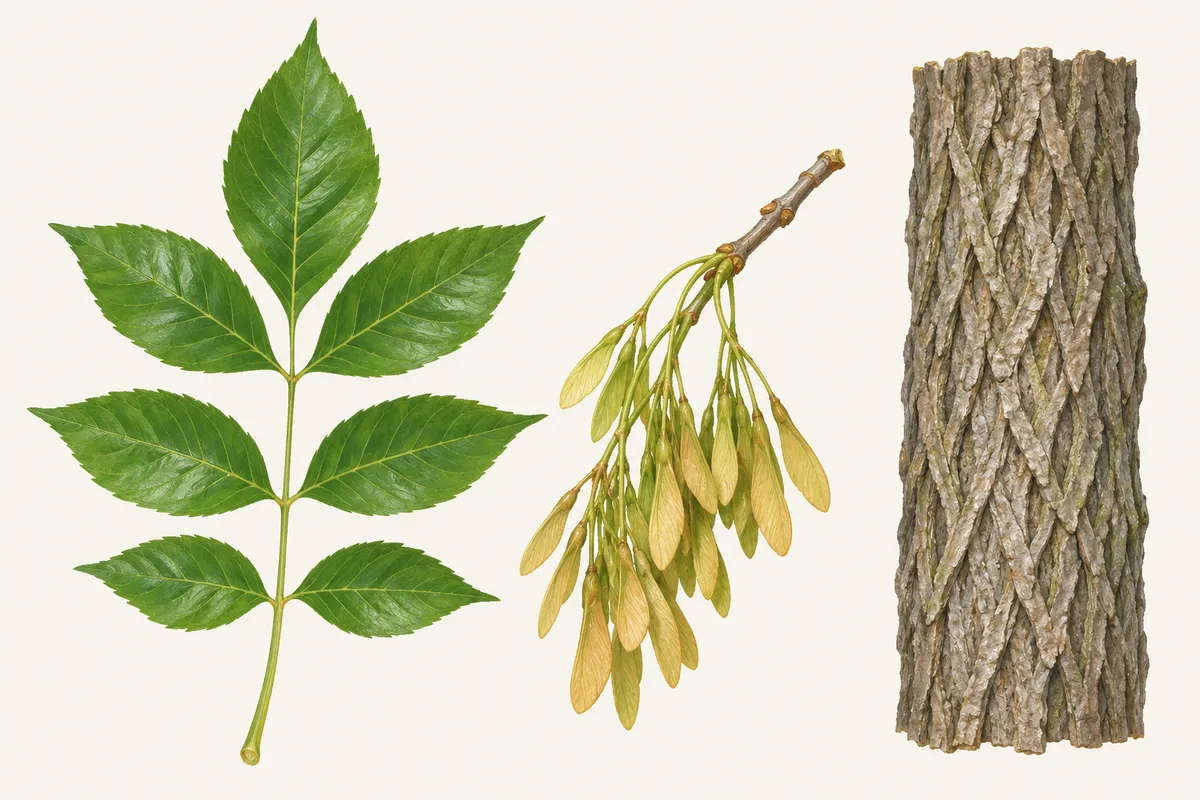
In short
Green ash tree identification starts with opposite, compound leaves 6 to 12 inches long with 5 to 9 leaflets, usually 7, toothed above the middle and often silky-hairy underneath. On the twig, each side bud sits on top of a flat or semicircular leaf scar, not in a notch. The bark forms gray diamond ridges, and fall color is yellow to bronze.
- Bud perched on top of a flat-topped leaf scar: green ash. Bud tucked into a notch: white ash.
- Green ash and red ash are names for the same species, Fraxinus pennsylvanica.
- It grows naturally on bottomlands and stream banks, and was planted in huge numbers in towns and shelterbelts.
Field marks at a glance
- Scientific name
- Fraxinus pennsylvanica
- Family
- Oleaceae (olive family)
- Type
- Broadleaf, deciduous
- Leaves
- Opposite, pinnately compound, 6 to 9 inches (Virginia Tech) to 12 inches (NC State) long, with 5 to 9 leaflets, usually 7. Leaflets 2.5 to 5 inches, oval to lance-shaped, on stalks under 1/4 inch; the bottom pair is smaller.
- Leaflet surface
- Yellowish to dark green above, paler below, smooth or silky-hairy; edges toothed above the middle or nearly smooth.
- Twigs and buds
- Stout, gray to greenish-brown, smooth or hairy, with white lenticels. Terminal bud reddish-brown, hairy, 3 to 8 mm; side buds sit on top of a flat or semicircular leaf scar.
- Bark
- Gray-brown, with corky ridges that intersect in a diamond pattern; somewhat scaly on old trees.
- Seeds
- Single-winged samara 1 to 2 inches (NC State) or 3 to 6 cm (Natural Resources Canada) long, the wing enclosing half or more of the seed case, often notched at the tip. Ripe late September to early October; on female trees only.
- Fall color
- Yellow, yellow-green or bronze; quality varies from year to year.
- Size
- 50 to 60 ft and 18 to 24 in across in the north; up to 120 ft on good southern sites (USDA Forest Service).
- Range
- Cape Breton Island and Nova Scotia west to southeastern Alberta, south through central Montana and northeastern Wyoming to southeastern Texas, east to northwestern Florida and Georgia.
- Habitat
- Moist bottomlands and stream banks on alluvial soils; widely planted in towns, yards and Plains shelterbelts.
Green ash is the most widely distributed ash in North America, according to the USDA Forest Service, and the most common one on US forest land: the Forest Service's tree census ranks it 23rd of all species by number of live trees. It is a bottomland tree by nature, but towns and Plains shelterbelts planted it widely as a tough, fast shade tree, so the ash on a street is often a green ash. Its twin, white ash, shares the leaf, the bark and the seeds. One small mark on the twig separates them.
How to identify a green ash, step by step
1. Opposite branching. Leaves, buds and side twigs come in pairs across the stem. Compound-leaved trees that alternate, such as hickories, walnuts and sumacs, are not ashes.
2. A compound leaf with 5 to 9 toothed leaflets. The Virginia Tech green ash fact sheet gives a leaf 6 to 9 inches long with 7 to 9 toothed, lance to oval leaflets. NC State Extension gives 6 to 12 inches and 5 to 9 leaflets, each 2.5 to 5 inches long on a stalk under 1/4 inch, the bottom pair smaller. Natural Resources Canada says usually 7, with the margin toothed above the middle.
3. Feel the underside. NC State describes a pale green underside with silky hairs; Virginia Tech says smooth or softly hairy, and Natural Resources Canada, which files the species as red ash, describes the underside as densely hairy, with a hairy central stalk. The upper surface is yellowish to dark green. White ash's underside is whitish and bare except on the veins.
4. Read the leaf scar. Below each side bud sits the scar of last year's leaf. On green ash the top of that scar is flat or semicircular and the bud sits on it like a ball on a tee. Virginia Tech and NC State both give this as the difference from white ash, whose bud sits inside a notch. Natural Resources Canada adds that green ash scars sometimes show a slight notch, so look at several.
5. Check the seed. Green ash's single-winged samara is 1 to 2 inches long (NC State) or 3 to 6 cm (Natural Resources Canada). Its wing encloses half or more of the seed case and is often notched at the tip; on white ash the wing wraps only the tip of a fatter seed case.
Tree Identifier can suggest a name from one photo of a low leaf or of the bark. It shows no confidence score or list of alternatives, so confirm a "green ash" answer at the leaf scar. You can then ask the follow-up chat under the result about the tree's emerald ash borer risk.
Twigs, bark and fall color
Green ash twigs are stout to medium, gray to greenish-brown, smooth or hairy depending on the form, and dotted with conspicuous white lenticels (NC State). The terminal bud is reddish-brown and hairy, 3 to 8 mm long, with the top pair of side buds set close to it (Natural Resources Canada).
The bark is gray-brown, often tinged red on young branchlets, and breaks into firm, narrow ridges that intersect in a diamond pattern (Natural Resources Canada). NC State gives a thickness of at least 1/2 inch and notes older bark may be scaly. It looks almost the same as white ash bark, so do not decide between the two on bark.
Fall color helps from a distance. NC State calls it yellow to bronze, varying a lot from year to year, the Morton Arboretum says yellow or yellow-green, and Natural Resources Canada says yellowish-brown. A row of street ashes in clean yellow is more likely green ash; purple tones point to white ash.
Green ash vs white ash and black ash
| Feature | Green ash | White ash | Black ash |
|---|---|---|---|
| Leaflets | 5–9, usually 7, short-stalked | Usually 7, stalked | 7–11, stalkless |
| Leaflet underside | Paler, smooth or silky-hairy | Whitish green, hairless except veins | Hairless except reddish-brown tufts at the base |
| Leaf scar and bud | Flat-topped scar, bud on top | Notched scar, bud in the notch | Nearly round scar; buds dark, top side buds set well below the end bud |
| Seed wing | Encloses half or more of the seed case | Encloses only the tip of the seed case | Broad, often twisted, reaches the base of the seed case |
| Fall color | Yellow to bronze | Purplish, bronze-purple | Described variously as yellow, reddish-brown or purplish |
| Typical site | Bottomlands, stream banks, towns | Rich, well-drained slopes | Northern swamps and bogs |
Figures come from Virginia Tech, NC State and Natural Resources Canada. Our white ash page covers the upland twin in full, and the black ash page the northern swamp ash. Boxelder, the maple with compound leaves, grows on the same riverbanks; its 3 to 5 lobed leaflets and paired seeds are on the boxelder page.
Where green ash grows, and why it is everywhere in towns
The USDA Forest Service maps green ash from Cape Breton Island and Nova Scotia west to southeastern Alberta, south through central Montana and northeastern Wyoming to southeastern Texas, and east to northwestern Florida and Georgia. It is naturally a tree of moist bottomlands and stream banks on alluvial soils, less often of swamps, and it tolerates flooding for up to 40 percent of the growing season. In the Prairie provinces, Natural Resources Canada says it is confined to river valleys, alongside willows, silver maple and eastern cottonwood.
Size depends on latitude. The Forest Service gives 50 to 60 feet tall and 18 to 24 inches in diameter in the north, and up to 120 feet and 24 to 30 inches on good southern sites. Natural Resources Canada puts the maximum age at about 100 years.
Its range on a map understates how often you meet it. The Forest Service describes green ash as a very popular residential shade tree, thanks to its form, adaptability and relative freedom from insects and diseases, and records wide planting in Great Plains shelterbelts and on strip-mine spoil banks. The Morton Arboretum lists hardiness zones 2 to 9 and tolerance of clay, alkaline soil, road salt, drought and flooding, which explains why so many cities chose it.
Flowers and seeds
Green ash is dioecious, with male and female flowers on separate trees; only females bear seed. The flowers are small, without petals, light green to purplish, in clusters. The Forest Service gives March or April in Florida and late April to early May in the north, with or just before the leaves; Virginia Tech and NC State place them just after the leaves emerge. Seeds are ripe by late September or early October, turn from green to yellow or brown, and keep falling into winter, so female trees hold clusters of tan paddles after leaf fall. Large seed crops feed many birds and mammals, according to the Forest Service.
Emerald ash borer
Green ash is very susceptible to emerald ash borer, the Morton Arboretum says, and it no longer recommends planting it anywhere in its region; NC State says the beetle typically kills an ash within 3 to 5 years after infestation. The beetle's D-shaped exit holes, S-shaped tunnels and a crown dying from the top down are covered in our emerald ash borer guide, with where to report a suspected case. Tree Identifier's Diagnose tool can describe what it sees in a photo of a declining ash, but only an inspection by your state agency or an arborist confirms the borer.
Look-alikes and how to tell them apart
White ash (Fraxinus americana)
Read the leaf scar under a side bud: white ash's is notched with the bud inside the notch, green ash's is flat-topped with the bud on top. White ash leaflets are whitish underneath and hairless except on the veins, and its seed wing wraps only the tip of a plump seed case.
Black ash (Fraxinus nigra)
Black ash has 7 to 11 stalkless leaflets, with tufts of reddish-brown hair where they join the leaf stalk. Rub the bark: black ash's soft corky ridges come off by hand, green ash's firm ridges do not.
Pumpkin ash (Fraxinus profunda)
Pumpkin ash is a rare southern swamp ash that the USDA Forest Service describes as a likely descendant of a green ash and white ash cross, so it shares traits with both parents. If an ash in a southern swamp does not fit green ash cleanly, ask a local forester.
Boxelder (Acer negundo)
Boxelder shares the opposite, compound leaf and the riverbank habitat, but has only 3 to 5 coarsely toothed, often lobed leaflets, green to purplish twigs, and paired V-shaped maple seeds instead of single paddles.
What a photo can't settle
- Green and white ash overlap in leaf size, leaflet count and bark. The leaf scar, the leaflet underside and the seed are the reliable differences, and all three need a twig, leaf or seed in hand.
- Natural Resources Canada notes green ash leaf scars are sometimes slightly notched, so one scar is not proof; read several on the same tree.
- Green ash hybridizes with velvet ash in the Southwest, according to the USDA Forest Service, and pumpkin ash in southern swamps resembles it; a photo app names the species, not a hybrid.
Questions people ask
Is red ash the same as green ash?
Yes. Natural Resources Canada files the species as red ash and notes that taxonomists now recognize only Fraxinus pennsylvanica under the name green ash, while other classifications recognize varietal forms, including northern red ash. The Morton Arboretum also lists red ash as another name for green ash.
How do you tell green ash from white ash?
Look at the leaf scar below a side bud. On green ash it is flat-topped or semicircular and the bud sits on top; on white ash it is notched and the bud sits in the notch. Natural Resources Canada notes some green ash scars show a slight notch, so check several.
Why are there so many green ash trees in towns?
The USDA Forest Service calls green ash a very popular residential shade tree for its form, adaptability and relative freedom from pests, and notes it was widely planted across the Plains States and Canada, including in shelterbelts. Emerald ash borer has since ended most new planting.
What color does green ash turn in fall?
Yellow. NC State Extension describes yellow to bronze and says the quality varies a lot from year to year; the Morton Arboretum says yellow or yellow-green, and Natural Resources Canada yellowish-brown. White ash, by contrast, usually shows purple.
Can green ash grow in wet ground?
Yes. The USDA Forest Service describes it as naturally a bottomland and stream-bank tree that tolerates flooding for up to 40 percent of the growing season, and Natural Resources Canada says it tolerates many weeks of flooding while dormant.
Sources
- Green Ash (Fraxinus pennsylvanica), Silvics of North America — USDA Forest Service
- Green ash fact sheet — Virginia Tech Dendrology
- Red ash (Fraxinus pennsylvanica) — Natural Resources Canada, Trees of Canada
- Fraxinus pennsylvanica (green ash) — North Carolina Extension Gardener Plant Toolbox, NC State University
- Green ash — The Morton Arboretum