Tree profile
Red maple tree (Acer rubrum): how to identify it
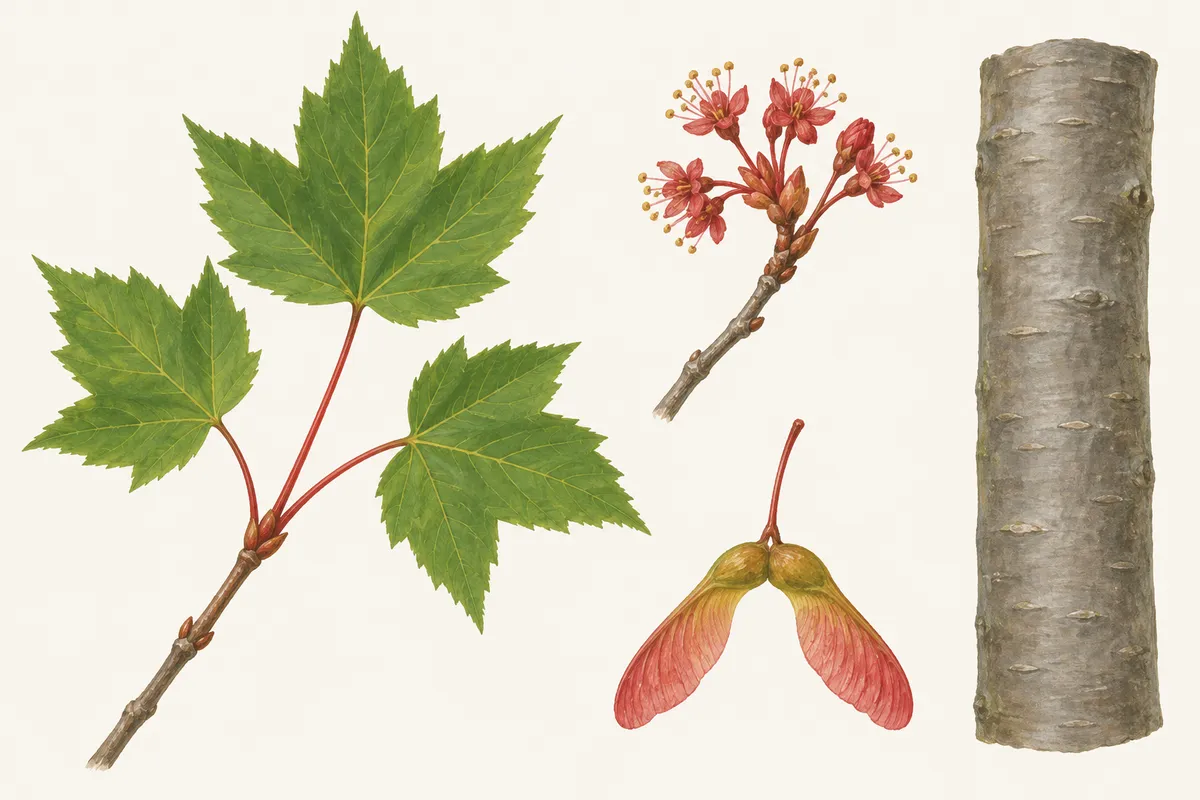
Red buds in winter, red flowers before the leaves, red seeds in May, red leaf stalks in summer and, often, a red crown in fall. The leaf shape and the teeth confirm what the color suggests.
In short
For red maple tree identification, look for opposite leaves 2 to 4 inches long with three main lobes, fine teeth all around the edge, shallow V-shaped notches and a whitish underside. In winter the buds are blunt and red, in early spring small red flowers cover the bare twigs, and the paired seeds, only 1/2 to 3/4 inch long, ripen and fall by early summer.
- Red maple is named for its buds, flowers and twigs, not its leaves: fall color can be yellow on some trees.
- Fine teeth and V-shaped notches separate it from sugar maple; shallower cuts and a less white underside separate it from silver maple.
- Red maple grows from dry ridges to swamps, so habitat rules almost nothing out.
Field marks at a glance
- Scientific name
- Acer rubrum
- Family
- Sapindaceae (soapberry family); Virginia Tech lists the older Aceraceae
- Type
- Broadleaf, deciduous
- Leaves
- Opposite, simple, 2 to 4 inches long (NC State gives up to 6), 3 main lobes, sometimes 5 with two small basal ones; edges toothed all around; notches V-shaped, usually shallow; underside whitish, sometimes waxy or hairy.
- Leaf stalk
- Long and usually red, 2 to 4 inches (NC State).
- Winter buds and twigs
- Buds blunt, green or red, with several loose scales, often with extra buds beside them; twigs reddish and shiny with small lenticels; V-shaped leaf scars with 3 bundle scars.
- Flowers
- Small, usually bright red, occasionally yellow, in drooping clusters on bare twigs, March to May depending on latitude, weeks before the leaves.
- Samaras
- Paired, 1/2 to 3/4 inch, slightly spreading, on long slender stalks; red, pink or yellow turning tan; ripe and falling April to June.
- Bark
- Smooth, light gray on young trees, easily taken for beech; later dark gray, broken into long, narrow, scaly plates that peel off easily.
- Fall color
- Often brilliant red, reddest in the north; orange and yellow also occur.
- Size and age
- 40 to 60 ft in landscapes (Morton Arboretum); 60 to 90 ft and 18 to 30 in across in forests, seldom over 150 years (USDA Forest Service).
- Range
- Newfoundland and southern Quebec to northern Minnesota, south to eastern Texas and southern Florida; every US region east of the 95th meridian except the prairies and the Everglades.
Red maple (Acer rubrum) is one of the most widespread trees of eastern North America, from Newfoundland to Florida and from swamps to dry ridgetops. Its name comes less from the fall leaves than from the rest of the tree: red buds, red flowers on bare twigs, red seeds and red leaf stalks. The leaf edge and the notch between the lobes confirm it.
How to identify a red maple: leaf, buds, flowers
Start with the branching, then the leaf. Three or four matches below settle it.
1. Opposite leaves. Leaves and buds grow in pairs on the twig, the first test for any maple. The maple identification page explains it.
2. Three main lobes, fine teeth, V-shaped notches. Virginia Tech's red maple fact sheet describes a leaf 2 to 4 inches long with 3 to 5 palmate lobes, a toothed margin and fairly shallow sinuses whose depth varies a lot. University of New Hampshire Extension's comparison counts three lobes, or five with the small basal ones, and a V-shaped notch. The teeth run all the way around the edge, including the sides of each lobe. The underside is whitish and sometimes waxy.
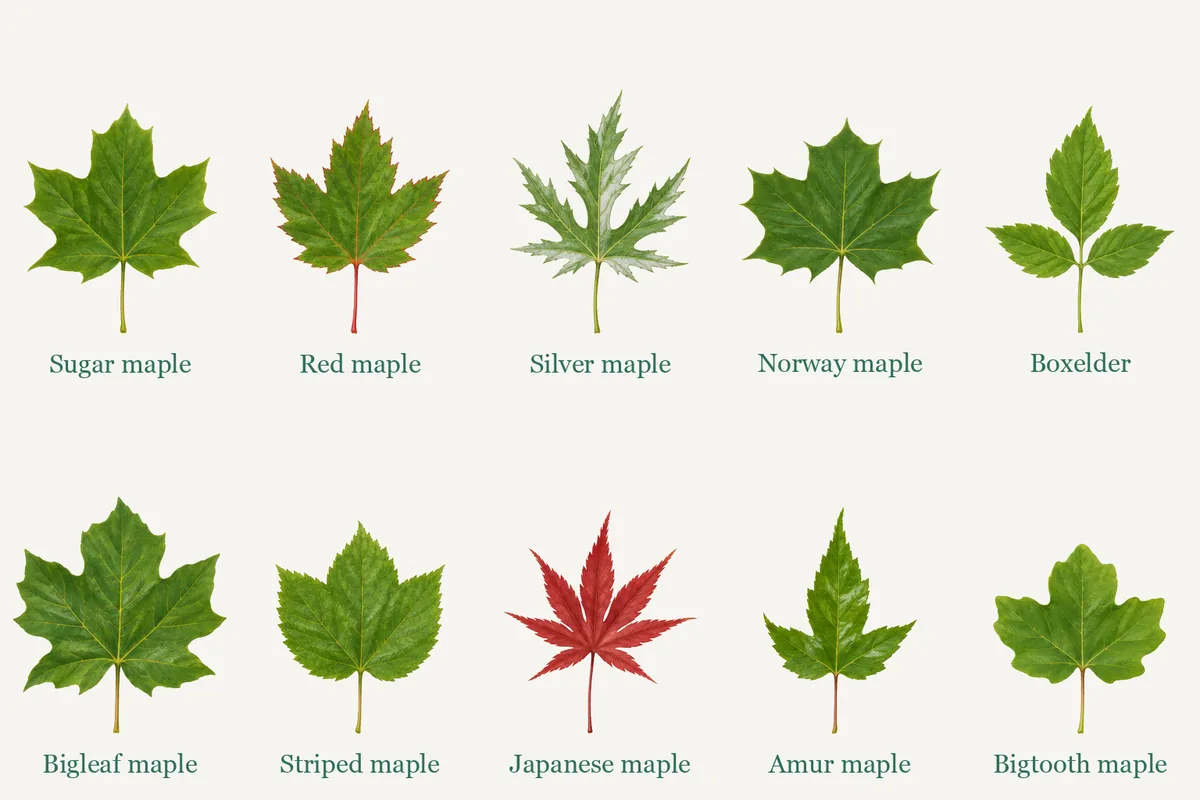
3. A red leaf stalk. NC State Extension's red maple page gives a red petiole 2 to 4 inches long. Snap one: the sap is clear.
4. Blunt red buds. In fall and winter the buds are blunt, green or red, with several loose scales, and extra buds often sit beside the main ones. The twigs are reddish and shiny. UNH notes that the bright red buds are most noticeable in late winter and early spring.
5. Red flowers before the leaves. Red maple is among the first trees to bloom. The USDA Forest Service's Silvics of North America gives March to May depending on latitude and elevation, several weeks before the leaves; NC State gives January to March in North Carolina. The small clusters are usually red, rarely yellowish, and a red haze over a bare crown in early spring is often the first sign of a red maple.
On the chart below, red maple is in the middle of the bottom row: three lobes, teeth all around and a red leaf stalk.
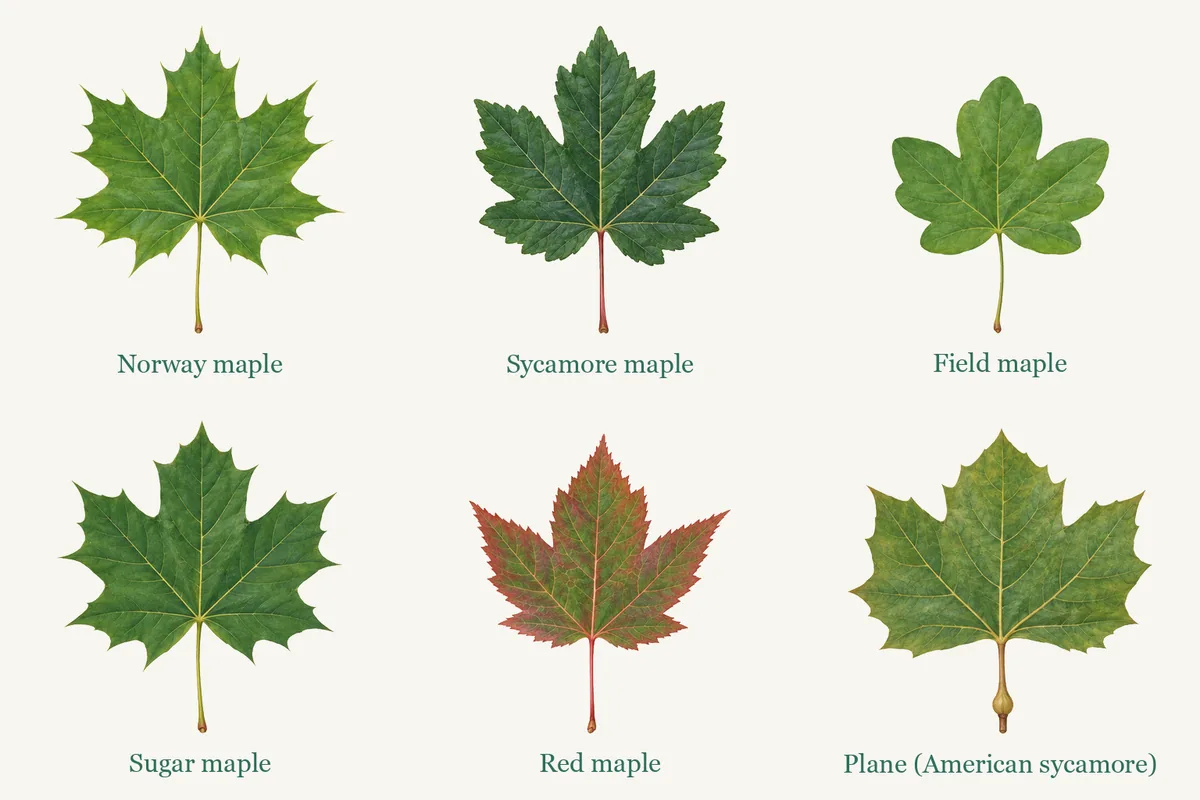
Red maple is one of the 138 species in Tree Identifier's Collection, and the app can name it from one photo of a leaf, the bark, the flowers or a seed cluster. It gives no confidence score or look-alike list, so compare the teeth and notches yourself.
Seeds, sexes and the spring sequence
Red maple seeds are small and early. Virginia Tech gives paired samaras 1/2 to 3/4 inch long with slightly spreading wings, hanging on long, slender stalks, light brown or reddish. NC State describes them as V-shaped, red, pink or yellow, turning tan. The Forest Service says they ripen from April to June, before the leaves are fully grown, and fall within one to two weeks. Seeds raining down in May point to red or silver maple; sugar and Norway maple drop theirs in fall.
Not every red maple carries seeds. The Forest Service describes the species as polygamo-dioecious: some trees are entirely male, some entirely female, and some carry both sexes, usually on different branches. The Morton Arboretum adds that male flowers are less intensely red than female ones. Red maples can bear seed as young as four years old, according to the Forest Service.
Red maple vs silver maple is the closest call in spring, because both bloom on bare twigs in the same weeks. Virginia Tech's silver maple fact sheet gives seed wings of 1 1/2 to 2 1/2 inches, about three times as long, leaves cut far deeper and twigs with an unpleasant smell when crushed, and Oregon State University describes the leaves of their hybrid as intermediate. The silver maple vs red maple page compares them in detail, including the hybrid, Freeman maple.
Bark and form from sapling to old tree
Young red maple bark is smooth and light gray. UNH warns that it can be confused with the bark of beech, which stays smooth for life. With age, Virginia Tech says, the bark darkens and breaks into long, fine, scaly plates; UNH describes old bark in narrow vertical plates that look shaggy and peel off easily.
The form depends on where the tree grew. In a forest, the trunk stays clear of branches for a good distance; in the open, the trunk is shorter and the crown rounded (Virginia Tech). The Forest Service gives mature trees 60 to 90 feet tall and 18 to 30 inches in diameter, mature at 70 to 80 years and seldom living beyond 150. Planted trees are smaller: Morton gives 40 to 60 feet tall and 35 to 45 feet wide.
Stumps sprout vigorously, the Forest Service notes, so in cut-over woods red maple often grows as a clump of several trunks from one base. UNH adds that red maple seals off wounds poorly, so rot can spread far from an old injury.
Where red maple grows
Red maple's range is vast. The Forest Service traces it from southern Newfoundland, Nova Scotia and southern Quebec to northern Minnesota, south to Wisconsin, Illinois, Missouri, eastern Oklahoma and eastern Texas, and east to Florida. It is native to every US region east of the 95th meridian except the Prairie Peninsula, the coastal prairie of Louisiana and Texas, and the Everglades, and it has the longest continuous range along the Atlantic Coast of any tree found in Florida.
It also tolerates almost any site. The Forest Service lists it "from dry ridges and southwest slopes to peat bogs and swamps", from sea level to about 3,000 feet, and calls it one of the most abundant and widespread trees in eastern North America. That is why it appears so high on lists of the most common trees in the US. The names swamp maple and soft maple, both listed by NC State, reflect its wet sites and its softer wood.
Fall color, planted cultivars and horses
Fall color is the clue most people reach for, and the least reliable. The Forest Service calls brilliant fall color one of red maple's outstanding features and says northern trees show the most red. NC State lists red, orange and yellow, and the Morton Arboretum warns that fall color can be yellow rather than red. Planted red maples are often named cultivars chosen for color, such as Red Sunset and October Glory, which Morton and NC State both list. A yellow maple with toothed, three-lobed leaves and red leaf stalks can still be a red maple.
Red maple is also the maple to know if you keep horses. The ASPCA lists it as toxic to horses and says wilted leaves are the most toxic, and NC State flags it as a problem for horses. Since wilted leaves are the most dangerous, branches that fall into a pasture in a storm deserve attention; a veterinarian is the person to call about any exposure.
In late winter, red maple can be tapped, but UNH's rule of thumb is about 60 gallons of sap per gallon of syrup against about 40 for sugar maple, and red maple buds earlier, which ends its season sooner. Identify them in summer with location turned on and Tree Identifier's Tree Map pins each one, which makes the right trees easy to find again in February.
Look-alikes and how to tell them apart
Silver maple (Acer saccharinum)
Leaves cut deep toward the center, coarsely toothed and silvery white beneath; crushed twigs smell unpleasant; seed wings 1 1/2 to 2 1/2 inches, three times red maple's.
Sugar maple (Acer saccharum)
Five lobes with smooth edges between the points and U-shaped notches; winter buds brown and very sharp-pointed; horseshoe-shaped seeds about 1 inch that ripen in fall, not spring.
Norway maple (Acer platanoides)
Snap a leaf stalk: Norway maple bleeds milky white sap. Its 5 to 7 lobes end in long tapering teeth with smooth edges between them, and its buds are large and turban-shaped.
Freeman maple (Acer × freemanii)
The red × silver hybrid, planted as cultivars such as Autumn Blaze. Oregon State University describes leaves intermediate between the parents, often cut deeper than red maple's; it is mostly a street and yard tree, and the Morton Arboretum notes much confusion between it and red maple in the nursery trade.
What a photo can't settle
- Red maple leaves vary a great deal in lobing and sinus depth from tree to tree, and a deeply cut leaf can look like silver maple; check several leaves, the underside and the seed size.
- Red maple hybridizes naturally with silver maple, and planted Freeman maple cultivars sit in between; a photo app gives one species name and cannot settle a hybrid.
- Fall color is not a reliable test: red maples can turn yellow, and many other trees turn red.
Questions people ask
Why is it called red maple if the leaves are green?
Because almost everything else on the tree is red at some point. UNH Extension notes that the name comes from the bright red buds, most visible in late winter and early spring, and that red maples don't necessarily have red leaves. The flowers, young seeds, twigs and leaf stalks are usually red too.
Do all red maples turn red in fall?
No. The USDA Forest Service calls brilliant fall color one of red maple's outstanding features, with the reddest trees in the north, but the Morton Arboretum warns that fall color can be yellow rather than red and recommends a cultivar bred for red color if you are planting one.
Is red maple toxic to horses?
The ASPCA lists red maple as toxic to horses and says wilted leaves are the most toxic; it reports damage to red blood cells among the effects. NC State Extension also flags it as a problem for horses. Keep fallen or storm-broken branches out of pastures and ask a veterinarian about any exposure.
Why do some red maples have no seeds?
Red maple is polygamo-dioecious, according to the USDA Forest Service: some trees are entirely male, some entirely female and some carry both sexes, usually on different branches. A male tree never sets seed. Some cultivars are sold as males, such as Brandywine, which the Morton Arboretum lists as seedless.
Is red maple the most common tree in America?
The USDA Forest Service calls it one of the most abundant and widespread trees in eastern North America, a major or associated species in 56 of 88 eastern forest cover types. It grows from dry ridges to peat bogs and swamps, from sea level to about 3,000 feet.
Sources
- Red maple fact sheet — Virginia Tech Dendrology
- Red Maple (Acer rubrum), Silvics of North America — USDA Forest Service
- Acer rubrum (red maple) — North Carolina Extension Gardener Plant Toolbox, NC State University
- Red maple (Acer rubrum) — The Morton Arboretum
- Red or Sugar Maple? How do you tell the difference? — University of New Hampshire Extension
- Silver maple fact sheet — Virginia Tech Dendrology
- Acer × freemanii — Oregon State University, Landscape Plants
- Red Maple — ASPCA Animal Poison Control
Keep reading
- Tree profileMaple trees (Acer): how to identify them
- Tree comparisonSilver maple vs red maple: how to tell them apart
- Tree comparisonRed maple vs sugar maple: how to tell them apart
- Clue guideWhich trees have red leaves in fall? Sort them by leaf shape
- Data guideThe most common trees in the US, by number of trees