Tree profile
Black willow (Salix nigra): how to identify the native tree willow
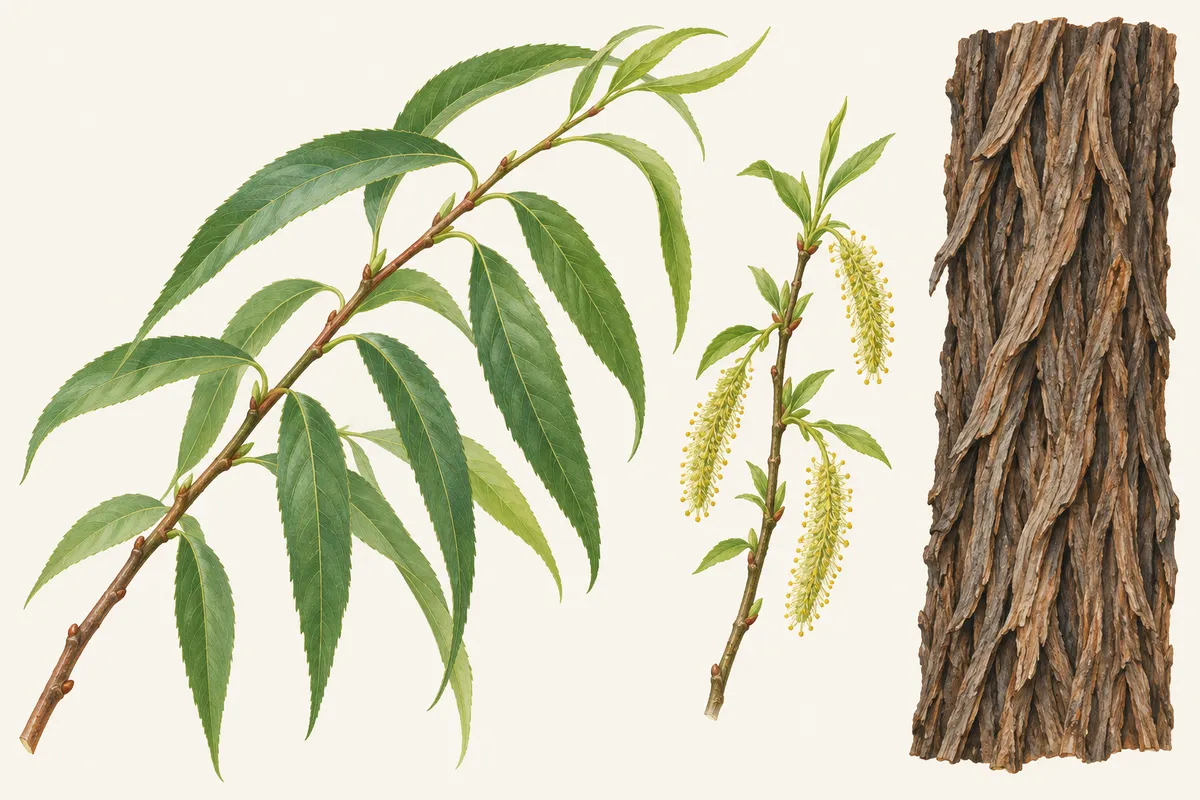
Narrow leaves that stay green underneath, a bud wrapped in a single scale, near-black ridged bark and leaning, often broken trunks on a riverbank: that combination is black willow.
In short
For black willow tree identification, check three things. The leaves are narrow and lance-shaped, 3 to 6 inches long, finely toothed, and light green underneath rather than white. Each bud is pressed to the twig under one cap-like scale. The bark is dark brown to nearly black with thick, scaly ridges, and the tree grows on wet ground by water, often with several leaning trunks.
- A green, not whitish, leaf underside separates black willow from peachleaf and white willow.
- One bud scale and no end bud mark any willow; check this before anything else.
- Black willow is the largest of about 90 willows native to North America, according to the USDA Forest Service.
Field marks at a glance
- Scientific name
- Salix nigra
- Family
- Salicaceae (willow family)
- Type
- Broadleaf, deciduous
- Leaves
- Alternate, simple, narrowly lance-shaped, 3 to 6 inches (8 to 14 cm) long, with a long, often curved tip and a very finely toothed edge; dark and shiny above, light green below.
- Stipules
- Small, green, toothed, ear-shaped stipules at the base of the short leaf stalk, which often stay on the twig.
- Buds
- Small, pointed, pressed flat against the twig, each covered by a single scale; no true end bud.
- Twigs
- Slender, orange-brown to reddish brown, brittle at the base so they snap off easily; bitter, aspirin-like taste.
- Bark
- Dark brown to grayish black, deeply furrowed into thick, scaly, flat-topped ridges.
- Flowers
- Catkins 1 to 3 inches long at or just before leaf-out; male and female catkins on separate trees.
- Fruit
- Light brown capsules about 1/4 inch (3 to 6 mm) long that split in two and release tiny seeds with long silky hairs.
- Form and size
- Often several leaning or forked trunks and a broad, irregular crown with broken limbs; 30 to 60 ft on northern and poor sites, up to 140 ft in the lower Mississippi Valley.
- Range
- Eastern North America, from southern New Brunswick and central Maine west to southeastern Minnesota, south to the Rio Grande and the Florida panhandle.
Most willows on an eastern riverbank are shrubs. Black willow is the one that becomes a real tree, with dark, deeply ridged bark, several leaning trunks and a ragged crown full of broken limbs. The USDA Forest Service calls it the largest of about 90 willow species native to North America and the only commercially important one. Identifying it means first confirming that the tree is a willow, then ruling out the handful of tree willows and willow-leaved trees that share its habitat.
How to identify a black willow tree
Work through these in order; the first two settle the genus, the next three the species.
1. The bud: one scale, no end bud. Every willow has small buds pressed flat against the twig, each wrapped in a single cap-like scale, and no true bud at the twig tip. Virginia Tech Dendrology lists this for black willow, along with prominent stipule scars. Poplars and cottonwoods have several bud scales; oaks have a cluster of buds at the tip.
2. The leaf: long, narrow, finely toothed. Black willow leaves are lance-shaped, 3 to 6 inches long according to Virginia Tech and the Missouri Department of Conservation, which adds that they are thin, papery and very long-pointed, the tip often curved. Natural Resources Canada gives 8 to 14 cm and a very finely toothed edge.
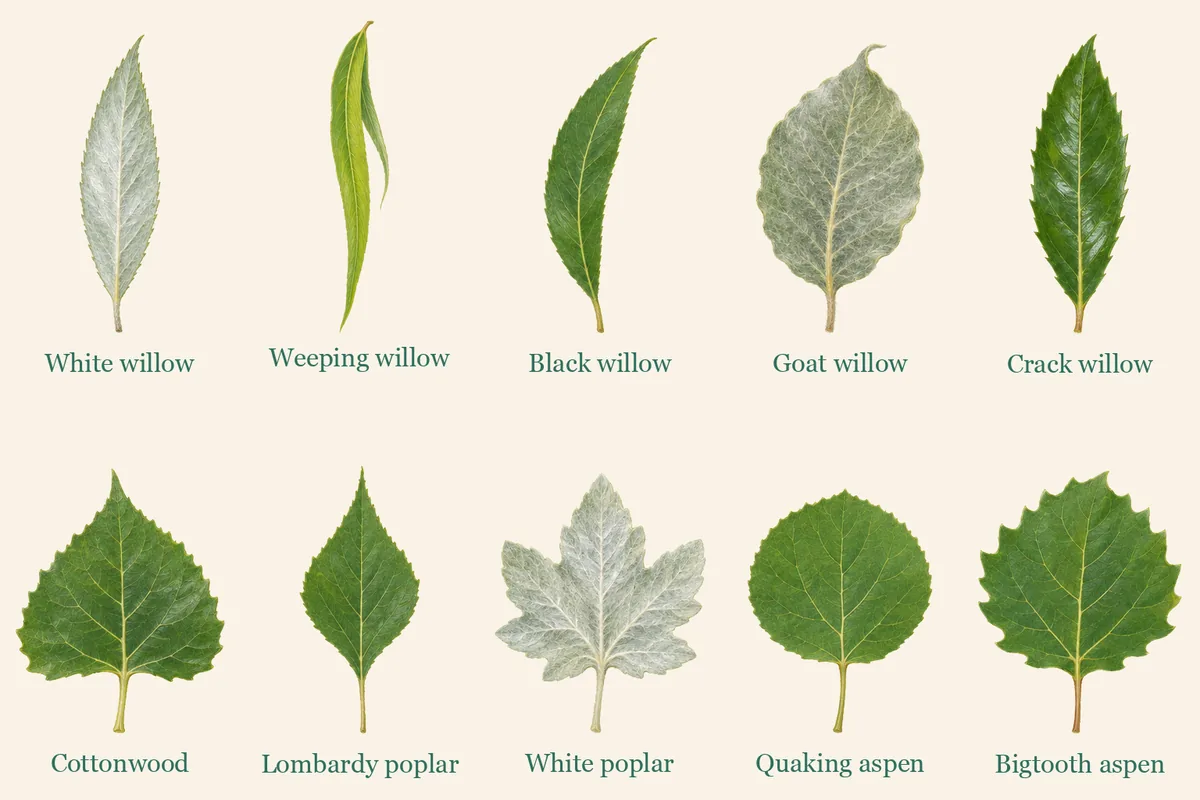
3. The underside: still green. This is the species test. Virginia Tech describes the underside as light green, Natural Resources Canada as paler than the top. Several look-alike willows have a whitish or silvery underside instead, so a leaf that is green on both sides narrows the field fast.
4. The stipules. At the base of the short leaf stalk (3 to 6 mm, per Natural Resources Canada) look for a pair of small, green, toothed, ear-shaped leafy flaps. They often stay on the twig through the season and are a good black willow mark when present.
5. The bark and the shape. Virginia Tech describes brown to grayish-black bark with thick, somewhat scaly ridges and deep furrows. Open-grown trees have a crooked, often forked trunk and a broad, irregular crown whose spreading branches break away easily (Natural Resources Canada).
If the tree leans out over the water and the leaves are out of reach, a photo of the bark or of a fallen leaf is enough for Tree Identifier to suggest a name. The app gives one answer without a confidence score or a list of look-alikes, so confirm a black willow result with the bud and leaf-underside tests above.
Catkins, cotton and the seed that needs water
Black willow is dioecious: male and female catkins grow on separate trees, and the USDA Forest Service's Silvics of North America notes that there is no reliable way to tell the sexes apart outside flowering and seed time. The catkins open at or just before leaf-out, from February in the South to late June at the northern edge of the range. Virginia Tech gives catkins 1 to 3 inches long; in Missouri, flowering is April to May and fruiting May to June.
Female catkins ripen into light brown capsules, 3 to 6 mm long by the Forest Service's figures, which split 45 to 60 days after pollination and release tiny seeds with long silky hairs. That is the white fluff that drifts over rivers in early summer. Black willow seed loses viability after only a few days of dryness and must reach a moist seedbed within 12 to 24 hours unless it is floating on water, which is why wild black willows line floodplains, sandbars and ditches rather than dry uplands. If you are not sure which tree is shedding fluff on your street, see which tree has white fluff.
Where black willow grows, and how big it gets
The Forest Service gives its range as southern New Brunswick and central Maine west through Quebec, southern Ontario and central Michigan to southeastern Minnesota, south and west to the Rio Grande just below the Pecos, and east along the Gulf Coast through the Florida panhandle and southern Georgia. It grows on wet soils near watercourses: floodplains, river margins, swamps, sloughs, bayou banks and drainage ditches, best at or slightly below water level. Missouri reports it statewide near almost any water source, tolerating long flooding and burial by flood sediment.
Size varies more than in most trees. In the lower Mississippi Valley, the Forest Service reports 10-year-old trees averaging 49 feet, 40-year-old trees about 101 feet, and the tallest trees 140 feet with trunks up to 48 inches across. Northern and poor-site trees are generally 30 to 60 feet. In Canada, Natural Resources Canada gives up to 12 m. The tree is short-lived (average age at maturity 55 years) and very weak: most large trees carry big broken limbs, and Virginia Tech notes that crown gall, witches' brooms and sprouts along the trunk are common. Ragged, half-broken crowns are part of the identification.
Black willow vs peachleaf, weeping and white willow, and willow oak
| Tree | Leaf | Underside | Twigs | Habit |
|---|---|---|---|---|
| Black willow | Lance-shaped, 3–6 in, finely toothed | Light green | Slender, orange-brown, brittle at base | Native; leaning trunks, near-black ridged bark |
| Peachleaf willow | Lance-shaped, 5–14 cm, finely toothed | Whitish | Yellowish-brown, flexible and tough | Native, British Columbia to Quebec and south; reddish-brown shaggy bark |
| Weeping willow | Very narrow, 3–6 in long, 3/8–1/2 in wide | Milky green | Olive to pale yellow-brown, hanging like rope | Planted; round crown sweeping the ground |
| Willow oak | Narrow, 2–5 in, smooth edge, bristle tip | Not a willow mark | Slender, several buds at the tip | Native oak; bears small acorns |
Figures come from Natural Resources Canada's peachleaf willow factsheet and Virginia Tech's weeping willow and willow oak fact sheets. The weeping willow page separates the planted weeping willows from each other, and the willow oak page covers the oak that mimics a willow leaf. Peachleaf willow's twigs are flexible and tough (Natural Resources Canada); black willow's are brittle at the base and snap off easily.
Two more trees share the riverbank. Eastern cottonwood has a triangular leaf on a flattened stalk and buds about 3/4 inch long with several resinous scales (Virginia Tech). Sandbar willow, which the Forest Service says often arrives first on new bars, dies out there before it reaches tree size. For the other North American and planted willows, from pussy willow to corkscrew willow, see the willow guide.
Varieties, hybrids and the Goodding willow question
The Forest Service lists two Texas varieties, Salix nigra var. altissima on the Gulf Coast and var. lindheimeri in central Texas, and notes that the western black willow, once var. vallicola, was renamed Salix gooddingii (Goodding willow). Whether Goodding willow is a species or a variety of black willow is still debated, and field guides in the Southwest use both names.
Natural hybrids are described as uncommon and hard to verify. The reported partners include white willow (S. × hankensonii), peachleaf willow (S. × glatfelteri), coastal plain willow and shining willow. A tree that fits black willow on most marks but has a slightly whitish leaf underside may be one of these, and only a specialist with flowers and capsules can settle it.
Black willow is not one of the 138 species in Tree Identifier's Collection, though a photo still returns a name. With location turned on, the app's Tree Map pins each identification, which helps if you want to come back in spring to see whether a particular tree carries male catkins or cotton-shedding female ones.
Look-alikes and how to tell them apart
Peachleaf willow (Salix amygdaloides)
Turn a leaf over. Natural Resources Canada describes peachleaf willow's underside as whitish; black willow's is paler green but still green. Peachleaf is the tallest native willow of the Prairie provinces and grows farther west, from British Columbia to Quebec.
Weeping willow (Salix babylonica)
Weeping willow's olive-green to yellowish twigs hang straight down almost like rope, its leaves are only 3/8 to 1/2 inch wide with a milky underside, and it is a planted tree. Black willow's branches spread or lean but do not hang in curtains.
Willow oak (Quercus phellos)
Willow oak leaves are narrow like a willow's but have a smooth edge and a tiny bristle at the tip, its twig tips carry a cluster of several buds, and it bears small acorns. Black willow leaves are toothed along the whole edge.
Eastern cottonwood (Populus deltoides)
Cottonwood shares the riverbank and the cottony seed, but its leaf is a triangle 3 to 6 inches long on a flattened stalk, and its buds are about 3/4 inch long with several resinous scales, not one.
What a photo can't settle
- Willows hybridize, and the Forest Service says putative black willow hybrids are hard to verify; a photo app gives one species name, not a hybrid parentage.
- Male and female black willows look the same outside the flowering and seed season, so a photo of the leaves cannot tell you whether a tree will shed cotton.
- Black willow and Goodding willow are treated as one or two species depending on the authority, so names differ between field guides in the Southwest.
Questions people ask
Why is it called black willow?
For the bark. Virginia Tech describes it as brown to grayish black with thick, scaly ridges, and Natural Resources Canada as very dark, black or dark brown.
How tall does a black willow get?
It depends on the site. The USDA Forest Service reports the tallest trees at 140 feet in the lower Mississippi Valley, while northern and poor-site trees are generally 30 to 60 feet. Natural Resources Canada gives up to 12 m (about 40 ft) in Canada.
How long does a black willow live?
Not long for a tree. The Forest Service gives an average age at maturity of 55 years and an oldest sound tree of 70 years; Natural Resources Canada gives a maximum age of about 70 years, and the Missouri Department of Conservation under 85 years.
Is Goodding willow the same as black willow?
It is debated. The USDA Forest Service notes that the western black willow, once Salix nigra var. vallicola, was renamed Salix gooddingii, and that whether it is a separate species or a variety of black willow is still argued. Treated as a variety, black willow's range reaches into the West.
Sources
- Black Willow (Salix nigra), Silvics of North America — USDA Forest Service
- Black willow fact sheet — Virginia Tech Dendrology
- Black willow (Salix nigra) — Natural Resources Canada, Trees, insects and diseases of Canada's forests
- Black Willow — Missouri Department of Conservation, Field Guide
- Peachleaf willow (Salix amygdaloides) — Natural Resources Canada, Trees, insects and diseases of Canada's forests
- Weeping willow fact sheet — Virginia Tech Dendrology
- Willow oak fact sheet — Virginia Tech Dendrology
- Eastern cottonwood fact sheet — Virginia Tech Dendrology
Keep reading
- Tree profileWillow trees (Salix): how to identify them
- Tree profileWeeping willow (Salix babylonica): how to identify it
- Tree profileWillow oak (Quercus phellos): how to identify it
- Tree profileEastern cottonwood (Populus deltoides): how to identify it
- Clue guideWhich tree sheds white fluff? Sort it by month, leaf and where the fluff sits