Tree profile
Cherrybark oak (Quercus pagoda): how to identify it
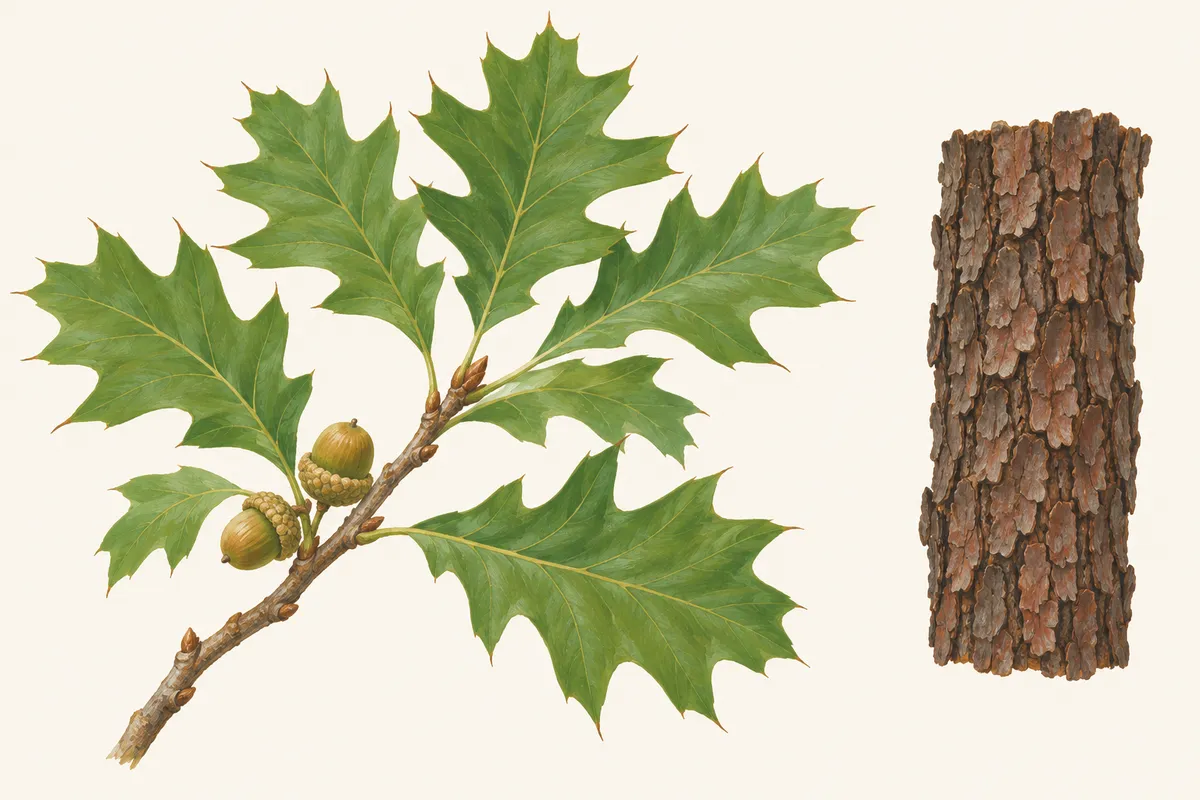
The big red oak of southern bottomlands: shallow lobes held out at right angles like a pagoda's roofs, a pale, hairy underside and scaly bark that can pass for black cherry.
In short
Cherrybark oak identification starts with the leaf: 5 to 8 inches long, with 5 to 9 shallow, bristle-tipped lobes set at nearly right angles to the midrib, glossy dark green above and pale, hairy below. The bark breaks early into small scaly ridges that can resemble black cherry. The acorn is about 1/2 inch, under a scaly cap covering about a third. It grows on southern stream bottoms.
- Shallow lobes that stick straight out from the midrib give the leaf a pagoda outline; southern red oak's lobes are deeper and its end lobe long and hooked.
- Look at the site: cherrybark oak is a bottomland tree, southern red oak an upland one.
- A tall, straight trunk free of branches for a long way, often over 100 feet tall, is typical of forest trees.
Field marks at a glance
- Scientific name
- Quercus pagoda (Q. falcata var. pagodifolia)
- Family
- Fagaceae (beech family)
- Type
- Broadleaf, deciduous
- Leaves
- Alternate, simple, 5 to 8 inches long, with 5 to 9 bristle-tipped lobes (NC State gives 5 to 11) and shallow sinuses; the lobe margins sit nearly at right angles to the midrib. Bright to dark glossy green above.
- Leaf underside
- Duller and grayish-white, with fine star-shaped hairs (NC State); scruffy hairs may also cover the leaf stalk.
- Bark
- Smooth at first, then quickly breaking into small scaly ridges, later dark, scaly and quite rough; at times it resembles black cherry bark.
- Acorns
- About 1/2 inch long, orange-brown, hairy when young; a scaly, somewhat hairy cap covers about a third of the nut. Matures in fall of the second year.
- Twigs and buds
- Twigs orange to reddish brown, often very hairy when young. End buds clustered, 1/8 to 1/4 inch, pointed, reddish brown, hairy on the upper half.
- Form and size
- A large tree with a straight trunk clear of branches for a long way: 100 to 130 ft tall and 36 to 60 in across (USDA Forest Service).
- Habitat
- Loamy, well-drained soils on first-bottom ridges and terraces along streams; tolerates drier sites.
- Range
- Atlantic and Gulf Coastal Plain from southeastern Virginia to northwestern Florida and eastern Texas, north up the Mississippi Valley to southeastern Oklahoma, southeastern Missouri, southern Illinois and southwestern Indiana.
Cherrybark oak is the tall, straight red oak of southern river bottoms, and the USDA Forest Service calls it "the high-value red oak in the South." It is close kin to southern red oak, close enough that some sources list it as a variety of that species, but the two separate well in the field: cherrybark has shallow, evenly spaced lobes, a gray-white hairy underside, bark like black cherry, and it grows in bottomlands rather than on dry ridges. Never eat a nut, seed or fruit on the strength of a web page or an app; check with a local expert.
How to identify a cherrybark oak, step by step
Descriptions and measurements are from Virginia Tech Dendrology's cherrybark oak fact sheet unless another source is named.
- Bristle tips. The lobes end in bristles, which puts the tree in the red oak group, and summer twigs carry acorns of two ages, since they take two seasons to ripen.
- Leaf outline. The leaf is 5 to 8 inches long with 5 to 9 lobes; NC State Extension's cherrybark oak profile gives 5 to 11. The lobes are shallower than southern red oak's, and their edges sit nearly at right angles to the midrib, so the leaf has a stacked, tiered outline. NC State says the shape is said to resemble a Chinese pagoda when the leaf is held upright.
- Underside. The top is glossy and bright to dark green. The underside is duller, and NC State describes it as grayish-white and densely covered in fine, star-shaped hairs. The leaf stalk may be hairy too.
- Bark. Smooth on young stems, the bark quickly breaks into small scaly ridges, then becomes dark, scaly and rough; Virginia Tech says it at times resembles black cherry bark, hence the name.
- Site and form. In the forest, look for a very tall tree with a long, straight trunk clear of branches, on a stream terrace or the higher ridges of a floodplain. The Forest Service contrasts its relatively branch-free trunk with pin and willow oak.
Tree Identifier can name an oak from one photo of a leaf, the bark or an acorn, which helps when the nearest leaves are 80 feet up; take a second photo of a fallen leaf's underside and check it against the steps above.
Cherrybark oak vs southern red oak and Shumard oak
The comparison that matters most is with southern red oak. The figures come from the Virginia Tech fact sheets for southern red oak and Shumard oak, and from the Forest Service.
| Mark | Cherrybark oak | Southern red oak | Shumard oak |
|---|---|---|---|
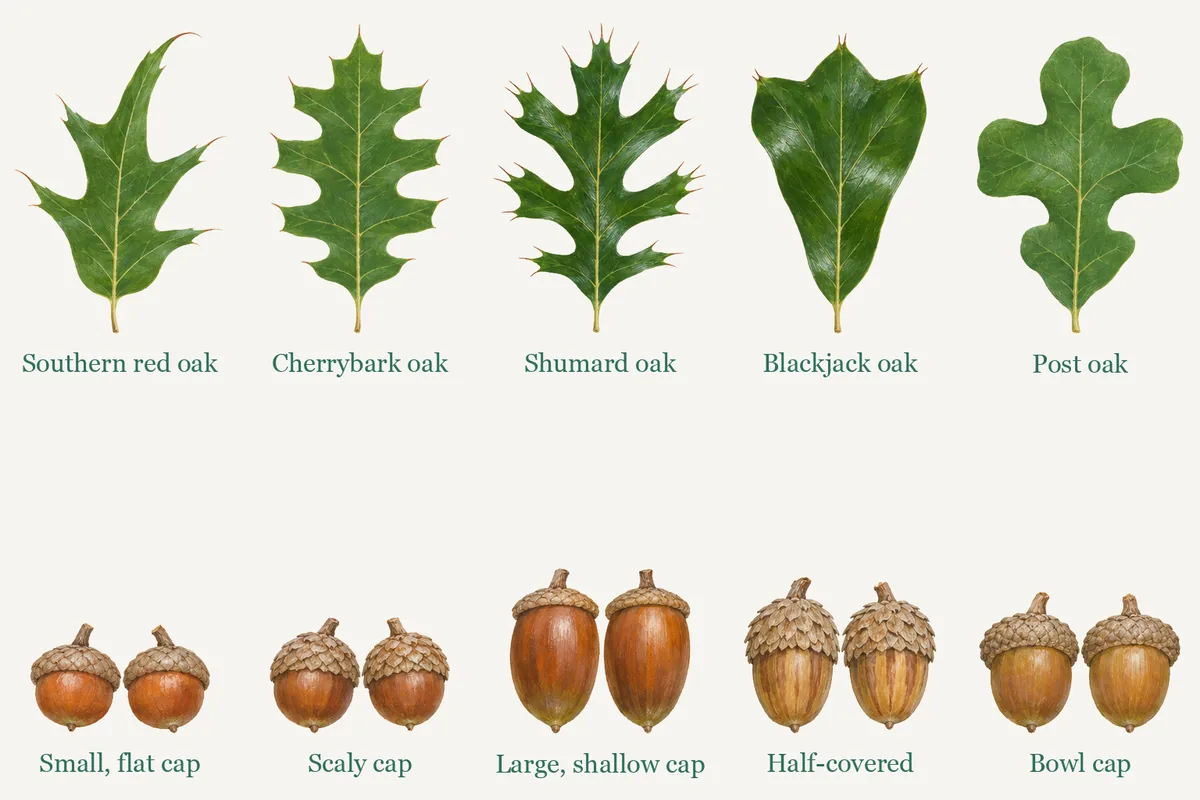
| Leaf | 5–8 in, 5–9 shallow lobes at right angles to the midrib | 5–9 in, 3 shallow lobes or 5–7 deeper ones, long hooked end lobe | 4–7 in, 5–9 lobes, sinuses more than halfway in |
| Underside | Grayish-white, hairy | Paler, fuzzy | Pale green |
| Bark | Small scaly ridges, like black cherry | Broad scaly ridges, deep narrow furrows | Dark furrows, pale gray to white ridge tops |
| Acorn | 1/2 in, scaly cap about 1/3 | 1/2 in, thin flat cap under 1/3 | 3/4–1 1/4 in, shallow cap under 1/3 |
| Site | Stream bottoms and terraces | Dry uplands | See the Shumard oak page |
Southern red oak's full profile, with its two leaf forms, is on the southern red oak page. Shumard oak, which shares the same bottomlands, has the Shumard oak page. Virginia Tech also lists black oak and northern red oak as look-alikes; both are covered on the oak identification page.
Species or variety
The USDA Forest Service's Silvics of North America names cherrybark oak Quercus falcata var. pagodifolia, a variety of southern red oak, and lists bottomland red oak, swamp red oak, swamp Spanish oak and Elliott oak among its common names. Virginia Tech and NC State treat it as its own species, Quercus pagoda, and NC State notes the older name.
For identification the label matters less than the traits. The Forest Service's southern red oak silvics describes southern red oak as mainly an upland tree of dry sandy or clay soils, rare in Mississippi Delta bottomlands, while cherrybark grows best on loamy, well-drained soils along streams. A shallow-lobed, gray-bellied red oak on a floodplain terrace is almost always cherrybark.
Where cherrybark oak grows
The Forest Service gives the range as the Atlantic and Gulf Coastal Plain from southeastern Virginia to northwestern Florida and west to eastern Texas, extending north through the Mississippi Valley to extreme southeastern Oklahoma, southeastern Missouri, southern Illinois and southwestern Indiana. It grows best on first-bottom ridges and terraces along streams, on acid to medium acid soils; NC State adds that it tolerates drier sites and lists it for USDA zones 6a to 9a.
Its neighbors on those sites include other bottomland red oaks such as water oak and willow oak, with their small, unlobed leaves. For the wider region, see Southeast tree identification.
Size, acorns and timber
The Forest Service gives a height of 100 to 130 feet and a diameter of 36 to 60 inches, with diameter growth of 3 to 6 inches per 10 years. It is intolerant of shade. Flowers appear from February to May depending on latitude, and acorns mature from August to November of the second year. Trees bear from about 25 years of age, best between 50 and 75, with good crops every 1 or 2 years.
Gray squirrels, wild turkeys and blue jays eat the most acorns, followed by wood ducks, woodpeckers, nuthatches, grackles, raccoons, deer and fox squirrels, per the Forest Service. Its heavy, strong wood goes into furniture and interior finish, and the Forest Service regards it as one of the best red oaks for its form and quality.
With location turned on, Tree Identifier's Tree Map pins each find, which is useful on a floodplain where one big oak looks much like the next.
Look-alikes and how to tell them apart
Southern red oak (Quercus falcata)
Southern red oak's leaf has either 3 shallow lobes or 5 to 7 deeper ones, often with one long, hooked end lobe like a turkey's foot and a U-shaped base; cherrybark's lobes are shallower, more even and set at right angles. Southern red oak bark has broad scaly ridges and deep furrows, and the tree is mainly an upland species.
Shumard oak (Quercus shumardii)
Shumard oak's sinuses cut more than halfway to the midrib, its leaves are shiny dark green above and pale green below, and its acorn is larger, 3/4 to 1 1/4 inches. Its bark has light gray to white scaly ridge tops. Cherrybark's leaf is shallowly lobed and hairy, gray-white beneath.
Black oak (Quercus velutina)
Black oak's end buds are larger, 1/4 to 1/2 inch, buff and fuzzy all over, and its inner bark is yellow-orange. Its bark turns nearly black with horizontal breaks, not cherry-like scaly plates, and it is a tree of dry uplands.
What a photo can't settle
- Sources disagree on whether cherrybark oak is a species or a variety of southern red oak, and intermediate trees exist where the two meet; a photo app gives one name and cannot settle the taxonomy.
- Leaves from the shaded lower crown and from sprouts are less typical than sun leaves from the upper crown, which on a tree over 100 feet tall are often only reachable as fallen leaves.
- A photo app, Tree Identifier included, returns one name with no confidence score and no list of alternatives. Check the leaf underside, the bark and the site before settling on cherrybark oak.
Questions people ask
Why is it called cherrybark oak?
For its bark. Virginia Tech says the bark, smooth at first, quickly develops small scaly ridges and at times resembles black cherry bark; NC State says the mature bark resembles a cherry tree's. The scientific name pagoda refers to the leaf, which NC State says is said to resemble a Chinese pagoda when held upright.
Is cherrybark oak the same as southern red oak?
Not quite. The USDA Forest Service's Silvics of North America treats it as a variety of southern red oak, Quercus falcata var. pagodifolia; Virginia Tech and NC State treat it as a separate species, Quercus pagoda. Either way, the two differ in leaf shape, bark and habitat, so they can be told apart in the field.
How tall does a cherrybark oak grow?
Very tall for an oak. The USDA Forest Service gives 100 to 130 feet tall and 36 to 60 inches in diameter, and Virginia Tech says it is often well over 100 feet tall and over 3 feet across. NC State gives 90 to 130 feet tall and 30 to 70 feet wide.
Where does cherrybark oak grow?
On southern bottomlands. The USDA Forest Service says it grows best on loamy, well-drained soils on first-bottom ridges and terraces along streams, across the Atlantic and Gulf Coastal Plain from southeastern Virginia to eastern Texas and up the Mississippi Valley to southern Illinois and southwestern Indiana.
Sources
- Cherrybark oak fact sheet — Virginia Tech Dendrology
- Cherrybark Oak (Quercus falcata var. pagodifolia), Silvics of North America — USDA Forest Service
- Quercus pagoda (cherrybark oak) — North Carolina Extension Gardener Plant Toolbox, NC State University
- Southern red oak fact sheet — Virginia Tech Dendrology
- Southern Red Oak (Quercus falcata), Silvics of North America — USDA Forest Service
- Shumard oak fact sheet — Virginia Tech Dendrology
Keep reading
- Tree profileSouthern red oak (Quercus falcata): how to identify it
- Tree profileOak trees (Quercus): how to identify them
- Tree profileShumard oak (Quercus shumardii): how to identify it
- Tree profileWater oak (Quercus nigra): how to identify it
- Regional guideSouthern tree identification for the Southeast US