Tree profile
Shumard oak (Quercus shumardii): how to identify it
One of the largest southern red oaks: glossy leaves cut more than halfway to the midrib, an inch-long acorn in a shallow cap, and bark with pale ridge tops.
In short
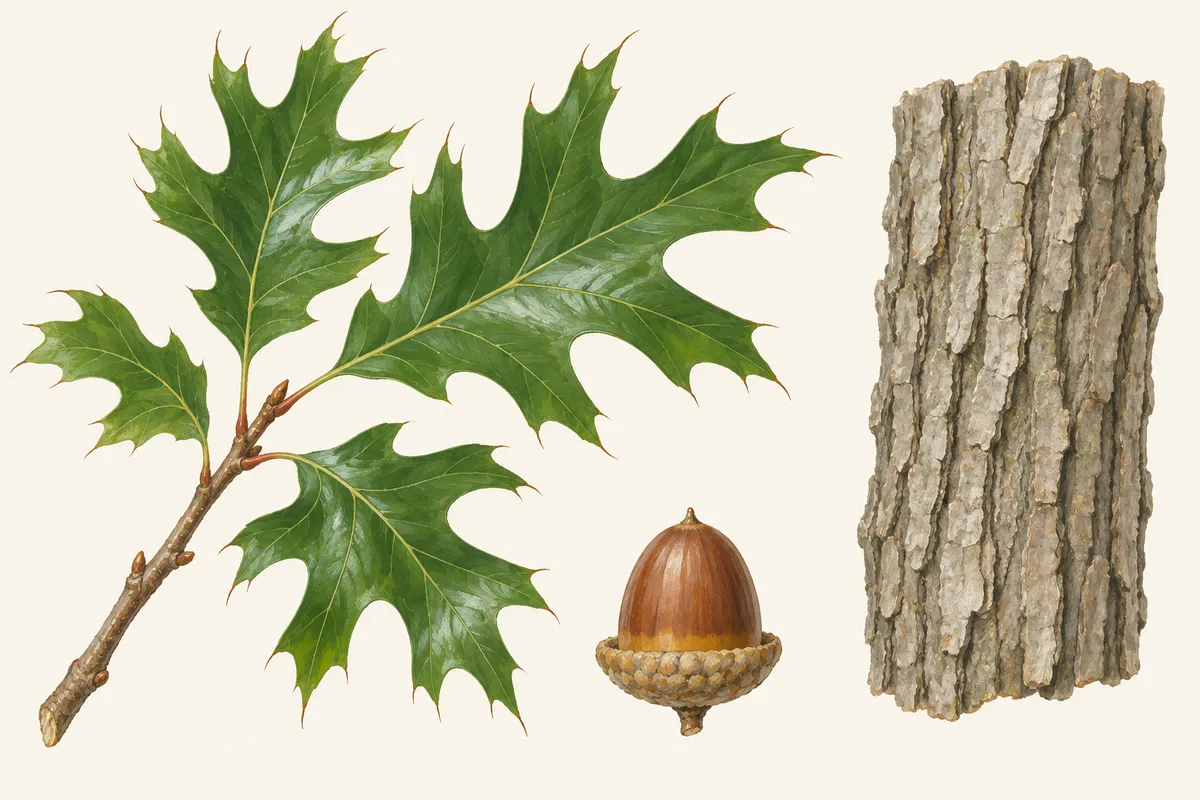
Shumard oak identification starts with a glossy, dark green leaf 4 to 7 inches long with 5 to 9 bristle-tipped lobes and sinuses cut more than halfway to the midrib. Its acorns are large, 3/4 to 1 1/4 inches long, in a shallow scaly cap covering less than a third of the nut, and its buds are smooth and gray-brown. Fall color is red to burgundy.
- Shumard oak sits between northern red oak and pin oak: deeper sinuses than red oak, a much bigger acorn than pin oak.
- Against scarlet oak, check the acorn cap: under a third of the nut on Shumard, about half on scarlet.
- Smooth, gray-brown buds about 1/4 inch long are a winter clue; scarlet oak's are reddish and hairy on the upper half.
Field marks at a glance
- Scientific name
- Quercus shumardii
- Family
- Fagaceae (beech family)
- Type
- Broadleaf, deciduous
- Leaves
- Alternate, simple, 4 to 7 inches long, with 5 to 9 lobes ending in coarse bristle tips; sinuses more than halfway to the midrib (NC State: 1/2 to 3/4 of the way).
- Leaf surfaces
- Shiny dark green above, pale green below, with tufts of hair in the vein angles underneath.
- Fall color
- Red to burgundy (NC State).
- Acorns
- 3/4 to 1 1/4 inches long, oblong-egg-shaped, single or paired, in a shallow, bowl-shaped scaly cap covering less than a third of the nut; ripen September or October of the second year.
- Twigs and buds
- Twigs moderately stout, gray-brown, hairless; clustered end buds about 1/4 inch, ovoid, pointed, gray-brown, smooth or slightly fuzzy.
- Bark
- Gray-brown with dark, deep furrows; ridge tops light gray to white and scaly.
- Size and form
- Large: often over 100 ft in the wild with a clear trunk and a broad, spreading crown; 50 to 70 ft planted (NC State), pyramidal when young.
- Range
- Coastal Plain from North Carolina to northern Florida and west to central Texas, up the Mississippi Valley to central Oklahoma, eastern Kansas, Missouri, Illinois, Indiana, Ohio, Kentucky and Tennessee; local north to Michigan, Pennsylvania and Maryland.
Shumard oak is the big red oak of southern stream terraces and bluffs, and a common planted tree along streets and in parks. It is easy to place in the red oak group, with its bristle-tipped lobes, and hard to separate from its relatives, because its leaf sits between the shallow-cut northern red oak and the deeply cut pin and scarlet oaks. The acorn and the buds settle it.
How to identify a Shumard oak
1. Glossy leaves cut more than halfway. The Virginia Tech Shumard oak fact sheet describes alternate leaves 4 to 7 inches long with 5 to 9 lobes ending in coarse bristle tips, sinuses reaching more than halfway to the midrib, shiny dark green above and pale below. NC State Extension gives 2 to 4 pairs of pointed lobes and sinuses cut 1/2 to 3/4 of the way to the midrib, with tufts of hair underneath in the vein angles.
2. A large acorn in a shallow cap. Virginia Tech gives acorns 3/4 to 1 1/4 inches long, oblong-egg-shaped, single or paired, in a shallow, bowl-shaped, scaly cap covering less than a third of the nut. The USDA Forest Service Silvics of North America gives about 1 inch long, in a thick, flat, saucer-shaped cup, ripening in September or October of the second year.
3. Smooth gray-brown buds. End buds are clustered, about 1/4 inch long, ovoid and pointed, gray-brown, smooth or slightly fuzzy (Virginia Tech; the Forest Service describes them as smooth with overlapping gray-brown scales). Twigs are moderately stout, gray-brown and hairless.
4. Bark with pale ridge tops. Gray-brown bark develops dark, deep furrows, and the ridge tops turn light gray to white and scaly (Virginia Tech). On a big tree the light ridges stand out against the dark furrows.
5. Size and setting. Shumard is one of the largest southern red oaks, often over 100 feet tall in the wild with a clear trunk and a broad, spreading crown. Planted trees are smaller and pyramidal when young.
If the leaves are out of reach, Tree Identifier can name the tree from one photo of a fallen leaf or an acorn. With this group, take that name as a starting point and confirm it with the acorn cap and the buds below.
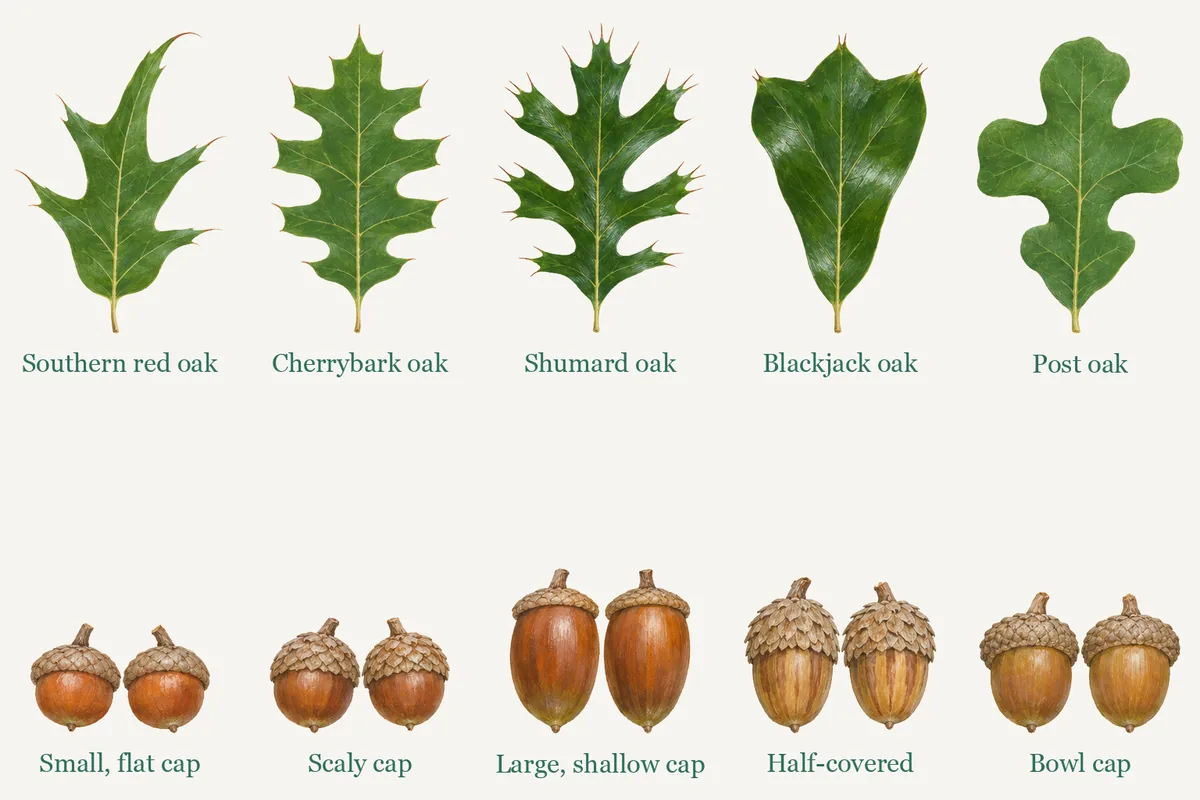
Shumard oak vs northern red, pin and scarlet oak
Virginia Tech lists black, scarlet, northern red and cherrybark oak as Shumard oak's look-alikes, and planted Shumards are often mistaken for pin oak. Figures come from the Virginia Tech fact sheets for northern red oak, pin oak and scarlet oak.
| Mark | Shumard oak | Northern red oak | Pin oak | Scarlet oak |
|---|---|---|---|---|
| Leaf | 4–7 in, 5–9 lobes, glossy | 5–8 in, 7–11 lobes, dull | 3–6 in, 5–9 lobes | 3–7 in, glossy |
| Sinus depth | More than halfway | 1/3–1/2 of the way | Almost to the midrib | Very deep |
| Acorn | 3/4–1 1/4 in | 3/4–1 in | About 1/2 in | 1/2–1 in |
| Cap | Shallow, under 1/3 | Flat beret, 1/4 or less | Thin saucer | About 1/2, rings at the nut tip |
| Buds | 1/4 in, gray-brown, smooth | Large, conical, red-brown | Small, chestnut-brown | Reddish-brown, hairy on upper half |
| Form | Large, clear trunk, spreading crown | Rounded crown in the open | Pyramid, lower branches droop | Irregular crown, swollen base |
Two checks do most of the work. Against northern red oak, look at sinus depth and gloss; the red oak page has its full profile. Against pin and scarlet oak, look at the acorn: pin oak's is half the size, scarlet oak's cap covers half the nut. The pin oak page shows pin oak's drooping lower limbs, which a Shumard does not have.
Fall color and seasons
NC State gives a red to burgundy fall color. In spring, the Forest Service says flowers usually appear in March or April: smooth male catkins 6 to 7 inches long and female flowers on hairy stalks. Acorns take two seasons, so in summer a twig carries this year's tiny acorns alongside last year's ripening ones, and they fall in September or October.
Fall color does not separate Shumard from pin, scarlet or northern red oak, which all turn red; our guide to trees with red leaves in fall covers the red-leaved trees together. In winter, rely on the smooth gray-brown buds and any acorns or caps on the ground.
Where Shumard oak grows
The Forest Service range centers on the Atlantic Coastal Plain from North Carolina to northern Florida and west to central Texas, and runs up the Mississippi Valley to central Oklahoma, eastern Kansas, Missouri, southern Illinois, Indiana, western and southern Ohio, Kentucky and Tennessee, with local populations north to southern Michigan, southern Pennsylvania and Maryland. It grows scattered among other hardwoods on moist, well-drained soils along streams, best on terraces, colluvial slopes and adjacent bluffs, and rarely on first bottoms. The Forest Service notes that it tolerates high-pH soils and drought.
Those tolerances make it a common planted tree. NC State lists it for USDA zones 5a through 9b and as tolerant of drought, urban conditions, air pollution and short-term flooding, with a planted size of 50 to 70 feet tall and 30 to 40 feet wide.
Varieties and hybrids
The Forest Service recognizes two varieties: var. shumardii, the typical tree, and var. texana, Texas oak, in central Texas and southern Oklahoma. It also lists hybrids with pin, northern red, black, willow, water, shingle, blackjack, Nuttall and silverleaf oak. In a mixed planting, a tree that shows Shumard leaves with a pin-oak-sized acorn may be one of these crosses.
The oak identification page covers the red oak and white oak groups together. Tree Identifier's follow-up chat can take a question such as "how does Shumard oak differ from scarlet oak", and, with location turned on, its Tree Map pins where a tree stands so you can return for the acorns in fall.
Look-alikes and how to tell them apart
Northern red oak (Quercus rubra)
Northern red oak leaves are dull green, 5 to 8 inches long with 7 to 11 lobes, and their sinuses stop a third to halfway to the midvein. Its acorn has a flat, beret-like cap. Shumard leaves are glossy and cut deeper, more than halfway in.
Pin oak (Quercus palustris)
Pin oak acorns are only about 1/2 inch long under a thin saucer cap; Shumard's are 3/4 to 1 1/4 inches. Pin oak is a narrow pyramid with drooping lower branches and smaller leaves, 3 to 6 inches, cut almost to the midrib.
Scarlet oak (Quercus coccinea)
Scarlet oak's acorn cap covers about half the nut, and the nut's tip often shows concentric rings; Shumard's cap covers under a third. Scarlet oak buds are reddish-brown and hairy on the upper half, Shumard's gray-brown and smooth, and scarlet oak trunks often swell at the base.
What a photo can't settle
- The Forest Service lists Shumard oak hybrids with pin, northern red, black, willow, water, shingle, blackjack, Nuttall and silverleaf oak; hybrid leaves and acorns can fall between the parents.
- Sources differ on the cap: Virginia Tech calls it shallow and bowl-shaped, the Forest Service thick, flat and saucer-shaped. Both agree it covers only a small part of the acorn.
- Leaves alone rarely separate Shumard, scarlet and pin oak with certainty. Tree Identifier names a tree from one photo with no confidence score, so photograph an acorn with its cap as well as a leaf.
Questions people ask
Is Shumard oak a red oak?
Yes. It is in the red oak group, with bristle-tipped lobes and acorns that take two seasons to ripen, and the USDA Forest Service calls it one of the largest southern red oaks. Shumard red oak and swamp red oak are among its common names.
How do I tell Shumard oak from northern red oak?
Look at the sinuses and the shine. Shumard leaves are glossy dark green and cut more than halfway to the midrib; northern red oak leaves are dull and cut only a third to halfway, according to Virginia Tech. Northern red oak's acorn cap is a flat beret; Shumard's is a shallow scaly bowl.
What color does Shumard oak turn in fall?
Red to burgundy, according to NC State Extension. Pin, scarlet and northern red oak also turn red, so fall color alone does not separate them; use the acorn and the sinus depth.
What is Texas oak?
The USDA Forest Service treats Texas oak as a variety of Shumard oak, Quercus shumardii var. texana, found in central Texas and southern Oklahoma.
Sources
- Shumard oak (Quercus shumardii) fact sheet — Virginia Tech Dendrology
- Shumard Oak, Silvics of North America — USDA Forest Service
- Quercus shumardii (Shumard oak) — North Carolina Extension Gardener Plant Toolbox, NC State University
- Northern red oak (Quercus rubra) fact sheet — Virginia Tech Dendrology
- Pin oak (Quercus palustris) fact sheet — Virginia Tech Dendrology
- Scarlet oak (Quercus coccinea) fact sheet — Virginia Tech Dendrology
Keep reading
- Tree profileOak trees (Quercus): how to identify them
- Tree profileNorthern red oak (Quercus rubra): how to identify it
- Tree profilePin oak (Quercus palustris): how to identify it
- Tree comparisonRed oak vs white oak trees: how to tell the living trees apart
- Clue guideWhich trees have red leaves in fall? Sort them by leaf shape