Tree profile
Southern red oak (Quercus falcata): how to identify it
The upland red oak of the Southeast, also sold as Spanish oak: a leaf with a long hooked end lobe, a fuzzy underside and a small acorn under a thin cap.
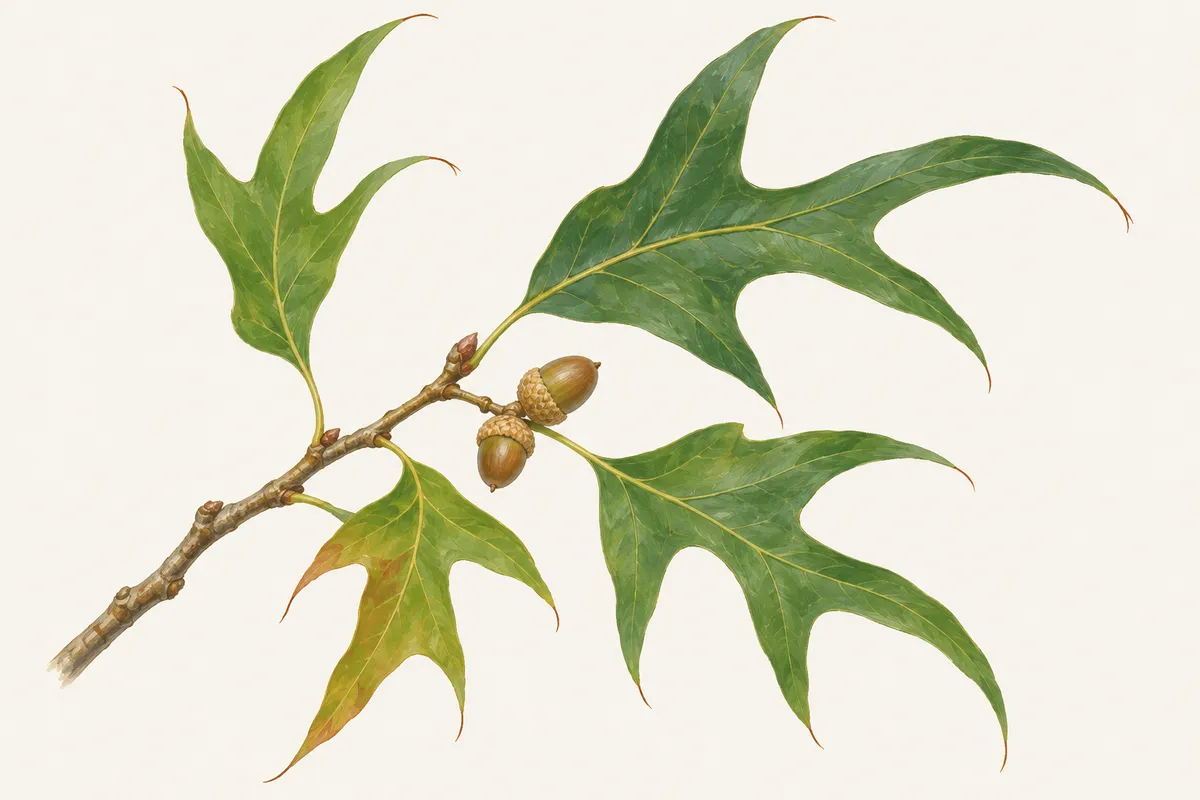
In short
Southern red oak identification starts with the leaf: 5 to 9 inches long, bristle-tipped, either 3 shallow lobes or 5 to 7 deeper ones, often with one long, hooked end lobe like a turkey's foot, glossy above and fuzzy below. The acorn is about 1/2 inch, orange-brown, under a thin, flat cap covering less than a third of the nut. The bark is dark, with broad scaly ridges.
- The long, curved end lobe and a rounded, U-shaped leaf base set southern red oak apart from most other red oaks.
- Leaves are fuzzy underneath; northern red oak's are hairless.
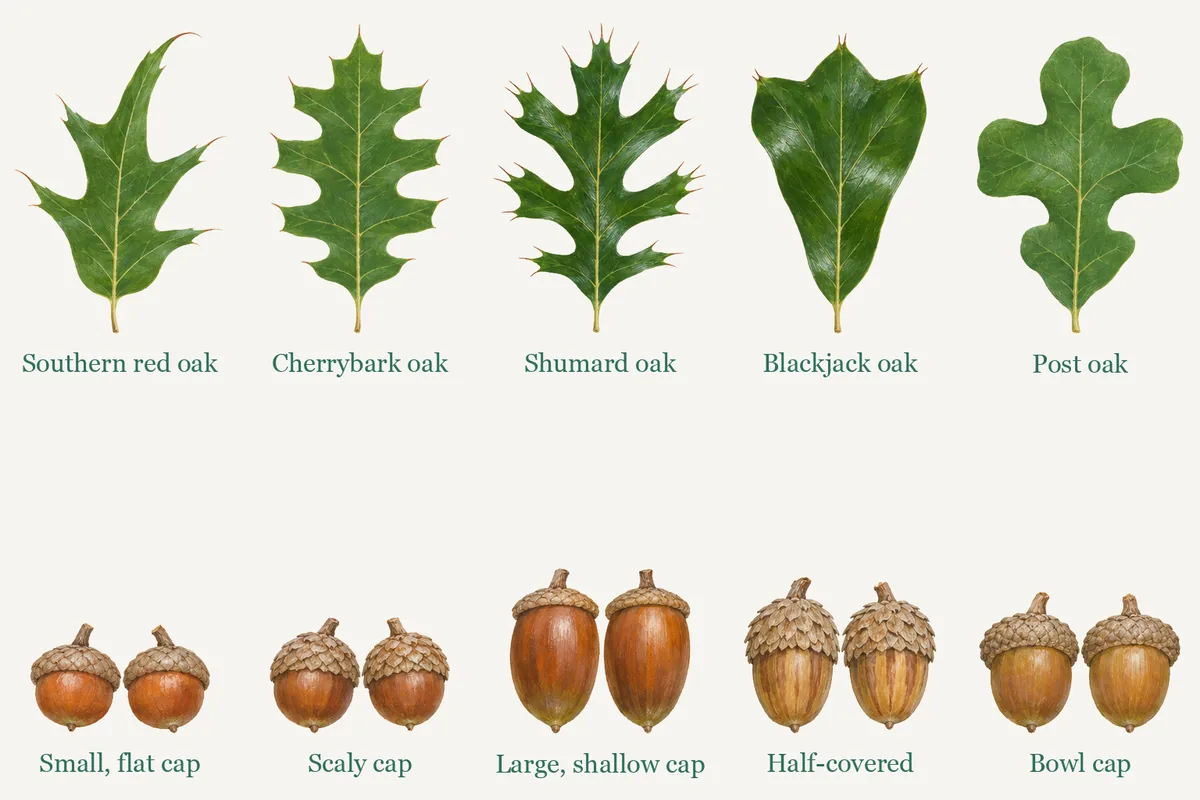
- Cherrybark oak, a bottomland relative, has shallower lobes set at near right angles to the midrib and bark that can look like black cherry's.
Field marks at a glance
- Scientific name
- Quercus falcata
- Family
- Fagaceae (beech family)
- Type
- Broadleaf, deciduous
- Leaves
- Alternate, simple, 5 to 9 inches long, roughly obovate, bristle-tipped. Two forms: 3 lobes with shallow sinuses (common on young trees) or 5 to 7 lobes with deeper ones, often with one long, hooked end lobe. Glossy green above, paler and fuzzy below.
- Leaf base
- Rounded and U-shaped on the lobed form, per NC State Extension; the 3-lobed form is pear-shaped, with the lobes near the tip.
- Acorns
- About 1/2 inch long, orange-brown and finely hairy. The cap is thin and flat and covers less than a third of the nut. Ripens in September and October of the second season.
- Bark
- Dark and thick, with broad, scaly ridges separated by deep, narrow furrows. Like black oak's, but the inner bark is only slightly yellow.
- Twigs and buds
- Twigs reddish brown, sometimes gray-hairy. End buds clustered, dark reddish brown, hairy and pointed, only 1/8 to 1/4 inch.
- Form and size
- Medium-sized, usually 70 to 80 ft tall and 24 to 36 in across, up to about 90 ft; a long straight trunk with upward-reaching limbs and a high, rounded crown.
- Range
- Long Island and New Jersey south to northern Florida, west across the Gulf States to the Brazos River in Texas, north to eastern Oklahoma, Arkansas, southern Missouri, southern Illinois, Ohio and western West Virginia.
- Fall color
- Reddish-brown to copper, not showy (NC State); leaves often hang on late into fall.
Southern red oak is the common red oak of dry uplands across the Southeast, from the Piedmont of the Carolinas and Georgia to east Texas. Its leaf is the easiest of the southern red oaks to recognize once you have seen it: a long, curved end lobe, two short side lobes and a fuzzy underside. The hard part is cherrybark oak, its bottomland relative, which some sources treat as a variety of the same species. Never eat a nut, seed or fruit on the strength of a web page or an app; check with a local expert.
How to identify a southern red oak, step by step
Descriptions and measurements are from Virginia Tech Dendrology's southern red oak fact sheet unless another source is named.
- Bristle tips. Each lobe ends in a bristle, which puts the tree in the red oak group. Rounded lobes mean a white oak; the oak identification page sorts the groups.
- Leaf shape. The leaf is 5 to 9 inches long and roughly widest above the middle. Look for one of two forms: 3 lobes with shallow sinuses, common on young trees, or 5 to 7 lobes with deeper sinuses. Virginia Tech says the leaf often resembles a turkey's foot, with one very long, hooked end lobe and two shorter lobes at the sides.
- Leaf base and underside. NC State Extension's southern red oak profile describes a U-shaped, rounded base on the lobed form and tan, downy undersides. Rub the underside: it feels fuzzy, while northern red oak's is hairless.
- Acorn. About 1/2 inch long, orange-brown and finely hairy, under a thin, flattened cap that covers less than a third of the nut. The cap scales are orange-brown, pressed flat and slightly hairy.
- Buds and bark. In winter, the end buds are dark reddish brown, hairy, pointed and small, only 1/8 to 1/4 inch. The bark is dark and thick, with broad, scaly ridges and deep, narrow furrows; Virginia Tech compares it to black oak's, except that the inner bark is only slightly yellow.
The leaf usually settles it in summer. Tree Identifier can give a name from a photo of a leaf, an acorn or the bark; when the low branches carry only sprout leaves, photograph a fallen leaf from the upper crown instead.
Two leaf forms on one species
Southern red oak's leaves vary more than most. The 3-lobed form looks like a pear or a bell, widest near the tip, with the lobes bunched at the end (NC State). The 5-to-7-lobed form has deeper sinuses and, often, the long, curved end lobe that Virginia Tech likens to a turkey's foot. Both forms can appear on one tree, and shade leaves near the trunk are often the least typical.
The upper surface is dark, glossy green, the lower surface paler and downy. NC State calls the fall color an insignificant reddish-brown to copper, and notes that leaves often hang on the tree late into fall, so the tree does not compete with the bright red oaks in autumn.
Southern red oak vs cherrybark, black and northern red oak
Virginia Tech lists black oak, northern red oak, turkey oak and cherrybark oak as southern red oak's look-alikes. The figures below come from the Virginia Tech fact sheets for cherrybark oak, black oak and northern red oak.
| Mark | Southern red oak | Cherrybark oak | Black oak | Northern red oak |
|---|---|---|---|---|
| Leaf | 5–9 in, 3 lobes or 5–7, long hooked end lobe | 5–8 in, 5–9 shallow lobes at near right angles to the midrib | 4–10 in, mostly 5–7 lobes | 5–8 in, 7–11 even lobes |
| Underside | Fuzzy | Duller, may be scruffy-hairy | Scruffy hairs, vein tufts | Hairless |
| Acorn and cap | 1/2 in, thin flat cap under 1/3 | 1/2 in, scaly cap about 1/3 | 1/2–3/4 in, fuzzy bowl 1/3–1/2 | 3/4–1 in, flat beret 1/4 or less |
| Buds | 1/8–1/4 in, dark red-brown | 1/8–1/4 in, hairy on upper half | 1/4–1/2 in, buff, fuzzy, angled | Large, red-brown, mostly hairless |
| Typical site | Dry uplands | Stream bottoms and terraces | Dry uplands | Many sites, farther north |
Cherrybark oak has its own page, cherrybark oak, and black oak is on the black oak page. Northern red oak's full profile is on the red oak page. In the same lowlands, the small spoon-shaped leaves of water oak are a separate puzzle.
Where southern red oak grows
The USDA Forest Service's Silvics of North America gives the range: Long Island, New York, south through New Jersey to northern Florida, west across the Gulf States to the Brazos River valley in Texas, and north through eastern Oklahoma, Arkansas, southern Missouri, southern Illinois, Ohio and western West Virginia. It is rare in the North Atlantic States, where it grows only near the coast.
It is mainly an upland tree of dry sandy or clay soils, typical of dry south- and west-facing ridgetops and upper slopes, and common in the Piedmont of the South Atlantic States. It is less frequent on the Coastal Plain and rare in Mississippi Delta bottomlands, where cherrybark oak takes over. NC State notes that in North Carolina it grows in all regions up to about 2,000 feet. For the other trees of the region, see Southeast tree identification.
Size, age and acorns
The Forest Service describes a medium-sized tree, typically 70 to 80 feet tall and 24 to 36 inches in diameter, with a long, straight trunk, upward-reaching limbs and a high, rounded crown; Virginia Tech gives up to 90 feet. Maximum age is about 150 years. Its thin bark makes it susceptible to fire injury, and it sprouts vigorously from stumps.
Flowers appear in April and May, and acorns ripen and fall in September and October of the second season. Trees begin producing acorns at about 25 years, with the most between 50 and 75, and wildlife depend on them. For an acorn found on its own, the acorn identification guide keys caps and sizes for the common oaks.
Tree Identifier's follow-up chat can take a question such as "how is southern red oak different from cherrybark oak", and, with location turned on, its Tree Map pins where each tree stands, which helps when you return for acorns in fall.
Look-alikes and how to tell them apart
Cherrybark oak (Quercus pagoda)
Cherrybark oak's 5 to 9 lobes are shallower and stick out at nearly right angles to the midrib, and its bark breaks into small scaly plates that can resemble black cherry. It grows on stream bottoms and terraces, while southern red oak is mainly an upland tree of dry ridges and slopes.
Black oak (Quercus velutina)
Black oak's end buds are larger, 1/4 to 1/2 inch, buff and fuzzy, against southern red oak's 1/8 to 1/4 inch dark red-brown buds. Black oak's inner bark is bright yellow-orange; southern red oak's is only slightly yellow. Black oak's acorn cap is a deeper bowl of loose, fuzzy scales.
Northern red oak (Quercus rubra)
Northern red oak's leaves are hairless below with 7 to 11 even lobes and no long hooked end lobe. Its acorn is bigger, 3/4 to 1 inch, under a flat beret cap. Its range reaches only the northern edge of the Southeast.
What a photo can't settle
- The USDA Forest Service recognizes nine hybrids of southern red oak with other red oaks, including black, water, willow and blackjack oak. A hybrid can carry leaves halfway between the parents.
- Leaves on one tree can show both the 3-lobed and the 5-to-7-lobed form; collect several before deciding.
- A photo app, Tree Identifier included, returns one name with no confidence score and no list of alternatives. Between southern red and cherrybark oak, the site (upland or bottomland) and the bark are as useful as any leaf photo.
Questions people ask
Why is southern red oak called Spanish oak?
Spanish oak is one of its common names, listed by the USDA Forest Service with water oak and red oak. The Forest Service does not explain the name. Because several oaks share these names, the scientific name, Quercus falcata, is the only unambiguous label.
What does a southern red oak leaf look like?
It is 5 to 9 inches long with bristle-tipped lobes, in two forms: 3 shallow lobes, common on young trees, or 5 to 7 deeper lobes. Virginia Tech says it often resembles a turkey's foot, with one very long, hooked end lobe and two shorter side lobes. The underside is fuzzy.
How long does a southern red oak live?
The USDA Forest Service gives a maximum age of about 150 years. Trees start producing acorns at about 25 years and produce most between 50 and 75.
Is cherrybark oak a kind of southern red oak?
It has been treated both ways. The USDA Forest Service's Silvics of North America lists cherrybark oak as Quercus falcata var. pagodifolia, a variety of southern red oak, while Virginia Tech treats it as its own species, Quercus pagoda. In the field they differ in habitat, lobe shape and bark.
Sources
- Southern red oak fact sheet — Virginia Tech Dendrology
- Southern Red Oak (Quercus falcata), Silvics of North America — USDA Forest Service
- Quercus falcata (southern red oak) — North Carolina Extension Gardener Plant Toolbox, NC State University
- Cherrybark oak fact sheet — Virginia Tech Dendrology
- Black oak fact sheet — Virginia Tech Dendrology
- Northern red oak fact sheet — Virginia Tech Dendrology