Tree profile
Black oak (Quercus velutina): how to identify it
A red oak whose leaves change shape from sun to shade, so one leaf often misleads. The buds, the inner bark and the acorn cap settle it.
In short
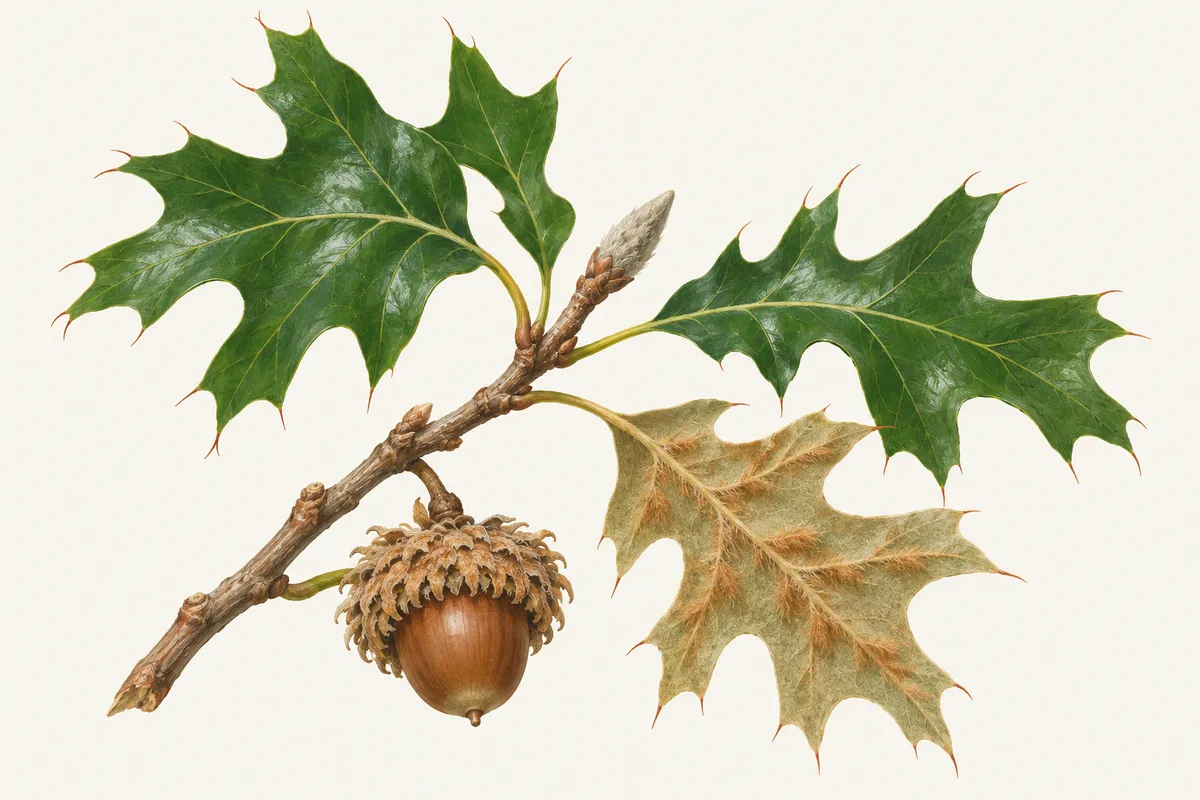
Black oak tree identification rests on three checks more than on the leaf. The end buds are large, 1/4 to 1/2 inch, buff-colored, fuzzy and sharply angled. Mature bark is nearly black and blocky, and a shallow cut shows yellow-orange inner bark. The acorn, 1/2 to 3/4 inch long, sits a third to half deep in a bowl of loose, fuzzy, light-brown scales.
- Black oak is in the red oak group: bristle-tipped lobes and acorns that take two seasons to ripen.
- Leaves vary from deeply cut in the sun to barely lobed in the shade, so judge buds and acorn caps rather than one leaf.
- Fuzzy, buff, angled end buds are the field mark Virginia Tech's description makes unique among the common red oaks.
Field marks at a glance
- Scientific name
- Quercus velutina
- Family
- Fagaceae (beech family)
- Type
- Broadleaf, deciduous
- Leaves
- Alternate, simple, 4 to 10 inches long, with 5 (mostly) to 7 bristle-tipped lobes. Sun leaves are deeply cut, shade leaves only shallowly. Glossy green above; paler below with scruffy hairs and tufts in the vein angles.
- Buds
- End buds clustered, 1/4 to 1/2 inch long, buff-colored, fuzzy, pointed and distinctly angled: the best single mark.
- Acorns
- Egg-shaped, 1/2 to 3/4 inch long, a third to half enclosed in a bowl-shaped cap of loose, light-brown, fuzzy scales, loosest at the rim. Ripen in late summer and fall of the second year.
- Bark
- Smooth and gray when young; then thick, rough, nearly black, deeply furrowed with horizontal breaks. The inner bark is yellow-orange and very bitter.
- Twigs
- Stout, red-brown to gray-green, usually hairless; fast-growing shoots may be hairy.
- Form and size
- Medium-sized, to about 80 ft, with an irregular crown and a tapering, rather limby trunk. Most mature trees are 60 to 80 ft tall and 24 to 36 in across.
- Range
- Southwestern Maine west through New York and extreme southern Ontario to southeastern Minnesota and Iowa, south to eastern Texas, east to northwestern Florida and Georgia.
- Fall color
- Yellow to yellow-brown according to the Morton Arboretum; not one of the bright red oaks.
Black oak is the dry-site red oak of the eastern United States, common on ridges and upper slopes from Maine to Texas. It is also one of the hardest red oaks to name from a leaf, because its leaves change shape with light: deeply cut in the sun, nearly plain in the shade. The good news is that its buds and bark carry marks no other common oak shares. Never eat a nut, seed or fruit on the strength of a web page or an app; check with a local expert.
How to identify a black oak, step by step
Work through these in order. Descriptions and measurements are from Virginia Tech Dendrology's black oak fact sheet unless another source is named.
- Confirm the red oak group. Each lobe ends in a fine bristle, and a summer twig carries two sizes of acorn, because red oak group acorns take two seasons to ripen. Rounded lobes without bristles mean a white oak instead; red oak vs white oak covers that split.
- End buds. At the twig tip, look for a cluster of large buds, 1/4 to 1/2 inch long, buff-colored, covered in fuzz, pointed and distinctly angled, with ridges running along their length. This one check separates black oak from northern red, scarlet and southern red oak, whose buds are smaller, darker or only partly hairy.
- Leaf underside. Leaves are 4 to 10 inches long, mostly with 5 lobes, sometimes 7. Turn one over: black oak's underside is paler, with a scruffy coat of hairs and small tufts where the veins meet the midrib. The upper surface is glossy.
- Acorn cap. The acorn is egg-shaped, 1/2 to 3/4 inch long, a third to half enclosed in a bowl-shaped cap. The cap scales are light brown, fuzzy and loosely pressed, loosest at the rim, so the edge looks ragged. The Morton Arboretum's black oak page calls the cap slightly fringed.
- Bark and inner bark. Mature bark is thick, rough and nearly black, cut by deep vertical furrows with horizontal breaks. On a fallen branch or a stump, the inner bark shows yellow-orange.
Two of these, usually buds plus acorn cap, are enough. Tree Identifier can name a tree from one photo of a leaf, a bud cluster, an acorn or the bark; in the red oak group, take a second photo of the buds or an acorn cap and check the name against the steps above.
Leaves that change with the light
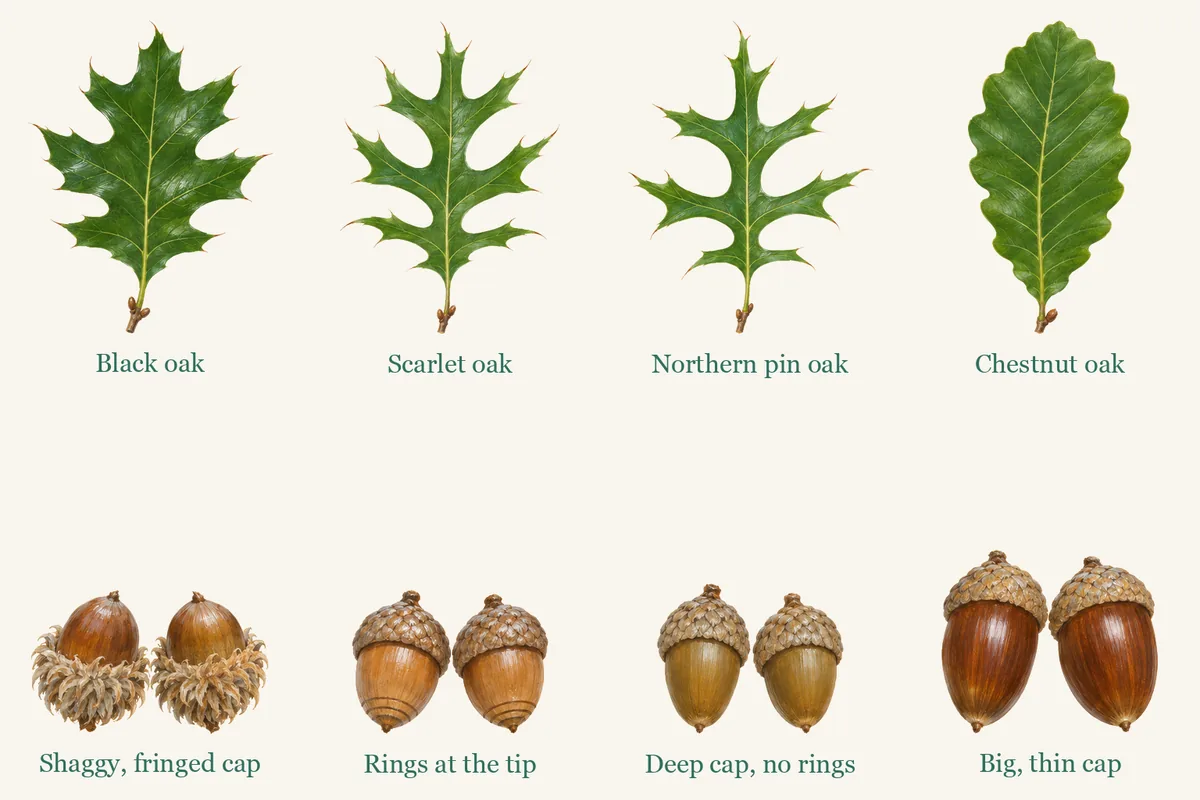
The black oak leaf is variable, and that is a field mark in itself. Virginia Tech describes sun leaves with deep sinuses and shade leaves with very shallow ones, on the same tree. A leaf from the lower, shaded crown can look broad and only shallowly lobed, while a leaf from the sunny top can be cut nearly as deeply as a scarlet oak's.
Two traits stay the same on both kinds: the glossy upper side and the scruffy hairs and vein-angle tufts underneath. Pick several leaves from different heights, rub the underside with a thumb, and look for those hairs. The Morton Arboretum gives a fall color of yellow to yellow-brown, so a red oak that turns brilliant red is more likely to be scarlet or northern red oak.
Black oak vs northern red, scarlet and southern red oak
Virginia Tech lists northern red oak, scarlet oak, northern pin oak and southern red oak as black oak's look-alikes. Figures come from the Virginia Tech fact sheets for northern red oak, scarlet oak and southern red oak.
| Mark | Black oak | Northern red oak | Scarlet oak | Southern red oak |
|---|---|---|---|---|
| End buds | 1/4–1/2 in, buff, fuzzy, angled | Large, conical, red-brown, mostly hairless | Reddish, plump, hairy on upper half | 1/8–1/4 in, dark red-brown, hairy |
| Leaf underside | Scruffy hairs, vein tufts | Hairless | Hairless, maybe vein tufts | Fuzzy |
| Acorn cap | Bowl, 1/3–1/2 of nut, loose fuzzy scales | Flat beret, 1/4 or less | Bowl, about 1/2, shiny tight scales | Thin, flat, under 1/3 |
| Inner bark | Yellow-orange | Not yellow | Reddish to orangish (NC State) | Slightly yellow |
The scarlet oak inner-bark color is from NC State Extension's scarlet oak profile. For northern red oak's full profile, see the red oak page; scarlet oak's own page is scarlet oak. Deeply cut leaves and a narrow pyramid shape point instead to pin oak.
Where black oak grows
The USDA Forest Service's Silvics of North America gives the range: southwestern Maine west through New York to extreme southern Ontario, southeastern Minnesota and Iowa; south through eastern Nebraska, eastern Kansas and central Oklahoma to eastern Texas; and east to northwestern Florida and Georgia. It climbs to 4,000 feet (1,200 m) in the southern Appalachians.
It grows on many sites but is typical of dry ground: the Morton Arboretum says it is commonly found on dry sites, and the Forest Service notes that it seldom lives past 200 years on poor, dry hillsides. Its best growth is on well-drained silty clay to loam in coves and on middle and lower slopes facing north or east. It often shares a stand with white oak and northern red oak, and dry ridges with post oak.
The Forest Service adds a regional detail useful for identification: northern trees have smaller acorns with less cap cover, paler yellow inner bark and smaller winter buds than southern trees. A northern black oak's buds can sit at the small end of the 1/4 to 1/2 inch range.
Acorns, age and wildlife
Black oak begins bearing acorns at about 20 years in forest stands, bears most heavily between 40 and 75, and has good crops every 2 to 3 years, per the Forest Service. Acorns ripen from late August to late October in their second season, depending on location. Squirrels, white-tailed deer, mice, voles, turkeys and other birds eat them, and blue jays carry them the farthest.
Most mature trees reach 60 to 80 feet and 24 to 36 inches in diameter, with the largest trees on the best sites reaching 150 feet. The tree age calculator gives a rough age from trunk circumference. For acorns found on the ground with no leaves nearby, the acorn identification guide keys them by cap, size and stalk, and the oak identification page sorts all the common oaks into their groups.
With location turned on, Tree Identifier's Tree Map pins each find, which helps when you want to come back in fall for an acorn cap or in winter for the buds.
Look-alikes and how to tell them apart
Northern red oak (Quercus rubra)
Northern red oak's end buds are red-brown and mostly hairless, not buff and fuzzy; its leaves are hairless below, and its acorn cap is a flat beret covering a quarter of the nut or less. Its bark shows flat-topped ridges like ski tracks rather than near-black blocks.
Scarlet oak (Quercus coccinea)
Scarlet oak's acorn cap has shiny, tight scales and the nut tip often shows concentric rings; black oak's cap scales are dull, fuzzy and loose at the rim. Scarlet oak's leaves are hairless below and its buds are reddish, hairy only on the upper half.
Southern red oak (Quercus falcata)
Southern red oak often has a long, hooked end lobe like a turkey's foot and a leaf base shaped like a U, with tan fuzz below. Its buds are only 1/8 to 1/4 inch, dark red-brown, and its inner bark is only slightly yellow. Its acorn cap is thin and flat.
What a photo can't settle
- Black oak hybridizes readily with other red oaks; the USDA Forest Service recognizes 13 named hybrids, among them one with scarlet oak. A hybrid can mix the bud, leaf and acorn marks.
- Shade leaves are barely lobed and sun leaves deeply cut, so a photo of one leaf can point to the wrong red oak. Add a bud or an acorn cap.
- A photo app, Tree Identifier included, returns one name with no confidence score and no list of alternatives. The inner-bark test needs a knife and the tree owner's permission; nothing on a screen replaces it.
Questions people ask
Why is it called black oak?
For the bark. Virginia Tech describes mature black oak bark as thick, very rough and nearly black, deeply furrowed with horizontal breaks. The inner bark, by contrast, is yellow-orange, which gave the tree its other names: the USDA Forest Service lists yellow oak, quercitron and yellowbark oak.
How do you tell black oak from northern red oak?
Look at the end buds and the leaf underside. Black oak's buds are 1/4 to 1/2 inch, buff and fuzzy, and its leaves carry scruffy hairs below. Northern red oak's buds are red-brown and mostly hairless and its leaves are hairless below. Acorn caps differ too: a fuzzy bowl on black oak, a flat beret on red oak.
How big does a black oak get?
The USDA Forest Service gives 60 to 80 feet tall and 24 to 36 inches in diameter for most mature trees, up to 150 feet and 48 inches on the best sites. The Morton Arboretum gives 50 to 60 feet tall and 40 to 70 feet wide for planted trees.
How long does a black oak live?
The USDA Forest Service says black oak reaches physiological maturity at about 100 years, some trees live 150 to 200 years, and on poor, dry hillsides it seldom lives past 200. It starts bearing acorns at about 20 years, bears best from 40 to 75, and has good crops every 2 to 3 years.
Sources
- Black oak fact sheet — Virginia Tech Dendrology
- Black Oak (Quercus velutina), Silvics of North America — USDA Forest Service
- Black oak (Quercus velutina) — The Morton Arboretum
- Northern red oak fact sheet — Virginia Tech Dendrology
- Scarlet oak fact sheet — Virginia Tech Dendrology
- Southern red oak fact sheet — Virginia Tech Dendrology
Keep reading
- Tree profileOak trees (Quercus): how to identify them
- Tree profileNorthern red oak (Quercus rubra): how to identify it
- Tree profilePin oak (Quercus palustris): how to identify it
- Clue guideAcorn identification: which oak dropped this acorn?
- Tree comparisonRed oak vs white oak trees: how to tell the living trees apart