Tree profile
Scarlet oak (Quercus coccinea): how to identify it
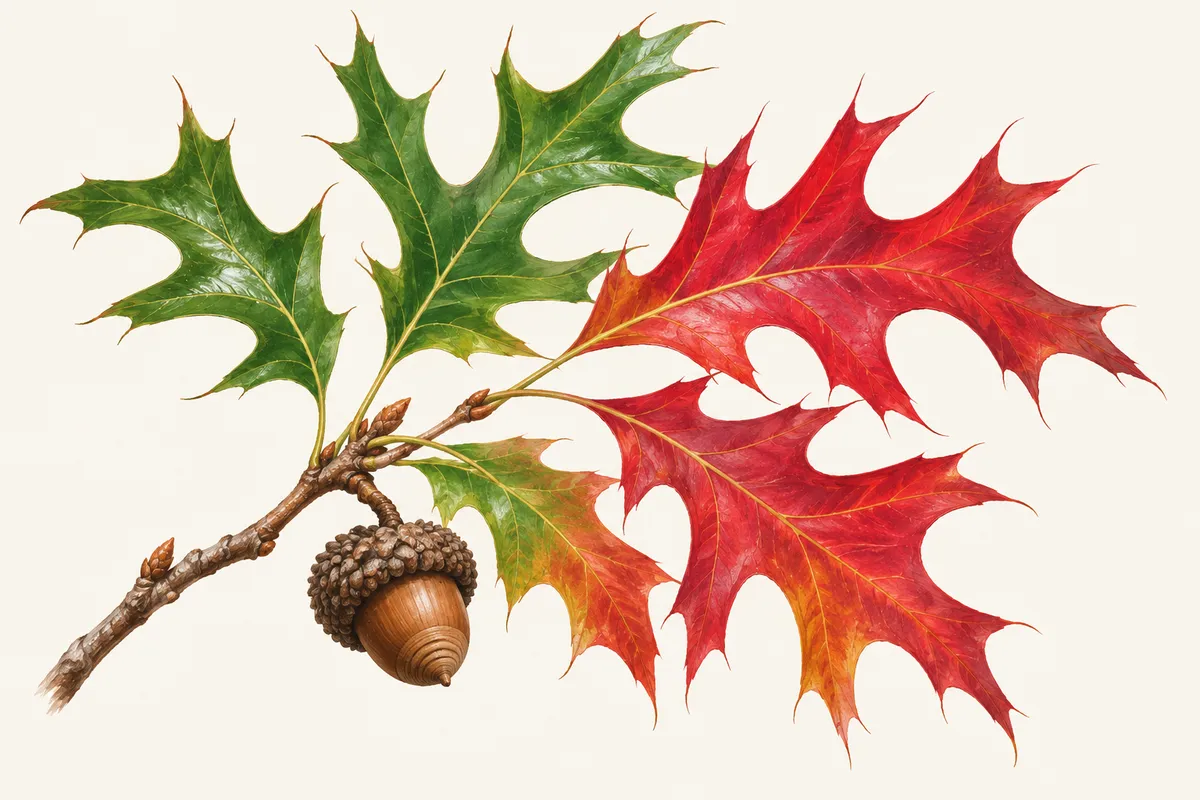
A dry-ridge red oak with leaves cut almost to the midrib, an acorn half hidden in a shiny cap, and brilliant scarlet fall color.
In short
Scarlet oak identification starts with a glossy leaf 3 to 7 inches long, cut by very deep, C-shaped sinuses into bristle-tipped lobes and hairless below. The acorn, 1/2 to 1 inch long, sits about halfway in a bowl of shiny, tight scales, and its tip often shows concentric rings. Older trunks often swell at the base, and the leaves turn bright scarlet late in fall.
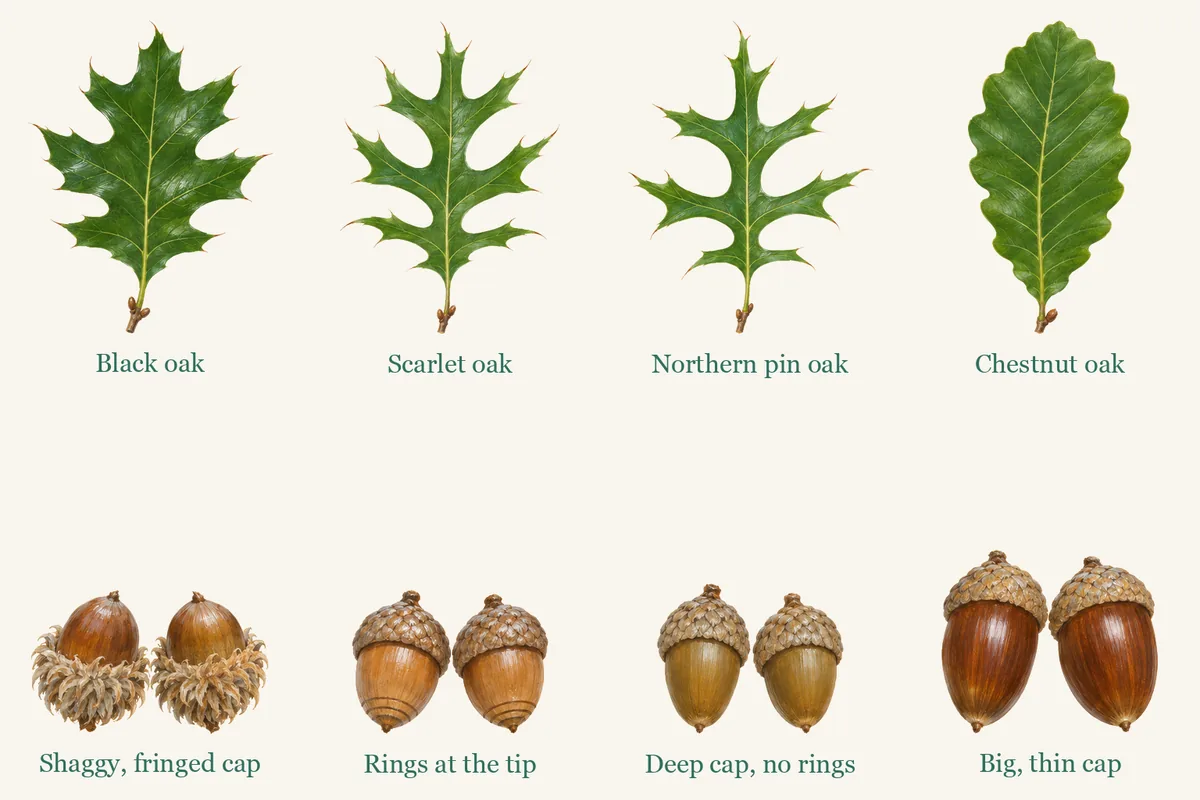
- Pin oak is the classic look-alike: check the acorn cap (half the nut on scarlet oak, a thin saucer on pin oak) and the sinus shape (C on scarlet, U on pin).
- Concentric rings or fine cracks at the acorn tip are a scarlet oak mark.
- Scarlet oak buds are reddish and hairy only on their upper half; black oak buds are buff and fuzzy all over.
Field marks at a glance
- Scientific name
- Quercus coccinea
- Family
- Fagaceae (beech family)
- Type
- Broadleaf, deciduous
- Leaves
- Alternate, simple, 3 to 7 inches long, oval in outline with very deep sinuses and bristle-tipped lobes, usually 7. Shiny green above, paler and generally hairless below, sometimes with tufts in the vein angles.
- Sinuses
- Rounded and C-shaped, cutting most of the way to the midrib (NC State); pin oak's are U-shaped.
- Acorns
- 1/2 to 1 inch long; the cap covers about half the nut, with shiny, tight scales like a varnished black oak cap. The tip often shows concentric rings or fine cracks. Ripens in fall of the second year.
- Buds
- Clustered at the twig tip, reddish brown, plump, pointed and slightly angled, with pale hairs on the upper half only.
- Bark
- Gray-brown with smooth streaks on young trees; later darker with irregular broad ridges and narrow furrows, especially near the base. Inner bark reddish to orangish (NC State).
- Form
- Medium-sized, up to about 80 ft, often with an irregular crown and many dead branches; a swollen trunk base (butt swell) is common and helps identification.
- Fall color
- Bright scarlet, late in the season.
- Range
- Southwestern Maine west to New York, Ohio, southern Michigan and Indiana; south to southern Illinois, southeastern Missouri and central Mississippi; east to southern Alabama and southwestern Georgia; north along the inner Coastal Plain to Virginia.
Scarlet oak is the red oak of dry, sandy and gravelly ridges in the eastern United States, and the one people notice in late fall, when its crown turns bright red after most maples are bare. In summer it is easy to confuse with pin oak, because both have leaves cut almost to the midrib. The acorn and the buds separate them reliably. Never eat a nut, seed or fruit on the strength of a web page or an app; check with a local expert.
How to identify a scarlet oak, step by step
Descriptions and measurements come from Virginia Tech Dendrology's scarlet oak fact sheet unless another source is named.
- Bristle tips and deep sinuses. The leaf is 3 to 7 inches long, oval in outline, with bristle-tipped lobes and very deep sinuses. NC State Extension's scarlet oak profile describes the sinuses as C-shaped: rounded at the bottom and opening out, so each gap looks like a letter C.
- Gloss and underside. The upper surface is shiny green; the underside is paler and generally hairless, sometimes with small tufts where the veins meet the midrib.
- Acorn. The acorn is 1/2 to 1 inch long, and the cap covers about half of it. Virginia Tech compares the cap scales to a varnished black oak cap: shiny, with the scales at the rim generally pressed down rather than loose. Look at the acorn's tip: it often carries concentric rings or fine cracks.
- Buds. In winter, the end buds are reddish brown, plump, pointed and slightly angled, with pale hairs on the upper half only.
- Trunk and crown. Older trees often have a noticeable swelling at the base of the trunk, which Virginia Tech calls useful in identification. Forest trees often have an irregular crown with many dead branches.
The acorn test is the strongest single check. Tree Identifier can put a name on a photo of a leaf, a bud cluster or an acorn; inside the red oak group, photograph an acorn with its cap and compare the name with the steps above.
Scarlet oak vs pin oak, black oak and northern red oak
Virginia Tech lists pin oak, black oak, northern red oak and northern pin oak as scarlet oak's look-alikes. The figures below come from the Virginia Tech fact sheets for pin oak, black oak and northern red oak.
| Mark | Scarlet oak | Pin oak | Black oak | Northern red oak |
|---|---|---|---|---|
| Leaf | 3–7 in, very deep C-shaped sinuses, glossy | 3–6 in, 5–9 lobes, U-shaped sinuses nearly to the midrib | 4–10 in, mostly 5–7 lobes, sun leaves deep, shade leaves shallow | 5–8 in, 7–11 lobes, sinuses 1/3–1/2 of the way in |
| Underside | Hairless, maybe vein tufts | Pale, vein tufts | Scruffy hairs, vein tufts | Hairless |
| Acorn cap | Covers about 1/2, shiny tight scales | Thin saucer | Bowl, 1/3–1/2, loose fuzzy scales | Flat beret, 1/4 or less |
| Acorn tip | Often concentric rings | Striped nut | Plain | Plain |
| Buds | Reddish, hairy on upper half | Small, chestnut brown, hairless | 1/4–1/2 in, buff, fuzzy all over | Large, red-brown, mostly hairless |
Pin oak has its own page, pin oak, which covers its pyramid shape and drooping lower limbs. Black oak's fuzzy buds and yellow-orange inner bark are on the black oak page, and northern red oak's beret cap and ski-track bark on the red oak page. A southern look-alike with glossy, deeply cut leaves is Shumard oak, whose acorn, 3/4 to 1 1/4 inches, sits in a shallow cap covering less than a third, per Virginia Tech's Shumard oak fact sheet.
Fall color
Scarlet oak is known for brilliant scarlet fall color. NC State describes its fall color as scarlet, showy and late in the season, and the USDA Forest Service's Silvics of North America names its brilliant autumn color, open crown texture and rapid growth as the reasons it is widely planted as a shade and ornamental tree in the United States and Europe.
Because it colors late, a bright red oak late in the season is a good scarlet oak candidate; confirm with the acorn. The guide to trees with red leaves in fall compares it with red maple, black gum, sourwood and the other red oaks.
Where scarlet oak grows
The Forest Service gives the range: southwestern Maine west to New York, Ohio, southern Michigan and Indiana; south to southern Illinois, southeastern Missouri and central Mississippi; east to southern Alabama and southwestern Georgia; and north along the western edge of the Coastal Plain to Virginia. It is common on light sandy and gravelly upland ridges and slopes, and reaches about 5,000 feet (1,520 m) in the southern Appalachians, though it is most common below 3,000 feet.
NC State lists it for USDA hardiness zones 4a to 9b and notes that, unlike pin oak, it is less prone to yellowing (chlorosis) on alkaline soils. That difference matters in towns: both trees are planted along streets, but a deeply cut red oak on a dry, sandy ridge is far more likely to be scarlet oak than pin oak, which the USDA Forest Service's pin oak silvics places mainly on level, poorly drained floodplain and river-bottom soils.
Size, acorns and wildlife
The Forest Service says scarlet oak normally matures at 60 to 80 feet tall and 24 to 36 inches in diameter, at most about 100 feet and 48 inches. It is very intolerant of shade and has a taproot with relatively few lateral roots, which makes it hard to transplant. Its thin bark leaves it very susceptible to fire damage.
It bears acorns from about 20 years of age, most heavily after 50, with good crops every 3 to 5 years; acorns take two growing seasons to ripen. Eastern gray squirrels, chipmunks, mice, wild turkeys, deer and birds, especially blue jays and red-headed woodpeckers, eat them. For the other oaks in the same woods, the oak identification page has acorn and leaf tables for both oak groups.
With location turned on, Tree Identifier's Tree Map pins each find, so you can return in late fall to see whether a deeply lobed oak really turns scarlet.
Look-alikes and how to tell them apart
Pin oak (Quercus palustris)
Pin oak's acorn is about 1/2 inch, striped, under a thin saucer cap; scarlet oak's cap covers about half the nut. Pin oak's sinuses form a U, its buds are small and chestnut brown without hairs, and it is a narrow pyramid with drooping lower branches, usually on wet ground.
Black oak (Quercus velutina)
Black oak's end buds are buff, fuzzy all over and 1/4 to 1/2 inch long; its leaves have scruffy hairs below; its acorn cap scales are dull, fuzzy and loose at the rim. Scarlet oak's cap is shiny and tight, and its leaves are hairless below.
Northern red oak (Quercus rubra)
Northern red oak's sinuses reach only a third to half of the way to the midvein, and its acorn sits under a flat beret cap covering a quarter of the nut or less. Scarlet oak's sinuses cut most of the way in and its cap covers about half.
Shumard oak (Quercus shumardii)
Shumard oak's acorn is larger, 3/4 to 1 1/4 inches, under a shallow cap covering less than a third. Its buds are grayish brown and smooth or slightly fuzzy. It is a large southern tree of stream terraces, often over 100 feet tall.
What a photo can't settle
- Scarlet oak hybridizes with black oak, bear oak and pin oak (USDA Forest Service), and a hybrid can blur the cap and sinus marks.
- Shade leaves and sprout leaves are less deeply cut; judge sinus depth on sunlit leaves from the outer crown.
- A photo app, Tree Identifier included, returns one name with no confidence score and no list of alternatives. For scarlet oak vs pin oak, photograph an acorn with its cap as well as a leaf.
Questions people ask
How do you tell scarlet oak from pin oak?
Use the acorn. Scarlet oak's cap covers about half the nut, with shiny scales and often rings at the tip; pin oak's is a thin saucer on a striped acorn about 1/2 inch long. NC State adds that scarlet oak's sinuses are C-shaped and pin oak's U-shaped, and pin oak's buds are hairless.
When does scarlet oak turn red?
Late. NC State describes the fall color as scarlet, showy and late in the season, and the USDA Forest Service names its brilliant autumn color as one reason it is planted.
Where does scarlet oak grow?
On dry ground in the eastern United States. The USDA Forest Service describes it as common on light sandy and gravelly upland ridges and slopes, from southwestern Maine to southern Michigan and south to Mississippi, Alabama and Georgia, up to about 5,000 feet in the southern Appalachians.
How big does a scarlet oak get?
The USDA Forest Service says it normally matures at 60 to 80 feet tall and 24 to 36 inches in diameter, reaching about 100 feet and 48 inches at most. NC State gives 50 to 80 feet tall and 45 to 60 feet wide for planted trees.
Sources
- Scarlet oak fact sheet — Virginia Tech Dendrology
- Scarlet Oak (Quercus coccinea), Silvics of North America — USDA Forest Service
- Quercus coccinea (scarlet oak) — North Carolina Extension Gardener Plant Toolbox, NC State University
- Pin oak fact sheet — Virginia Tech Dendrology
- Black oak fact sheet — Virginia Tech Dendrology
- Pin Oak (Quercus palustris), Silvics of North America — USDA Forest Service
- Shumard oak fact sheet — Virginia Tech Dendrology
Keep reading
- Tree profilePin oak (Quercus palustris): how to identify it
- Tree profileOak trees (Quercus): how to identify them
- Clue guideWhich trees have red leaves in fall? Sort them by leaf shape
- Tree profileNorthern red oak (Quercus rubra): how to identify it
- Tree profileBlack oak (Quercus velutina): how to identify it