Tree profile
Chestnut oak (Quercus montana): how to identify it
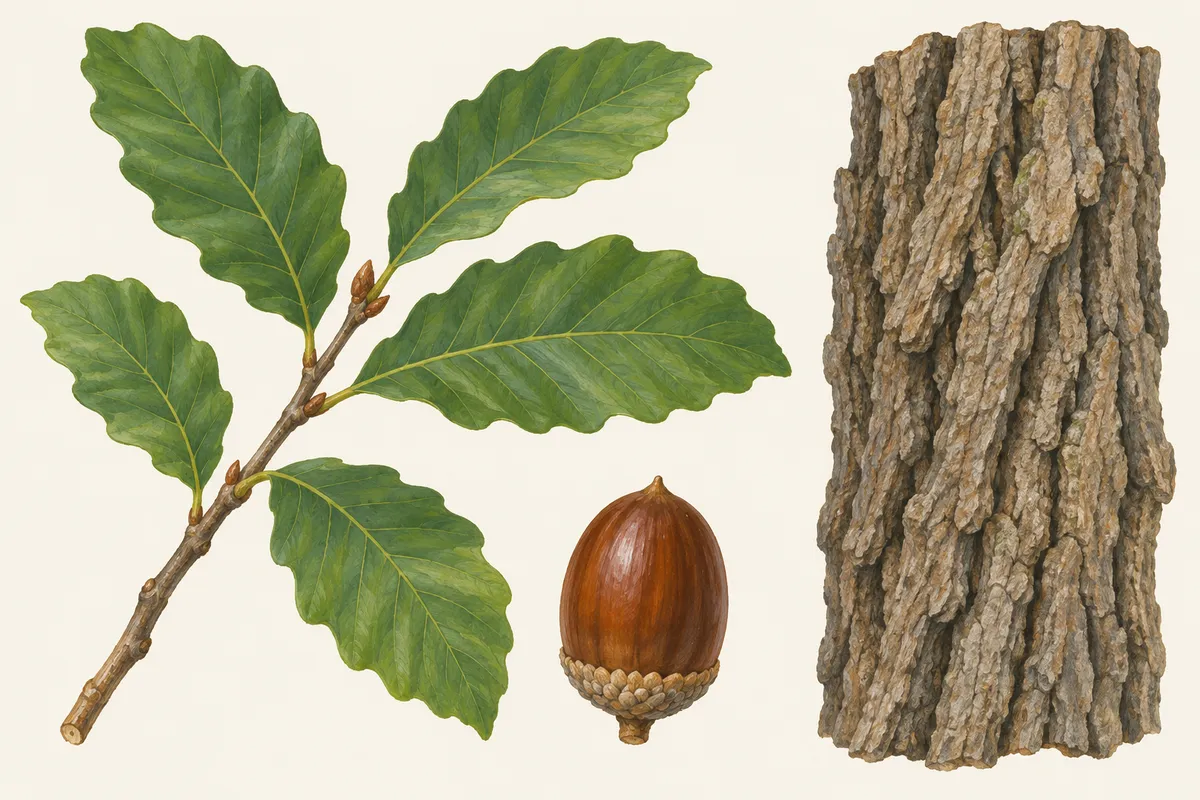
The oak of dry, rocky Appalachian ridges: leaves with rounded wavy teeth instead of lobes, acorns 1 to 1 1/2 inches long and bark in massive, deep ridges.
In short
Chestnut oak identification rests on three marks. The leaves are 4 to 8 inches long, unlobed, with a wavy edge of rounded teeth and no bristles. The acorns are large, 1 to 1 1/2 inches long, in a thin warty cap covering about a third of the nut. And old trunks carry thick, dark bark split into deep, hard ridges, the thickest bark of any native eastern oak.
- Chestnut oak is in the white oak group: no bristle tips on the leaf teeth, and acorns that ripen in a single season.
- On a dry, rocky ridgetop in the Appalachians, an oak with toothed, unlobed leaves and deeply ridged bark is most likely chestnut oak.
- Its look-alikes, chinkapin oak and swamp chestnut oak, differ in bark and habitat more than in leaf shape.
Field marks at a glance
- Scientific name
- Quercus montana (formerly Quercus prinus)
- Family
- Fagaceae (beech family)
- Type
- Broadleaf, deciduous
- Leaves
- Alternate, simple, unlobed, oval to obovate, 4 to 6 inches (Virginia Tech) or 4 to 8 inches (NC State) long; edge of rounded, wavy teeth with no bristles; leathery, shiny dark green above, paler, gray-green and hairy below.
- Acorns
- 1 to 1 1/2 inches long, oval, glossy brown, in a thin, warty, teacup-shaped cap of fused reddish-brown scales covering about 1/3 of the nut; single or in pairs, stalkless or nearly so; ripen in one season.
- Bark
- Smooth gray-brown on young stems; on old trees dark reddish-brown, very thick, cut into deep furrows between broad, hard ridges like an alligator's back.
- Twigs and buds
- Twigs orange-brown to gray and hairless; end buds clustered, chestnut brown, long and pointed.
- Fall color
- Reddish-yellow to brown, not showy (NC State).
- Size and form
- Usually 65 to 80 ft tall and 20 to 30 in across (USDA Forest Service), up to about 100 ft; on dry ridgetops much smaller, with a crooked trunk.
- Range
- Southwestern Maine west through New York to extreme southern Ontario and southeastern Michigan, south to northeastern Mississippi, central Alabama and Georgia, mostly west of the Coastal Plain.
- Habitat
- Dry ridgetops, upper slopes and rocky or sandy soils, from near sea level to about 4,600 ft in the southern Appalachians; best growth on rich, well-drained soil along streams.
Chestnut oak is the oak of the dry Appalachian ridgetop: shallow, rocky soil, south- and west-facing slopes, and trees that look stunted next to the oaks in the valley. Its leaves are not lobed like most oaks', which throws off anyone who expects an oak leaf to look like the classic outline. Instead the edge rolls in shallow, rounded waves, close enough to a chestnut leaf to give the tree its name. Three marks settle it: the wavy-toothed leaf, a large acorn and very thick, deeply ridged bark.
How to identify a chestnut oak
1. An unlobed leaf with rounded teeth. The Virginia Tech chestnut oak fact sheet describes simple, alternate leaves 4 to 6 inches long, shiny green above and paler below, with a scalloped edge of rounded teeth. NC State Extension gives 4 to 8 inches, calls them coarsely toothed ("some say shallowly lobed"), leathery, and gray-green and hairy underneath. Run a finger along the edge: there are no bristles.
2. A big acorn in a thin cap. Virginia Tech gives an acorn 1 to 1 1/2 inches long in a thin, warty cap shaped like a teacup; the nut separates from the cap when ripe. NC State describes the cap as reddish brown, of fused scales, covering about a third of the nut, with acorns single or in pairs and stalkless or nearly so. Few eastern oaks drop an acorn this large on dry ground.
3. The bark. Young stems are smooth and gray-brown. With age the bark grows into hard ridges that thicken and sharpen, which Virginia Tech compares to an alligator's back. NC State calls it dark reddish-brown and the thickest bark of the native oaks, deeply divided into broad ridges. On a mature trunk this is the fastest field mark.
4. Twigs and buds. Twigs are orange-brown to gray and hairless, with a cluster of long, pointed, chestnut-brown buds at the tip (Virginia Tech).
5. The site. The USDA Forest Service's Silvics of North America says chestnut oak is most common on ridgetops, upper slopes, south- and west-facing slopes and shallow, sandy or rocky soils. An oak with toothed, unlobed leaves on such a ridge is a strong lead before you check anything else.
Tree Identifier can name a chestnut oak from one photo of a leaf, an acorn or the bark. It shows a single name with no confidence score and no list of look-alikes, so run the bark and site checks above before you settle on it.
Chestnut oak vs chinkapin oak and swamp chestnut oak
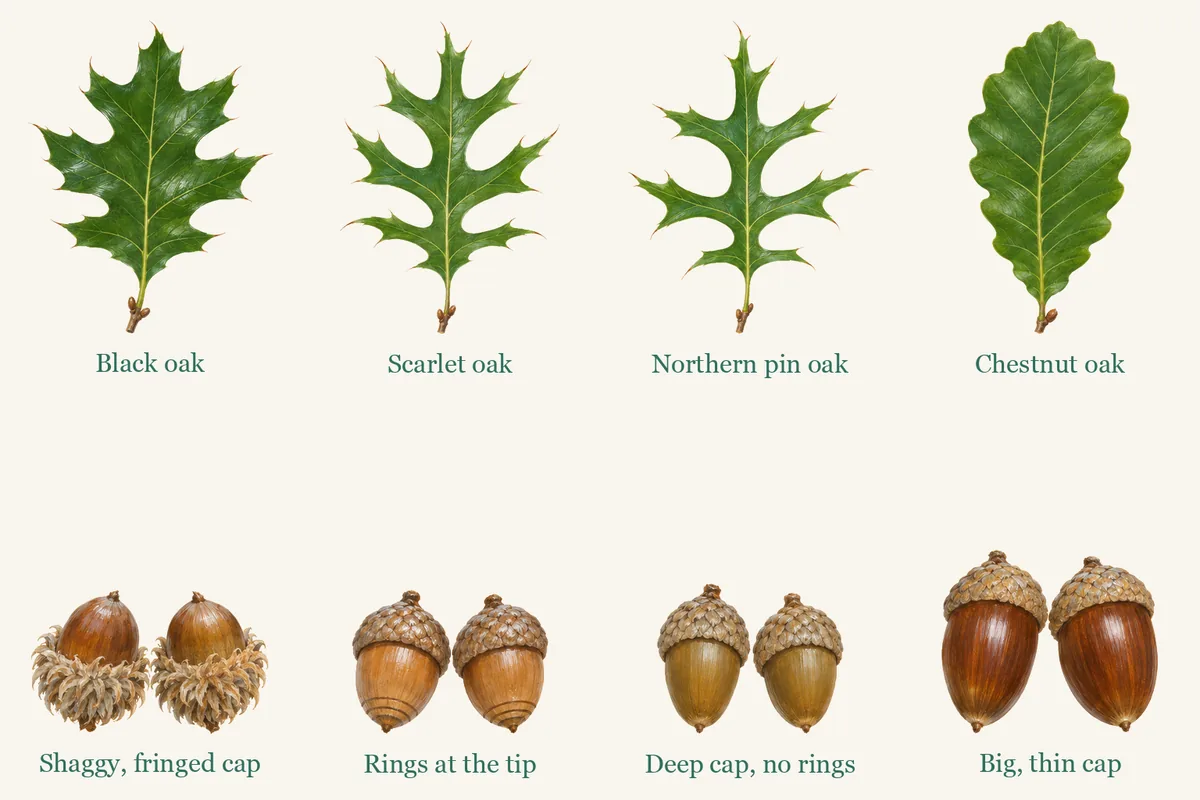
Virginia Tech lists chinkapin oak, swamp white oak, swamp chestnut oak and dwarf chinquapin oak as chestnut oak's look-alikes. All are white oaks with toothed, unlobed leaves. The figures below come from the Virginia Tech fact sheets for chinkapin oak, swamp chestnut oak and chestnut oak.
| Mark | Chestnut oak | Chinkapin oak | Swamp chestnut oak |
|---|---|---|---|
| Leaf | 4–6 in, rounded wavy teeth | 4–7 in, coarse teeth each tipped by a gland | 4–8 in long, 3–5 in wide, large rounded blunt teeth |
| Acorn | 1–1 1/2 in, thin warty teacup cap | 1/2–1 in, thin bowl cap with a tattered fringe | 1–1 1/2 in, rough scaly cap over about 1/3 |
| Bark | Very thick, deep hard ridges | Thin, light gray, rough and flaky | Ashy gray and scaly, like white oak |
| Site | Dry ridges and rocky slopes | Not stated | Southeastern bottomlands, swamp borders |
The leaf alone is a weak test between chestnut oak and swamp chestnut oak; the bark and the ground under your feet are better. Virginia Tech's landowner sheet places swamp chestnut oak on bottomlands that flood for short periods, such as swamp borders and river floodplains, the opposite of chestnut oak's dry ridges.
The chestnut vs buckeye page covers the American chestnut, whose fruit is a spiny bur; The American Chestnut Foundation describes its leaf teeth as each ending in a bristle that curves inward like a breaking wave. The oak identification page explains the white oak and red oak groups.
Acorns: early, big and irregular
Chestnut oak acorns ripen in one growing season. The Forest Service says they drop from early September to early October, 2 to 5 weeks before other upland oaks, and that heavy crops come only every 4 or 5 years; the tree generally produces fewer acorns than other upland oaks. Trees start bearing at about 20 years, and sprouts from stumps as young as 3 years can produce viable seed. Deer, turkeys, squirrels, chipmunks and mice eat the acorns.
Because the acorn is large and stalkless with a thin cap, it is easy to tell from a white oak acorn, which is smaller and sits in a warty bowl. The acorn identification guide keys loose acorns by cap, size and stalk. NC State lists chestnut oak acorns and leaves as low-severity toxic, a problem for horses in particular; it is not a page about eating acorns.
Where chestnut oak grows
The Forest Service range runs from southwestern Maine west through New York to extreme southern Ontario, southeastern Michigan, southern Indiana and Illinois, south to northeastern Mississippi, east to central Alabama and Georgia, and north to Delaware, mostly west of the Coastal Plain. It grows from near sea level on the Coastal Plain of New Jersey and Long Island to about 4,600 feet in the southern Appalachians, and grows best in the mountains of the Carolinas and Tennessee.
Its neighbors on the ridges include other upland oaks and hickories, sweet birch, blackgum, red maple and pines such as pitch, Table Mountain and Virginia pine, with mountain-laurel and blueberries underneath. The Appalachian tree identification guide walks through the ridge, slope and cove forests where it grows.
Size, sprouting and hybrids
The Forest Service gives a usual height of 65 to 80 feet and a trunk 20 to 30 inches across, depending on site, with a maximum around 100 feet and 72 inches. On dry ridgetops Virginia Tech notes a much smaller tree with a crooked stem; on good sites, a straight trunk and narrow crown. It is a long-lived tree.
Chestnut oak sprouts vigorously after cutting or top dieback, and the Forest Service estimates that 75 percent of chestnut oak reproduction in the southern Appalachians comes from sprouts. Several stems rising from one old stump are a common sight on logged ridges.
The same source names hybrids with white oak (Quercus × saulii), swamp white oak, English oak and post oak. A tree with chestnut oak bark but shallow lobes on its leaves may be one of them; collect several sun leaves before deciding. With location turned on, Tree Identifier's Tree Map pins the find, so you can return in September, when the acorns fall early and the cap shape is easy to check.
Look-alikes and how to tell them apart
Chinkapin oak (Quercus muehlenbergii)
Chinkapin oak leaves are narrower, 4 to 7 inches long, with sharper coarse teeth, each tipped by a small gland. Its acorn is smaller, 1/2 to 1 inch, and its bark is thin, light gray and flaky. Chestnut oak's bark is thick and deeply ridged, and its teeth are rounded.
Swamp chestnut oak (Quercus michauxii)
The leaf is nearly the same: 4 to 8 inches, wide, with large rounded teeth. Look at the bark and the ground: swamp chestnut oak has ashy gray, scaly bark like a white oak and grows on southeastern bottomlands and swamp borders, not on dry ridges.
American chestnut (Castanea dentata)
The American Chestnut Foundation describes chestnut leaves as long and narrow, thin and papery, each large tooth ending in a bristle that curves inward like a breaking wave. Chestnut oak's teeth are rounded with no bristle, and it bears acorns, not spiny burs.
Swamp white oak (Quercus bicolor)
Swamp white oak leaves have large, blunt teeth too, but Virginia Tech describes the underside as very pale, and its acorns grow singly or in pairs on a stalk about 2 inches long. Chestnut oak acorns sit stalkless or nearly so.
What a photo can't settle
- Chestnut oak hybridizes with white oak, swamp white oak, post oak and English oak (USDA Forest Service), and a hybrid can carry lobes or leaf hairs from the other parent.
- Chestnut oak, swamp chestnut oak and chinkapin oak share a toothed, unlobed leaf. One photo of one leaf rarely separates them, and Tree Identifier shows one name with no list of alternatives, so check the bark and the site too.
- Young trees lack the deep ridged bark, so the bark test works only on trunks that have had decades to thicken.
Questions people ask
Why is it called chestnut oak?
Because its leaf looks like a chestnut leaf at a glance: long, unlobed and toothed. Virginia Tech explains the name by the wavy leaf margins, and montana means of the mountains. The resemblance ends at the fruit: chestnut oak bears acorns, the American chestnut spiny burs.
Is chestnut oak a white oak?
It belongs to the white oak group. Its leaf teeth carry no bristles and its acorns ripen in one season, the two group marks. Virginia Tech notes that its lumber is sold and used as white oak, although the species called white oak is Quercus alba.
What is the difference between Quercus montana and Quercus prinus?
They have been used for the same tree. Older references, including the USDA Forest Service's Silvics of North America, call chestnut oak Quercus prinus; Virginia Tech and NC State use Quercus montana, and NC State lists the prinus names as former names of the same tree. Use montana when you look it up today.
When do chestnut oak acorns fall?
Early. The USDA Forest Service says they drop from early September to early October, 2 to 5 weeks before other upland oaks, and that heavy crops come only every 4 or 5 years. Deer, turkeys, squirrels, chipmunks and mice eat them.
Can you identify chestnut oak by its bark alone?
Often, on an old tree. NC State calls its bark the thickest of the native oaks, dark reddish-brown with deep furrows between broad ridges. Young trees have smoother gray-brown bark, so check a leaf or acorn on small stems.
Sources
- Chestnut oak (Quercus montana) fact sheet — Virginia Tech Dendrology
- Chestnut oak, landowner fact sheet — Virginia Tech Dendrology
- Chestnut Oak, Silvics of North America — USDA Forest Service
- Quercus montana (chestnut oak) — North Carolina Extension Gardener Plant Toolbox, NC State University
- Chinkapin oak (Quercus muehlenbergii) fact sheet — Virginia Tech Dendrology
- Swamp chestnut oak (Quercus michauxii) fact sheet — Virginia Tech Dendrology
- Chinese and American Chestnuts — The American Chestnut Foundation
- Swamp chestnut oak, landowner fact sheet — Virginia Tech Dendrology
Keep reading
- Tree profileOak trees (Quercus): how to identify them
- Tree profileWhite oak (Quercus alba): how to identify it
- Tree comparisonChestnut vs buckeye: chestnut tree identification
- Regional guideAppalachian tree identification, from the peaks down to the coves
- Clue guideAcorn identification: which oak dropped this acorn?