Tree profile
Cork oak (Quercus suber): how to identify it
The tree that wine corks come from. Press your thumb into the trunk: no other oak in a British garden or a Californian street has bark that gives.
In short
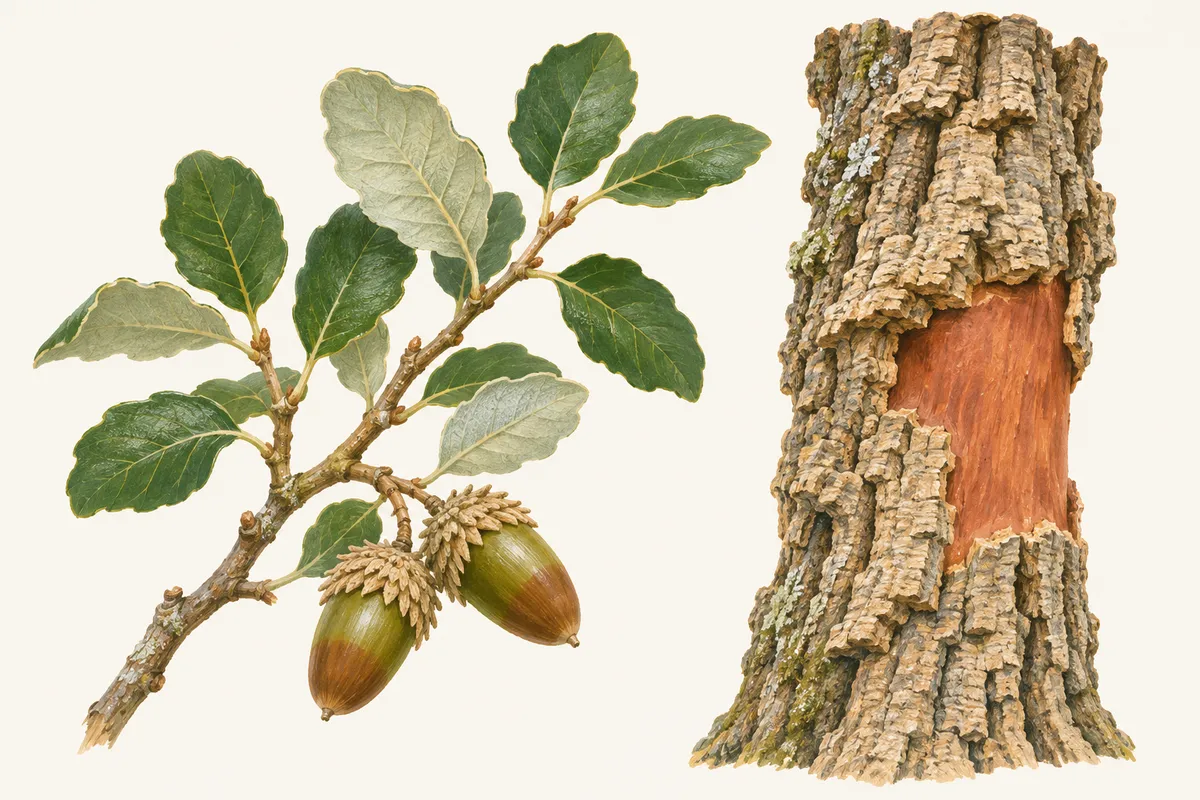
Cork oak identification starts with the trunk: the bark is thick, light grey, craggy and corky, split by deep reddish-brown furrows, and brick red where cork has been stripped. The leaves are evergreen and leathery, about 2 to 3 inches long, glossy dark green above and felted pale beneath with wavy teeth. Long, slender acorns sit in a shaggy, scaly cup.
- Bark you can dent with a fingernail is the one mark that separates cork oak from holm oak, whose leaves are almost the same.
- A trunk that is brick red or reddish-brown below a line and grey above has been stripped of its cork; Portugal forbids stripping the same tree more often than every nine years.
- Cork oak is evergreen and rated hardy through most of the UK by the RHS, so you meet it in British botanic gardens as well as in Mediterranean cork forests.
Field marks at a glance
- Scientific name
- Quercus suber
- Family
- Fagaceae (beech family)
- Type
- Broadleaf, evergreen
- Bark
- Thick and corky, light grey with deep reddish-brown furrows; cork layers measured in inches (Virginia Tech), up to 12 inches thick (NC State). Freshly harvested trunks are brick red (RHS).
- Leaves
- Alternate, simple, evergreen, leathery, ovate to elliptic, 2 to 3 inches (5 to 8 cm) long (Virginia Tech; NC State gives 2 to 4); cupped, dark glossy green above, whitish and fuzzy beneath.
- Leaf edges
- Wavy, with a few sparse teeth, sometimes almost smooth; edges curving downward (NC State).
- Acorns
- Long and slender, 1 to 1.5 inches (2.5 to 4 cm), in a loose, shaggy, scaly cup; Virginia Tech and NC State say the cup covers about half the nut, the RHS less than a third. Ripen in one season, in autumn.
- Twigs and buds
- Light grey-brown twigs with abundant grey fuzz; reddish-brown, broadly triangular, pointed buds in clusters (Virginia Tech).
- Flowers
- Slender yellow-green male catkins 2 to 3 inches long, and tiny female flowers in clusters of 2 to 4 in the leaf axils, in early spring (Virginia Tech).
- Shape and size
- Short trunk, often dividing low, thick branches and a rounded, spreading crown. Up to 65 ft (Virginia Tech); 10 to 15 m in Portuguese cork forests (APCOR); NC State gives 70 to 100 ft.
- Native range
- Western Mediterranean: Portugal, Spain, southern France, Corsica, Sardinia, Sicily, Italy, Morocco, Algeria and Tunisia (NC State).
- In the app's Collection
- Yes: cork oak (Quercus suber) is one of the 138 species in Tree Identifier's Collection.
Cork oak is an evergreen Mediterranean oak grown for its bark, the source of wine corks and cork flooring. In Portugal and Spain it covers whole landscapes; in Britain and the warmer parts of the United States it is a specimen tree in botanic gardens, parks and big private gardens. Its leaves look like a holm oak's, so most people pass it by. The trunk is what gives it away.
How to identify a cork oak
- Press the trunk. The RHS describes the mature bark as craggy, fissured and grey. Virginia Tech Dendrology adds light grey bark with deep reddish-brown furrows and cork layers measured in inches, ruggedly ridged. On an old tree you can press a fingernail or a thumb into it and feel it give, like a wine cork. No other oak you are likely to meet does that.
- Look for a red band. Where cork has been harvested, the RHS says the exposed layer is brick red until new bark forms. A trunk that is red below a certain height and grey above has been stripped.
- Turn a leaf over. Leaves are evergreen, leathery, 2 to 3 inches long and cupped, dark green above and densely fuzzy and whitish below (Virginia Tech). NC State Extension describes the edge as wavy and sparsely toothed, sometimes nearly toothless, curving downward.
- Find an acorn. In autumn, the acorns are narrow and oblong, 1 to 1.5 inches long, in a loose, shaggy cup. Virginia Tech and NC State say the cup covers about half the nut; the RHS says less than a third. Either way, the cup's scales stand loose and shaggy rather than lying flat.
When the tree stands behind a fence, Tree Identifier can suggest a name from one photo of the trunk or a twig, and cork oak is one of the 138 species in its Collection. The app shows one name without a look-alike list, so finish with the press test.
The bark: cork, and how it is harvested
Cork oak bark is the reason the tree is grown. NC State gives the corky bark as up to 12 inches thick on mature trees, rough and deeply fissured. APCOR says the layer that makes the cork stays active after extraction, so the bark grows back.
Harvesting follows strict rules in Portugal, the largest producer. APCOR, the Portuguese cork association, says a tree may be stripped for the first time only when its trunk is at least 70 cm round at 130 cm above the ground, which usually happens at about 25 years. The first stripping may not go higher than twice that perimeter. After that, harvesting at intervals shorter than nine years is prohibited, even when a tree looks ready, and work is done from roughly mid-May to mid-August, when the tree is in good condition and the weather is dry and still.
APCOR also notes that cork oak is protected by law in Portugal: unauthorised felling is prohibited, and a tree may be cut only if dead or diseased, with written permission. It was named Portugal's national tree in December 2011.
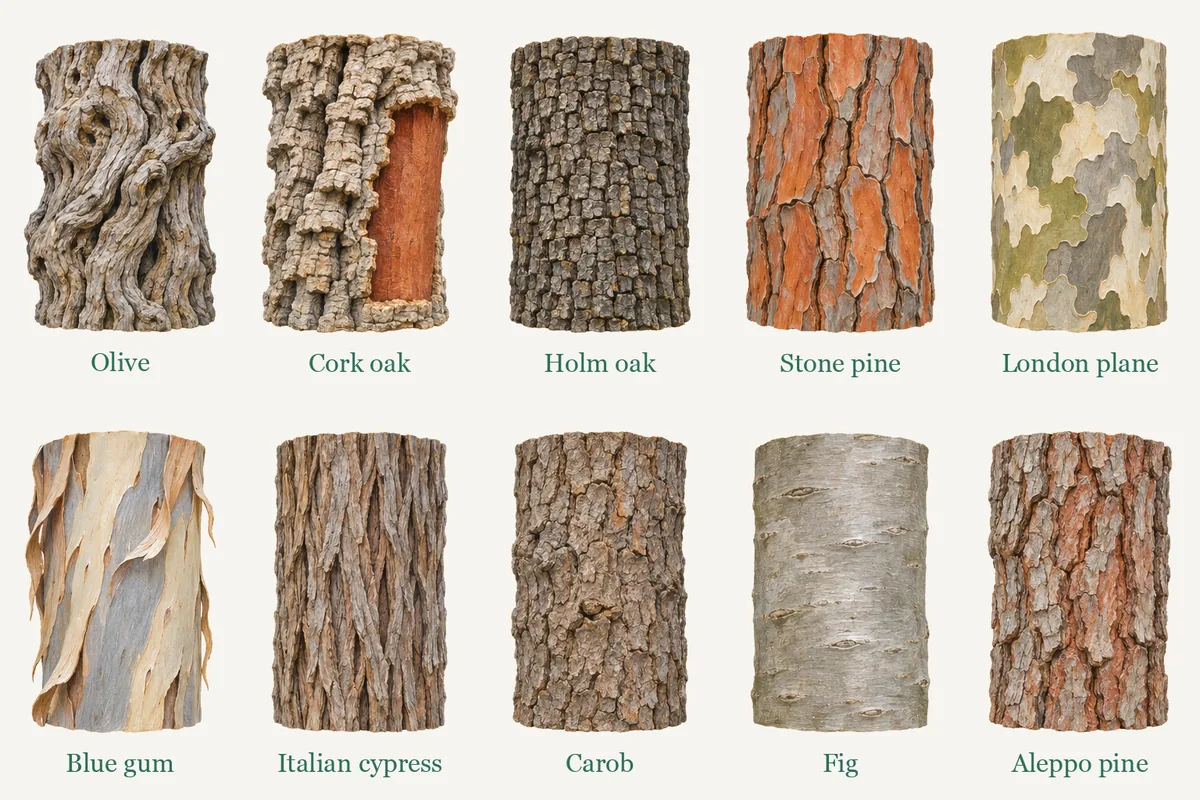
For the bark of the trees around a cork oak in a British or American garden, see the guide to identifying trees by bark.
Cork oak vs holm oak and other evergreen oaks
| Tree | Bark | Leaf underside | Acorn cup |
|---|---|---|---|
| Cork oak | Thick, spongy, grey, deep reddish furrows | Whitish, fuzzy | Loose, shaggy scales |
| Holm oak | Thin, hard, black, finely cracked | Pale, downy | Thin scales pressed flat |
| Fulham oak (hybrid) | Thickly fissured | Varies | Varies with parentage |
| Southern live oak | Not corky | Pale, hairy | Warty bowl, acorns in clusters |
Holm oak is the tree most often mistaken for cork oak in Britain, because its leaves are evergreen, leathery and pale beneath too. The Woodland Trust describes holm oak bark as black and finely cracked, and its acorns as smaller and more pointed than English oak's. The holm oak page shows how its leaves change from spiny to smooth as the tree ages.
Hybrids with Turkey oak. Cambridge University Botanic Garden grows a Fulham oak, Quercus × hispanica, near its cork oak. It says the hybrid took rapid growth from Turkey oak and its thickly fissured bark, evergreen foliage and form from cork oak. A fissured, evergreen oak in an old British estate garden may therefore be a hybrid; the garden's label or a local recorder can settle what a photo cannot.
Southern live oak is the American evergreen oak. Virginia Tech's live oak fact sheet gives leaves 2 to 5 inches long, pale and hairy beneath, with acorns in clusters of 3 to 5 in a warty, bowl-shaped cap. The deciduous oaks, with lobed leaves, are covered on the oak identification page.
Where cork oak grows
NC State lists the native range as the western and central Mediterranean: Portugal, Spain, France, Corsica, Sardinia, Sicily, Italy, Morocco, Algeria and Tunisia, in forests and open woodland, and introduced in the Balearic and Canary Islands. APCOR's production table, from FAO and Agro.Ges figures, puts Portugal at 46% of world cork and Spain at 33%, then Morocco, Algeria, Tunisia, Italy and France.
In Britain. The RHS describes a slow-growing evergreen tree, higher than 12 metres and wider than 8 at maturity, taking 20 to 50 years to get there, and rates it H5: hardy in most places throughout the UK, even in severe winters. Cambridge University Botanic Garden calls its own tree a very fine specimen despite the species' reputation for poor growth in England, and says it stays evergreen in all but the coldest winters there.
In North America. Virginia Tech says cork oak is planted in the warmer parts of the United States and is not known to escape widely from cultivation. NC State gives USDA hardiness zones 8a to 10b and lists it for the coastal region of North Carolina, as slow-growing and drought tolerant.
Cork oak through the year
- Spring: slender yellow-green male catkins, 2 to 3 inches long, hang from the shoots, and tiny female flowers sit in clusters of 2 to 4 in the leaf axils (Virginia Tech).
- Summer: the crown stays dark and evergreen. In Portugal, this is the harvest season.
- Autumn: acorns ripen in a single season (Virginia Tech, NC State), long and slender in their shaggy cups.
- Winter: the tree keeps its leaves, and the grey, ridged trunk is easiest to read with nothing else in leaf around it.
Never eat an acorn, seed or leaf on the strength of a web page or an app. If you find a cork oak in a park, identify it with location turned on and Tree Identifier's Tree Map pins it, so you can come back in autumn for the acorns.
Look-alikes and how to tell them apart
Holm oak (Quercus ilex)
Same evergreen leaf, dark above and pale and downy below. Press the trunk: holm oak bark is thin, hard, black and finely cracked, never spongy. Its acorns are small and pointed, in a cup of thin, pressed-down scales.
Fulham oak (Quercus × hispanica)
A hybrid of cork oak and Turkey oak planted in British gardens. Cambridge University Botanic Garden says it inherited thickly fissured bark and evergreen leaves from cork oak and rapid growth from Turkey oak; check for the deep, soft cork layer of a true cork oak.
Southern live oak (Quercus virginiana)
The evergreen oak of the American South. Its leaves are similar in size and pale beneath, but Virginia Tech gives its acorns as short and dark, 3/4 inch, in clusters of 3 to 5 in warty, bowl-shaped cups, where cork oak's are long and slender in shaggy cups.
What a photo can't settle
- A photo of foliage alone may not separate cork oak from holm oak: the leaves overlap in size, shape and the pale underside. Photograph the trunk.
- NC State describes the deep, rough fissures on mature trees; a young cork oak, or a trunk recently stripped, shows less cork, so the bark test is clearest on an old, unharvested trunk.
- Cork oak hybridises with Turkey oak, and the hybrids are planted in Britain; a photo app gives one species name and cannot settle hybrid parentage.
Questions people ask
Does cork oak grow in the UK?
Yes, as a planted tree. The RHS rates it H5, hardy in most places throughout the UK even in severe winters, and Cambridge University Botanic Garden grows a mature, spreading specimen that stays evergreen through all but the coldest Cambridge winters, despite the species' reputation for poor growth in England.
Does harvesting cork kill the tree?
No, when done within the rules. APCOR, the Portuguese cork association, says the cork-producing layer stays active after extraction and the bark regrows. Portuguese rules allow the first stripping only once the trunk is at least 70 cm round at 1.3 m, usually at about 25 years, and forbid stripping more often than every nine years.
Why is the trunk of a cork oak red?
It has been stripped. The RHS says the layer exposed by harvesting is brick red until new bark forms, and Virginia Tech describes recently harvested bark as reddish brown. In cork forests the line between the red lower trunk and the grey upper bark shows how high the cork was taken.
Is cork oak evergreen?
Yes. Virginia Tech, NC State and the RHS all describe it as an evergreen tree with leathery leaves. Tree Identifier's own catalog files cork oak under deciduous trees, which is the app's grouping, not botany.
Where does most cork come from?
From Portugal and Spain. APCOR's table, based on FAO and Agro.Ges figures, gives Portugal 46% and Spain 33% of world cork production, followed by Morocco, Algeria, Tunisia, Italy and France.
Sources
- Quercus suber, cork oak — Royal Horticultural Society
- Cork oak fact sheet — Virginia Tech Dendrology
- Quercus suber (cork oak) — North Carolina Extension Gardener Plant Toolbox, NC State University
- Cork oak — APCOR, Portuguese Cork Association
- Cork oak — Cambridge University Botanic Garden
- Holm oak (Quercus ilex) — Woodland Trust
- Live oak fact sheet — Virginia Tech Dendrology
Keep reading
- Tree profileHolm oak (Quercus ilex): how to identify the evergreen oak
- Tree profileOak trees (Quercus): how to identify them
- Field guideTree bark identification: seven bark types and the trees that have them
- Clue guideAcorn identification: which oak dropped this acorn?
- Tree profileLive oak (Quercus virginiana): how to identify it