Tree profile
Holm oak (Quercus ilex): how to identify the evergreen oak
An oak that is still green in January, with leaves that look like holly on a young tree and like an olive's on an old one. Turn a leaf over and the pale felt underneath gives it away.
In short
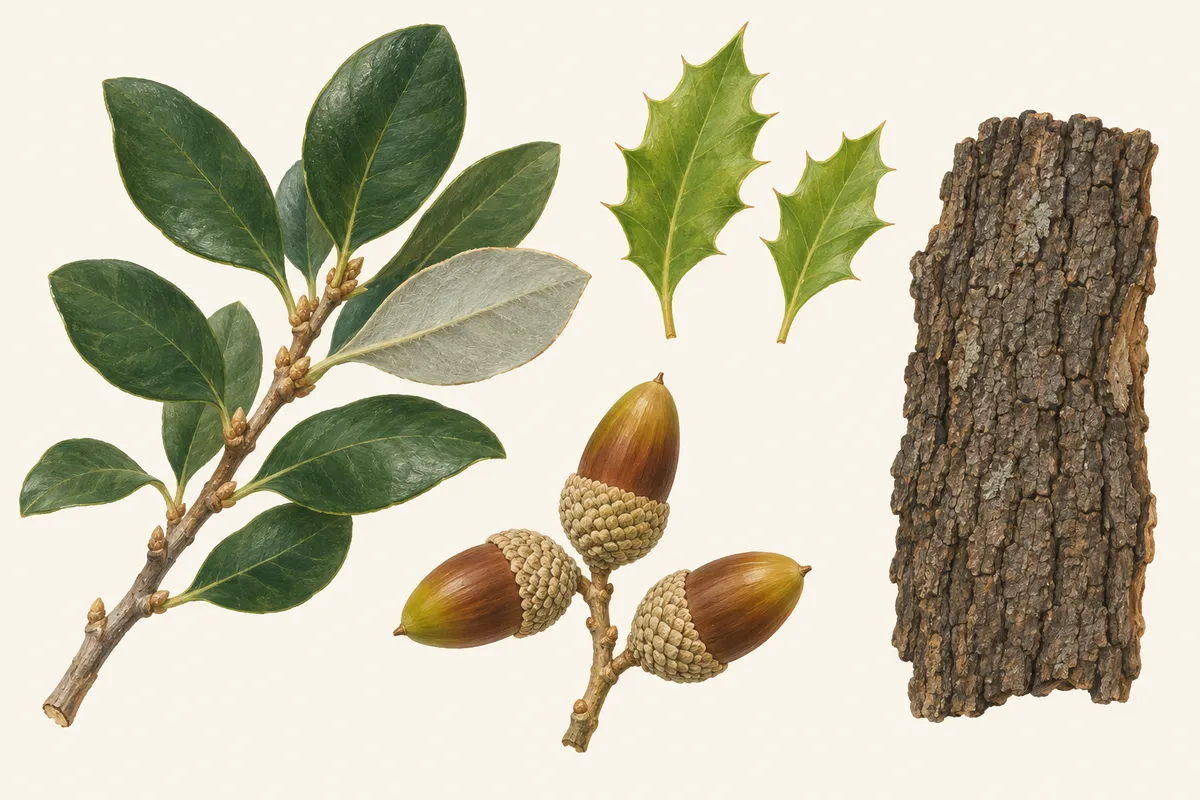
Holm oak identification starts with a leaf turned over: it is evergreen and leathery, glossy dark green above and covered in pale, downy hairs beneath, about 3 to 7 cm long. Leaves on young trees and low shoots are spiny like holly; older leaves have smooth edges. Confirm with the bark, black and finely cracked, and with small pointed acorns sitting in a cup of pressed-down scales.
- The downy, pale underside of the leaf separates holm oak from holly, whose leaves are hairless.
- Spiny leaves low down and smooth leaves higher up on the same tree are normal for holm oak, not a sign of two species.
- In Britain a big evergreen oak in a park, churchyard or seafront garden is almost always holm oak; it was brought over in the late 1500s.
Field marks at a glance
- Scientific name
- Quercus ilex
- Family
- Fagaceae (beech family)
- Type
- Broadleaf, evergreen
- Leaves
- Alternate, simple, leathery, evergreen, 3 to 7 cm long, ovate to lance-shaped, on a stalk 6 to 15 mm (Oregon State); glossy dark green above and downy with pale hairs beneath (Woodland Trust), often slightly cupped.
- Leaf edges
- Spiny or toothed like holly on young trees and shoots; smooth on older leaves. Oregon State calls the adult margin entire or remotely toothed.
- Acorns
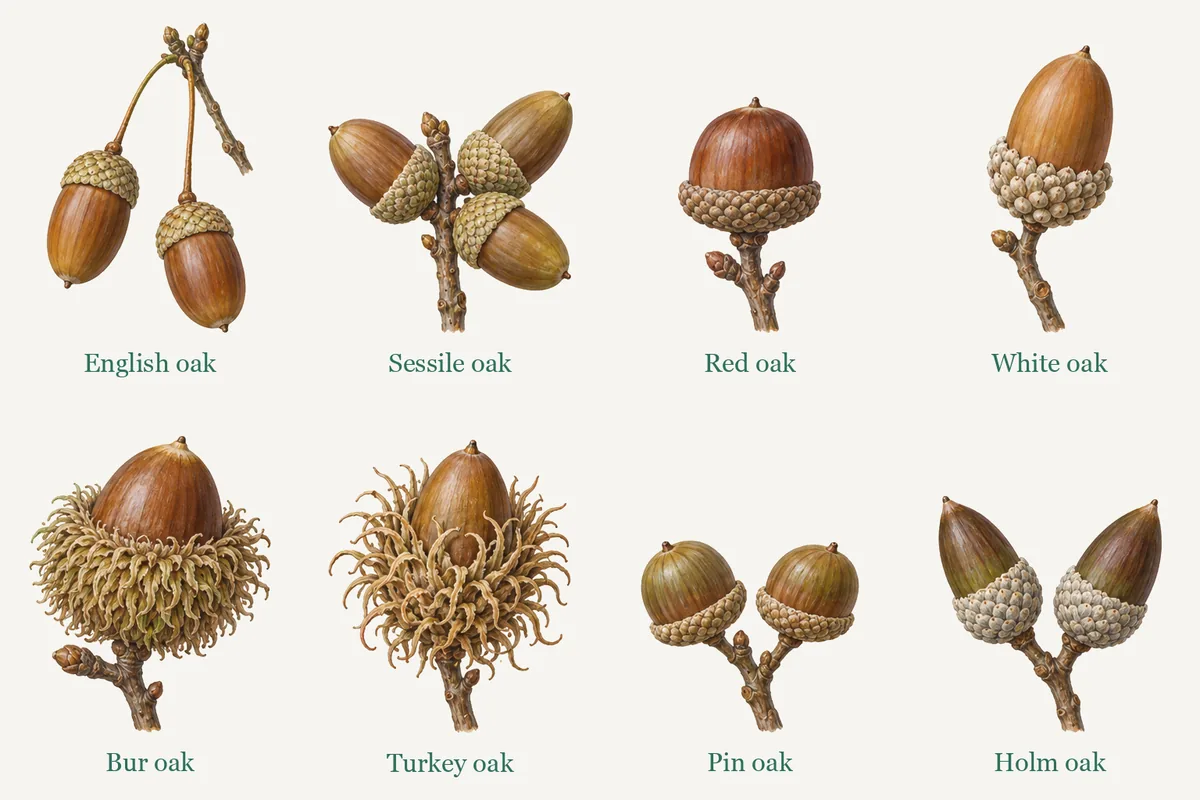
- Smaller and more pointed than English or sessile oak acorns, green ripening to dark red-brown (Woodland Trust); 2 to 3.5 cm, about half held in a cup of thin, pressed-down scales (Oregon State).
- Bark
- Black and finely cracked (Woodland Trust, RHS); Oregon State describes it as grey, nearly smooth or finely scaly. It never turns thick and corky.
- Twigs
- Slender, covered in light brown, felt-like hairs (Woodland Trust).
- Flowers
- Small, elongated yellow catkins in spring; male and female flowers on the same tree, wind-pollinated (Woodland Trust).
- Shape and size
- Large, dense, rounded crown on a short trunk. Up to 20 m in Britain (Woodland Trust); Oregon State gives 20 m, rarely 30 m.
- Where in Britain
- Parks, gardens, churchyards, streets and coastal windbreaks, commonest in southern England; introduced in the late 1500s and naturalised (Woodland Trust).
Holm oak is the big evergreen oak of British parks, churchyards and seafronts, a Mediterranean tree that keeps a dense, dark crown through winter. It confuses people for one reason: it changes its leaves as it ages. A young holm oak, or a clipped hedge of one, has spiny leaves that look like holly; the top of an old tree has smooth, plain leaves. Three checks get past both disguises.
How to identify a holm oak
Do these in order. The first one settles most trees.
- Turn a leaf over. The Woodland Trust describes oval, evergreen leaves with no lobes, glossy dark green to almost black above, and downy underneath with a coating of pale hairs. Rub the underside with a thumb and you can feel the felt. Oregon State University gives leaves 3 to 7 cm long, leathery, with a yellowish or whitish down beneath.
- Look at the edges at two heights. Young leaves are spiny like holly and may be toothed; older leaves have smooth edges (Woodland Trust). A tree carrying spiny leaves low down and smooth ones higher up is behaving exactly as a holm oak should.
- Check the bark and twigs. The bark is black and finely cracked, as both the Woodland Trust and the RHS put it, and the slender twigs are covered in light brown, felt-like hairs.
- Find an acorn. In autumn, look under the tree for small acorns, more pointed than English oak's, green turning dark red-brown before they fall. Oregon State gives them 2 to 3.5 cm long, about half enclosed by a cup of thin scales pressed flat against it.
If the leaves are out of reach, Tree Identifier can suggest a name from one photo of a fallen twig, the bark or the whole tree. It shows one common and scientific name with no look-alike list, so do the leaf test above before trusting it on a spiny young shoot.
Holm oak leaves: two shapes on one tree
Most mistakes come from the leaves. Ilex, the species name, is the Latin word for holly, and the RHS lists holly oak and holly-leaved oak among the tree's common names. On seedlings, sprouts from a cut stump and the lower branches of a big tree, the leaf edge is wavy and set with spiny teeth. Higher in the crown of an old tree the leaves become plainer and smooth-edged, so a branch brought down by a storm can look quite different from a twig picked at head height.
What does not change is the underside. On both shapes the Woodland Trust describes it as downy, with a coating of pale hairs, against a glossy upper surface; Oregon State calls it yellowish or whitish. Twigs carry the same felt, so even a leafless twig picked up from the ground can point to holm oak.
The other oaks you meet in Britain, English and sessile oak, are deciduous and have lobed leaves; the oak identification page explains the lobes, acorns and the two groups of oaks. A holm oak has no lobes at all.
Holm oak vs holly, cork oak and live oak
| Tree | Leaf underside | Fruit | Bark | Best single test |
|---|---|---|---|---|
| Holm oak | Pale, downy | Small pointed acorn | Black, finely cracked | Felt under the leaf, plus acorns |
| Holly | Hairless | Red berries, female trees only | Smooth, thin, with small warts | No acorns, ever |
| Cork oak | Pale, fuzzy | Long, slender acorn in a shaggy cup | Thick, spongy, ridged cork | Press the trunk |
Holly is the look-alike that fools people most often in Britain, especially in hedges. NC State's English holly profile lists the leaves as glossy, dark green, wavy, spiny and hairless, 1 to 3 inches long, and the Woodland Trust notes that older hollies also grow smooth leaves near the top. So spines tell you nothing; the felt underneath does. Holly also bears scarlet berries on female trees and never an acorn. The holly page has the full holly key.
Cork oak is the closest relative and has nearly the same leaf. The RHS describes cork oak leaves as dark glossy green on top and paler and felty underneath, and its acorns as long and slender with less than a third held in a shaggy cup. The trunk is the giveaway: thick, craggy cork you can press a fingernail into. The cork oak page covers it in detail.
Southern live oak, for American readers, is the evergreen oak of the Gulf and Atlantic coastal plain, not a European tree. Virginia Tech describes leaves 2 to 5 inches long, pale and hairy beneath like a holm oak's, but with edges often rolled under, and acorns in clusters of 3 to 5; the live oak page separates it from the other American live oaks.
Where you see holm oak in Britain
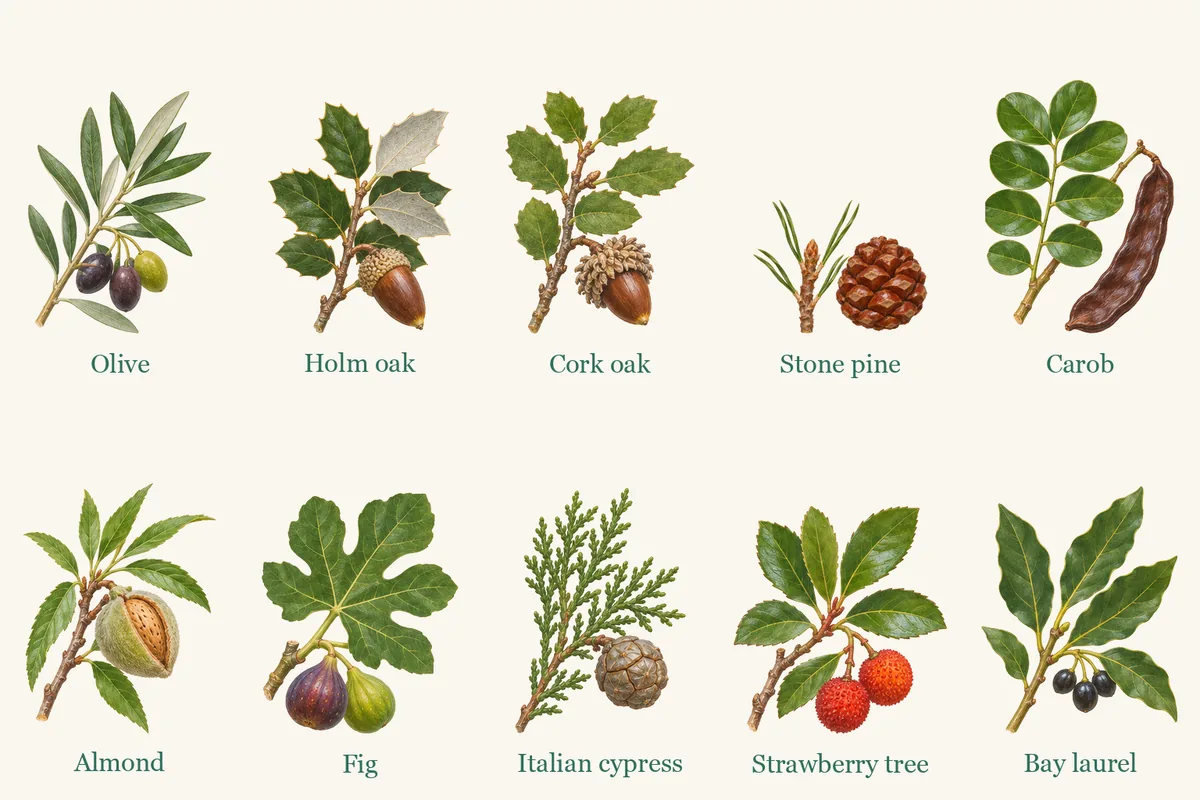
The Woodland Trust says holm oak arrived in Britain in the late 1500s and has naturalised. It is mostly a tree of parks and gardens, often shaped by pruning, and it is common in southern England. Because it tolerates salt spray it was planted as a windbreak on the coast, and because it tolerates shade and air pollution it is also used as a street tree and in city parks.
It is not fully at home in the cold. The Woodland Trust notes that holm oak struggles in freezing conditions and may lose its leaves, or die, in severe winters. The RHS rates it H4, hardy through most of the UK, and describes a large tree with a massive, rounded crown that takes 20 to 50 years to reach full size. For the native trees growing alongside it, see the UK tree identification guide.
Wildlife uses it less than the native oaks: the Woodland Trust says its value is lower than English and sessile oak's, though bees take pollen from the catkins, birds shelter in the evergreen canopy all year, and jays eat the acorns. It is also less troubled by pests and pathogens than native oaks, although acute and chronic oak decline can affect it.
Holm oak through the year
- Spring: long yellow catkins hang through the crown; the Woodland Trust describes male and female flowers on the same tree, pollinated by wind. New shoots and their felted twigs are pale.
- Summer: the large, rounded crown is dark and dense; the Woodland Trust describes the leaves as dark green to black on top.
- Autumn: acorns ripen from green to dark red-brown and fall. This is the easiest season to prove the tree is an oak.
- Winter: the evergreen crown stands out among bare English oaks. If a severe frost browns or strips it, the Woodland Trust notes that this is a known weakness.
Never eat an acorn, leaf or seed on the strength of a web page or an app. Holm oak is not one of the 138 species in Tree Identifier's Collection, but the app can still suggest a name from a photo, and, with location turned on, the Tree Map pins the find so you can come back in October for the acorns.
Look-alikes and how to tell them apart
Holly (Ilex aquifolium)
Turn the leaf over. Holm oak leaves are downy with pale hairs underneath; NC State lists English holly leaves as hairless, and they are thicker, wavier and very glossy. Holly bears red berries on female trees and never an acorn.
Cork oak (Quercus suber)
The leaves are almost the same, pale and fuzzy beneath. Press the trunk: cork oak bark is thick, spongy, deeply ridged cork, while holm oak bark is thin, hard, black and finely cracked.
Southern live oak (Quercus virginiana)
The evergreen oak of the American South, not of Britain. Virginia Tech gives its leaves as 2 to 5 inches, often with edges rolled under, and its dark acorns as growing in clusters of 3 to 5 in a warty, bowl-shaped cap.
What a photo can't settle
- A photo of a spiny young shoot can look like holly to a person or an app. Photograph a leaf turned over, and an acorn if there is one.
- Holm oak and cork oak leaves are nearly identical; a photo of foliage alone may not separate them. The bark settles it.
- Oregon State notes that the species includes several subspecies; a photo app gives the species, not the subspecies.
Questions people ask
Is holm oak native to the UK?
No. The Woodland Trust says holm oak was brought to Britain in the late 1500s and has since naturalised; the RHS lists it as not native to Great Britain or Ireland. The Woodland Trust gives its home as the eastern Mediterranean, while Oregon State describes southern Europe and north-west Africa.
Why does my holm oak have spiny leaves at the bottom and smooth ones at the top?
That is normal. The Woodland Trust says young holm oak leaves are spiny like holly and may be toothed, while older leaves have smooth edges. Low shoots, hedges and sprouts from a cut stump keep the spiny form, so a clipped holm oak hedge can look like holly.
Does holm oak lose its leaves?
It is evergreen, so the crown stays green all year. The Woodland Trust notes that it struggles in freezing conditions and may lose its leaves, or die, in severe winters. The RHS rates it H4, hardy through most of the UK down to about -10 to -5 °C.
What is the difference between holm oak and holly oak?
None: holly oak is another name for holm oak, Quercus ilex, used by the Woodland Trust, the RHS and Oregon State. The RHS also lists evergreen oak, holly-leaved oak and ilex. Oregon State notes that holm refers to the prickly foliage.
Is holm oak harmful to dogs?
The RHS flags Quercus ilex as harmful to dogs if eaten and refers to the Horticultural Trades Association guide to potentially harmful plants. If a dog has chewed acorns or leaves, call your vet.
Sources
- Holm oak (Quercus ilex) — Woodland Trust
- Quercus ilex, holm oak — Royal Horticultural Society
- Quercus ilex — Landscape Plants, Oregon State University
- Ilex aquifolium (English holly) — North Carolina Extension Gardener Plant Toolbox, NC State University
- Holly (Ilex aquifolium) — Woodland Trust
- Live oak fact sheet — Virginia Tech Dendrology
- Quercus suber, cork oak — Royal Horticultural Society
Keep reading
- Tree profileOak trees (Quercus): how to identify them
- Tree profileHolly tree (Ilex): how to identify American and English holly
- Tree profileCork oak (Quercus suber): how to identify it
- Clue guideAcorn identification: which oak dropped this acorn?
- Field guideTree identification in the UK: British trees by leaf, bark and picture