Tree profile
Dawn redwood (Metasequoia glyptostroboides): how to identify it
A feathery conifer that turns russet and goes bare every winter, planted in parks and campuses from a handful of seed lots sent out of China in 1948.
In short
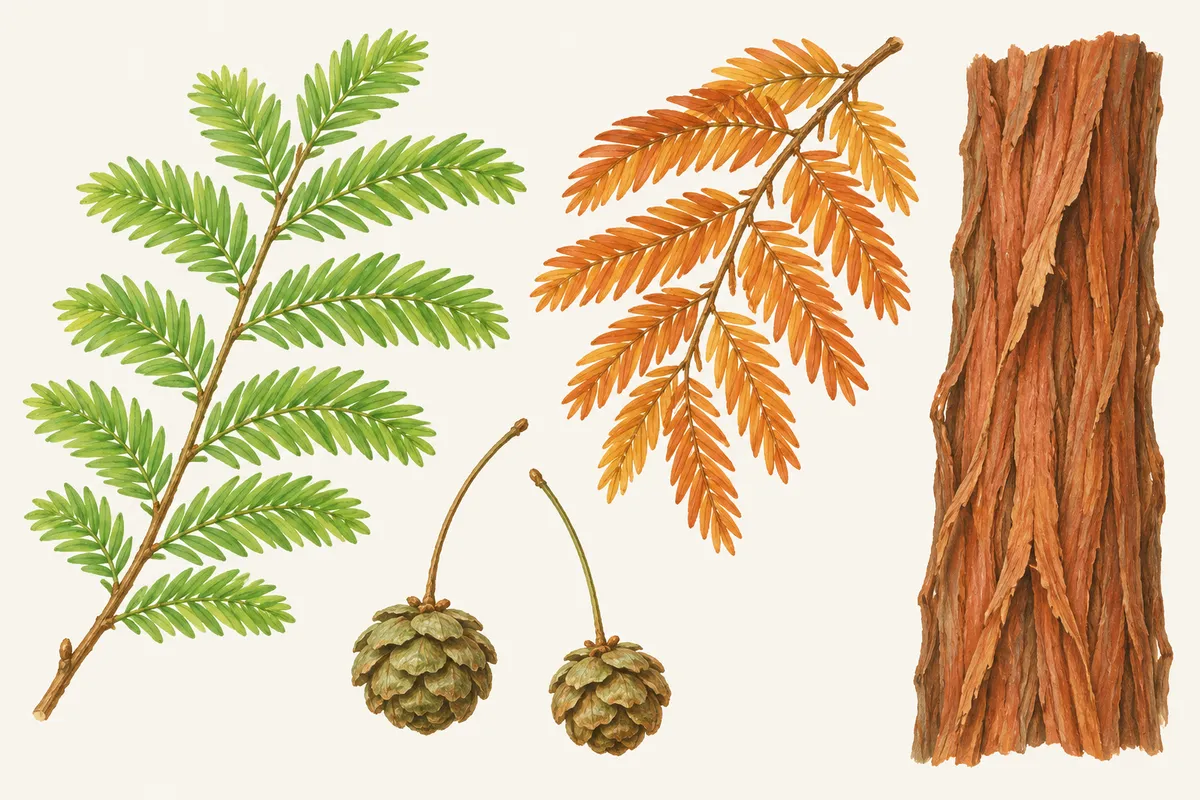
Dawn redwood identification starts with a branchlet: soft, flat needles under 1 inch long set in exact opposite pairs, like a fern frond. The needles turn copper to russet in fall and drop, so the tree is bare in winter. Cones up to 1 inch hang on stalks up to 1 1/2 inches long, and the reddish-brown trunk flares and flutes at the base.
- Needles in opposite pairs mean dawn redwood; needles that alternate along the twig mean bald cypress.
- A conifer that turns russet and stands bare all winter is not dying: dawn redwood is deciduous.
- Every dawn redwood planted in the West until the 1990s traces back to seed shipped to the Arnold Arboretum in 1948.
Field marks at a glance
- Scientific name
- Metasequoia glyptostroboides
- Family
- Cupressaceae (cypress family)
- Type
- Conifer, deciduous
- Needles
- Linear, soft and feathery, under 1 inch long, set in opposite pairs along short side shoots; light green in spring, deep green in summer, paler below with two faint bands.
- Fall color
- Brownish copper to red-bronze or russet, then shed, with the side shoots; bare all winter.
- Buds
- Opposite, in pairs, egg-shaped to ellipsoid: the winter version of the needle test.
- Seed cones
- Hanging, barrel-like, up to 1 inch long, green ripening dark brown, with 14 to 28 scales, on stalks up to 1 1/2 inches.
- Pollen cones
- Round, about 1/2 inch; male and female cones grow on the same tree.
- Bark
- Reddish brown to dark brown or burgundy, rough, peeling in long strips, deeply fissured on old trees.
- Trunk and form
- Narrow pyramid; lower trunk buttressed and fluted, widening with age; branches spread and droop on old trees.
- Size
- Fast-growing, about 70 to 100 feet tall and 15 to 25 feet wide (Morton Arboretum, NC State).
- Origin
- Native to central and western China, often on wet sites; known first as a fossil, found alive in 1941.
Dawn redwood is the feathery conifer on a college lawn or beside a park pond that turns the color of rust in November and then stands bare until spring. It is native to China and was known only from fossils until the 1940s. Today it grows in parks, campuses and gardens far from China. One test names it: needles in exact opposite pairs. Two more, the hanging cones and the fluted trunk, confirm it.
How to identify a dawn redwood
Pick a branchlet from a low limb, or one from the ground in fall, and check these in order.
1. Opposite needles. NC State Extension's dawn redwood profile describes linear, soft, feathery needles, each under 1 inch long, arranged opposite (sometimes slightly offset, "subopposite") along short side shoots. Hold the shoot up: each needle has a partner directly across the stem, like the leaflets of a fern. The Morton Arboretum compares the foliage to a yew's.
2. Color through the year. Light green in spring, deep green in summer, paler beneath with two faint stomatal bands (NC State). In fall the needles turn brownish copper to red-bronze; the Morton Arboretum calls it russet-brown. Then they drop.
3. Cones on long stalks. Female cones hang down, barrel-like and up to 1 inch long, with 14 to 28 scales, green at first and dark brown when ripe (NC State). Morton describes them as rounded, on stalks up to 1 1/2 inches long. Round pollen cones about 1/2 inch grow on the same tree.
4. Bark and trunk base. The bark is reddish brown, rough, and peels in long strips (Morton); NC State gives dark brown to reddish burgundy, deeply fissured on mature trees. The lower trunk is buttressed, and NC State notes that it broadens at the base and develops fluting, sometimes elaborate, as the tree ages.
5. Shape and size. A narrow, pyramidal to conical tree that grows fast to 70 to 100 feet (Morton) and spreads about 25 feet, with branches that droop with age (NC State).
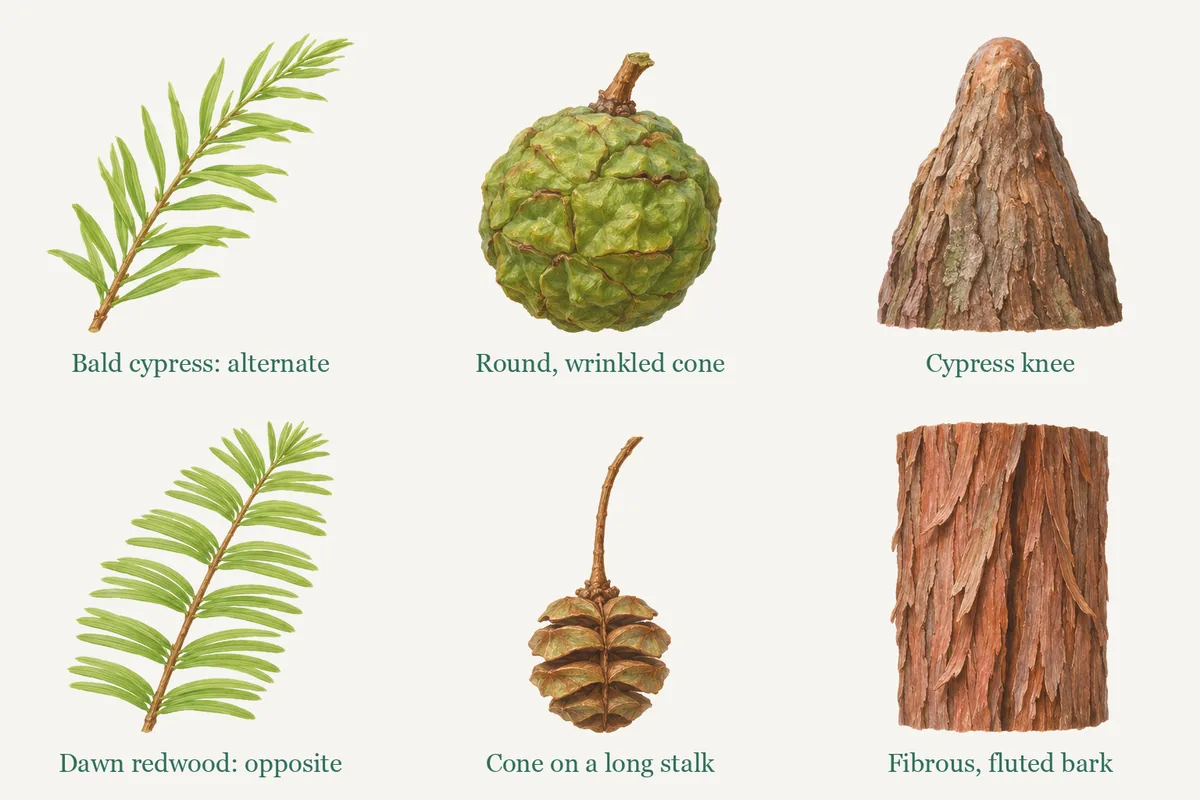
The sheet below sets dawn redwood beside its usual look-alike, bald cypress, part by part.
If the branches are out of reach, Tree Identifier can name the tree from one photo of a branchlet, a cone or the trunk, and dawn redwood is in the app's Collection. It shows one name with no confidence score or look-alike list, so confirm the opposite needles yourself.
A conifer that goes bare: dawn redwood in fall and winter
People often worry when a dawn redwood turns brown in October. It is meant to. Iowa State Extension's page on seasonal needle loss lists larch, bald cypress and dawn redwood as deciduous conifers that lose all their needles every fall, turning yellow, russet or reddish brown first.
In winter the tree is a bare, narrow cone of fine twigs. Identification then moves to the twig: NC State describes the buds as opposite, in pairs, egg-shaped to ellipsoid. Opposite buds and side-shoot scars, a few hanging cones and a fluted, reddish trunk add up to dawn redwood. NC State also notes that the tree is intolerant of early freezes.
Dawn redwood vs bald cypress, coast redwood and larch
Three trees cause most mix-ups:
- Bald cypress. The closest look-alike, and NC State lists each as a tree the other is confused with. Its NC State profile gives needles 1/4 to 3/4 inch, alternate and two-ranked, round cones 3/4 to 1 inch wide on short stalks, orange to cinnamon-brown fall color and, near water, knees. The bald cypress page covers it in full.
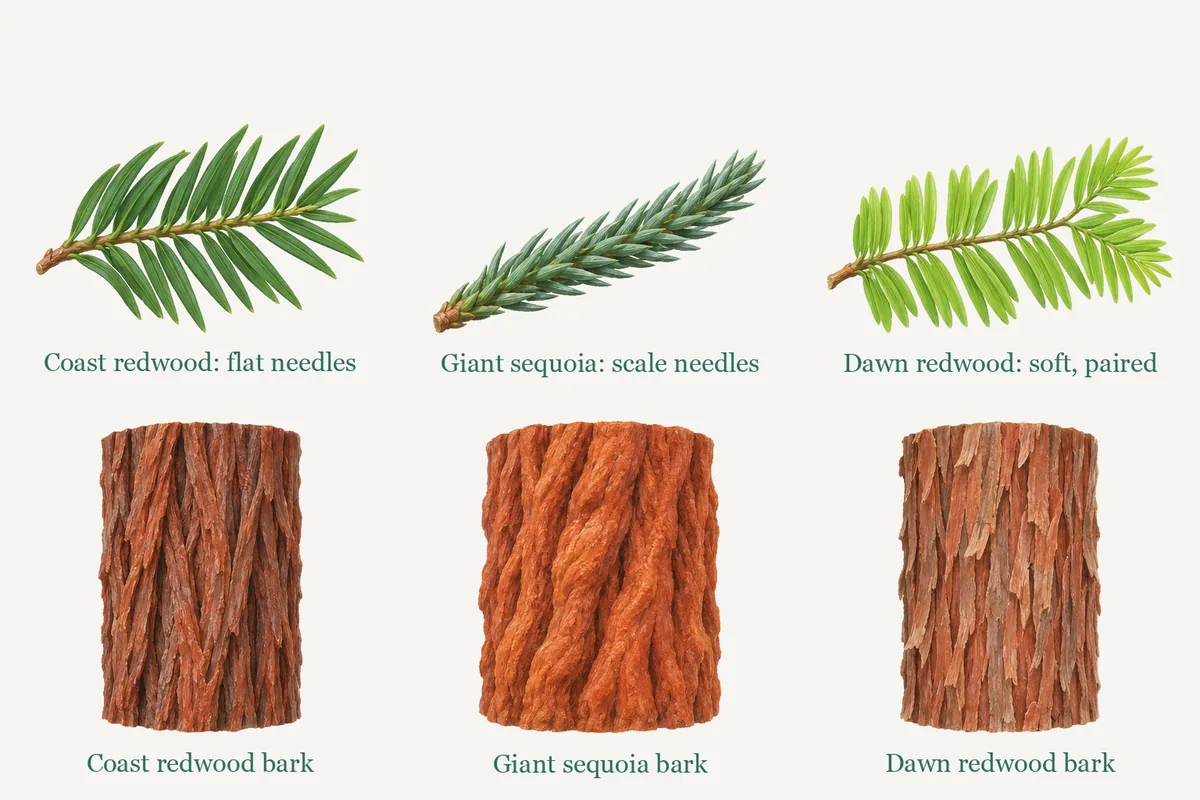
- Coast redwood. Evergreen, so it stays green when dawn redwood is bare. NC State describes its flat needles, 1/2 to 1 inch, as alternate and spirally arranged with two white bands beneath, and its cones as about 1 inch, hard and woody. The redwood vs sequoia page compares it with giant sequoia.
- Larch and tamarack. Also bare in winter. Virginia Tech's tamarack fact sheet describes needles 3/4 to 1 inch borne in clusters on spur shoots, turning yellow in fall, and small egg-shaped cones that persist through winter. See the tamarack page.
The living fossil: how dawn redwood reached your park
Dawn redwood was described from fossils before anyone knew it still grew. NC State says the fossil record shows it existed for at least 50 million years, and that the living tree was at first misidentified as Glyptostrobus pensilis, which is where its species name, glyptostroboides, comes from.
The Arnold Arboretum of Harvard University tells the rest in The Living Fossil. Professor T. Kan first saw the tree near the village of Mou-tao-chi in the winter of 1941, without collecting specimens; T. Wang collected herbarium specimens in the summer of 1944. In January and again in February 1948, two seed shipments reached the Arnold Arboretum, which redistributed the seed in at least 600 packets to gardens, arboreta and universities worldwide. The Arboretum's record of the 1947 collection adds that, until new collections in the 1990s, every dawn redwood in the West traced back to those 1948 seed lots and their offspring.
That history explains where you find dawn redwoods: on campuses, in botanical gardens and arboreta, and in city parks. The Morton Arboretum gives USDA hardiness zones 4 through 8 (NC State: 4a to 8b) and notes that in China it is often found on wet sites.
Size, growth and where it grows
Dawn redwood grows fast. The Morton Arboretum gives a mature height of 70 to 100 feet and a width of about 25 feet; NC State gives 62 to 100 feet and 15 to 25 feet. Male and female cones grow on the same tree (Morton), so a mature tree can carry its hanging seed cones without a partner nearby. In its native range it grows in central and western China (NC State). If you find one in summer, identify it with location turned on so Tree Identifier's Tree Map pins it, and come back in November: a dawn redwood will be russet or bare, a coast redwood still green.
Look-alikes and how to tell them apart
Bald cypress (Taxodium distichum)
Bald cypress needles alternate along the twig, spread into two flat rows; dawn redwood's sit in opposite pairs. Bald cypress cones are round, 3/4 to 1 inch, on short stalks, it turns orange to cinnamon-brown in fall, and near water it grows knees.
Coast redwood (Sequoia sempervirens)
Coast redwood is evergreen, green in January. Its flat needles, 1/2 to 1 inch, alternate along the twig and carry two white bands beneath; dawn redwood's are opposite with only faint pale bands, and fall every autumn.
Tamarack and other larches (Larix)
Larches also go bare in winter, but most of their needles grow in clusters on short spur shoots and turn yellow, not russet. Their cones are small, upright eggs about 3/4 to 1 inch, held on the twig, not hanging on long stalks.
What a photo can't settle
- In winter, without needles, the only reliable split from bald cypress is the arrangement of buds and side shoots, opposite or alternate, which a distant photo will not show.
- Planted dawn redwoods include named cultivars, and a single photo rarely tells one cultivar from another.
- A single photo of a green shoot can confuse dawn redwood, bald cypress and even hemlock or yew; photograph a branchlet flat against your hand so the needle pairs show.
Questions people ask
Is a dawn redwood evergreen?
No. Dawn redwood is a deciduous conifer. NC State Extension says its needles turn brownish copper to red-bronze in fall and are shed, and Iowa State Extension lists it with larch and bald cypress as conifers that lose all their needles each year. New needles open light green in spring.
How do you tell a dawn redwood from a bald cypress?
Look at how the needles sit on a branchlet. Dawn redwood needles grow in opposite pairs; bald cypress needles alternate. Dawn redwood cones hang on stalks up to 1 1/2 inches long, while bald cypress cones are round on short stalks. In winter, check the buds: opposite on dawn redwood.
Is a dawn redwood a real redwood?
It is one of three trees called redwood, all in the cypress family, but each in its own genus. Dawn redwood is Metasequoia, coast redwood is Sequoia and giant sequoia is Sequoiadendron. The Morton Arboretum describes dawn redwood as closely related to bald cypress and redwood.
Why is it called a living fossil?
Because it was known from fossils first. NC State Extension says fossil records show it existed for at least 50 million years, and the Morton Arboretum says it was thought extinct until living trees were found in China in 1941. It reached US gardens in the late 1940s.
How fast does a dawn redwood grow?
Fast. Both NC State Extension and the Morton Arboretum call it fast-growing, and they give a mature height of 62 to 100 feet and 70 to 100 feet respectively, with a spread of about 25 feet. It needs a large space.
Sources
- Metasequoia glyptostroboides (Dawn Redwood) — North Carolina Extension Gardener Plant Toolbox, NC State University
- Dawn redwood — The Morton Arboretum
- The Living Fossil — Arnold Arboretum of Harvard University
- Taxodium distichum (Bald Cypress) — North Carolina Extension Gardener Plant Toolbox, NC State University
- Sequoia sempervirens (Coast Redwood) — North Carolina Extension Gardener Plant Toolbox, NC State University
- Tamarack fact sheet — Virginia Tech Dendrology
- 1947: Metasequoia Collection — Arnold Arboretum of Harvard University
- Seasonal Needle Loss — Iowa State University Extension and Outreach, Yard and Garden
Keep reading
- Tree profileBald cypress (Taxodium distichum): how to identify it
- Tree comparisonRedwood vs sequoia: coast redwood, giant sequoia and dawn redwood
- Tree profileTamarack (Larix laricina): how to identify it
- Field guideConifer identification: three questions about the needles, then the cone
- Clue guideWhich tree has fern-like leaves? Count the divisions first