Also in Deutsch
Tree profile
Eastern white pine (Pinus strobus): how to identify a white pine tree
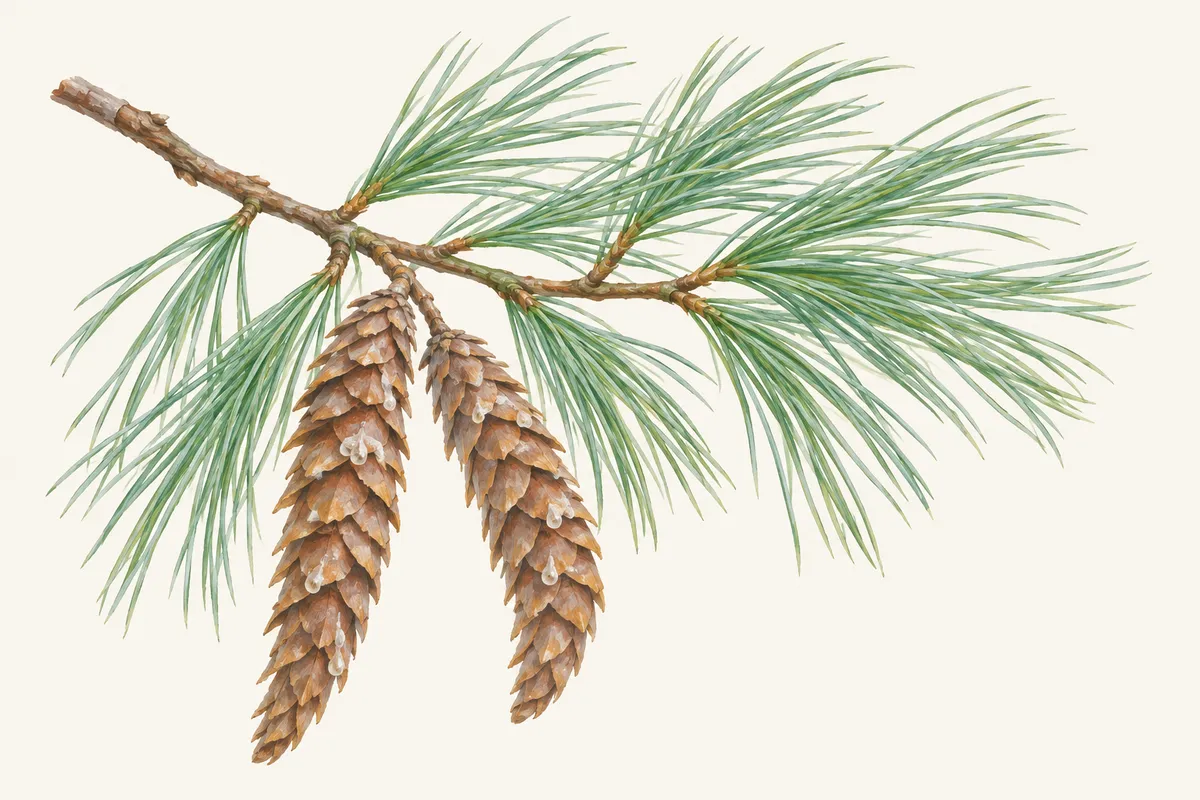
Count to five. Eastern white pine is the only common eastern pine with five needles in each bundle, and its long, narrow, sticky cones confirm it on the ground.
In short
White pine tree identification is a count: eastern white pine carries five slender, soft, blue-green needles per bundle, 3 to 5 inches long, the only common pine in the East with five. Its cones are long and narrow, 4 to 7 inches, resinous and without prickles, hanging on stalks. Old trees have a straight trunk, dark furrowed bark and wispy, upturned branches.
- Five needles per bundle in eastern North America means eastern white pine, unless the tree was planted.
- The cone is long, narrow and sticky with resin, with smooth scale tips you can rub without a prickle.
- Planted five-needle pines (Himalayan, western white) also have five needles; their needle length and cones tell them apart.
Field marks at a glance
- Scientific name
- Pinus strobus
- Family
- Pinaceae (pine family)
- Type
- Conifer, evergreen
- Needles
- Five per bundle, slender and flexible, 3 to 5 inches (Virginia Tech) or 5 to 15 cm (NRCan) long, blue-green from whitish lines of stomata, finely toothed edges; the bundle sheath falls off early.
- Needle life
- Each needle stays on the tree 1 to 4 years (NRCan), so the foliage looks soft and feathery rather than dense.
- Cones
- Cylindrical, hanging, 4 to 7 inches (Virginia Tech) or 8 to 20 cm (NRCan), on a stalk about 2 cm; thin rounded scales with no prickle, very resinous.
- Cone timing
- Ripen in August and September of the second year, about 13 months after fertilization; green when young, yellow-green to light brown when ripe (USDA Forest Service).
- Bark
- Thin, smooth and gray-green on young trees; on old trees dark grayish-brown with long scaly ridges and deep furrows.
- Twigs and buds
- Slender, gray-green to orange-brown; buds long, egg-shaped and reddish brown.
- Form
- Very straight trunk, often over 100 ft; conical when young, then a wispy crown of horizontal branches that curve upward, in whorls.
- Native range
- Newfoundland and southern Canada south through the Great Lakes and New England, and down the Appalachians to northern Georgia and northwestern South Carolina; outliers in western Kentucky, western Tennessee and Delaware.
- In the app's Collection
- Yes: eastern white pine (Pinus strobus) is one of the 138 species in Tree Identifier's Collection.
Eastern white pine (Pinus strobus) is the big pine of the Northeast and the Great Lakes with the soft blue-green foliage and the long, narrow, sticky cones. On our pine identification page it is one row in a chart of 14 pines, where five needles per bundle separates it from the rest. This page adds what that row leaves out: the bark through a tree's life, the crown shape that lets you recognize it from a road, the cones by season, and the planted five-needle pines that share its count.
How to identify a white pine tree
Three checks, in order. The first one is nearly always enough in the East.
1. Count five needles. Pull one bundle from the middle of a branch. Virginia Tech's eastern white pine fact sheet gives five slender, flexible needles per bundle, 3 to 5 inches long, blue-green from several whitish lines of stomata; Natural Resources Canada's factsheet gives 5 to 15 cm and adds that the edges are finely toothed. The sheath around the base falls off early, so you see five loose needles meeting at a point. Run a needle between your fingers the wrong way and you can feel the fine teeth.
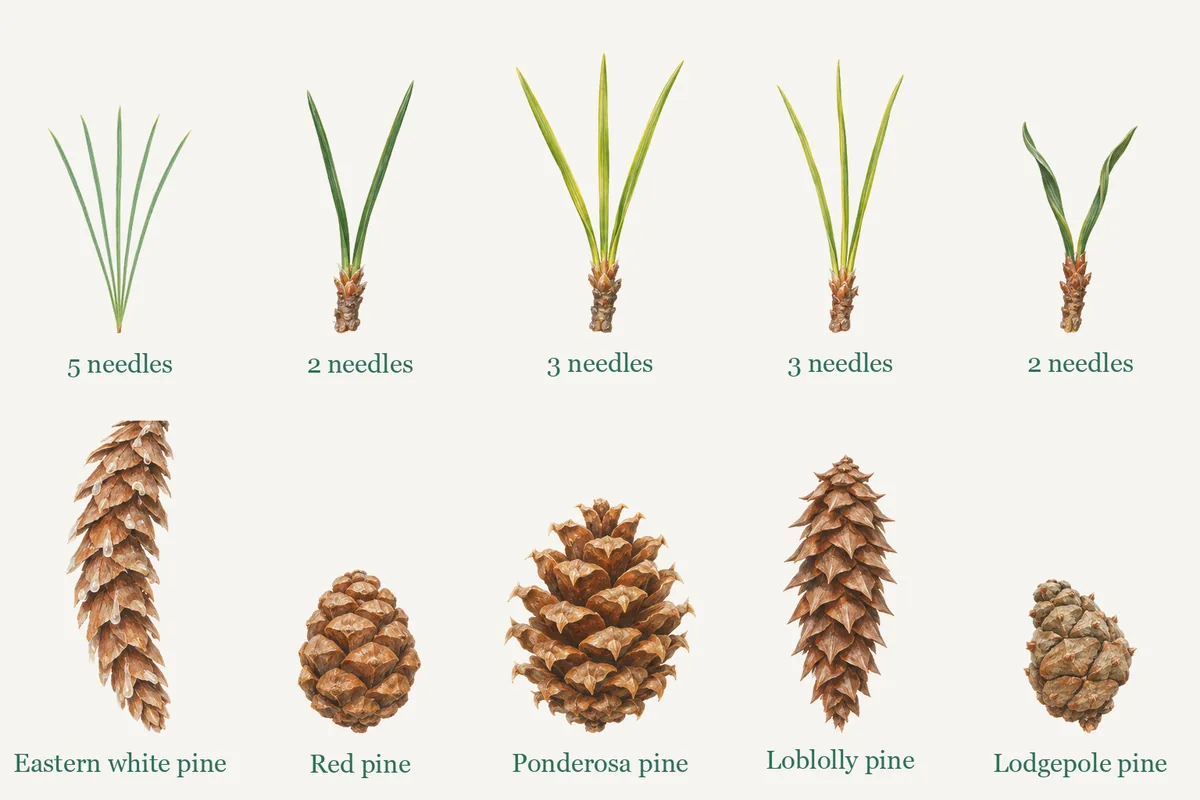
2. Find a cone. White pine cones hang on stalks and are long and narrow: 4 to 7 inches in Virginia Tech's figures, 8 to 20 cm on a 2 cm stalk in NRCan's. The scales are thin and rounded, without the prickle that most hard pines carry, and the cones are very resinous, so a fresh one leaves your fingers sticky. Under a mature tree you will usually find dozens. The pine cone identification chart puts it beside red, pitch, Scots and the southern pines.
3. Look at the crown. Virginia Tech describes a very straight trunk, often well over 100 feet, with a conical crown when young that becomes wispy, with horizontal branches that curve upward. On a big tree, the branches stand out in layers, each a whorl from one year's growth.
If the branches are out of reach, Tree Identifier can name a white pine from one photo of a fallen bundle, a cone or the whole tree; eastern white pine is one of the 138 species in its Collection. The app gives one name and no confidence score or look-alike list, so count the needles yourself before you trust it.
Bark from sapling to old tree
Bark changes so much that a young and an old white pine look like different species.
- Young trees: Virginia Tech gives thin, smooth, gray-green bark with lighter, splotchy patches.
- Mature trees: the bark becomes thick, reddish to gray-brown, with long, finely scaly ridges and darker furrows. NRCan gives broad scaly ridges 2 to 5 cm thick, separated by deep furrows, turning dark grayish-brown.
Old white pine bark is darker and more deeply furrowed than red pine bark, which Virginia Tech describes as red-brown or pink to gray and later plated with a reddish tinge. For the two pines side by side, see red pine vs white pine, which adds jack pine.
Cones and seasons
The USDA Forest Service's Silvics of North America explains why you can find two kinds of cones on one tree. Fertilization follows pollination by about 13 months, and cones mature in August and September of the second year. In summer, then, a branch may carry small green first-year cones and full-size second-year cones at once. Ripe cones are yellow-green to light brown, and most seed falls within the month after the cones mature.
The Forest Service adds that female flowers can appear on trees 5 to 10 years old, but good seed crops wait until about 20 to 30 years, and good seed years come every 3 to 5 years. A young planted white pine without cones is still identifiable by its needle count.
Size, range and the weevil
Size and age. The Forest Service says trees 150 feet tall and 40 inches across were common in virgin forests of Pennsylvania, Michigan and New England, and lists champions of 158 feet in Michigan and 147 feet in Maine. Undisturbed trees commonly reach 200 years and may exceed 450. NRCan gives up to 30 m, occasionally taller, and about 200 years.
Range. Southern Canada from Newfoundland, south through the Great Lakes and New England and down the Appalachians to northern Georgia and northwestern South Carolina, with small outliers in western Kentucky, western Tennessee and Delaware, and a variety in the mountains of southern Mexico and Guatemala (Forest Service). It grows from dry sandy soils and rocky ridges to sphagnum bogs and does best on moist sandy loam (NRCan).
Crooked trunks. The white pine weevil kills the leading shoot, often the last two or three years of growth. Side branches from the highest live whorl turn upward to replace it, which leaves a crook in the trunk and sometimes several competing tops. The Forest Service also calls white pine blister rust highly virulent throughout the range; trees are susceptible from seedling to maturity, with high losses in young stands.
Other five-needle pines you may meet
In the East, five needles means eastern white pine unless the tree was planted. Two planted relatives cause most of the confusion.
- Himalayan pine (Pinus wallichiana): Virginia Tech's Himalaya pine fact sheet gives needles 4 to 8 inches, gray or bluish-green and distinctly drooping, and cones 6 to 12 inches. Its long, limp needles make it look shaggier than a white pine.
- Western white pine (Pinus monticola): native in the West. Virginia Tech's western white pine fact sheet gives shorter needles, 2 to 4 inches, with white lines on only two of the three faces, cones 5 to 12 inches often tipped with white resin, and bark in square blocks, not ridges and furrows.
Eastern white pine is also the five-needle pine of the New England tree guide. If you are unsure whether a tree is a pine at all, the conifer identification guide covers spruce, fir, hemlock and larch, and Tree Identifier's follow-up chat can answer questions like whether a soft-needled yard pine is a cultivar.
Look-alikes and how to tell them apart
Red pine (Pinus resinosa)
Two needles per bundle, 4 to 6 inches long, that snap cleanly when bent, and egg-shaped cones only 1 1/2 to 2 1/2 inches. Its bark is reddish, in scaly plates. White pine has five soft needles that bend without breaking.
Himalayan pine (Pinus wallichiana)
A planted five-needle pine whose needles are longer, 4 to 8 inches, and distinctly drooping, and whose cones are 6 to 12 inches. Eastern white pine needles are 3 to 5 inches and do not hang limply.
Western white pine (Pinus monticola)
A five-needle pine of the West with shorter needles, 2 to 4 inches, white lines on only two of the three faces, cones 5 to 12 inches often tipped with white resin, and bark broken into square blocks rather than ridges and furrows.
Eastern hemlock and other soft conifers
From a distance a white pine's soft, feathery foliage can be mistaken for hemlock, but hemlock needles grow one at a time and are far shorter. Any bundle of five needles joined at the base settles it as a white pine.
What a photo can't settle
- Planted five-needle pines (Himalayan and western white pine and their cultivars) share the bundle count; in a park or yard, check needle length and the cone before trusting the count alone.
- Dwarf and weeping white pine cultivars do not have the tree's layered crown, so judge them by needle and bundle only.
- On a tall tree, the needles you can reach may be on shaded lower branches; a photo of a fallen bundle or cone is better evidence than a distant crown.
Questions people ask
How do I know if a pine is a white pine?
Pull off one bundle of needles and count them. Eastern white pine has five per bundle, slender and soft, 3 to 5 inches long. Then look for a cone: white pine cones are long and narrow, 4 to 7 inches, sticky with resin and without prickles on the scales. No other common eastern pine has five needles.
How many needles does a white pine have per bundle?
Five. Virginia Tech Dendrology and Natural Resources Canada both give five needles per bundle for eastern white pine. The papery sheath that holds the bundle falls off early, so you will see five bare needles joined at the base. Count several bundles on the middle of a branch, not damaged tips.
What is the difference between white pine and red pine?
White pine has five soft, flexible needles per bundle and cones 4 to 7 inches long. Red pine has two needles, 4 to 6 inches long, that snap cleanly when bent, and egg-shaped cones 1 1/2 to 2 1/2 inches. Red pine bark is reddish in scaly plates; old white pine bark is dark and furrowed.
Why does my white pine have a crooked or forked trunk?
Often the white pine weevil. The USDA Forest Service explains that it kills the top shoot, often the last two or three years of growth; side branches from the highest whorl then turn upward to replace it, leaving a crook in the trunk. The tree itself is seldom killed unless it is very small.
How old can an eastern white pine get?
The USDA Forest Service says undisturbed trees commonly reach 200 years and may exceed 450. Natural Resources Canada gives a maximum of about 200 years, occasionally older. Trees 150 feet tall and 40 inches across were common in virgin forests of Pennsylvania, Michigan and New England.
Sources
- Eastern white pine fact sheet — Virginia Tech Dendrology
- Eastern White Pine (Pinus strobus), Silvics of North America — USDA Forest Service
- Eastern white pine (Pinus strobus), Trees, insects and diseases of Canada's forests — Natural Resources Canada, Canadian Forest Service
- Red pine fact sheet — Virginia Tech Dendrology
- Himalaya pine fact sheet — Virginia Tech Dendrology
- Western white pine fact sheet — Virginia Tech Dendrology
Keep reading
- Tree profilePines (Pinus): how to identify a pine tree
- Tree comparisonRed pine vs white pine: how to tell them apart, with jack pine
- Field guidePine cone identification: what tree a cone came from
- Regional guideNew England tree identification, north to south
- Field guideConifer identification: three questions about the needles, then the cone