Tree profile
Common fig (Ficus carica): how to identify it
A big, rough, hand-shaped leaf with three to seven lobes, milky sap in every part, and smooth gray bark on a low, many-stemmed tree. Here is the order to check them in.
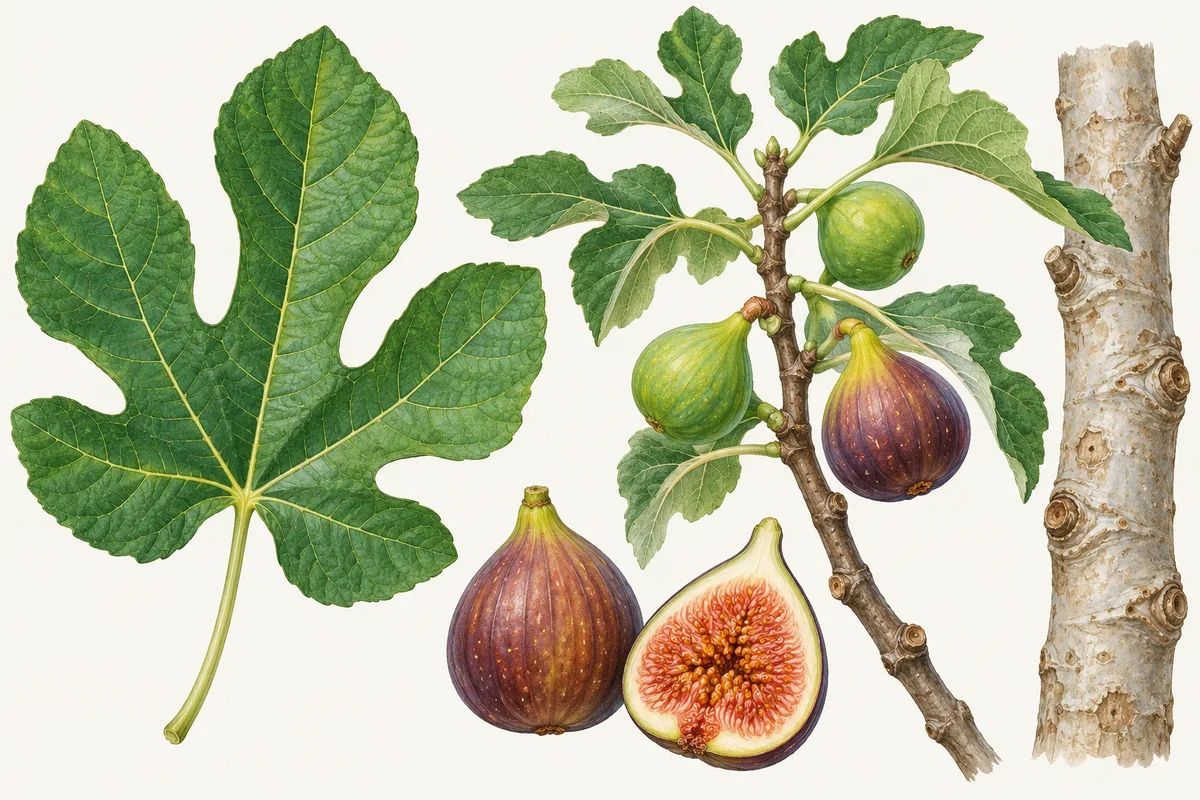
In short
Fig tree identification starts with the leaf: alternate, very large (5 to 10 inches long), deeply cut into 3 to 5 lobes, sometimes 7, thick and rough like sandpaper on top. Then check for milky sap when a leaf or twig is snapped, and smooth silver-gray bark on a low, spreading, often many-stemmed tree 10 to 30 feet tall.
- Big, palm-like leaf, deeply lobed, rough on top, alternate on the twig: common fig.
- Milky sap is a fig trait, but mulberry has it too: mulberry leaves are toothed all round and smaller.
- Fig sap can irritate skin and cause a sun-triggered rash: wear gloves when you cut or handle the tree.
Field marks at a glance
- Scientific name
- Ficus carica
- Family
- Moraceae (mulberry family)
- Type
- Broadleaf, deciduous
- Leaves
- Alternate, simple, 5 to 10 inches long and 4 to 7 inches wide (NC State); up to 1 foot (UF/IFAS). Deeply, palmately lobed, usually 3 or 5 lobes, up to 7 (Morton).
- Leaf surface
- Thick, rough and hairy on top like sandpaper; paler underneath. UF/IFAS notes the leaf hairs can irritate skin.
- Sap
- Copious milky latex in every part. It contains furanocoumarins and can cause contact dermatitis and phytophotodermatitis (NC State).
- Bark and twigs
- Bark smooth and silver-gray when young, becoming bumpy with age. Twigs brown to copper, each with one terminal bud larger than the side buds.
- Fruit
- A fleshy, hollow, pear-shaped or top-shaped receptacle (a syconium), 1 to 4 inches long, yellowish-green, coppery, bronze or dark purple depending on the variety. Ripens late summer to fall.
- Flowers
- Hidden inside the young fruit, so the tree never shows open blossoms.
- Form and size
- Low, spreading, often multi-stemmed shrub or small tree, 10 to 30 feet tall and wide; suckers can form thickets. Seldom over 25 feet in the Southeast because of cold injury (UF/IFAS).
- Range
- Native from the Mediterranean to Central Asia. Grown outdoors in USDA zones 7 to 10; dormant trees are hardy to about 15 to 20°F.
The common fig (Ficus carica) is a low, spreading tree from the Mediterranean and western Asia, grown outdoors in the warmer US zones (7 to 10) and as a garden tree far beyond its native range. Its leaf is one of the easiest in the garden to recognize once you know what to feel for, and three checks settle it: the leaf, the sap and the bark.
How to identify a fig tree: leaf, sap, bark
1. Look at a leaf, then touch it. NC State's common fig profile describes simple, alternate leaves 5 to 10 inches long and 4 to 7 inches across, deeply and palmately lobed with three or five lobes, rough and hairy on top and paler underneath. Julia Morton's Fruits of Warm Climates entry on fig, published by Purdue, gives blades up to 10 inches long and wide, deeply divided into 3 to 7 main lobes, fairly thick and rough on the upper surface. Run your thumb over the top: it feels like fine sandpaper. UF/IFAS's The Fig adds that leaf hairs can irritate skin, so a brief touch is enough.
2. Snap a leaf stalk. Fig contains copious milky latex in every part (Morton). A white drop at the break, plus a big, rough, deeply lobed leaf, is a fig. Wash it off promptly: NC State says the sap contains furanocoumarins and can cause contact dermatitis and phytophotodermatitis, a rash that appears when skin touched by the sap is exposed to sunlight.
3. Check the bark and shape. Young bark is smooth and silver-gray, becoming bumpy with age (NC State). Figs are usually low and wide: NC State describes a multi-stemmed, spreading shrub or tree with a rounded habit, 10 to 30 feet tall and wide, that produces many suckers and can form thickets. Morton notes a trunk rarely more than 7 inches (17.5 cm) in diameter.
If the leaf is large, rough and deeply lobed, the sap is milky, and the bark is smooth and gray, you have a common fig.
Fig fruit and the hidden flowers
A fig never shows open blossoms, which puzzles many gardeners. The flowers are hidden inside a hollow receptacle near the branch tips, in the leaf axils (NC State). That receptacle swells into the fruit, which botanists call a syconium.
Morton describes the fruit as pear-shaped or top-shaped, 1 to 4 inches (2.5 to 10 cm) long, ranging from yellowish-green to coppery, bronze or dark purple by variety. NC State says it ripens in late summer or fall on new wood, sometimes with a small second crop in spring. UF/IFAS lists cultivar skin colors of black, purple, pink, yellow and green. Common garden figs in North America set fruit without pollination (NC State), so a single tree in a yard fruits on its own; wild figs depend on small wasps.
Fruit color helps tell varieties apart, but it does not identify the variety by itself. UF/IFAS mentions Brown Turkey and Celeste as more cold hardy than many other cultivars; naming a cultivar needs records or a specialist. For the other fruit trees in a backyard, the fruit tree identification guide compares apple, pear, cherry, plum and peach.
Fig vs mulberry and maple
Two groups get mistaken for a fig, and NC State names the mulberries as the commonest.
| Tree | Leaf | Leaf arrangement |
|---|---|---|
| Common fig | 5–10 in, thick, rough on top, 3–7 deep lobes; milky sap | Alternate |
| Mulberry | Usually 3–6 in, toothed all round, mixed shapes; milky sap | Alternate |
| Maples | Palm-shaped, lobed | Opposite |
Mulberries. Mulberries are in the same family and also bleed milky sap. The difference is in the edge and the size: mulberry leaves are usually 3 to 6 inches long and toothed all the way around, with unlobed, mitten-shaped and lobed leaves mixed on one tree, as the mulberry page explains. Fig leaves are bigger, thicker and deeply lobed on most leaves, and the fruit is a single pear-shaped fig rather than a cluster like a blackberry.
Maples. A young fig with a few leaves can pass for a maple at a glance. Check how the leaves sit on the twig: maples grow their leaves in opposite pairs (see the maple identification page), while fig leaves alternate, one per node. Fig leaves are also much thicker and rougher.
For other trees with very large leaves, from catalpa to bigleaf magnolia, the trees with big leaves guide sorts them by leaf shape.
Where figs grow and how cold limits them
NC State gives the native range as the Mediterranean through Central Asia, and the name carica refers to Caria, a region of southwestern Turkey. Morton says fig remains have been found in Neolithic sites dated to at least 5,000 B.C., and that figs reached Mexico in 1560 and Virginia in 1669.
In the US, cold decides where a fig grows as a tree. NC State lists USDA zones 7a to 10b. UF/IFAS says fully dormant trees are hardy to about 15 to 20°F, that dormant buds are more vulnerable than wood, and that cold injury to trunks and limbs is why most figs in the Southeast grow as bushes, seldom taller than 25 feet, though a fig can reach 50 feet. A fig in a cold region that keeps dying back to a clump of stems is behaving normally.
Using a photo to confirm it
Tree Identifier names a tree from one photo of the whole tree, a leaf, the bark or the fruit. For a fig, the clearest picture is one whole leaf laid flat, top side up, with its stalk; add a photo of the fruit if there is any. Common fig is among the 138 species in the app's Collection, so an identified fig fills in its card. The app shows no confidence score and no look-alike list, so if it suggests fig, confirm with the rough upper surface and the milky sap. The Care Guide and the follow-up chat can answer questions about pruning or winter protection, and the Toxicology tool gives AI-written notes on the sap for people, dogs and cats.
Look-alikes and how to tell them apart
Mulberries (Morus alba, Morus rubra)
Mulberry leaves also bleed milky sap and can be lobed, but they are smaller, usually 3 to 6 inches, and toothed all around the edge, with unlobed and mitten-shaped leaves mixed on one tree. Fig leaves are bigger, thick and deeply cut into 3 to 7 lobes on nearly every leaf.
Maples (Acer)
Maple leaves are palm-shaped too, but they grow in opposite pairs on the twig. Fig leaves are alternate, much thicker and rough on top, and every fig twig bleeds milky latex.
What a photo can't settle
- Fig leaf shape varies by variety and even on one tree: some leaves are barely lobed. A single leaf photo can be mistaken for a mulberry; photograph several leaves and a broken twig showing the latex.
- Sources differ on the leaf underside: NC State calls it smooth, Morton softly hairy. Use the rough upper surface, not the underside, as the test.
- Naming the fig variety (Brown Turkey, Celeste and others) needs the fruit, nursery records or a specialist; a photo app identifies the species, not the cultivar.
Questions people ask
What does a fig tree leaf look like?
Large and hand-shaped: 5 to 10 inches long and 4 to 7 inches wide in NC State's description, deeply cut into 3 or 5 lobes (up to 7, says Morton). The upper side is thick and rough like sandpaper, the underside paler. Leaves sit alternately along the twig, one per node.
How can I tell a fig tree in winter?
Look at the bark and twigs. A fig has smooth, silver-gray bark on young stems, a low, often many-stemmed shape, and stout brown to copper twigs with one terminal bud larger than the side buds (NC State). A snapped twig still bleeds milky latex.
Is fig sap harmful?
It can be. NC State lists the milky sap as the plant's poisonous part, containing furanocoumarins that can cause contact dermatitis and phytophotodermatitis, a rash triggered by sunlight. Morton warns that latex from any part may be severely irritating to the skin if not removed promptly. Wear gloves when pruning.
Why does my fig tree never flower?
It does, but you cannot see it. The flowers are hidden inside the young fruit, a hollow receptacle called a syconium (NC State). Common garden figs in North America set fruit without pollination, while wild figs depend on tiny wasps that enter the fruit.
How big does a fig tree get?
Usually 10 to 30 feet tall and wide (NC State; Morton). UF/IFAS notes figs can reach 50 feet but are seldom taller than 25 feet in the southeastern US, where periodic cold injury keeps most of them as multi-branched shrubs.
Sources
- Ficus carica (Common Fig) — NC State Extension, North Carolina Extension Gardener Plant Toolbox
- Fig, in Fruits of Warm Climates (Julia F. Morton, 1987) — Purdue University, Center for New Crops and Plant Products
- The Fig (HS27/MG214) — UF/IFAS Extension (Ali Sarkhosh and Peter C. Andersen)