Tree profile
Gambel oak (Quercus gambelii): how to identify it
The oak of the Rocky Mountain foothills, where it grows as dense thickets of stems from one root system, as pole-sized clumps or, less often, as a real tree.
In short
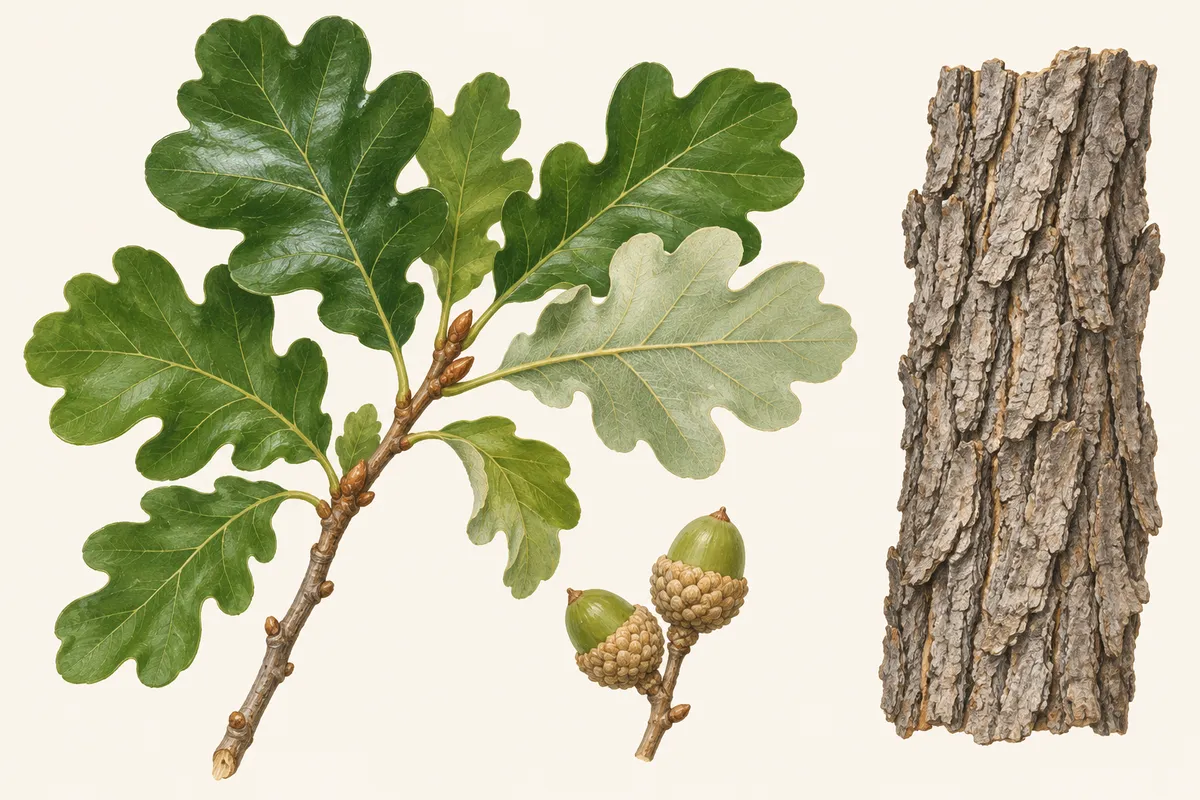
Gambel oak identification starts with the leaf: 3 to 6 inches long, deeply cut into 5 to 9 rounded lobes with no bristle tips, glossy above and paler, often hairy, below. Acorns are 1/2 to 1 inch long in a scaly cap covering a quarter to half the nut, ripening in one season. Most Gambel oaks grow as thickets of stems that sprout from a shared root system.
- Utah State University calls it the common scrub oak of the Wasatch foothills: oak brush on a dry Rocky Mountain foothill is usually Gambel oak.
- It is a white oak: rounded lobes with no bristles and acorns that ripen in a single season.
- A patch of oak brush is often one plant: Utah State University describes large underground lignotubers that send up new stems after fire or cutting.
Field marks at a glance
- Scientific name
- Quercus gambelii
- Family
- Fagaceae (beech family)
- Type
- Broadleaf, deciduous
- Leaves
- Alternate, simple, 3 to 6 inches long (Utah State: 2 1/2 to 7), widest above the middle, 5 to 9 rounded lobes, cut moderately to deeply, sometimes almost to the midrib; leathery.
- Leaf surfaces
- Glossy green, smooth above; paler below, from smooth to densely hairy. Fall color yellow, orange, red or brown.
- Acorns
- 1/2 to 1 inch long, egg-shaped, brown, single or paired, stalkless or short-stalked, in a warty, hairy cap covering 1/4 to 1/2 of the nut; ripen in one season.
- Twigs and buds
- Stout, orange- to red-brown and hairy; brown, blunt end buds clustered at the tip.
- Bark
- Thin and light on young stems; older stems gray-brown, scaly to platy, sometimes furrowed or ridged.
- Growth form
- Thickets of small stems, pole-sized clumps or single trees; usually 6 to 30 ft (Utah State), up to about 60 to 65 ft.
- Range
- Southwestern US (Utah, Colorado, Arizona, New Mexico) and northwestern Mexico; foothills and lower mountains of the southern and central Rockies.
- Habitat
- Dry foothills, lower mountain slopes and canyon walls, about 4,000 to 8,000 ft in Utah; often with ponderosa pine, bigtooth maple and serviceberry.
Gambel oak is the oak brush that covers the foothills of the Wasatch, the Colorado Front Range and the mesas of the Southwest. Most of it does not look like an oak tree at all: it forms dense patches of stems a few feet to a few yards high, often with open gaps between them. Up close, the leaf gives it away. It is a classic white oak leaf, deeply lobed with rounded lobes and no bristles, on a plant that may be shorter than you.
How to identify a Gambel oak
1. A deeply lobed, round-lobed leaf. The Virginia Tech Gambel oak fact sheet describes alternate leaves 3 to 6 inches long and 2 to 3 inches wide, widest above the middle, with 5 to 9 rounded lobes cut moderately to deeply, leathery, yellow-green and smooth above and paler beneath. Utah State University's tree identification page gives 2 1/2 to 7 inches and 7 to 9 lobes, dark green and hairless above, pale and hairy below. Oregon State University notes sinuses that sometimes reach almost to the midrib.
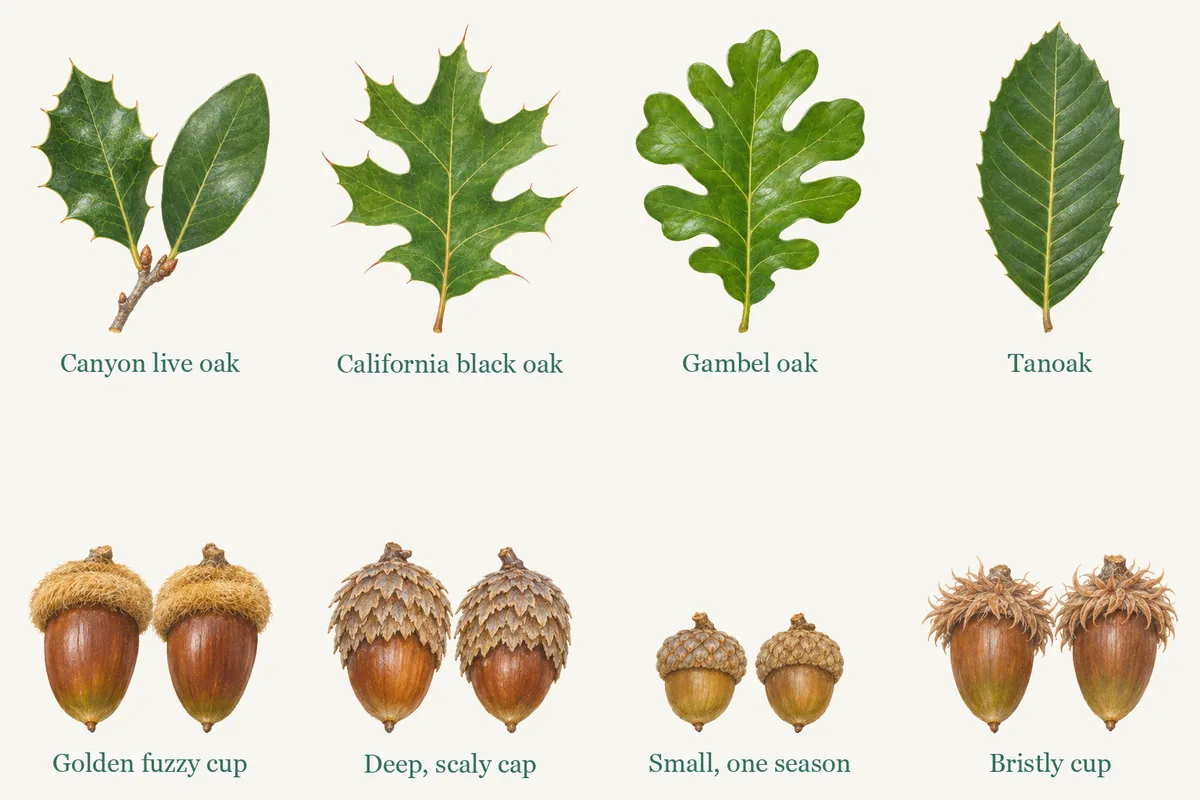
2. No bristles. Run a finger around the lobes: they are rounded, with no bristle tips. That puts Gambel oak in the white oak group, explained on the oak identification page.
3. A small acorn in a deep, scaly cap. Virginia Tech gives acorns about 1 inch long, single or in clumps, maturing in one season. Utah State gives 1/2 to 3/4 inch, brown, stalkless or short-stalked, a quarter to half enclosed in a warty, hairy cap. Oregon State's landscape plants page gives 1.5 to 2 cm, egg-shaped, the cup enclosing a quarter to half of the nut.
4. Hairy twigs. Twigs are stout, orange- to red-brown and hairy, with blunt brown buds clustered at the tip (Utah State).
5. The growth form. A clump of many stems, in a patch with other clumps, on a dry foothill slope, is typical. Single trees occur too, especially in ponderosa pine forests.
Tree Identifier can name a Gambel oak from one photo of a leaf or an acorn. It shows one name without a confidence score or a list of look-alikes, so check the rounded lobes and the acorn cap against the marks above.
Thickets, clumps and trees
Gambel oak's shape depends on its history more than its species. A USDA Forest Service research note on Gambel oak growth forms describes clones in southwestern ponderosa pine forests and recognizes three basic forms: shrubby thickets of small-diameter stems, pole-sized clumps and large trees. Shrubby forms give browse and cover but produce few acorns; large oaks produce more acorns. Pole-sized clumps can develop from thickets as stems thin themselves, and burning or cutting keeps thickets in the shrub form by stimulating sprouts.
The Utah State University range plants page explains why: Gambel oak reproduces from seed, root sprouts and tillers, and its large underground lignotuber supports rapid, extensive sprouting after the tops are removed. Across most of its range, it regenerates more by sprouting than by seed. So a whole hillside of oak brush may be a handful of plants, each with many stems.
Utah State's forestry page adds that it is very drought tolerant and shade intolerant, and fire-prone on native sites.
Gambel oak vs bur oak, Oregon white oak and maples
| Mark | Gambel oak | Bur oak | Oregon white oak |
|---|---|---|---|
| Leaf | 3–6 in, 5–9 rounded lobes | 6–12 in, two middle sinuses nearly to the midrib | 3–6 in, 5–9 irregular rounded lobes, often touching |
| Acorn | 1/2–1 in, cap covers 1/4–1/2 | About 1 1/2 in, cap with a long fringe covers about 1/2 | About 1 in, shallow bowl over about 1/3 |
| Twig | Stout, red-brown, hairy | Stout, yellow-brown, often corky ridges | Stout, hairy at first, then smooth |
| Usual form | Thickets and clumps; trees to 60–65 ft | Large tree, often over 100 ft | Tree 40–80 ft |
Figures come from the Virginia Tech fact sheets for bur oak, Oregon white oak and Gambel oak. Bur oak matters because nurseries sell Gambel × bur hybrids (Utah State); a planted oak in a Colorado or Utah yard with large, fringed acorns is probably not a pure Gambel oak. The bur oak page has the full profile.
Bigtooth maple grows with Gambel oak in Utah canyons, and both color the foothills in fall. The maple's leaves sit in opposite pairs and it bears paired winged seeds; the oak's leaves alternate along the twig, crowd toward the tip, and it bears acorns.
Where Gambel oak grows
Oregon State University gives a native range in the southwestern US (Arizona, Utah, Colorado and New Mexico) and northwestern Mexico, above about 5,000 feet in the Rocky Mountains. Utah State's forestry page calls it native to most of the Utah foothills, the Intermountain West and the southern and central Rockies, and the common scrub oak along the Wasatch foothills. Utah State's range plants page puts it at about 4,000 to 8,000 feet in Utah, on dry foothills and canyon walls with 12 to 25 inches of rain a year, with its northern limit at Sardine Canyon in Box Elder County.
Its common neighbors there are chokecherry, bigtooth maple, ponderosa pine and serviceberry. The Rocky Mountain tree identification guide covers the conifers above it.
Why Gambel oak is so common
Counting stems favors Gambel oak. In the USDA Forest Service's Forest Inventory and Analysis data, it ranks tenth among all US tree species by number of live trees on forest land, and it is the most numerous tree of the Rocky Mountain region; our most common trees in the US guide has the full ranking. Each clump of brush contributes many small stems.
For wildlife it is a staple. Utah State says livestock, deer, elk and small mammals browse it, livestock and wildlife eat the acorns, and it gives good winter habitat and cover for mule deer. It also reports that the shoots can poison cattle in spring when they eat little else, and that frost-blackened young leaves are extremely toxic to them. With location turned on, Tree Identifier's Tree Map pins the find, so you can come back in September to check the acorns, which ripen the same year.
Look-alikes and how to tell them apart
Bur oak (Quercus macrocarpa)
Bur oak leaves are bigger, 6 to 12 inches, with two middle sinuses that nearly reach the midrib, and its acorn is about 1 1/2 inches in a cap with a long fringe. Gambel oak acorns are under an inch, with no fringe. Planted Gambel × bur hybrids mix both.
Oregon white oak (Quercus garryana)
Virginia Tech lists the two as look-alikes. Oregon white oak is a tree 40 to 80 feet tall, 2 to 3 feet across, with a shallow acorn cap covering about a third of the nut, not as foothill thickets.
Bigtooth maple (Acer grandidentatum)
Bigtooth maple grows with Gambel oak in Utah canyons and also has lobed leaves that color in fall. Its leaves grow in opposite pairs and its fruit is a pair of winged seeds; Gambel oak leaves alternate along the twig and it bears acorns.
What a photo can't settle
- Gambel × bur oak hybrids are sold by nurseries (Utah State University), and Gambel oak leaves vary in lobe depth and in hairiness underneath, from smooth to densely hairy (Virginia Tech); one leaf may not be typical.
- Thicket stems are small and their bark is not yet characteristic, so the leaf and acorn carry the identification.
- Tree Identifier gives one name for one photo, with no confidence score and no list of alternatives; in the Southwest, where several scrub oaks meet, treat that name as a starting point.
Questions people ask
Is Gambel oak a shrub or a tree?
Both. Virginia Tech describes a small to medium tree up to 65 feet or a thicket-forming shrub, and Utah State University gives 6 to 30 feet as usual. A USDA Forest Service research note recognizes three basic forms: shrubby thickets of small stems, pole-sized clumps and large trees.
Why does Gambel oak grow in thickets?
It spreads underground. Utah State University Extension says it reproduces from seed, root sprouts and tillers, and that its large underground lignotuber supports rapid, extensive sprouting after fire or cutting. Across most of its range, new stems come more from sprouting than from acorns.
Is Gambel oak toxic to livestock?
Utah State University Extension reports that the shoots contain tannic acid and that cattle, and occasionally sheep, may be poisoned in March and April, usually when Gambel oak makes up more than half the diet. It notes that young foliage blackened by frost is extremely toxic.
Where does Gambel oak grow?
Oregon State University gives a native range in Arizona, Utah, Colorado and New Mexico and in northwestern Mexico. Utah State University places it on dry foothills and canyon walls at about 4,000 to 8,000 feet, and says its northern limit in Utah is Sardine Canyon in Box Elder County.
How common is Gambel oak?
Very. In the USDA Forest Service's Forest Inventory and Analysis count of live trees on US forest land, Gambel oak ranks tenth of all species, and the most numerous tree of the Rocky Mountain region, because its thickets hold so many small stems.
Sources
- Gambel oak (Quercus gambelii) fact sheet — Virginia Tech Dendrology
- Gambel Oak, Tree Identification — Utah State University Extension, Forestry
- Gambel Oak, Range Plants of Utah — Utah State University Extension
- Quercus gambelii — Landscape Plants, Oregon State University
- Gambel oak growth forms: management opportunities for increasing ecosystem diversity (RMRS-RN-37) — USDA Forest Service, Rocky Mountain Research Station
- Oregon white oak (Quercus garryana) fact sheet — Virginia Tech Dendrology
- Bur oak (Quercus macrocarpa) fact sheet — Virginia Tech Dendrology
Keep reading
- Tree profileOak trees (Quercus): how to identify them
- Tree profileBur oak (Quercus macrocarpa): how to identify it
- Tree profileWhite oak (Quercus alba): how to identify it
- Regional guideRocky Mountain tree identification, from foothills to treeline
- Data guideThe most common trees in the US, by number of trees