Tree profile
Gray birch (Betula populifolia): how to identify it
The small white birch of old fields, road cuts and burned land in the Northeast: chalky bark that stays tight, a black chevron under every branch, and leaves shaped like a poplar's.
In short
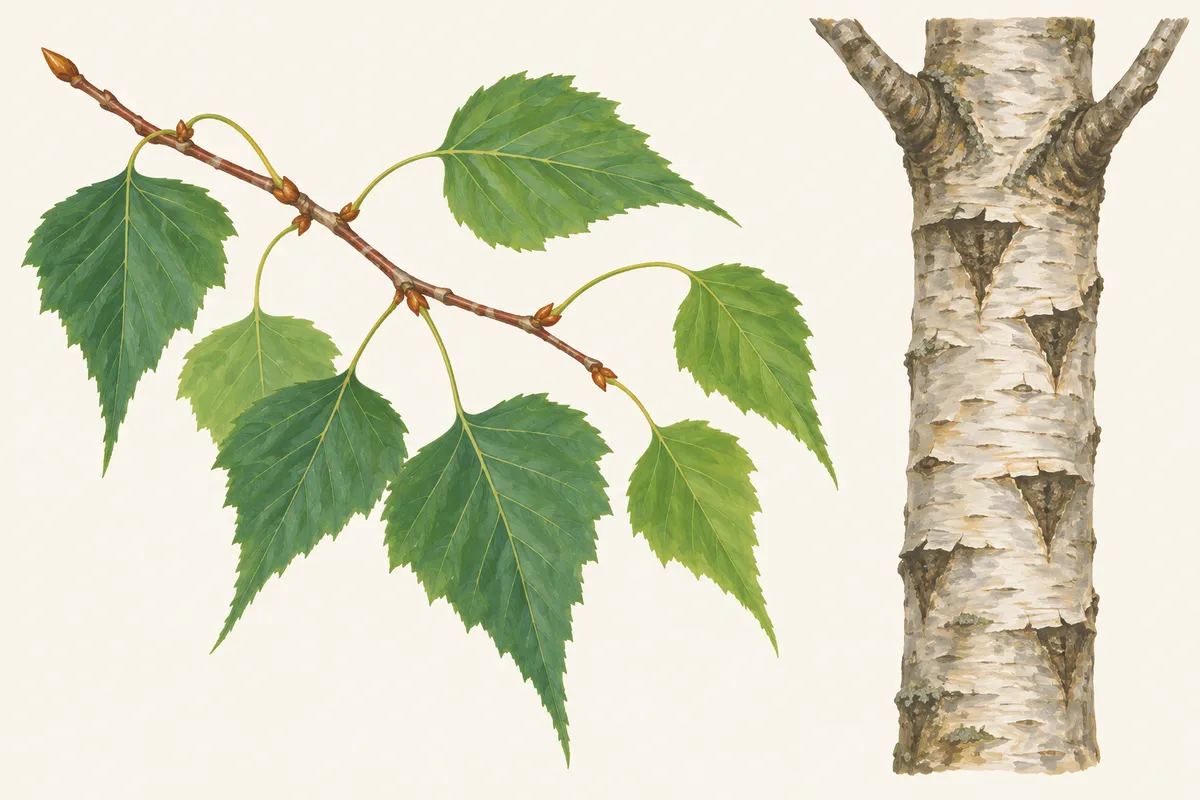
Gray birch identification starts with the bark: dull, chalky white, smooth and tight, not peeling in sheets like paper birch, with black triangular patches below each branch. The leaves are triangular with a long, tapering tip and a nearly straight base, about 4 to 7 cm long and doubly toothed. Trunks are thin, often several together and leaning, rarely over 30 to 40 feet tall.
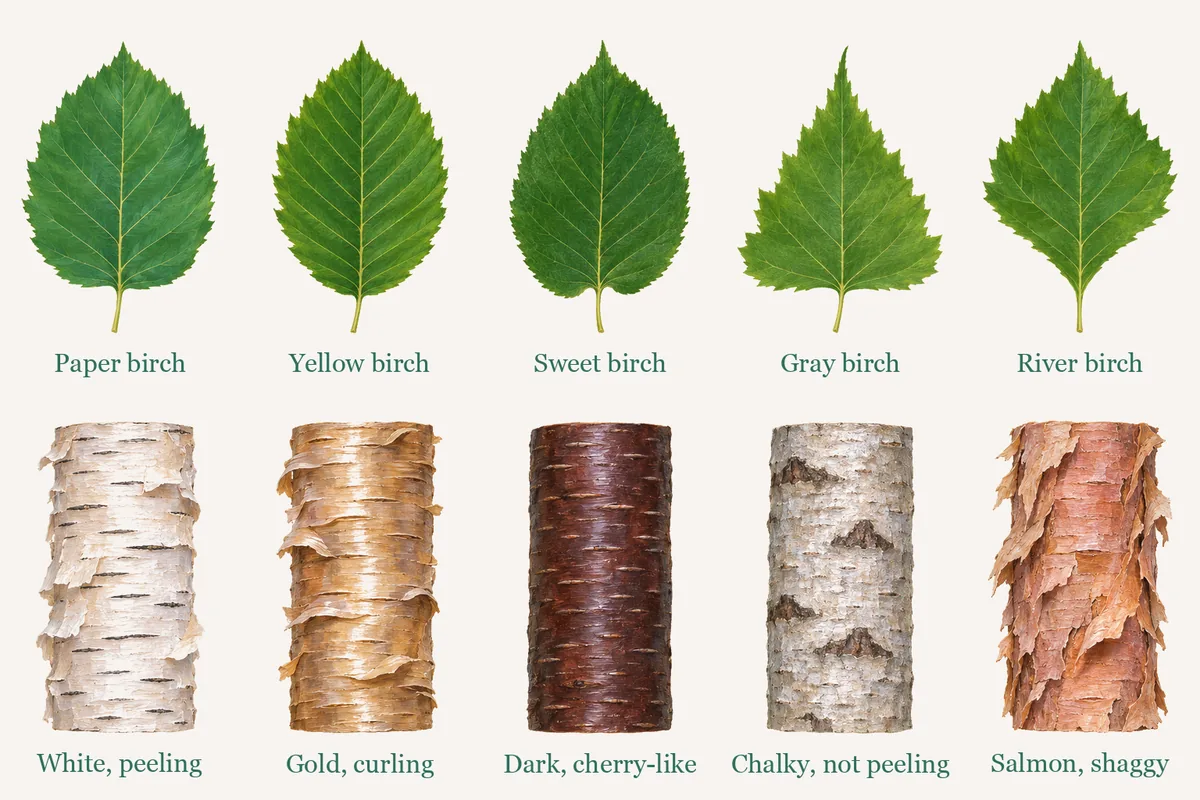
- White bark that does not peel, with a black triangle under every branch: gray birch. White bark peeling in papery sheets: paper birch.
- The leaf is a triangle drawn out into a long point, like a poplar leaf, which is where the name populifolia comes from.
- Gray birch catkins usually hang singly; paper birch's often come in groups of 2 to 4, according to Go Botany.
Field marks at a glance
- Scientific name
- Betula populifolia
- Family
- Betulaceae (birch family)
- Type
- Broadleaf, deciduous
- Leaves
- Alternate, simple, triangular with a long, tapering tip and a base almost straight across; 4 to 7 cm (NRCan; UConn gives 2 to 3.5 inches), doubly toothed, shiny dark green, rough above.
- Bark
- Reddish-brown on young stems, then dull chalky white, smooth and tight; generally does not peel, or only with difficulty in small thin plates.
- Branch marks
- Black triangular patches below the branches, where they meet the trunk; Go Botany calls them chevron-like.
- Twigs and buds
- Slender, orange-brown to gray, rough with warty, raised lenticels (Virginia Tech); buds pointed, gummy, light brownish-gray; no terminal bud.
- Catkins
- Male catkins usually single, 6 to 10 cm at pollination; seed catkins 1.5 to 2 cm, narrow and semi-erect, breaking apart in late autumn and early winter.
- Form
- Small, often several trunks from one base, usually curved and leaning; narrow, irregular, open crown with slender branches.
- Size
- Rarely over 30 ft (Virginia Tech); up to 12 m and 15 cm across (NRCan); 20 to 40 ft (UConn); 35 to 50 ft planted (UMaine Extension).
- Fall color
- Yellow (UMaine Extension, UConn).
- Range and habitat
- Northeastern United States and northeastern Canada, including all six New England states and the Maritime provinces; sandy or gravelly soils, old pastures, road cuts, cut and burned land.
Gray birch is the small white birch of the Northeast that grows where little else will: abandoned pastures, gravel pits, road cuts, clearcuts and burned ground. It is often mistaken for a young paper birch, and in gardens for a European white birch. Three marks sort it out quickly: bark that stays tight instead of peeling, a black triangle under every branch, and a triangular leaf drawn out into a long point.
How to identify a gray birch
Check these in order; two or three matches settle it.
1. Bark: chalky white, tight, not peeling. Virginia Tech's gray birch fact sheet describes bark that turns gray to white and chalky with age, stays fairly smooth and generally does not peel. Natural Resources Canada's grey birch factsheet says it peels only with difficulty, in small thin rectangular plates.
2. Black triangles under the branches. Where each branch meets the trunk, the bark carries a black triangular patch. University of Maine Extension calls these patches prominent, and Go Botany describes them as gray chevron-like markings.
3. Leaf: a triangle with a long tip. NRCan gives a triangular leaf 4 to 7 cm long with a long, tapering tip and a base almost straight across, shiny dark green, rough on top, with doubly toothed edges and 6 to 9 veins per side. The shape recalls a poplar leaf, the meaning of populifolia. NRCan describes them as pendulous, on slender stalks.
4. Twig: rough to the touch. Run a twig through your fingers. Virginia Tech describes slender orange-brown to gray twigs made rough by raised, warty lenticels, with slender pointed buds and no terminal bud. NRCan adds many resin glands.
5. Form: thin, leaning, in clumps. Gray birch is small and often grows several trunks from one base. NRCan describes trunks that are usually curved and leaning, and a narrow, open crown of slender branches; older branches are often S-shaped.
Tree Identifier can name a birch from one photo of the bark or a leaf. For gray birch, frame a section of trunk that includes a branch junction so the black triangle shows, then check the leaf tip against step 3; the app returns one name, with no confidence score and no list of look-alikes.
Gray birch vs paper birch and European white birch
| Mark | Gray birch | Paper birch | European white birch |
|---|---|---|---|
| Bark | Chalky white, tight, generally not peeling | Peeling in papery sheets | — |
| Leaf tip | Long, tapering | Pointed, not long-tapering | — |
| Vein pairs | 5–7 (Go Botany), 6–9 (NRCan) | 7–9 | — |
| Catkins | Usually single; female 10–25 mm | Fruiting catkins often 2–4 together | Male usually paired; female 23–40 mm |
| Branches | Spreading to ascending | — | Drooping on mature trees |
Comparisons come from Go Botany's gray birch page. Go Botany gives no bark or leaf-tip contrast for European white birch, so check its drooping branches and paired male catkins first. The paper birch page covers that tree's peeling bark and larger size, and the birch page sets gray birch beside river, yellow and black birch.
White bark is not only a birch trait. Quaking aspen also has pale, smooth bark, and the birch vs aspen page shows how the leaf stalk and the bark marks separate them. The white bark guide gathers every common tree with pale bark.
Where gray birch grows
UConn's plant database gives the native range as the northeastern United States and northeastern Canada; Go Botany lists it in all six New England states, and NRCan in the Maritime provinces. It is a pioneer. NRCan describes it on sandy or gravelly soils of any moisture, often in clumps, forming pure stands on abandoned pastures and recently cut or burned land, and intolerant of shade, so longer-lived trees eventually replace it. University of Maine Extension's native tree bulletin adds that it often grows with quaking aspen, bigtooth aspen and paper birch. The New England tree guide places it among those neighbors.
Size, lifespan and what bends it
Sources give different sizes, partly because wild and planted trees differ: Virginia Tech says rarely over 30 feet, NRCan up to 12 m tall and 15 cm across, UConn 20 to 40 feet, and University of Maine Extension 35 to 50 feet for planted trees. NRCan gives a maximum age of about 50 years.
Bent-over gray birches are a common sight after winter storms: UConn describes the tree as very prone to being bent or snapped by ice and heavy snow. UConn also names birch leafminer as its main limitation, disfiguring but not fatal, while University of Maine Extension says gray birch has the greatest resistance to bronze birch borer among native birches. Fall color is yellow.
Gray birch (Betula populifolia) is not in Tree Identifier's 138-species Collection; paper birch and silver birch (Betula pendula) are. With location turned on, the app's Tree Map pins the find, so you can come back in late summer when the new male catkins form at the twig tips.
Look-alikes and how to tell them apart
Paper birch (Betula papyrifera)
Paper birch bark peels in papery sheets; gray birch bark stays tight and chalky with black triangles under the branches. Paper birch leaves are pointed but not drawn out into a long tip and have 7 to 9 vein pairs, and its fruiting catkins often hang 2 to 4 together.
European white birch (Betula pendula)
Mature European white birches usually have drooping, weeping branches; gray birch branches spread or ascend. Male catkins on European white birch usually come in pairs, singly on gray birch, and its female catkins are larger, 23 to 40 mm against 10 to 25 mm (Go Botany).
What a photo can't settle
- Young gray birches have reddish-brown bark, not white; on saplings, use the triangular leaf and the warty twig instead.
- Go Botany notes that many old herbarium records of European white birch in the region were misidentified hybrids or related birches, and gray birch hybridizes with mountain paper birch (the uncommon blue birch); an odd white birch may not match either parent.
- Planted cultivars such as 'Whitespire' have whiter bark than the wild species (UMaine Extension), which weakens the chalky-bark clue in gardens.
Questions people ask
How do you tell gray birch from paper birch?
Look at the bark and the leaf tip. Paper birch bark peels in thin, papery sheets; gray birch bark stays tight, dull and chalky, with black triangles under each branch. Gray birch leaves are triangular with a long, drawn-out tip; paper birch leaves are more oval, pointed but without the long tip.
Does gray birch bark peel?
Hardly. Virginia Tech says gray birch bark generally does not peel, and Natural Resources Canada says it peels only with difficulty, into small, thin, rectangular plates. Bark that comes off in large curling sheets points to paper birch.
Why do gray birches bend over?
Their trunks are thin and flexible. The UConn Plant Database describes gray birch as very prone to being bent over or snapped off by ice storms or heavy snow, and Natural Resources Canada notes that trunks are usually curved and leaning.
How long does a gray birch live?
Not long. Natural Resources Canada gives a maximum age of about 50 years, and UConn calls it short-lived. It is a pioneer of open, disturbed ground that is eventually replaced by more shade-tolerant, longer-lived trees.
Sources
- Gray birch fact sheet — Virginia Tech Dendrology
- Grey birch (Betula populifolia), Trees, insects and diseases of Canada's forests — Natural Resources Canada
- Betula populifolia (gray birch) — Go Botany, Native Plant Trust
- Bulletin #2567, Native Trees and Shrubs for Maine Landscapes: Gray Birch — University of Maine Cooperative Extension
- Betula populifolia (Gray Birch) — UConn Plant Database, University of Connecticut
Keep reading
- Tree profileBirches (Betula): how to identify a birch tree
- Tree profilePaper birch (Betula papyrifera): how to identify the white birch
- Clue guideWhich tree has white bark? Sort it by peel, leaf and region
- Tree comparisonBirch vs aspen: how to tell the two white-barked trees apart
- Regional guideNew England tree identification, north to south