Tree profile
Lodgepole pine (Pinus contorta): how to identify it
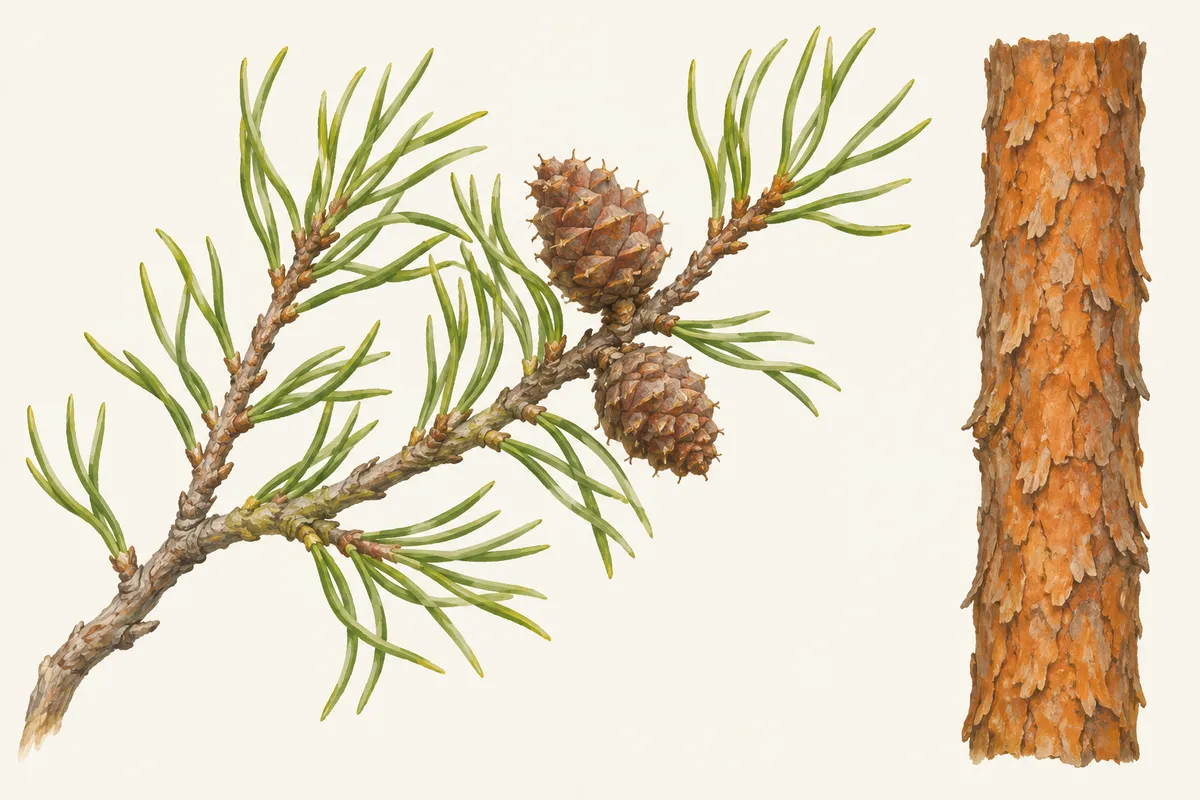
Two short, twisted needles, a small lumpy cone that often stays closed on the branch, thin scaly bark and a pole-straight trunk: the pine that fills burned slopes across the West.
In short
Lodgepole pine identification starts with the needles: two per bundle, twisted, yellow-green and 1 1/2 to 3 inches long. The cones are small, 1 to 2 inches, often lopsided and lumpy near the base, with a short prickle on each scale, and many stay closed on the tree for years. The bark is thin and finely scaly, and inland trees grow tall and slender in dense stands.
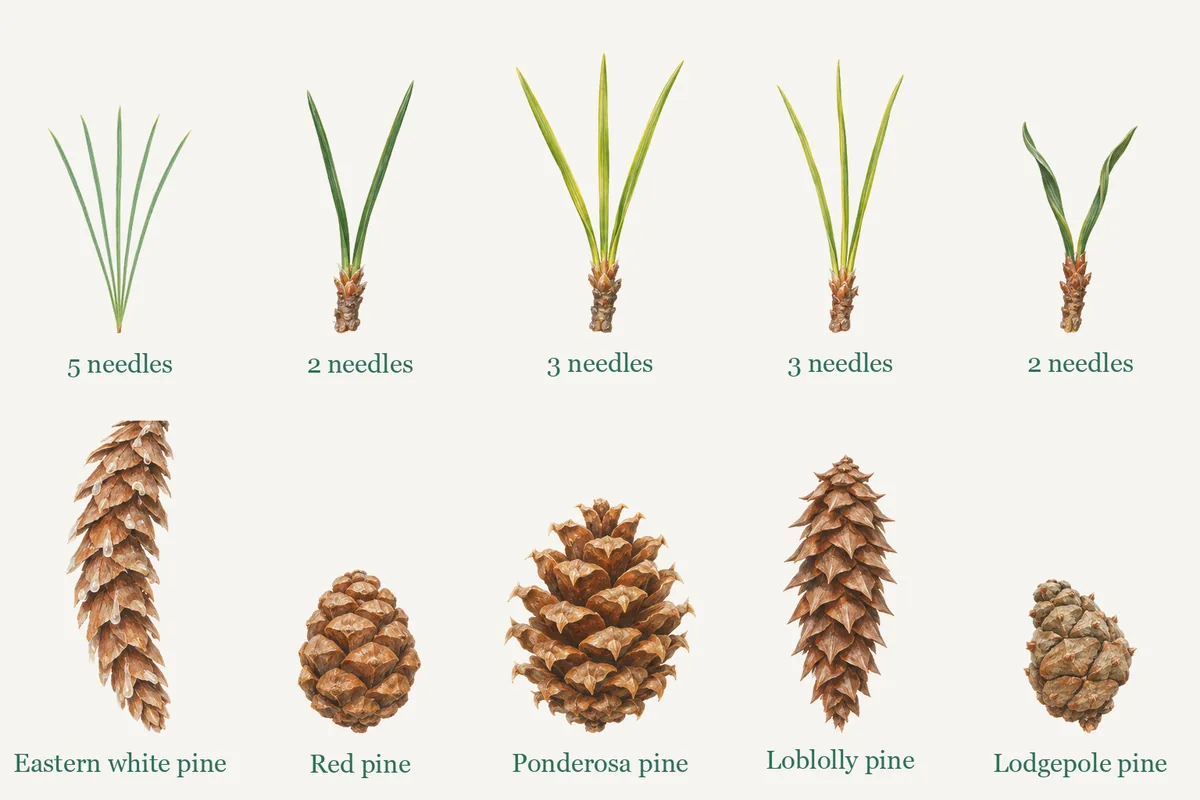
- Two needles per bundle and a cone no longer than 2 inches rule out ponderosa pine, which has needles 5 to 10 inches long, mostly in threes, and cones 3 to 6 inches.
- Closed cones clinging to the branches for years are typical of Rocky Mountain lodgepole; their resin seal breaks at 113 to 140°F, the heat of a fire.
- On the Pacific coast the same species grows as shore pine, a short, often scrubby tree whose cones usually open soon after they ripen.
Field marks at a glance
- Scientific name
- Pinus contorta
- Family
- Pinaceae (pine family)
- Type
- Conifer, evergreen
- Needles
- 2 per bundle, 1 1/2 to 3 inches long, twisted, yellow-green to green, with a sheath at the base (Virginia Tech). Natural Resources Canada gives 3 to 7 cm for the inland variety, stiff and sharp-pointed.
- Cones
- 1 to 2 inches, light to medium brown, often asymmetrical and lumpy near the base, a short prickle on each scale; stalkless. Many stay closed on the tree for years.
- Cone timing
- Cones mature August to October, turning from purple-green to light brown (USDA Forest Service); Natural Resources Canada says closed cones can persist 10 to 20 years.
- Twigs and buds
- Twigs orange-brown, darkening with age; buds narrowly egg-shaped, reddish brown and resinous, up to 15 mm.
- Bark
- Thin, under 2 cm thick, grayish brown to orange-brown, broken into many small, fine scales; it stays fairly even on older trees.
- Form
- Inland: tall and slender with a narrow crown, up to about 80 ft (Virginia Tech) or 30 m (Natural Resources Canada), often in dense even-aged stands. Coast: 20 to 40 ft, often scrubby.
- Range
- From about 64° N in the Yukon to about 31° N in Baja California, and from the Pacific coast east to the Black Hills of South Dakota (USDA Forest Service).
- Elevation
- Shore pine from sea level to about 2,000 ft; Rocky Mountain lodgepole from about 1,600 to 12,000 ft (USDA Forest Service).
Lodgepole pine (Pinus contorta) is one of the trees you meet most in the western mountains. The USDA Forest Service estimates that forests dominated by it cover about 15 million acres in the western United States and about 50 million acres in Canada. It is a pine of contrasts, tall and pole-straight in the Rockies, short and wind-bent on the Pacific shore, and many of its cones stay sealed until a fire opens them.
How to identify a lodgepole pine
Four checks, in this order, separate lodgepole from every other western pine.
1. Count the needles in a bundle. Pull a bundle from the middle of a branch: lodgepole has two. Virginia Tech's lodgepole pine fact sheet describes needles 1 1/2 to 3 inches long, twisted, yellow-green to green. Natural Resources Canada's fact sheet for the inland variety gives 3 to 7 cm, stiff and sharp-pointed, with a sheath that stays on. Utah State University Extension notes the needles stay on the tree for about 4 to 6 years, so the foliage looks dense along the twigs.
2. Find a cone. Lodgepole cones are small, 1 to 2 inches according to Virginia Tech, light to medium brown, often lopsided and lumpy near the base, with a short prickle on each scale. They sit directly on the branch. Look for clusters of old, gray, closed cones along the limbs: on many inland trees they stay shut for years.
3. Look at the bark. Thin, less than 2 cm thick, grayish brown to orange-brown and broken into many small, fine scales (Natural Resources Canada). It does not form the broad plates of ponderosa pine, and Utah State notes it stays fairly smooth and even on older trees.
4. Read the shape and the stand. Inland, lodgepole grows as a tall, slender tree with a narrow, loose crown, often in dense stands of trees the same age that came up together after a fire. On the coast the same species is short and often scrubby.
When the branches are out of reach, a photo of a fallen bundle and cone on your palm is enough for Tree Identifier to suggest a name. The app shows no confidence score and no list of alternatives, so count the needles yourself before you trust the answer.
Closed cones and fire
Lodgepole is the West's best-known closed-cone pine. The USDA Forest Service's Silvics of North America explains that serotinous cones are held shut by a resin bond that breaks at 113 to 140°F (45 to 60°C). A fire melts the seal, and seed stored on the tree for years falls onto freshly burned ground; that is why burned slopes in the Rockies come back as dense, even-aged lodgepole stands. Cones lying within about a foot of the soil can also open from the sun's heat on the ground.
The trait varies a lot by place, and the Forest Service sets it out plainly:
- Rocky Mountains: common, though many stands have fewer than half their trees with closed cones.
- Eastern Oregon: not common.
- Pacific coast: rare; shore pine cones usually open soon after they ripen.
- Sierra Nevada, southern California and Baja California: absent.
So a lodgepole with open cones is still a lodgepole. Cones ripen from August to October, turning from purple-green to light brown. Natural Resources Canada says closed cones can stay on the tree 10 to 20 years, which gives old trees a knobby look along the branches.
The four varieties: shore pine to Rocky Mountain lodgepole
The Forest Service describes one species in four forms, and where you stand mostly tells you which one you are looking at.
| Variety | Common name | Where | Cone habit |
|---|---|---|---|
| contorta | Shore, coast or beach pine | Pacific coast, sea level to about 2,000 ft | Reflexed, persistent, usually opens soon after ripening |
| bolanderi | Bolander pine | Mendocino White Plains, California | Heavy, knobby, often closed |
| murrayana | Sierra lodgepole, tamarack pine | Sierra Nevada and Cascades | Light, flattish scales, opens promptly |
| latifolia | Rocky Mountain lodgepole, black pine | Inland, about 1,600 to 12,000 ft | Hard, heavy, often closed |
Size follows the same pattern. The Forest Service reports Rocky Mountain trees of 60 to 80 feet at 140 years and Sierra trees of 90 to 100 feet at 100 years, while mature coastal trees reach 20 to 40 feet and dwarf forms only 2 to 5 feet. Natural Resources Canada gives the inland tree a height up to 30 m, a trunk up to 60 cm across and a lifespan of up to 200 years, while the Forest Service notes pure stands around Yellowstone with trees 300 to 400 years old.
Lodgepole vs jack, ponderosa and Scots pine
Several pines share lodgepole's short needle pairs or its range. These are the quick tests.
Jack pine is its eastern twin. Virginia Tech's jack pine fact sheet gives shorter needles, 3/4 to 1 1/2 inches, twisted and spread apart, and curved cones 1 1/2 to 2 inches that stay on the tree for years. Lodgepole needles are longer and its cones lumpy at the base rather than curved. The jack pine page covers the zone in western Canada where the two meet.
Ponderosa pine shares lodgepole's mountains, usually lower down. Its needles are 5 to 10 inches long, in threes or occasionally twos, its cones 3 to 6 inches, and mature bark breaks into cinnamon-colored plates (Virginia Tech's ponderosa pine fact sheet). One bundle settles it; the ponderosa pine page adds the tests against Jeffrey pine.
Scots pine is a planted European tree with two twisted, blue-green needles. Its orange, peeling bark on the upper trunk is the giveaway; lodgepole has nothing like it.
For the other pines of the West, from pinyon to limber pine, see the chart on our pine identification page, and for how they stack up by elevation, with Engelmann spruce, subalpine fir and aspen, the Rocky Mountain tree identification guide.
Where lodgepole grows, and the mountain pine beetle
The Forest Service gives a range from about 64° N in the Yukon to about 31° N in Baja California, and from the Pacific coast east to the Black Hills of South Dakota. Utah State University describes it as a tree of higher elevations, moderately drought tolerant and intolerant of shade, and notes that it often forms dense, single-species stands after heavy seeding following fire. The Forest Service has long regarded lodgepole forests as a fire-maintained type, and rates its thin bark as more vulnerable to fire than Douglas-fir's but less than Engelmann spruce's or subalpine fir's.
Its most serious pest is the mountain pine beetle. According to the Forest Service, adults attack in July or August and bring in bluestain fungi that help kill the tree, and its periodic epidemics leave stands of dead trees that become fuel for later fires, which in turn favor new lodgepole. If you photograph a stand to come back to after a fire or an outbreak, Tree Identifier's Tree Map pins the identification when location is on.
Look-alikes and how to tell them apart
Jack pine (Pinus banksiana)
Jack pine also has two twisted needles and cones that stay closed, but its needles are shorter, 3/4 to 1 1/2 inches, and spread apart, and its cones are curved rather than lumpy at the base. It grows in boreal Canada and the upper Great Lakes, east of most lodgepole.
Ponderosa pine (Pinus ponderosa)
Ponderosa needles are 5 to 10 inches long and mostly in threes, and its cones are 3 to 6 inches. Mature ponderosa bark breaks into cinnamon-colored plates; lodgepole bark stays thin and finely scaly.
Scots pine (Pinus sylvestris)
A planted European pine with two blue-green, twisted needles of a similar length, but its upper trunk and branches show orange, peeling bark. Lodgepole bark is gray-brown to orange-brown and finely scaly all the way up.
Pinyon pine (Pinus edulis)
Pinyon also carries two short needles, 1 to 2 inches, but they are stiff and curved, the tree is small and bushy, and its cones are rounded with very thick scales and no prickles. Pinyon grows in dry foothill woodlands with juniper, below lodgepole country.
What a photo can't settle
- Lodgepole and jack pine hybridize where their ranges meet in western Canada, and a tree there can carry traits of both; no single photo settles it.
- The four varieties differ in shape and cone habit, but a photo app names the species, not the variety; use location and the cone to judge which one you have.
- Many cones and branches are high on slender trunks; without a fallen cone or a reachable bundle, a crown photo rarely separates lodgepole from other two-needle pines.
Questions people ask
How do you identify a lodgepole pine?
Count and measure the needles: two per bundle, twisted, 1 1/2 to 3 inches long. Then find a cone: 1 to 2 inches, often lopsided and lumpy at the base, with a short prickle on each scale, and often still closed. The bark is thin and finely scaled, and inland trees grow straight and slender.
Why do lodgepole pine cones stay closed?
Many are serotinous: a resin bond holds the scales shut until heat breaks it, at 113 to 140°F (45 to 60°C), according to the USDA Forest Service. Fire then releases seed stored over many years. The trait is common in the Rockies, rare on the coast and absent in the Sierra Nevada.
What is the difference between lodgepole pine and ponderosa pine?
Lodgepole has two needles per bundle, 1 1/2 to 3 inches long, and cones of 1 to 2 inches. Ponderosa has needles 5 to 10 inches long, usually three per bundle, cones 3 to 6 inches, and older bark in cinnamon-colored plates. In the Rockies ponderosa usually grows lower on the slopes.
Is shore pine the same as lodgepole pine?
Yes, it is the coastal variety, Pinus contorta var. contorta. The USDA Forest Service describes four varieties: shore pine on the coast, Bolander pine in Mendocino County, Sierra lodgepole in the Sierra Nevada and Cascades, and Rocky Mountain lodgepole inland. Coastal trees are short, often 20 to 40 feet.
How long do lodgepole pine cones stay on the tree?
Often for years. Virginia Tech says the cones may stay closed for several years, and Natural Resources Canada gives 10 to 20 years for the inland variety, whose cones open with the heat of a wildfire or direct sunlight. Coastal shore pine cones usually open soon after they ripen.
Sources
- Lodgepole pine fact sheet — Virginia Tech Dendrology
- Lodgepole Pine (Pinus contorta), Silvics of North America — USDA Forest Service
- Lodgepole pine (Pinus contorta var. latifolia) — Natural Resources Canada, Trees, insects and diseases of Canada's forests
- Lodgepole Pine — Utah State University Extension, Forestry
- Jack pine fact sheet — Virginia Tech Dendrology
- Ponderosa pine fact sheet — Virginia Tech Dendrology
Keep reading
- Tree profilePines (Pinus): how to identify a pine tree
- Tree profileJack pine (Pinus banksiana): how to identify it
- Tree profilePonderosa pine (Pinus ponderosa): how to identify it
- Regional guideRocky Mountain tree identification, from foothills to treeline
- Field guidePine cone identification: what tree a cone came from