Tree profile
Mockernut hickory (Carya tomentosa): how to identify it
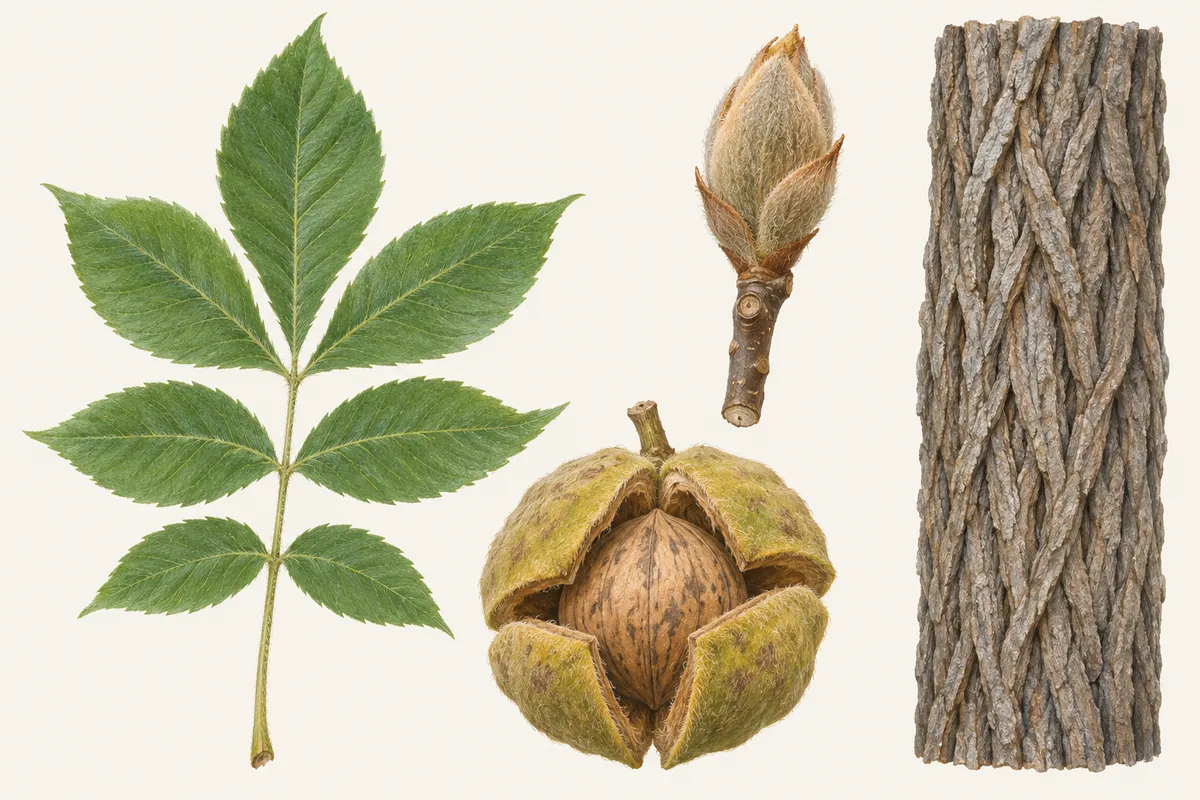
Fuzzy leaves that smell of citrus when crushed, a winter bud as big as a thumb tip, and gray bark woven into a net that never peels: mockernut is the hairiest hickory, and the hairs are the clue.
In short
Mockernut hickory identification is easiest in winter: the terminal bud is very large and broadly egg-shaped, and its dark outer scales drop in autumn to show a silky, nearly white bud. In summer, look for alternate compound leaves 9 to 14 inches long with 7 to 9 toothed leaflets on a stout, very hairy stalk. Mature bark forms rounded gray ridges in a net and is never shaggy or peeling.
- A big whitish bud on a stout hairy twig in winter points straight to mockernut.
- The leaf stalk and leaf undersides are hairy; crushed leaves smell strongly of citrus (USDA Forest Service).
- Mockernut nuts are large, with a thick husk that splits cleanly and a strongly four-ribbed shell.
Field marks at a glance
- Scientific name
- Carya tomentosa (also listed as Carya alba)
- Family
- Juglandaceae (walnut family)
- Type
- Broadleaf, deciduous
- Buds
- Terminal bud very large, broadly egg-shaped; the dark outer scales fall in autumn, leaving a silky, nearly white bud; NC State gives 1/2 to 3/4 inch.
- Leaves
- Alternate, pinnately compound, 9 to 14 inches long, with 7 to 9 toothed, lance-shaped leaflets (NC State: 5 to 7); stalk stout and very hairy; undersides often fuzzy.
- Smell
- Crushed leaves smell strongly of citrus, a help with seedlings and saplings (USDA Forest Service, 2026 revision).
- Fruit
- Oval to egg-shaped, 1 1/2 to 2 inches long (Virginia Tech), in a thick husk that splits cleanly into four; singly or up to four together; ripe September to October.
- Nut
- Light brown, thick, hard shell, strongly four-ribbed; large and heavy for a hickory.
- Bark
- Smooth and gray when young; later interlaced, rounded, light gray ridges separated by shallow darker furrows, in a lattice; never shaggy or peeling.
- Twigs
- Stout and hairy; leaf scars three-lobed, the monkey face.
- Fall color
- Yellow (NC State Extension).
- Size
- 30 to 100 ft tall, trunks 18 to 24 in across (USDA Forest Service); NC State gives 50 to 80 ft or more.
- Range
- Eastern US, from southern New England west to eastern Oklahoma and Texas, south to the Florida Panhandle; most abundant in the Appalachians and Ozarks; also southern Ontario.
Mockernut hickory (Carya tomentosa, also listed as Carya alba) is the most common hickory on US forest land: it ranks 42nd of 431 species in the USDA Forest Service inventory of live trees, ahead of pignut and shagbark. It is also the hairiest hickory, which is what tomentosa refers to, and those hairs, on twig, leaf stalk and leaf underside, are the first thing to check. Never eat a nut on the strength of a web page or an app; check with a local expert. This page is about naming the tree.
How to identify mockernut hickory
Mockernut is easy in winter and only slightly harder in summer. Check these in order.
1. The bud. Virginia Tech's mockernut fact sheet describes a very large, broadly egg-shaped terminal bud whose dark outer scales fall in autumn, leaving a silky, nearly white bud. The USDA Forest Service's Silvics of North America calls the buds large, cream-colored and densely hairy, and easy to identify in winter. NC State Extension gives 1/2 to 3/4 inch and lists big-bud hickory among the common names. No other common eastern hickory has a big pale bud.
2. The leaf and its hairs. Leaves alternate and are pinnately compound, 9 to 14 inches long, with 7 to 9 toothed, lance-shaped leaflets on a stout, hairy stalk (Virginia Tech). NC State gives 5 to 7 leaflets and orange-brown hairs underneath; the Forest Service notes the often fuzzy undersides. Run a finger along the leaf stalk: hairy points to mockernut, smooth to pignut.
3. The smell. The 2026 revision of the Forest Service chapter adds a field test: crushed leaves smell strongly of citrus, which it suggests for identifying seedlings and saplings.
4. The bark. Smooth and gray on young trees, then interlaced, rounded, light gray ridges separated by shallow darker furrows (Virginia Tech). The Forest Service describes a rough gray lattice that, unlike shagbark and pignut, does not flake. Virginia Tech puts it simply: never shaggy or peeling.
5. The fruit. Oval to egg-shaped, 1 1/2 to 2 inches, with a thick husk that splits cleanly open and a strongly four-ribbed shell, ripe in early fall. The Forest Service gives a range of 1 to 3.5 inches across, singly or up to four together, and calls the nuts large and heavy compared with other hickories.
Tree Identifier can suggest a name from one photo of a twig, a leaf or the trunk. It shows no confidence score and no list of alternatives, so check the bud and the leaf stalk hairs yourself; you can also ask the follow-up chat under the result how mockernut differs from pignut.
Mockernut vs pignut, shagbark and bitternut
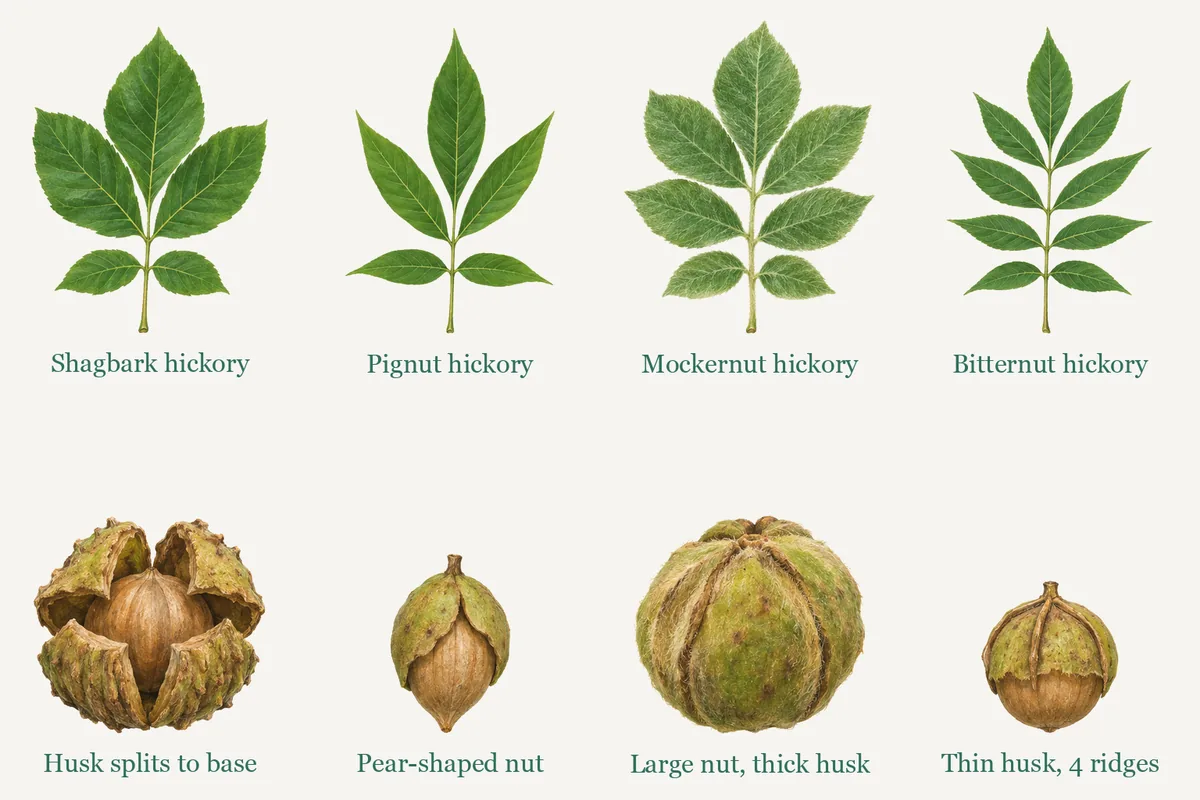
| Feature | Mockernut | Pignut | Shagbark | Bitternut |
|---|---|---|---|---|
| Terminal bud | Very large, silky whitish after scales drop | Small, about 1/4 in, light brown | Large, brown, hairy, 3–4 scales | Narrow, sulfur-yellow |
| Leaflets | 7–9 | 5, sometimes 7 | 5, sometimes 7 | 7–11 |
| Leaf stalk | Stout, very hairy | Slender, smooth | Stout, mostly smooth | Slender, hairy |
| Bark | Rounded gray ridges in a net, never peels | Close interlacing ridges, shaggy tops | Long plates curling away | Thin, tight, smooth for years |
| Husk | Thick, splits cleanly | Thin, opens partway | Very thick, splits in four | Thin, four-winged above the middle |
Figures from Virginia Tech's fact sheets for pignut, shagbark and bitternut. Each tree has its own page: pignut hickory, shagbark hickory and bitternut hickory. Pignut is the usual confusion, because the two often grow on the same ridge; the hairy stalk and the bud size separate them at any season.
Mockernut in winter
Winter is mockernut's best season for identification. Look at the end of a lower branch: a stout, hairy twig ending in a bud the Forest Service calls large and cream-colored. On other hickories the bud is brown (shagbark, pignut) or yellow (bitternut). Leaf scars on all of them are three-lobed, the monkey face.
Under the tree, look for old husks. Mockernut husks are thick and split cleanly into four, and the nut inside has a hard shell with four strong ribs. The winter tree identification guide covers buds and leaf scars for the other common trees, and the guide to identifying trees by bark shows how mockernut's lattice differs from oak and ash bark.
Where mockernut hickory grows
The Forest Service describes a broad eastern range, most abundant in the Appalachian and Ozark regions, reaching its northern limit in southern New England (Connecticut, Rhode Island, Massachusetts, Vermont, New Hampshire), west to eastern Oklahoma and Texas, and south into Louisiana, Mississippi, Alabama and the Florida Panhandle. It is sparse in the Mississippi River embayment, southeastern Georgia and southern Indiana. NC State adds southern Ontario.
It is most common around 700 feet (200 m) and reaches about 3,900 feet (1,200 m). Most trees grow on moist, low-nutrient soils on ridgetops and slopes, with white, black, northern red, scarlet, chestnut and post oaks, other hickories, blackgum, tuliptree and sourwood.
Size, age and nut years
The Forest Service gives a mature height of 30 to 100 feet and trunks 18 to 24 inches across, with a dense crown and a taproot that can reach about 4 feet; NC State gives 50 to 80 feet or more and a spread of 40 to 60 feet. It is long-lived: suppressed understory trees have been found at 50 to more than 150 years old.
Nut production starts at about 25 years, is greatest between 40 and 125, and can continue to 200 years. Crops vary from year to year, but the Forest Service says some seed is produced every year, so a few husks are usually there to find. With location turned on, Tree Identifier's Tree Map pins each tree you identify, so you can find the same mockernut again in winter to check its pale buds.
Look-alikes and how to tell them apart
Pignut hickory (Carya glabra)
Pignut usually has 5 leaflets on a slender, smooth stalk, a small light brown bud about 1/4 inch long, and a pear-shaped fruit whose thin husk only splits partway. Mockernut has 7 to 9 leaflets on a hairy stalk, a huge whitish bud and a thick husk that opens cleanly.
Shagbark hickory (Carya ovata)
Shagbark's mature bark peels in long plates that curl away from the trunk, while mockernut's never peels. Shagbark usually has 5 leaflets and a large brown hairy bud with 3 to 4 scales that stay on in winter.
Shellbark hickory (Carya laciniosa)
Shellbark has long, loose shaggy bark plates and much longer leaves, 15 to 24 inches, usually with 7 leaflets; it grows on wet bottomlands. Mockernut bark is a tight net of rounded ridges and its leaves are 9 to 14 inches.
Bitternut hickory (Carya cordiformis)
Bitternut buds are narrow and sulfur-yellow, not large and whitish, and its fruit is only about 1 inch long with a thin husk four-winged above the middle. Mockernut's fruit is 1 1/2 to 2 inches with a thick husk.
What a photo can't settle
- Leaflet counts differ between sources (Virginia Tech 7 to 9, NC State 5 to 7) and on one tree; count several leaves and use the hairs and buds too.
- Virginia Tech lists sand hickory (Carya pallida) as a mockernut look-alike in the Southeast; it is not covered here, so a southern tree may need a local key.
- The Forest Service reports mockernut hybrids with black hickory, pecan and shagbark; hybrids will not match every row of the ID card.
Questions people ask
How do you identify a mockernut hickory?
Check the twig and the leaf stalk for hairs. Mockernut has a stout, hairy twig, a very large bud that turns silky whitish after its outer scales drop, and leaves with 7 to 9 leaflets on a very hairy stalk. Mature bark is a net of rounded gray ridges that never peels.
Is mockernut hickory Carya tomentosa or Carya alba?
Both names are in use. The USDA Forest Service's Silvics chapter uses Carya tomentosa, and NC State Extension lists Carya alba as an earlier name; the Forest Service tree inventory uses Carya alba. They are the same tree.
Why do mockernut leaves smell like citrus?
The USDA Forest Service's 2026 Silvics revision notes that crushed mockernut leaves smell strongly of citrus, and suggests using the smell to identify seedlings and saplings. Crush a leaflet between your fingers and compare with a pignut leaf nearby.
When does mockernut hickory produce nuts?
The USDA Forest Service says nut production starts at about 25 years, is greatest between 40 and 125 years and can continue to 200. Crops vary from year to year, but some seed is produced every year. The nuts ripen in September and October.
Does mockernut hickory have shaggy bark?
No. Virginia Tech says mockernut bark is never shaggy or peeling, and the USDA Forest Service contrasts it with shagbark and pignut, which often grow alongside it and do flake. Mockernut bark forms a rough gray lattice of rounded ridges.
Sources
- Mockernut Hickory (Carya tomentosa), Silvics of North America — USDA Forest Service
- Mockernut hickory fact sheet — Virginia Tech Dendrology
- Carya tomentosa (mockernut hickory) — North Carolina Extension Gardener Plant Toolbox, NC State University
- Pignut hickory fact sheet — Virginia Tech Dendrology
- Shagbark hickory fact sheet — Virginia Tech Dendrology
- Shellbark hickory fact sheet — Virginia Tech Dendrology
Keep reading
- Tree profileHickory trees (Carya): how to identify them
- Tree profilePignut hickory (Carya glabra): how to identify it
- Tree profileShagbark hickory (Carya ovata): how to identify it
- Winter field guideWinter tree identification, from buds to bark
- Field guideTree bark identification: seven bark types and the trees that have them